• العربية
  • فارسی
Brand
  • Iran Insight
  • Politics
  • Economy
  • Analysis
  • Special Report
  • Opinion
  • Podcast
  • Iran Insight
  • Politics
  • Economy
  • Analysis
  • Special Report
  • Opinion
  • Podcast
  • Theme
  • Language
    • العربية
    • فارسی
  • Iran Insight
  • Politics
  • Economy
  • Analysis
  • Special Report
  • Opinion
  • Podcast
All rights reserved for Volant Media UK Limited
volant media logo

Iran nuclear industry cannot be destroyed by strikes, atomic chief tells IAEA

Sep 15, 2025, 11:10 GMT+1Updated: 00:41 GMT+0
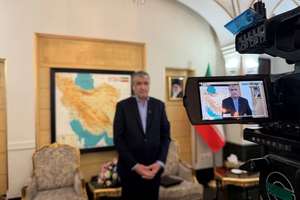
Mohammad Eslami, head of the Atomic Energy Organization of Iran (AEOI), speaks at the opening of the International Atomic Energy Agency (IAEA) General Conference at the agency's headquarters in Vienna, Austria, September 15, 2025.

Iran’s nuclear chief Mohammad Eslami told the International Atomic Energy Agency’s annual general conference in Vienna on Monday that Tehran’s atomic program will not be destroyed by military operations, accusing Israel and the United States of illegal strikes on its facilities.

“Enemies of Iran should know that our nuclear industry has deep roots and cannot be eliminated through military action,” Eslami said in his address to the 69th General Conference.

He added that “Iran will not yield to political or military pressure and will not give up its inherent rights.”

The head of the Atomic Energy Organization of Iran said Tehran’s cooperation with the IAEA “has been broad and consistent,” but accused the agency of failing to condemn what he called aggressive acts against Iranian nuclear sites.

“Despite our formal request, the agency did not condemn the attacks by the United States and Israel on the nuclear centers of the Islamic Republic,” he said. “This silence and inaction will remain as a stain on the Agency’s history.”

Eslami also criticized European efforts to trigger the “snapback” mechanism to restore UN sanctions on Iran, calling them illegal.

He said the 2015 nuclear deal, formally known as the Joint Comprehensive Plan of Action (JCPOA), had shown diplomacy could succeed, but argued that Western states had undermined it.

“Today, on the anniversary of the JCPOA, we see unlawful attempts to activate the snapback mechanism,” he said. “These efforts are a mockery of Resolution 2231.”

Eslami also said Israel’s attacks on Iranian nuclear facilities had targeted not only infrastructure but also diplomacy itself. “The Zionist regime’s goal is not merely to destroy our nuclear centers but to derail the path of diplomacy and peace,” he said.

Eslami also Iran would table a resolution at the conference to ban attacks on nuclear facilities and would hold meetings with states cooperating with Tehran.

The comments come as Iran’s Supreme National Security Council has laid out conditions for future IAEA inspections under a new arrangement signed in Cairo last week by Foreign Minister Abbas Araghchi and IAEA Director General Rafael Grossi.

The council said any inspection of damaged facilities would require its approval, and warned that implementation would stop if hostile actions, including reinstated UN resolutions, were taken against Iran.

Britain, France and Germany triggered the snapback process on August 28, demanding Iran return to talks and account for missing uranium stockpiles. Unless the Security Council blocks the move, sanctions will automatically resume by late September.

The IAEA reported earlier this month that Iran’s 60% enriched uranium stockpile rose to 440.9 kilograms before the June strikes on its facilities. Grossi said the Cairo deal aims to re-establish monitoring once technical procedures are agreed.

Most Viewed

Iran negotiators ordered to return after internal rift over Islamabad talks
1
EXCLUSIVE

Iran negotiators ordered to return after internal rift over Islamabad talks

2
ANALYSIS

US blockade enters murky phase as tankers spoof signals and buyers hesitate

3
ANALYSIS

Why the $100 billion Hormuz toll revenue is a myth

4

US tightens financial squeeze on Iran, warns banks over oil money flows

5
ANALYSIS

US blockade targets Iran oil boom amid regional disruption

Banner
Banner

Spotlight

  • Hardliners push Hormuz ‘red line’ as US blockade tests Iran’s leverage
    INSIGHT

    Hardliners push Hormuz ‘red line’ as US blockade tests Iran’s leverage

  • Ideology may be fading in Iran, but not in Kashmir's ‘Mini Iran'
    INSIGHT

    Ideology may be fading in Iran, but not in Kashmir's ‘Mini Iran'

  • War damage amounts to $3,000 per Iranian, with blockade set to add to losses
    INSIGHT

    War damage amounts to $3,000 per Iranian, with blockade set to add to losses

  • Why the $100 billion Hormuz toll revenue is a myth
    ANALYSIS

    Why the $100 billion Hormuz toll revenue is a myth

  • US blockade targets Iran oil boom amid regional disruption
    ANALYSIS

    US blockade targets Iran oil boom amid regional disruption

  • Iran's digital economy battered by prolonged blackout
    INSIGHT

    Iran's digital economy battered by prolonged blackout

  • Khamenei's office rejects calls to halt uranium enrichment, missile program

    Khamenei's office rejects calls to halt uranium enrichment, missile program

  • Iran to table resolution against attacks on nuclear sites at IAEA conference

    Iran to table resolution against attacks on nuclear sites at IAEA conference

  • Araghchi tells MPs IAEA deal follows law, critics demand text be public

    Araghchi tells MPs IAEA deal follows law, critics demand text be public

•
•
•

More Stories

Iran’s Sistan-Baluchestan faces irreversible collapse as Hamoun wetlands dry up

Sep 15, 2025, 10:47 GMT+1

Iran’s Sistan-Baluchestan province is grappling with a worsening environmental crisis as drought and intensifying dust storms devastate the Hamoun wetlands, with experts warning of farmland collapse, forced migration and irreversible ecological damage, local media reported.

“Caught between drought and choking dust storms, Iran’s Sistan-Baluchestan province faces an escalating environmental crisis as the Hamoun wetlands dry up and 120-day winds turn into walls of sand,” Tasnim news agency reported on Monday.

Experts warn more than 85% of Hamoun has vanished, driving mass farmland loss, biodiversity collapse, and waves of forced migration.

Studies say 65% of croplands around the wetland are already barren, while dust storms now last over 200 days a year, cutting visibility to a few hundred meters and worsening respiratory illness.

  • Iran’s Anzali Wetland faces collapse, $300mn needed for revival, governor says

    Iran’s Anzali Wetland faces collapse, $300mn needed for revival, governor says

  • Government wheat purchases plunge as drought hits Iran

    Government wheat purchases plunge as drought hits Iran

Officials blame water shortages from Afghanistan’s dams on the Helmand River, which deprive Hamoun of its lifeline. Local researchers say completion of the Bakhshabad dam could “deal the final blow” to the wetland.

With little hope of receiving the agreed water rights from Kabul, Iranian specialists are pushing homegrown fixes.

Despite pilot projects and pledges, locals complain of empty promises. “They say they will revive Hamoun, but nothing happens -- every day it dries more,” a resident told Tasnim.

Environmentalists warn time is running out: without immediate action, the region risks irreversible collapse, with fallout for Iran and its neighbors.

Araghchi tells MPs IAEA deal follows law, critics demand text be public

Sep 15, 2025, 10:16 GMT+1

Iran’s Foreign Minister Abbas Araghchi told lawmakers in a three-hour closed-door session that the new cooperation deal with the UN nuclear watchdog cannot be published due to diplomatic norms, the Farhikhtegan daily reported Monday, after some MPs demanded its release.

Members of parliament’s National Security and Foreign Policy Committee questioned whether the agreement with International Atomic Energy Agency (IAEA) chief Rafael Grossi, signed last week in Cairo, fully complies with a law passed by parliament that restricts nuclear cooperation.

“Some lawmakers asked whether the government had the authority to sign the agreement and whether parliament’s legislation was observed,” one participant in the meeting, who declined to be named, told the state-run Farhikhtegan daily.

“Mr. Araghchi responded that the negotiations and the agreement had been approved within the framework of the Supreme National Security Council.”

Scope of cooperation

According to accounts published by Iranian media, Araghchi explained that the agreement distinguishes between nuclear facilities that have been bombed and those that remain intact.

Sites such as the Bushehr power plant and Tehran’s research reactor would be subject to requests for inspection on a case-by-case basis, reviewed by the Supreme National Security Council (SNSC).

“For facilities like Fordow, Natanz, and Isfahan that were targeted, Iran must first conduct safety and environmental checks,” the participant said. “Reports will only be sent to the IAEA once approved by the SNSC. Any subsequent verification steps will also need council authorization.”

Araghchi told lawmakers that the agreement cites UN resolutions and affirms that attacks on nuclear facilities are illegal under the IAEA statute and international law.

He said the text also explicitly refers twice to Iran’s parliamentary law governing nuclear cooperation, underscoring that inspections cannot proceed without national approval.

  • Hardline MP shares details of Iran-IAEA deal, says it won't block snapback

    Hardline MP shares details of Iran-IAEA deal, says it won't block snapback

  • Khamenei's office rejects calls to halt uranium enrichment, missile program

    Khamenei's office rejects calls to halt uranium enrichment, missile program

  • Iran to table resolution against attacks on nuclear sites at IAEA conference

    Iran to table resolution against attacks on nuclear sites at IAEA conference

Dispute over confidentiality

Some MPs urged the government to publish the text. Araghchi replied that releasing the agreement would contravene diplomatic norms.

“The minister said he had brought the text to the session for review by the committee’s leadership and that it had been circulated to parliament earlier in the day,” Farhikhtegan reported.

While some lawmakers expressed unease, others said the session clarified ambiguities.

Behnam Saeedi, a committee member, told reporters: “Representatives raised concerns that the IAEA has been influenced by Israel and the United States in its reporting. The minister explained the text in detail, and while not all were fully satisfied, many concerns were addressed. The important point is that Iran’s red lines and parliamentary law were observed.”

The Cairo deal was reached after June airstrikes by Israel and the United States damaged several Iranian nuclear facilities, forcing inspectors to withdraw. Grossi has said the agreement covers all declared sites, including those attacked, but that practical arrangements will require further negotiations.

Hardline MP Hamid Rasaee separately criticized the deal on Sunday, saying it lacked explicit safeguards against the UN “snapback” mechanism for restoring sanctions. He argued that Araghchi’s public statements had overstated the protections.

Shortly after, the SNSC confirmed that its nuclear committee had approved the agreement and that Tehran would provide reports to the IAEA only after council review.

Diaspora rallies mark third anniversary of Woman, Life, Freedom

Sep 15, 2025, 09:46 GMT+1

Iranian communities abroad staged demonstrations across Europe, North America, Australia, and New Zealand on Sunday to mark the third anniversary of Mahsa Amini’s death and to honor those killed in protests since 2022.

The gatherings followed a first wave of commemorations the previous day.

In Toronto, Hamed Esmaeilion, a board member of the Association of Families of Flight PS752 Victims, told demonstrators: “Who is more deserving than the people of Iran to determine the fate of the country? Who is more deserving than the people of Iran to bring the perpetrators of crimes to trial? Who is more deserving than the people of Iran to drag Khamenei and other criminal clerics out of hiding?”

Amini, 22, died on September 16, 2022, after being detained by Iran’s morality police for allegedly violating mandatory hijab rules. Her death sparked months of unrest in which at least 551 protesters, including 68 children, were killed, according to rights groups, and thousands detained.

Voices in London

Several rallies also took place in London, called by around 15 political and civil groups. Videos sent to Iran International showed protesters chanting the names of Mahsa Amini and others killed in the 2022 protests.

Mahsa Piraei, daughter of protest victim Minou Majidi, addressed one gathering. “Today we have come together to shout the names of the victims and not let their memory be forgotten, because what dictatorships do is erase memories. We are heirs to a wounded truth, and we will not let the Islamic Republic bury justice,” she said.

Protests worldwide

Events were held in The Hague, Brussels, Frankfurt, Nicosia, Sydney, Melbourne, Brisbane, Auckland, Calgary, Montreal, Los Angeles, and Washington.

In Sydney, demonstrators urged the Australian government to designate the Revolutionary Guards as a terrorist organization, days after Canberra closed Iran’s embassy and expelled its diplomats over involvement in terror operations.

Alongside the street demonstrations, a two-day National Dialogue for Iran conference was convened in Washington. The 13-panel event gathered former political prisoners, journalists, activists, and victims of state violence.

Participants included former US State Department spokesperson Alan Eyre, German MEP Hannah Neumann, Swedish-Iranian MP Alireza Akhundi. Writers and activists such as Nazanin Afshin-Jam, Nazanin Boniadi, Azar Nafisi, and Atena Daemi joined, alongside Iranian journalists and survivors of eye injuries sustained during protests.

On Saturday, Iranians in Sweden, Switzerland, the Netherlands, Britain, Denmark, Germany, Cyprus, Canada, and the United States had also rallied to mark the anniversary of Mahsa Amini’s killing in morality police custody.

Mossad knows location of Iran’s near-bomb-grade uranium - Jerusalem Post

Sep 14, 2025, 20:59 GMT+1

Israel’s Mossad has sufficient knowledge of the location of Iran’s highly enriched uranium stockpiles and could intervene if Tehran attempts to use them, The Jerusalem Post reported on Sunday citing unnamed sources.

Iran had 440.9 kilograms (972 pounds) of uranium enriched up to 60% before the Israeli and US airstrikes in June, according to the UN nuclear watchdog.

While the international community has been pressing Iran to disclose the whereabouts of the near weapons-grade stocks, The Jerusalem Post says Mossad knows their location and could intervene if Tehran tried to make any new dangerous moves with the uranium.

On Thursday, Iranian foreign minister Abbas Araghchi acknowledged that Iran’s inventory of highly enriched uranium is buried under rubble following the strikes.

Araghchi’s comments came after the UN nuclear watchdog warned that Iran’s stockpile of highly enriched uranium is “a matter of serious concern,” saying the agency has no visibility country’s activities since the June strikes on its nuclear facilities.

However, unnamed Israeli defense officials cited by the Jerusalem post believe that even if Iran immediately began rebuilding the bombed components of its nuclear program, it would take roughly two years before it could attempt to produce a nuclear weapon.

Female Mossad agents in Iran

Dozens of female Mossad agents were deployed inside Iran during Israel’s June strikes on Tehran’s nuclear and missile programs, The Jerusalem Post report said citing unnamed sources.

The report added Mossad Director David Barnea viewed the women’s role during the 12-day conflict as “very substantial.”

While their exact activities remain classified, the Post said that the spy agency has increasingly assigned women to all types of missions, from surveillance to kinetic operations.

The report added that Barnea sent hundreds of agents, including Iranian dissidents recruited by Mossad, into operations in Iran simultaneously. Targets included radar platforms, ballistic missiles, and sites struck by Israeli jets.

Hardline MP shares details of Iran-IAEA deal, says it won't block snapback

Sep 14, 2025, 19:15 GMT+1

Iran’s new agreement with the UN nuclear watchdog contains no clause preventing the reimposition of UN sanctions on Tehran under the snapback mechanism, an ultraconservative lawmaker said Sunday, citing the text of the deal he said he had reviewed.

“I read the text of the agreement with the Agency. The text does not state that ‘implementation of this agreement is conditional on no hostile action against Iran, including snapback,’ whereas Araghchi said that in an interview," Hamid Rasaee said.

The hardline cleric said lawmakers attending a Saturday briefing with Araghchi believed this key condition was included in the text, but it was not.

"So the agreement does not prevent the implementation of the snapback mechanism. It was the same in the JCPOA, where the text did not match the claims,” Rasaee wrote on X.

Hamid Rasaee
100%
Hamid Rasaee

Iranian lawmakers, including the cleric, convened an emergency meeting with Araghchi on Saturday to review the government’s new cooperation agreement with the International Atomic Energy Agency (IAEA), signed in Cairo last week.

Neither Araghchi nor Grossi provided any details after signing the agreement.

Rasaee said parliament had not been given access to the text, criticizing Araghchi for keeping it confidential.

"Mr. Araghchi has said that it was agreed with the agency that the text of the agreement must be kept confidential and publishing it would be against diplomatic norms," he said in a video message posted on X Sunday.

According to Rasaee, only parliament speaker Mohammad Bagher Ghalibaf and the head of the national security and foreign policy committee had received copies of the agreement on Saturday night.

Alleged details

Rasaee said the text of the deal that he reviewed explicitly condemns attacks on Iran's nuclear facilities and also establishes that future inspections will be conducted under a new procedure.

The agreement specifies that the UN nuclear watchdog must carry out its inspections in line with the law passed by Iran’s parliament, he said.

Under the terms, he claimed, inspections of sites that have not been targeted in attacks will only be made upon specific requests.

"Such requests will be reviewed by Iran’s Supreme National Security Council, which will decide whether to grant authorization."

For facilities that have been attacked, the arrangement sets out a more restrictive process, according to Rasaee. The Atomic Energy Organization of Iran must first perform environmental and related assessments and submit a report.

"That report will be passed to the IAEA only if it is approved by the Supreme National Security Council. Even after that stage, each step of the inspection process requires further approval from the Council. The IAEA will not be permitted to conduct inspections without these clearances."

"The question is: why should the text remain confidential?! If it is a good text, if all our conditions are met in it, why keep it secret?" he said.

Shortly after Rasaee's criticism, Iran's Supreme National Security Council confirmed it had approved the cooperation protocol, with its secretariat saying the agreement reached between Araghchi and IAEA chief Rafael Grossi had been approved by the council.

The body led by Ali Larijani also said that Tehran will submit reports to the Agency only after the Council’s review.