• العربية
  • فارسی
Brand
  • Iran Insight
  • Politics
  • Economy
  • Analysis
  • Special Report
  • Opinion
  • Podcast
  • Iran Insight
  • Politics
  • Economy
  • Analysis
  • Special Report
  • Opinion
  • Podcast
  • Theme
  • Language
    • العربية
    • فارسی
  • Iran Insight
  • Politics
  • Economy
  • Analysis
  • Special Report
  • Opinion
  • Podcast
All rights reserved for Volant Media UK Limited
volant media logo

Meet nuclear obligations now or face UN sanctions, E3 warn Iran

Sep 10, 2025, 16:45 GMT+1Updated: 01:14 GMT+0

France, Britain and the United Kingdom on Wednesday said they were alarmed by the lack of clarity on Iran's stockpile of near-bomb-grade uranium and that Tehran must show not claim if it wanted to avoid more sanctions.

"To put it bluntly, there up to this moment near zero IAEA oversight of Iran’s nuclear programme, and there are thousands of kilos of enriched uranium in Iran which the IAEA has not been able to verify for nearly three months," the European troika said.

"It is not enough for Iran to make promises for tomorrow, we need to see evidence from Iran today that demonstrates it is ready for a diplomatic solution that addresses the international community’s concerns."

"That starts by showing, not claiming, that it is meeting the fair and reasonable conditions set by the E3 for a Snapback extension," the statement read.

The E3's remarks came in the form of an open letter to the International Atomic Energy Agency, which is tasked with inspections of Iranian nuclear sites.

"Iran is obfuscating the status and location of this material from the international community, and Iran refused to allow the Agency to verify this stockpile," it added.

Sanctions loom

The three powers last month triggered the so-called "snapback" mechanism within a 2015 international nuclear deal to which they are party along with Iran, giving Tehran 30 days to comply with the agreement or face restored international sanctions.

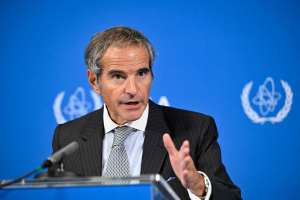
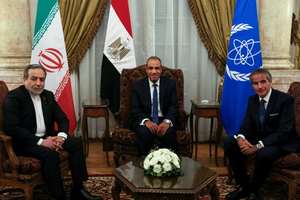
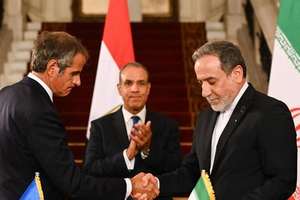
IAEA chief Raphael Grossi inked a deal to pave a way forward on resuming cooperation with Iran alongside its foreign minister Abbas Araghchi at a ceremony in Cairo on Wednesday.

Grossi said the new deal covers inspections at all of Iran’s declared nuclear sites, including those hit by Israeli and US strikes in June, in what he called a step in the right direction toward restoring safeguards.

IAEA inspectors quit the country for safety reasons during the war but subsequently returned, though they have not resumed most of their duties.

Araghchi said on Wednesday the deal does not currently allow inspectors into nuclear sites and access would be discussed in future talks, adding the accord’s survival depends on Western powers refraining from restoring UN sanctions.

'Critical jucnture'

The E3 in its letter said Iran must swiftly engage in diplomacy to provide an extension to the sanctions and meet what it called its "fair and achievable" conditions: unconditional talks with Washington, compliance with safeguarding obligations and transparency on its uranium stockpile.

"We are at a critical juncture," it wrote. "The E3 have been clear to Iran and the international community that we remain committed to diplomacy."

"It is now up to Iran to quickly take concrete steps to demonstrate it is serious about finding a diplomatic solution and to engage meaningfully with our offer, which will remain on the table during the 30-day window before snapback takes effect," the E3 added.

Iran’s parliament has since adopted a law suspending cooperation, a serious obstacle to renewed cooperation.

'No guarantee'

The IAEA-Iran agreement on Tuesday appears to provide few concrete guarantees on when the watchdog's work can resume and may give little impetus to the European powers to take a softer line.

"I understand that the European view is that Tuesday’s agreement is very UNLIKELY to shift the plans on SnapBack," Wall Street Journal correspondent Laurence Norman wrote on X on Wednesday.

"The Europeans see the absence of clear timelines and deadlines as a major problem — effectively guaranteeing nothing."

Most Viewed

Iran negotiators ordered to return after internal rift over Islamabad talks
1
EXCLUSIVE

Iran negotiators ordered to return after internal rift over Islamabad talks

2
ANALYSIS

US blockade enters murky phase as tankers spoof signals and buyers hesitate

3
ANALYSIS

Why the $100 billion Hormuz toll revenue is a myth

4

US tightens financial squeeze on Iran, warns banks over oil money flows

5
ANALYSIS

US blockade targets Iran oil boom amid regional disruption

Banner
Banner

Spotlight

  • Hardliners push Hormuz ‘red line’ as US blockade tests Iran’s leverage
    INSIGHT

    Hardliners push Hormuz ‘red line’ as US blockade tests Iran’s leverage

  • Ideology may be fading in Iran, but not in Kashmir's ‘Mini Iran'
    INSIGHT

    Ideology may be fading in Iran, but not in Kashmir's ‘Mini Iran'

  • War damage amounts to $3,000 per Iranian, with blockade set to add to losses
    INSIGHT

    War damage amounts to $3,000 per Iranian, with blockade set to add to losses

  • Why the $100 billion Hormuz toll revenue is a myth
    ANALYSIS

    Why the $100 billion Hormuz toll revenue is a myth

  • US blockade targets Iran oil boom amid regional disruption
    ANALYSIS

    US blockade targets Iran oil boom amid regional disruption

  • Iran's digital economy battered by prolonged blackout
    INSIGHT

    Iran's digital economy battered by prolonged blackout

•
•
•

More Stories

Thousands at risk as Iran executions surge to 'horrific scale' - Amnesty

Sep 10, 2025, 13:54 GMT+1

Thousands of people in Iran face the risk of execution amid what Amnesty International on Wednesday called a deepening execution crisis, with death sentences handed down after unfair trials and on vaguely worded charges such as enmity against God and corruption on earth.

The rights group said more than 800 people had been executed in 2025 so far, nearly double the pace of last year, and warned that thousands more remain under investigation or prosecution on capital charges, including drug-related offences and accusations of espionage.

Since the 2022 Woman, Life, Freedom uprising, Amnesty said, Iranian authorities have “weaponized the death penalty as a tool of oppression”.

In June, following Israel’s airstrikes and a 12-day war with Iran, officials intensified calls for swift trials and executions for those accused of collaborating with Israel. Parliament has also advanced legislation to expand the use of capital punishment, pending approval by the Guardian Council.

“The authorities are carrying out executions on a horrific scale,” Amnesty said, urging Tehran to halt all planned executions, quash existing sentences, and declare an official moratorium with a view to abolition.

According to the UN Office for Human Rights, at least 841 executions were carried out between January and late August, compared with 429 during the same period in 2024.

Rights monitors say executions are disproportionately affecting minorities, including Afghans, Baluchis and Kurds.

  • Iran court sentences six Baha'i women to combined 39-year prison term

    Iran court sentences six Baha'i women to combined 39-year prison term

  • Iran executes man convicted in connection with 2022 protests

    Iran executes man convicted in connection with 2022 protests

The warning comes days after Iran executed protester Mehran Bahramian in Isfahan despite allegations of torture and international appeals to halt his sentence. He was the latest detainee from the 2022 unrest to be put to death on charges of “enmity against God.”

Iran’s judiciary has defended its use of capital punishment as enforcement of Islamic law and a deterrent against serious crime, particularly drug trafficking.

But rights groups argue Revolutionary Courts lack independence and routinely deny defendants fair trial rights, including access to lawyers and protection from torture.

  • Rights advocates warn of 1988-style mass executions in post-war Iran

    Rights advocates warn of 1988-style mass executions in post-war Iran

  • IRGC media calls for 1980s-style mass executions of Israel ‘collaborators’

    IRGC media calls for 1980s-style mass executions of Israel ‘collaborators’

Amnesty said rhetoric from senior officials, including Judiciary Chief Gholamhossein Mohseni Ejei, calling for “1988-style executions” against perceived collaborators, has fueled fears of mass killings reminiscent of past prison massacres.

“Iran accounted for nearly two-thirds of all known executions worldwide in 2024,” Amnesty said. “The current trajectory shows an even darker year ahead unless immediate action is taken.”

Iran says no IAEA access yet, warns pact hinges on avoiding snapback

Sep 10, 2025, 12:25 GMT+1

Iran said on Wednesday its new agreement with the UN nuclear watchdog does not currently allow inspectors into nuclear sites and will only move to define any access in later talks, adding the accord’s survival depends on Western powers refraining from restoring UN sanctions.

Foreign Minister Abbas Araghchi told state TV that the Cairo agreement with International Atomic Energy Agency (IAEA) chief Rafael Grossi “recognizes Iran’s legitimate security concerns,” aligns cooperation with a new domestic legal framework, and does not by itself reopen facilities to inspectors.

“Based on this agreement, no access is being granted to IAEA inspectors at the moment,” he said. “The nature and scope of inspectors’ access will be discussed in due course after Iran submits its reports, and any access will be negotiated at the appropriate time.”

Araghchi said one exception continues under an earlier decision. “No access is granted now except at the Bushehr power plant due to a fuel change. This access was approved by the Supreme National Security Council and is ongoing,” he said.

He stressed that the document reflects Tehran’s post-June war posture. “A new situation was created after the attacks on our nuclear facilities. Cooperation cannot be the same as before and must take a new form,” he said.

“The agreement has accepted Iran’s security concerns as legitimate, recognized Iran’s rights, and defines a new shape of cooperation with the Agency. This was exactly what we sought.”

  • IAEA chief says new Iran deal to cover all facilities, including bombed sites

    IAEA chief says new Iran deal to cover all facilities, including bombed sites

  • China, Russia urge Europe to halt UN snapback after Iran-IAEA deal

    China, Russia urge Europe to halt UN snapback after Iran-IAEA deal

Cairo pact cleared by top authorities

Araghchi said the government’s approach has been cleared at the highest level. “The negotiations and the provisions needed to meet our concerns were raised and approved at the Supreme National Security Council,” he said, adding that under Iran’s law “everything must be approved by the SNSC, and that pathway is recognized in this document.”

He also tied the accord’s implementation to the broader diplomatic track with Europe, which has triggered the UN “snapback” mechanism to restore sanctions unless monitoring advances.

“I must emphasize that the validity and continuation of this agreement depend on there being no hostile action against the Islamic Republic, including activation of snapback,” Araghchi said, echoing similar remarks by Grossi earlier in the day.

'Deal is void if sanctions return'

“I said clearly in the negotiations, to our Egyptian hosts and at the press conference, that if any hostile action is taken, including the reinstatement of cancelled UN Security Council resolutions, Iran will consider these practical steps null and void.”

Araghchi called the Cairo talks “a step in the right direction to remove pretexts” used by critics. “It disarms those who sought to exploit the situation for their own purposes,” he said, while thanking Egypt’s president and foreign minister for facilitating the discussions.

Grossi, briefing IAEA member states in Vienna earlier in the day, described the technical document as setting out procedures for inspections, notifications and reporting and said it is intended to restore safeguards activity across Iran’s declared program.

“This includes all facilities and installations in Iran, and it also contemplates the required reporting on all the attacked facilities, including the nuclear material present at those,” he said.

He added that safeguards approaches for each site would be reviewed at a technical level “in line with the rights and obligations of Iran and the Agency under the NPT Safeguards Agreement, which are not modified or amended as a result of these practical steps.”

Grossi said resuming work after the June strikes that forced inspectors to withdraw would not be “an automatic or simple bureaucratic process,” but welcomed what he called Iran’s stated decision to remain within the Nuclear Non-Proliferation Treaty framework.

“Iran and the Agency will now resume cooperation in a respectful and comprehensive way,” he said, while cautioning there could be “difficulties and issues to be resolved” during implementation.

Britain, France and Germany began the snapback process in late August, saying they would pause it only if Iran restored inspections, accounted for its highly enriched uranium stockpile and engaged in nuclear talks with the United States.

Diplomats say whether the new steps will be sufficient to head off sanctions will hinge on how quickly inspectors can resume work on the ground and whether Tehran provides a full accounting.

Araghchi emphasized that the new arrangement is calibrated to Iran’s internal law while keeping a door open to technical engagement. “The new framework moves exactly along the path set by the parliament’s law,” he said. “It pays attention to Iran’s security concerns, recognizes Iran’s rights, and defines a new shape of cooperation with the Agency. We hope this will advance a diplomatic solution—provided the other side is serious about one.”


Iran debates women’s motorcycle licenses amid legal ambiguity and hijab concerns

Sep 10, 2025, 11:36 GMT+1

A former senior Iranian traffic police official said there is no legal ban on issuing motorcycle licenses to women, but a regulatory gap has left them unable to ride legally, pointing to debate in parliament where some lawmakers have raised concerns over hijab compliance.

Colonel Einollah Jahani, the former deputy head of Iran’s traffic police, told ISNA news agency on Wednesday that Article 20 of the country’s traffic law currently tasks the police with issuing motorcycle licenses for men but is silent on women.

“From a legal perspective, this article only clarifies the police’s duty toward men and does not prohibit issuing licenses to women,” he said. “The silence of the law has created a gap that must be resolved by parliament.”

Iranian women, Bahareh, Saqar and Farah ride motorcycles without a license, while female motorcycling is still not officially legal, in Tehran, Iran, September 7, 2025.
100%
Iranian women, Bahareh, Saqar and Farah ride motorcycles without a license, while female motorcycling is still not officially legal, in Tehran, Iran, September 7, 2025.

The government has submitted a bill to parliament to address the issue, state media has reported, but Jahani said that some lawmakers remain uneasy over how women would observe Islamic dress codes while riding.

He argued the concern was misplaced: “Both men and women must wear helmets, and helmets provide the necessary coverage to meet hijab requirements. This is a safety obligation that also addresses religious concerns.”

  • Women’s motorcycle licenses need legal change, Iran police say

    Women’s motorcycle licenses need legal change, Iran police say

  • Tehran cafe shut down over women bikers’ event

    Tehran cafe shut down over women bikers’ event

Iran’s traffic police chief, Brigadier General Teymour Hosseini, said earlier this week that any licensing of women would require formal changes to bylaws and law, and that the force was “awaiting an official notification on women’s motorcycling so we can proceed.”

Women have been legally allowed to own and register motorcycles in their name, but licensing has been withheld, leaving many to ride without permits in a legal gray zone.

Jahani said this inconsistency should be corrected: “There is no prohibition for women to own motorcycles under the constitution. They can hold official registration papers in their own name, so logically they should also be able to obtain licenses.”

He added that women have increasingly demanded the right to ride motorcycles, citing economic pressures, traffic congestion and the need for affordable transportation.

Iranian woman, Bahareh, sits on her motorcycle, while female motorcycling is still not officially legal, in Tehran, Iran, September 7, 2025.
100%

“In the past there was no demand, but today motorcycling has become a social demand,” he said, noting that research shows women generally drive more cautiously than men.

The debate comes against the backdrop of wider calls for women’s rights in Iran since the 2022 death of Mahsa Amini in morality police custody, which ignited nationwide protests.

Conservative clerics have resisted moves to permit public motorcycling by women, arguing it could breach social norms, but reformist officials say formal training courses can provide a workable compromise.

IAEA chief says new Iran deal to cover all facilities, including bombed sites

Sep 10, 2025, 10:51 GMT+1

The head of the UN nuclear watchdog said on Wednesday that its new deal with Iran covers inspections at all of the country’s declared nuclear sites, including those hit by Israeli and US strikes in June, in what he called a step in the right direction toward restoring safeguards.

International Atomic Energy Agency (IAEA) Director General Rafael Grossi told member states in Vienna that the technical document signed in Cairo on Tuesday with Iranian Foreign Minister Abbas Araghchi sets out procedures for inspections, notifications, and reporting obligations.

“This includes all facilities and installations in Iran, and it also contemplates the required reporting on all the attacked facilities, including the nuclear material present at those,” Grossi said.

Grossi acknowledged the challenges posed by the aftermath of June’s Israeli and US airstrikes on Iranian nuclear facilities, which forced the withdrawal of inspectors for safety reasons.

“Safeguards approaches to each facility will be reviewed at technical level, always in line with the rights and obligations of Iran and the agency under the NPT safeguards agreement, which are not modified or amended as a result of these practical steps,” he said.

“Resuming this indispensable work would not be an automatic or simple bureaucratic process,” he said, adding that Iran’s parliament had since adopted a law suspending cooperation, creating the risk of non-compliance with safeguards obligations.

But he pointed to what he called “Iran’s declared willingness not to leave the NPT and to continue working inside the international nonproliferation regime” as a positive signal.

Grossi said the new arrangement reflected both Iran’s concerns and the agency’s technical requirements. “Iran and the agency will now resume cooperation in a respectful and comprehensive way,” he told diplomats.

  • Iran, UN nuclear watchdog reach agreement on resuming inspections

    Iran, UN nuclear watchdog reach agreement on resuming inspections

  • China, Russia urge Europe to halt UN snapback after Iran-IAEA deal

    China, Russia urge Europe to halt UN snapback after Iran-IAEA deal

He said the talks were aimed at finding ways to reconcile Iran’s new legislation with its binding treaty obligations, adding: “This required dialogue and a thorough understanding of the situation and Iran’s specific views.”

"Iran expressed concerns, and it is our duty as an international organization to listen to those and find ways and means to address them in a form which would reconcile these important parameters, Iran's new law and the existing legal obligations emanating from the NPT safeguards agreement”

While he cautioned that “there may be difficulties and issues to be resolved,” he underlined the broader importance of the agreement.

“It is my sincere hope that the resumption of our inspection activity in Iran may serve as a good sign, as a reference, an indication that agreements and understandings are possible,” Grossi said.

Iran suspended all cooperation with the IAEA following the June attacks, and last month Britain, France and Germany triggered a UN “snapback” process to restore sanctions unless inspections resumed and Iran provided clarity on its enriched uranium stockpile.

Araghchi, speaking in Cairo on Tuesday, said the agreement created “a practical mechanism for cooperation” but warned that Iran would void it if hostile measures, including renewed UN sanctions, were imposed.

Diplomats say whether the new steps will be sufficient to head off European sanctions will depend on how quickly inspectors can resume work and whether Tehran provides full accounting of its highly enriched uranium.

Israel strike in Qatar signals drive for regional dominance, Iran security chief warns

Sep 10, 2025, 09:44 GMT+1

Ali Larijani, Iran’s top security official, reacted to Israel’s strike on Qatar with a pointed message in Arabic on social media, casting the attack as a signal of Israel’s future ambitions for regional dominance.

Larijani, secretary of Iran’s Supreme National Security Council, wrote, “The message of the Zionist entity’s recent crime in Qatar is clear: O countries of the region! Prepare yourselves for my coming domination.”

His comments came a day after Israeli warplanes bombed a Hamas office in Doha, in what Israel called an operation against the group’s senior leadership. Qatar condemned the attack as “criminal and cowardly,” while Iran labeled it an “extremely dangerous” violation of sovereignty and international law.

President Masoud Pezeshkian also condemned the strike as an “illegal, inhumane and anti-peace action,” telling Qatar’s Emir Sheikh Tamim bin Hamad Al Thani by phone that Tehran stood in solidarity with its Persian Gulf neighbor. “Attacking an independent country is a clear violation of national sovereignty and the UN Charter,” he said.

  • Iran condemns 'extremely dangerous' Israeli strike on Hamas in Qatar

    Iran condemns 'extremely dangerous' Israeli strike on Hamas in Qatar

The strike in Doha, coordinated with Washington according to Israeli media, killed members of Hamas’s political bureau, though both Qatar and Hamas gave no details on casualties. Israeli Prime Minister Benjamin Netanyahu later insisted the raid was “a wholly independent Israeli operation.”

Hamas, which has based its political leadership in Qatar for years, said its ceasefire delegation had survived the attack and accused the United States of enabling Israel’s actions while presenting itself as mediator.

The incident comes as Iran recalibrates its foreign policy after a June war with Israel and the United States devastated its military and nuclear infrastructure.

  • Calls for Larijani to lead nuclear talks may signal push for rethink

    Calls for Larijani to lead nuclear talks may signal push for rethink

Supreme Leader Ali Khamenei has in recent weeks sought Qatari mediation with the West, and Larijani is seen as a potential lead negotiator in renewed nuclear talks as UN sanctions loom.

Iranian media and analysts have floated his possible return to leading nuclear negotiations, amid suggestions the Supreme National Security Council could regain control of the dossier as Tehran faces looming UN sanctions under the European-triggered “snapback” mechanism.

The strike on Qatar marks a dangerous new front in a region still unsettled by June’s 12-day war, when Israeli and US forces targeted Iran’s nuclear facilities and military infrastructure.