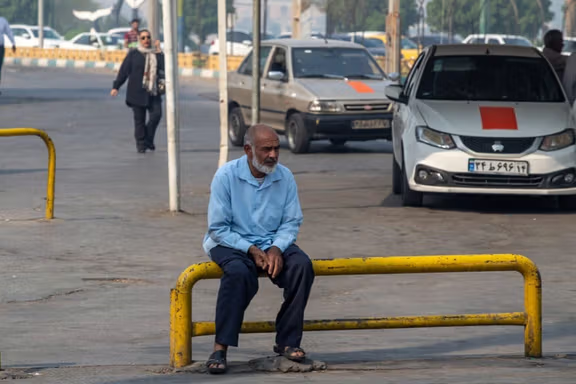
An elderly man sits on a metal railing at a taxi station in the southern Iranian city of Ahvaz, August 25, 2025.
Europe’s move to trigger the so-called snapback mechanism has sparked an online storm in Iran, ranging from despair and anger to calls for war, regime change, and nuclear weapons.
While those opposed to Tehran’s rule largely see in snapback a chance for collapse or regime change, hardliners dismiss the sanctions as psychological warfare and call for retaliation and escalation.
“If snapback is extended, what guarantee is there that six months later we won’t face demands over missiles?” an ultraconservative activist asked online. “Withdraw from the NPT, expel European ambassadors, block the Strait of Hormuz.”
Some went further still. “What rational reason is left not to build a nuclear bomb?” one user asked on X. Another warned: “From now on, any official who stands against developing nuclear weapons will not be remembered kindly in Iran’s history.”
Hardliners rallied under the hashtag “JCPOA is pure damage,” referring to the 2015 Joint Comprehensive Plan of Action, the nuclear deal between Iran and world powers. Many dismissed renewed UN sanctions as empty threats. “The uproar over snapback is merely psychological warfare,” one user insisted.
Defending the deal
Others countered that the nuclear accord shielded Iran from Chapter VII sanctions and the threat of war for a decade and should not be discarded.
Journalist Hossein Yazdi recalled the grim days before the deal: “Ask those who remember how dire things were before the JCPOA. Was it not true that people in Khuzestan traded rice for Iraqi infant formula?”
Writer Mohammadreza Mohajer drew a parallel with Iraq before the 2003 invasion.
“It hardly matters whether we have 400 kilos of enriched uranium or 40 million tons—just as it didn’t matter whether Saddam had weapons of mass destruction,” he posted on X.
“Let’s not forget: we did not want Iran for enrichment; we wanted enrichment for Iran.”
‘Blessing in Disguise’
Some voices on the other extreme framed snapback as less a source of despair than a potential opening.
“Iranians are drowning anyway … But perhaps snapback will bring war, and with it a chance to break the chains,” one activist wrote. “Yes, we, the people of Iran, welcome snapback.”
Another argued that sanctions would finally “prove to the grey middle class that hoping for Khamenei to make concessions was always an illusion” and push them toward revolt.
Humor and anxiety
Not all reactions were grim. “How long does snapback take to kick in? It’s been a day since activation, and I don’t feel anything yet,” one user joked.
But humor quickly drew pushback. “Snapback is no laughing matter. It is about people’s daily bread, our children’s future, our very lives. How can anyone joke about this?” journalist Hoda Hashemi wrote.
Others highlighted the human cost more directly.
“The activation of snapback saddens me, because I know the burden will fall directly on the people … who had no role in creating this catastrophe,” diaspora activist Amin Pouria posted.
“But I would still mourn had it not been activated, because that would mean the Islamic Republic and Khamenei could once again breathe easy. Either way, the people suffer. Damn you for holding an entire nation hostage!”
Iran expelled more than 1.8 million undocumented migrants who are mainly Afghans over the past year, an interior ministry official said on Sunday, adding that at least 800,000 more must leave under the government’s removal plan.
The program began with classifying migrants into legal and illegal groups to provide services to the former and facilitate the return of the latter, Nader Yarahmadi, Head of the Interior Ministry’s Center for Foreign Nationals and Migrants.
“From the total 1,833,636 undocumented migrants who left, 1.2 million departures occurred this year alone,” Yarahmadi said.
“More than 70 percent of these undocumented migrants went back home with their families,” he said.
Yarahmadi added that the expulsions are not over. “At least 800,000 more people must be removed as undocumented migrants, which is on the agenda in the next phases,” he said.
Crackdown after ceasefire with Israel
Iran launched a sweeping crackdown on Afghan migrants in the wake of a ceasefire with Israel, targeting them for deportation and alleged security threats.
Taliban authorities have warned of a looming humanitarian crisis in western Afghanistan due to the rapid influx.
Over the decades, Afghan migrants have been treated as expendable tools in Tehran’s shifting policies in the region. They were recruited to fight in Syria as part of the Fatemiyoun Brigade, exploited as cheap undocumented labor inside Iran, and periodically threatened with mass expulsion in bouts of official populism. During moments of domestic discontent, Afghan migrants became convenient targets to deflect public anger.
Following the Taliban’s return to power in 2021, a massive influx of Afghan refugees entered Iran and as many as two million Afghans crossed the border within two years.
Iran's Supreme Leader Ali Khamenei (right) and Iran's top security official Ali Larijani (left)
A day after three European states triggered a UN mechanism that reimposes international sanctions on Iran, the move appeared to wrongfoot Tehran's establishment despite months of warnings.
Iran's new Security Chief, Ali Larijani, seemed to misread the immediacy of the threat in an interview days before the diplomatic setback.
In an interview with Supreme Leader Ali Khamenei's official website on August 22, Larijani insisted that China and Russia could shield Iran against the snapback threat.
"This issue is currently under review domestically, and as far as I know, some countries are making efforts to negotiate in order to prevent it from happening. Russia and China also hold a different position. They're acting as obstacles."
Larijani is a seasoned politician, but less savvy figures, including state-appointed Friday prayer leaders, also contributed to the confusion with their remarks.
In Shiraz, Friday Prayers imam Lotfollah Dejkam offered a revisionist take on world history, saying: "Europeans have been defeated by Iran several times, and they are likely to experience an even bigger defeat as a result of the snapback."
Ahmad Alamolhoda, the Friday Prayers Imam of Mashhad, appeared to downplay the seriousness of the likely economic pain due to be wrought by sanctions.
Iranians, he said, who rushed to capital markets to buy gold and foreign currency in anticipation of further devaluation of the Iranian rial were "simpletons."
Many commentators questioned the leadership's broader understanding of the nuclear deal and the international frameworks governing it.
Among the critics was Heshmatollah Falahatpisheh, former head of the Iranian parliament's National Security and Foreign Relations Committee, who condemned fellow politicians for their impulsive reactions.
In a post on X, he specifically addressed members of parliament who had tabled a triple-urgency motion calling on the Islamic Republic to exit the Non-Proliferation Treaty. Ironically, despite attaching the highest urgency label to the bill, lawmakers postponed its discussion until Saturday, as Friday is a public holiday in Iran.
"Exiting NPT, closing Strait of Hormuz and producing an atomic bomb! For years, the nation has been paying the price for the nonsense you still repeat on (state TV)," Falahatpisheh wrote.
"You believed your own nonsense, which has prevented any rationality and initiative to get out of the deadlocks," he added.
Meanwhile, the promise of diplomatic roads not taken was examined anew.
In an interview with the Entekhab website, Mahmoud Vaezi, chief of staff to former President Hassan Rouhani, revealed that during Rouhani's final days in office, he had asked his successor, President Ebrahim Raisi, to allow him to broker a deal with the United States to revive the 2015 nuclear agreement.
According to Vaezi, Raisi insisted on reviving the agreement under his own administration. Rouhani argued that even if his government signed the deal, the revenue from oil sales would benefit the incoming government.
Nonetheless, Raisi rejected the proposal, and negotiations with the United States ran aground.
Iranian authorities denied reports that Saeed Toosi, a Qur’an reciter accused of sexually abusing underage boys, was shot in the city of Mashhad on Friday.
The prosecutor of Mashhad Hassan Hemmati Far said the story first appeared in a social media post by a truck driver in the city of Fasa and quickly spread. He said security, police and intelligence services investigated the report and found it to be baseless.
Iranian state broadcaster IRIB had earlier reported that Toosi was shot by unidentified gunmen in Mashhad and was hospitalized in critical condition. It gave no further details.
IRGC-affiliated Tasnim News also dismissed the reports as unconfirmed rumors, but said a competent authority should clarify the matter.
This came after Khorasan Daily reported that Toosi had been wounded and hospitalized. Earlier, his brother told the outlet there had been a physical attack.
Toosi gained national recognition after winning two international Qur’an recitation competitions and performing at events attended by Supreme Leader Ali Khamenei.
However, in 2016, at least ten men came forward accusing him of sexual abuse during their teenage years, often while traveling with him for religious training or competitions. The allegations were first aired on Voice of America Persian, after judicial proceedings in the country stalled.
Despite an initial indictment, the case was later dismissed, prompting outrage from activists and victims who accused the judiciary of protecting a figure close to the establishment. Toosi denied all allegations, calling them “bogus and total lies.”
Iran’s Ministry of Culture and Islamic Guidance has issued a confidential directive to domestic media, instructing outlets to limit coverage of the European move to trigger the UN snapback mechanism and avoid content that could cause public concern or market instability.
Confidential order restricts tone and content
The directive, sent to newsroom chiefs and editors, outlines six points aimed at controlling how the issue is reported. It calls on newsrooms to avoid “emotional,” “crisis-oriented,” or “provocative” headlines and urges editors to present the snapback as a manageable development. The stated goal is to preserve “psychological calm” in society.
Media are specifically told to refrain from publishing content that highlights economic risks, such as inflation, currency devaluation, or the potential impact on gold and foreign exchange markets. Such coverage, the ministry warns, could increase inflationary expectations or contribute to public anxiety.
Instructions call for emphasis on Iran’s resilience
Instead, the directive advises the use of regional experts and commentary that frames the snapback as a sign of European weakness or dependence on the United States. Media are encouraged to highlight Iran’s ability to withstand sanctions and emphasize the country’s “strength in facing pressure.”
The publication of reports that suggest a negative or uncertain outlook for the future is discouraged. Outlets are instructed to “avoid portraying a bleak future” and to focus instead on narratives of continuity and resistance.
Coverage of Western policy encouraged, not domestic impact
According to the directive, media should shift their focus toward criticizing Western governments and highlighting what it describes as contradictions and internal crises in Europe and the US.
The guidance advises against reporting that could fuel debate over the domestic implications of renewed UN sanctions or revive concerns over Iran’s access to oil revenues and currency reserves. No timeline was provided for how long these restrictions should remain in place.
Recent economic reporting limited after new warnings
The directive follows recent domestic reports warning that snapback sanctions could worsen inflation and further weaken the rial. Earlier this week, the Tehran Chamber of Commerce projected that the dollar could reach 1.65 million rials under pessimistic scenarios. That report was later downplayed under apparent pressure from security agencies.
As Iran International exclusively reported, members of the chamber’s international affairs team were questioned this week by the IRGC’s intelligence unit over the economic forecast, and senior officials were instructed not to speak publicly about it.
The Ministry of Culture has not officially commented on the new guidelines. Iranian state media and major news agencies have so far reported the snapback process using neutral language and limited economic analysis.
Part of broader restrictions on public discourse
The new instructions come amid heightened sensitivity within Iranian institutions over public reaction to international developments. The approach reflects a broader pattern of preemptive media control during major diplomatic or economic events.
Iranian media outlets operate under oversight from multiple government agencies, including the Ministry of Culture, the Supreme National Security Council, and intelligence bodies. Directives such as this one are typically circulated in private and not publicly acknowledged.
A woman enters a currency exchange shop in Tehran's business district October 24, 2011.
Iran could face fresh shocks to its already deeply rattled currency, costs of living and growth prospects if UN sanctions lifted by a 2015 nuclear deal are reimposed.
Britain, France and Germany on Thursday triggered a 30-day process—the so-called “snapback” mechanism—to restore the international sanctions on Iran over its nuclear program in a formal letter sent to the UN Security Council.
Activation of the snapback mechanism would reinstate comprehensive UN sanctions which would include travel bans, asset freezes, UN inspections of Iranian shipments and arms trade prohibitions—but notably exclude direct sanctions on oil exports or the Central Bank of Iran.
Restrictions on oil and banking have instead come mainly from unilateral US and EU measures imposed after the UN resolutions, which put direct pressure on Iran’s foreign exchange earnings. Energy exports are the state's biggest source of revenue.
Markets react
Renewed UN sanctions would indirectly reduce oil revenues, constrain access to foreign currency and place heavy pressure on the rial.
A weaker rial would raise import costs and production inputs, driving faster inflation. At the same time, the government might be forced to finance deficits through borrowing and money printing while inflation expectations climb, amplifying price pressures.
According to experts at the Tehran Chamber of Commerce (TCC), factors such as declining currency reserves, limited oil sales, rising inflationary expectations and geopolitical risks are the main drivers of the projected surge in the dollar rate.
In a report released on Wednesday, the TCC outlined Iran’s economic outlook if the snapback mechanism was activated, presenting three scenarios—optimistic, likely, and pessimistic—through the end of 2025.
According to the report, the free-market exchange rate, which stood around 930,000 rials per dollar in August, could climb to 1.65 million under the pessimistic case. Annual inflation, already near 50%, is projected to reach 60–90%, while economic growth would remain negative in all cases, between a loss of 0.6% and 3.1%.
In the optimistic scenario, the rial would reach 1.15 million per dollar, inflation 60%, growth 1.5%, unemployment 10.5%, and the stock market value $120 billion.
Historical experience reinforces the risks: in 2012 and 2013, intensified oil and banking sanctions drove inflation from around 20% to nearly 40%, showing that even small disruptions in currency access can destabilize the economy.
In 2018, following the US withdrawal from the nuclear deal, the rial plunged again, and inflation stabilized at 30-50%.
Ultraconservative denial
Ultraconservative outlets like Tasnim and Fars frame the snapback as a chance to highlight Iran’s resilience. These outlets reflect the so-called “resistance economy” doctrine, claiming that sanctions are largely ineffective and that Iran has already learned how to bypass them.
“Iran’s economy has already endured the main shock of sanctions, and that experience has driven structural changes in oil sales, foreign trade, and even banking mechanisms," an article in the Revolutionary Guards-affiliated Tasnim, said. "As a result, it cannot be assumed that a return of the same sanctions—this time in a more limited form—would replicate the effects of the early 2010s.”
However, the reformist-leaning daily Jahan-e Sanat warned that the Iranian economy's capacity to absorb new shocks has diminished, and even the smallest constraint could upset the fragile balance.