• العربية
  • فارسی
Brand
  • Iran Insight
  • Politics
  • Economy
  • Analysis
  • Special Report
  • Opinion
  • Podcast
  • Iran Insight
  • Politics
  • Economy
  • Analysis
  • Special Report
  • Opinion
  • Podcast
  • Theme
  • Language
    • العربية
    • فارسی
  • Iran Insight
  • Politics
  • Economy
  • Analysis
  • Special Report
  • Opinion
  • Podcast
All rights reserved for Volant Media UK Limited
volant media logo

Iran-backed Houthis confirm death of PM, ministers in Israeli strike

Aug 30, 2025, 17:22 GMT+1Updated: 02:24 GMT+0
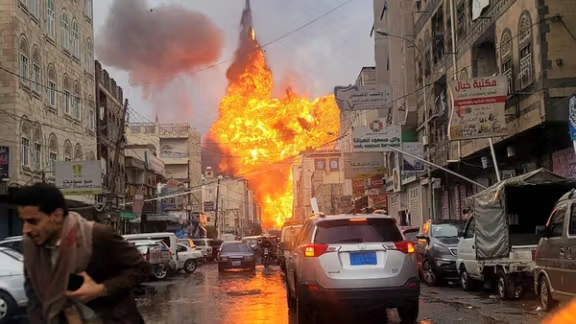
A fireball rises from the site of an Israeli air strike in Sanaa

Yemen’s Houthi rebels confirmed on Saturday that their prime minister, Ahmad Ghaleb al-Rahwi, and several ministers were killed in an Israeli airstrike on a building in the capital, Sanaa.

The announcement was made by Mahdi al-Mashat, head of the group’s Supreme Political Council.

According to the Houthis, al-Rahawi and his colleagues were holding a cabinet meeting when the strike took place.

Al-Rahawi had served as prime minister since 2024, though his role was seen largely as administrative. The council announced that Mohamed Ahmad Moftah has been appointed as acting prime minister.

The Israeli military said on Friday that its air force carried out a broad operation against Houthi positions in Sanaa, targeting senior political and military leaders.

Slain Houthi Prime Minister Ahmad Ghaleb al-Rahawi
100%
Slain Houthi Prime Minister Ahmad Ghaleb al-Rahawi

Israel’s Channel 12 reported the strike likely killed the entire Houthi cabinet, including al-Rahawi and up to 12 ministers.

The fresh airstrikes came after the Israeli military concluded that the Houthis had used cluster munitions in one of their ballistic missile attacks on the Jewish State.

Houthis ready to fight back

After confirming the deaths of the group’s senior officials, the Houthi defense minister announced that the Houthis are ready to confront Israel.

The Houthis have been launching attacks on international shipping in the Red Sea, the Bab al-Mandab strait, and the Gulf of Aden since the outbreak of the Gaza war. Their operations, which have also extended into the Indian Ocean, have repeatedly disrupted maritime security.

The group has also launched missiles and drones toward Israel, framing its attacks as support for Palestinians. While the United States says it recently secured a halt to Houthi strikes on American vessels, the Houthis have said the truce does not apply to Israel and vowed to continue their attacks.

Most Viewed

Iran negotiators ordered to return after internal rift over Islamabad talks
1
EXCLUSIVE

Iran negotiators ordered to return after internal rift over Islamabad talks

2
ANALYSIS

US blockade enters murky phase as tankers spoof signals and buyers hesitate

3
ANALYSIS

Why the $100 billion Hormuz toll revenue is a myth

4

US tightens financial squeeze on Iran, warns banks over oil money flows

5
ANALYSIS

US blockade targets Iran oil boom amid regional disruption

Banner
Banner

Spotlight

  • Hardliners push Hormuz ‘red line’ as US blockade tests Iran’s leverage
    INSIGHT

    Hardliners push Hormuz ‘red line’ as US blockade tests Iran’s leverage

  • Ideology may be fading in Iran, but not in Kashmir's ‘Mini Iran'
    INSIGHT

    Ideology may be fading in Iran, but not in Kashmir's ‘Mini Iran'

  • War damage amounts to $3,000 per Iranian, with blockade set to add to losses
    INSIGHT

    War damage amounts to $3,000 per Iranian, with blockade set to add to losses

  • Why the $100 billion Hormuz toll revenue is a myth
    ANALYSIS

    Why the $100 billion Hormuz toll revenue is a myth

  • US blockade targets Iran oil boom amid regional disruption
    ANALYSIS

    US blockade targets Iran oil boom amid regional disruption

  • Iran's digital economy battered by prolonged blackout
    INSIGHT

    Iran's digital economy battered by prolonged blackout

•
•
•

More Stories

Hackers targeted officials active on Iranian crypto exchange, source says

Aug 30, 2025, 15:28 GMT+1

An attack by Israeli-linked hackers on Iran's top cryptocurrency exchange amid a 12-day war in June focused their targeting on accounts held by officials and their so-called hot and cold wallets, a source told Iran International on Friday.

The Western-sanctioned Nobitex exchange was hit on June 18 by the hacking group Predatory Sparrow and $90 million dollars in its currency was destroyed, according to independent monitors. Nobitex has denied any military or government connections.

Hackers analyzed the stolen data and identified assets, networks, and transactions linked to Iranian officials, distinguishing them from those of civilians and ordinary users, the source said.

Nobitex announced after the attack that losses were limited to hot wallets only. However, a source told Iran International that both hot and cold wallets had been affected.

Hot wallets are internet-connected digital wallets designed for quick transactions but vulnerable to hacks. Cold wallets—offline hardware devices or paper keys—offer higher security but are slower and less convenient for daily use.

Determining whether destroyed assets were in hot or cold wallets can be done by examining transaction patterns and blockchain data tagged by analysis firms.

The United States sanctioned Nobitex in September 2022, followed by Canada in December 2022 and New Zealand in 2023, citing the exchange’s role in arms cooperation with Russia and drone transfers in the Ukraine war.

While the released data suggested extensive sanctions-evasion activities, the Nobitex team insisted it is merely a startup and denied any illegal conduct.

During the June conflict, Israel-linked hackers launched some of the most disruptive cyberattacks of the campaign.

The Predatory Sparrow claimed responsibility for destroying $90mn from Iran’s Nobitex cryptocurrency exchange and crippling services at Bank Sepah and Bank Pasargad by disabling their main and backup data centers.

“During the Nobitex hack, the asset withdrawals specifically occurred from high-frequency addresses, typically associated with hot wallets, and were transferred to burn addresses,” Mehdi Saremi Far, a science and technology journalist, told Iran International.

Iran’s cryptocurrency market is estimated at $5–12 billion, with Nobitex handling about 87% of its transaction volume.

TRM Labs, which specializes in detecting and disrupting blockchain-based illicit activity such as ransomware and money laundering, announced in July that Nobitex was not only used for illicit activities but also served as a surveillance tool.

“The Nobitex breach showed that the exchange’s internal infrastructure was designed to evade detection by the US Treasury Department’s Financial Crimes Enforcement Network (FinCEN) and US-based blockchain intelligence firms. This included modules for generating stealth addresses, obfuscating transactions, and evading surveillance,” TRM Labs said.

Eight arrested in northeastern Iran over Mossad links, Guards say

Aug 30, 2025, 11:29 GMT+1

Eight people were arrested on suspicion of attempting to pass sensitive information about military officials and strategic sites to Israel’s Mossad, Iran’s Revolutionary Guards announced on Saturday.

“These individuals, who had received their specialized training online from agents of Mossad, had sent the coordinates of vital and sensitive centers, as well as information related to prominent military figures, to Mossad intelligence officers during the 12-day war,” read the announcement.

Israel launched the 12-day air campaign against Iran in June, with brief support from the United States, targeting nuclear sites and killing senior military officials and nuclear scientists. The strikes crippled much of Iran’s air defense network and damaged a significant portion of its ballistic missile arsenal, Israel said.

The people were arrested in northeastern Razavi Khorasan province before carrying out their plans, according to the statement. Authorities said they seized equipment for producing explosives, bombs and booby traps.

The announcement follows a broader crackdown in the wake of the June war. State media reported that police detained as many as 21,000 people during the 12-day conflict with Israel, though no details were given about the charges. Security forces also expanded their street presence during the brief war, which ended in a US-brokered ceasefire after Iran launched missile barrages on Israeli cities and military sites.

Earlier this month, Iran hanged nuclear scientist Rouzbeh Vadi, accusing him of providing intelligence to Israel about another scientist later killed in Israeli strikes. In total, at least eight people have been executed in recent months on espionage-related charges.

Human rights groups argue Tehran often uses espionage allegations and swift trials to stifle dissent and tighten control, particularly during periods of conflict.

According to Amnesty, Iran was responsible for 64 percent of all recorded executions worldwide in 2024 and has carried out 612 hangings in the first half of 2025 alone.

Malley-led Yale course on Iran lists speakers tied to Islamic Republic – JNS

Aug 30, 2025, 10:49 GMT+1

A Yale University course on US-Iran relations features former US diplomat Robert Malley as instructor and lists guest speakers with ties to the Islamic Republic, according to an op-ed published by the Jewish News Syndicate (JNS).

The fall 2025 course, titled Adversaries by Design: Deconstructing the Iran-US Relationship, is described in Yale’s course catalogue as an examination of more than four decades of tension between Washington and Tehran, beginning with the 1979 Islamic Revolution. The class will explore each government’s worldview and ask students to take the perspective of US and Iranian decision-makers. Topics include regional politics, US sanctions, and nuclear talks.

The syllabus says the course will feature guest lecturers presenting both Iranian and US perspectives.

In the JNS op-ed, a Yale student who arrived from Tehran in 2023 wrote that the class lists Mohammad Javad Zarif, Hossein Mousavian, and Ali Vaez as speakers. All three have previously held positions or advised on policy within or linked to Iran’s government. “Malley purports to offer Iranian perspectives, but the class will likely only feature Islamic Republic officials and supporters,” the author wrote.

Malley, a longtime figure in US Middle East policy, served as US special envoy for Iran under President Joe Biden and was a key architect of the 2015 Joint Comprehensive Plan of Action (JCPOA) during the Obama administration. He was placed on leave and had his security clearance suspended in 2023.

According to a Wall Street Journal report published last September, the FBI viewed Malley’s handling of classified material as “sloppy,” while the State Department did not consider his conduct to constitute serious misconduct.

In 2023, Iran International and Semafor investigation uncovered the Iran Experts Initiative (IEI) - a network formed under then-Foreign Minister Zarif to promote Iran's foreign policy and nuclear strategy through scholars based abroad. Ali Vaez was named as one of its key members.

Hossein Mousavian, one of the listed guest speakers, recently ended his 15-year tenure at Princeton University, which the university described as a retirement. Activists, however, said it followed pressure over his past role as an Iranian diplomat and nuclear negotiator, and alleged ties to state-linked assassinations and propaganda efforts.

Snapback and survival: sanctions gauntlet further imperils Tehran

Aug 29, 2025, 20:50 GMT+1
•
Shahram Kholdi

The sands of time fall swiftly through the glass, and with each passing day the Islamic Republic of Iran is borne closer to the fateful hour: 18 October 2025, when a 2015 nuclear deal finally expires.

What was once heralded as a diplomatic triumph—a landmark nuclear agreement that promised peace in our time—now stands battered, its legal scaffolding trembling beneath the weight of defiance, duplicity and exhaustion.

In these waning weeks, the world confronts a choice of historic consequence. Shall sanctions be restored, snapping back with the force of law? Will diplomacy, extended yet again, provide a further lease on life to a faltering compact? Or will events-military, political, or economic overtake deliberation and hurl the region into crisis?

To speak plainly: snapback is no illusion. Contrary to misreporting, there is no "30-day prerequisite" before the mechanism may be activated.

The Council requires no incubation period. Once a party files notification of "significant non-performance," the thirty-day clock begins. Unless a fresh resolution is passed, the sanctions of a bygone decade automatically return-immediately, inexorably and beyond veto.

Europe's gambit

The E3—Britain, France and Germany—have already pulled the lever. In their formal notice, they declared Iran to be in "significant non-performance" of its obligations. This, procedurally, is the point of no return.

Unless Moscow can secure nine votes for its draft, and unless Washington refrains from veto, the sanctions of yesteryear will rise again like specters.

For Europe, this is both an act of law and of frustration. Years of oscillation—inspectors expelled, enrichment concealed, commitments broken-have eroded the credibility of diplomacy.

The E3, once patient custodians of compromise, now stand as executioners of its failure.

Moscow's shield, Beijing's hedge

Earlier last week, before E3 notify the UN of their intention to "trigger the snapback à la UNSCR 2231", Russia and China had already stepped into the breach by a draft resolution to extend October 18, 2025, expiry date of UNSCR 2231.

Moscow's draft resolution, tabled before the Security Council, proposes a six-month extension of 2231 to April 2026, granting Tehran a stay of execution.

It is a tactical gambit: stall the clock, suspend deliberation and deny Europe the satisfaction of reimposed sanctions. For Russia, it is one more lever in its great game against the West, wielding Iran as both pawn and partner.

China, ever cautious, has lent its support. Beijing's foreign ministry denounces snapback and extols dialogue, yet behind closed doors its diplomats speak with candor.

If Moscow's extension fails, they admit, China may be resigned to the automatic return of sanctions. For all its rhetoric, Beijing is loath to be cast as breaker of the Council's law. In this careful hedging lies recognition: once triggered, snapback is a machine that runs of itself.

Khamenei's defiance

In Tehran, Supreme Leader Ayatollah Khamenei responded with thunder. In a speech days ago, he rejected outright the prospect of direct negotiations with the United States, branding the dispute "unsolvable."

He warned that Israel, ever the adversary, may seize the moment to again strike Iranian facilities. His words were defiance clothed as prophecy, meant to steel his people and to warn his foes.

Yet, however loud the thunder, the storm advances. Sanctions gnaw at Iran's economy. The rial buckles. Inflation devours. To millions of Iranians, Khamenei's words are less shield than sentence.

Even as the Leader railed, International Atomic Energy Agency inspectors returned to Iran for the first time in months, resuming limited work at Bushehr. It was no great opening: they were kept from Fordow, Natanz and other contested sites.

But it was something. Director General Rafael Grossi hailed the step as "an early indication of progress," though with Churchillian caution: "full cooperation," he warned, "remains a work in progress".

Iran presented the move as magnanimity; parliamentarians denounced it as betrayal. Yet the fact remains: Tehran, sensing peril, cracked open the door.

The transformation ultimatum

There is yet a more radical road. Under the hammer of snapback, with Moscow's shield broken and Beijing resigned, Khamenei may, like Khomeini before him, bow to survive.

He could proclaim a volte-face: accept spontaneous inspections anywhere in Iran; relocate enrichment to a consortium abroad—in the United Arab Emirates or Qatar—or cede it wholly to Russia.

The Leader could pledge compliance with the Financial Action Task Force and thereby grant external auditors full access to Tehran's banking system.

Khamenei might even agree to dismantle the Revolutionary Guards, curtail ballistic missiles and drones and to watch, powerless, as Lebanon advances toward the disarmament of Hezbollah and Iraq presses its own militias into submission.

Already Israeli strikes on Iran's allies in Yemen, with senior Houthi officials reported killed.

Were all this to unfold, Iran would face not mere concession, but transformation. A kleptocratic, hybrid theocracy would be stripped of its praetorian guard, its financial opacity and its regional claws.

History shows that regimes so hollowed seldom survive. This, then, would be snapback not as sanction, but as sentence.

In her own words: Nobel laureate Shirin Ebadi calls for Iranian uprising

Aug 29, 2025, 18:54 GMT+1

Below is a transcript of Iranian lawyer, activist and Nobel laureate Shirin Ebadi's remarks in a wide-ranging conversation with Iran International's Eye for Iran podcast.

Political awakening

First of all, I would like to add that this is my first book, and my second book - in which I wrote about the reason why I left Iran and the fate of Iran today - I wrote in another book titled Until We Are Free.

But about Mr. Bani-Sadr, in the book (Iran Awakening) whom you asked about, I must say that it was not Bani-Sadr the president. It was the brother of the president - the first president, who at that time ran the justiciary. He headed the judiciary.

When he told me this, he said, put on your headscarf even if it's not in your belief, as a sign of respect, as someone who has come as a guest to our home - by which he meant Khomeini's.

I told him, why are you encouraging me to be hypocritical or pretend? I realized very quickly that all the things Khomeini was saying were lies and meant for deception, and for that reason from the very first months I separated my path.

In the articles that I wrote at the very beginning of the revolution, given that during the first year of the revolution there was more freedom, I was able to write articles and they were published.

But, that very moment was the reason that, after I left the judiciary and wanted to obtain my law license, they did not give me a license for seven years and kept me waiting because of the articles I had written.

Women as 'slaves'

In any case, unfortunately the Islamic Revolution sought to use women as slaves, although women resisted too, and because of their resistance the Islamic Republic was not able to shape the kind of woman it desired according to its own ideology.

Still, as much as it could, it tried to impose its culture on the women of Iran through unjust laws.

My first encounter with Khomeini being a liar, and the revolution not being what I wanted, was on March 8, 1979. I remember listening to the radio news. There was an interview with Mr. Eshraghi, the son-in-law of the Imam, and he quoted Khomeini as saying that women working in government offices and state-owned companies must wear hijab, and without hijab no one would be allowed in.

That was when I realized that Khomeini did not stand by the things he had said. He had lied. After that, one discriminatory law after another was passed against women, and the situation of women became much worse than before. It meant that we even lost the rights we had won.

Disillusionment

I am a defender of human rights and naturally sought peaceful change in Iran. That's why, when Khatami was elected, I felt that perhaps his words could be trusted and that maybe reforms could improve conditions without bloodshed or heavy costs. But

I grew more hopeless day by day, and my despair came after the events of July 9, [1999] — the day when the Tehran University student dormitory was attacked and a young man named Ezzat Ebrahimnejad was killed. I was Ezzat Ebrahimnejad's lawyer, and I saw and had information in this regard about what a tragedy had occurred.

We expected Khatami and the reformist government to take the students' side. But unfortunately, we saw that many students were arrested without any justice being carried out as to why that tragedy had been brought upon the students.

And that was when I thought nothing could be done any longer. Many more events afterwards only strengthened this belief. I hope you will read Until We Are Free to understand what events took place.

For this to happen, first of all the constitution must be changed. As a lawyer, I only look at the laws. And based on the constitution, there are principles that the constitution itself has stipulated are unchangeable forever.

All our problems stem entirely from these principles. One of these principles is that all laws must be based on Islamic criteria. Another principle is that the ones who determine this are the six jurists of the Guardian Council, who are directly appointed by the [Supreme] Leader, the Vali-e Faqih. The Vali-e Faqih's powers are among the principles that are unchangeable.

Overthrow 'must take place'

In my view, the current ruling body must be deposed. This means that in reality an overthrow must take place. I hope this overthrow will happen without a heavy price and in a short time.

To achieve that, there is no other way except for the people inside Iran to take to the streets and with one voice say, they do not want this government, stop working, and then this [ruling] system will become paralyzed and through people's resistance it collapses.

Then, the people who brought down this government can easily establish their desired [ruling] system through a referendum.

In such a situation — that is, when a government falls and is left without one, the United Nations can intervene, sending representatives to oversee the transitional period and help hold a fair and proper referendum.

Of course, US policies-and those of Western governments in general-will have an impact, but the final and ultimate impact lies with the people of Iran. That means, it is the people of Iran who in the end must change the destiny of their country in the way they wish.

From grumbling to action

You see, as long as people submit to oppression despite their dissatisfaction, and in other words remain in a so-called gray state...which now the gray stratum is gradually breaking away toward those who believe in overthrowing this regime. And only under these circumstances will something good happen.

I repeat: people are dissatisfied, and they have gradually realized that they must move beyond staying at home, grumbling, and complaining, and instead display their protest in the streets to the government and to the world. And now we are now seeing protests breaking out in the streets over electricity and water shortages.

Our streets must be occupied by the people again. I know this may come at a price, but living under the rule of this government is even more costly for the people.

Even ordinary life — water, electricity, and gas - has been withheld from the people. While we are sitting on a sea of oil, we are facing shortages — or as the government calls it, facing an imbalance — of electricity and gas. What kind of government is this? It has ruled for forty-six years and has destroyed Iran.

Human rights in international talks

I have always said, Western governments that claim they respect human rights must also talk about human rights violations in all dealings and meetings they have with the leaders of the Islamic Republic.

But over these forty-six years we have seen the opposite. That is, The Iranian government imprisons innocent people—indeed, takes them hostage-to extort the West. And how easily Western governments pay ransom.

You saw how Obama sent a plane of cash. You saw how Britain, in exchange for the release of several innocent people who had British nationality, gave ransom so that they would be freed. You saw how the Iranian terrorist diplomat who had been sentenced to twenty years in prison was released. You saw how Hamid Nouri was freed.

These are ransoms given to a terrorist and terror-filled government. This behavior has been wrong, we have always objected.

I hope that one day Western governments realize that they must respect the human rights situation in Iran, it must matter to them, and if they deal or negotiate with a criminal government like Iran, they must also talk about human rights issues, and it must be at the top of the matters they ask the government to improve.

Western governments must be put under pressure. How? Through their own people. That is why the main duty of human rights activists, especially those outside Iran, is to inform, to speak out, and to raise awareness in Western civil society. We know that, for example, France or Britain - after all, they have democracies and are elected by the people's vote.

So the voters must be made aware to elect those who care about humanity. In my view, the most important way [to do this] is raising awareness, and in this regard both human rights defenders and the media have a duty. The media must echo the voice of the defenseless people of Iran to the world and show what Iranians are enduring.

Iranian unity

I was not at the Munich conference. I only sent a message. And in that message I repeated what I have always said: I am not a monarchist, nor am I a republican. I am for Iran. My wish is to live in a homeland that is democratic and secular-that is, exactly what the people of Iran want. And this will not be possible unless Iranians unite.

The disputes that for many years they pointlessly had with each other over minor issues must be set aside, and they must form a coalition with each other and help so that an overthrow can happen.

Then, at the ballot box, during the referendum, it will be determined what Iran's political system will be in the future. My message to the people has always been unity, because I know that unity is the key to our victory.

I was invited [to Munich]. I did not go because I was somewhere else and did not have the possibility to attend. They asked me to send a message, and I did. And any other group that invites me and is willing to broadcast my message, I will gladly give them the same message.

Now is the time for us to unite and form a coalition. For forty-six years we have been fighting among ourselves. You see, in these forty-six years it has been proven that neither the monarchists alone, nor the republicans alone, nor the left alone, nor the right alone - no group on its own can succeed in overthrowing the government of Iran and freeing us from tyranny. We must all unite, hand in hand, and work together.

And my goal is not that we should all think the same. The unity I speak of is different from the "unity of word" that Khomeini talked about. What I mean by unity is that we become willing to work together while also maintaining our own political preferences and beliefs.

At the referendum it will then be determined what the future of Iran will be. But right now we all have one demand — overthrow.

Arrests and executions

So we must join hands to achieve it. I completely agree with you. Look, right now at least three people are executed every single day. The number of arrests is extremely high. For the smallest comment or even a short social media post, someone can be imprisoned.

When a cherished national treasure is sentenced to prison just for posting a dot - then you can imagine what the situation of freedom of expression in this country is. That's why I say this government must be overthrown-because there is no other solution.
The longer this government remains, the more crimes it commits.

These crimes bring us to this firm conviction that an end point must be put to these crimes. This end point is the downfall of the regime. For this reason, unfortunately, no path remains except overthrow.

It may come at a cost, but the people have been left with no alternative. No path of reconciliation remains.

Resource-rich, yet poor

Look, this is not just one sign - there are many signs. Iran has abundant oil, yet people live with at least three hours of power outages each day. The lakes have dried up. There is no water. This is not due to drought.

We look at our neighbors - Qatar, the Emirates, Kuwait - those who are in worse conditions than us. Yet none of them are suffering like we are, where people are forced to buy water.

The economy is on the brink of collapse. All of Iran's banks are bankrupt, surviving only by document fabrication and false accounting. The national currency loses value every single day. By the government's own statistics, about one-third of Iranians have fallen into poverty, though the real figure is higher.

Housing and rent prices are so high that it is beyond the means of many. Our top university graduates all dream of leaving the country not because they do not love Iran, but because there is no work in Iran.

When you get into a Snapp car or a taxi, you find that the drivers are engineers or doctors—because there is no work, they are forced to work [as drivers].
In such conditions, the government relies only on violence, repression, executions, and prisons to try to silence everyone.

'Demon of tyranny'

Well, no way forward remains. No hope remains. All the signs show clearly that this government cannot continue.

It thrashes about to delay its fall, but it can't hold on for much longer. Day by day, we are moving closer to the end of the Islamic Republic.

My message to the people of Iran, to all political groups, and to anyone dissatisfied with the current situation is this: if we unite, hand in hand, we can achieve victory over the demon of tyranny that has coiled itself around Iran.

What has allowed this regime to survive is the divisions among Iranians themselves. But those divisions are starting to fade. I now see that inside Iran, different groups are beginning to work together. Outside the country, there are signs of solidarity as well, even if small.

These must grow stronger. If we can become united, cohesive, and speak with one voice, then we can easily topple the Islamic Republic and bring to power the government of our choosing- under which we will finally be able to live a normal life. Because right now in Iran, nothing is normal.