• العربية
  • فارسی
Brand
  • Iran Insight
  • Politics
  • Economy
  • Analysis
  • Special Report
  • Opinion
  • Podcast
  • Iran Insight
  • Politics
  • Economy
  • Analysis
  • Special Report
  • Opinion
  • Podcast
  • Theme
  • Language
    • العربية
    • فارسی
  • Iran Insight
  • Politics
  • Economy
  • Analysis
  • Special Report
  • Opinion
  • Podcast
All rights reserved for Volant Media UK Limited
volant media logo
ANALYSIS

Isolated allies: Iran turns to Belarus as sanctions leave few partners

Maryam Sinaiee
Maryam Sinaiee

Iran International

Aug 22, 2025, 18:56 GMT+1Updated: 02:57 GMT+0
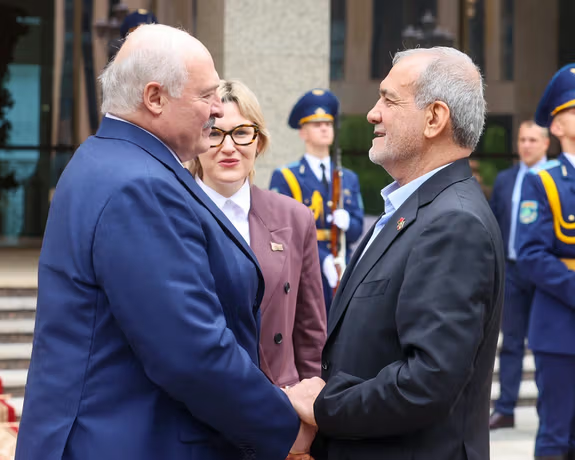
Iran's President Masoud Pezeshkian and President of Belarus, Aleksandr Lukashenko. August 2025

Iranian President Masoud Pezeshkian visited Belarus this week, a heavily sanctioned Russian ally, in a trip that highlighted how Tehran’s “Look East” strategy ties it more closely to Moscow and Beijing and their sanctioned partners.

Tehran has framed the August 20 visit as part of a concerted move against Western pressure.

Iran newspaper, the administration’s mouthpiece, wrote that the president’s decision to visit Minsk was a logical continuation of Tehran’s foreign policy—a policy emphasizing a multipolar world, national sovereignty, independence, and resistance to coercion.”

Similarly, Nour News, close to Ali Khamenei's top advisor Ali Shamkhani, described the trip as a “clear message against global unilateralism and sanctions.”

Consolidating the 'Look East' strategy

For many observers, the choice of Belarus as one of Pezeshkian’s first foreign destinations after the 12-day war with Israel was a deliberate statement of intent.

Esfandiar Khodaee, a foreign relations commentator, wrote in Khabar Online that the visit showed the “Looking East” policy was no longer just a legacy of Mahmoud Ahmadinejad or Ebrahim Raisi, but “a standing pillar of the Islamic Republic’s foreign policy.”

The approach traces back to Ahmadinejad’s presidency, when Tehran expanded ties with China, Russia, India, and members of the Shanghai Cooperation Organization. Supreme Leader Ali Khamenei reaffirmed the policy in 2018 with the slogan “Looking East,” emphasizing reliance on non-Western partners as sanctions mounted.

Analysts note that Europe’s hardened stance on Iran’s nuclear file—coupled with escalating US sanctions—has pushed Tehran further into Russia’s orbit.

As a commentary published by Moj News Agency put it, “Tehran’s choice of Belarus at this moment highlights its prioritization of ties with anti-Western, pro-Russian states—especially as Europe in recent months has shown no flexibility in its dealings with Iran.”

"Those who say we shouldn’t work with China and Russia — do they mean we should stand alone?" Ali Larijani, the secretary of Iran's Supreme National Security Council said in an interview with Khamenei's website published on Friday.

"Well, when the Westerners don’t work with us, we work with China, we work with other countries," he added.

A message of resilience

Belarus, like Iran, is heavily sanctioned and has faced sharp international isolation since aligning with Moscow over the war in Ukraine. Both states thus share an interest in showcasing resilience against sanctions.

Alireza Salimi, a member of parliament’s presiding board, told ISNA that the president’s visits to Armenia and Belarus sent a message that Iran is “sanctions-proof”.

The rhetoric was reinforced by the agreements signed in Minsk. Foreign Minister Abbas Araghchi announced that Tehran and Minsk were upgrading their Comprehensive Cooperation Roadmap for 2023–2026 into a strategic partnership agreement.

The two sides also discussed closer alignment within the Eurasian Economic Union, BRICS, and the Shanghai Cooperation Organization.

Military and security undertones

Though economic cooperation was highlighted, the military dimension loomed large. Tehran and Minsk have quietly expanded security ties in recent years: an August 2023 defense memorandum paved the way for Belarusian forces to join Iranian drills in 2024, and Iran opened its first military attaché office in Minsk in 2025.

Belarusian officials have recently discussed ramping up missile production, including exploring nuclear-capable options for their Polonez rocket systems. Iran’s expertise in missile development makes it a potential partner and could raise concerns in Western capitals.

Both governments also maintain open support for Moscow’s war effort, a stance that has drawn sharp condemnation from Ukraine and NATO states. Kyiv in particular has repeatedly denounced Tehran’s supply of drones to Russia.

Trade remains modest but symbolic

Despite official optimism, trade between the two countries remains limited. Araghchi said bilateral exchanges totaled $140 million in the first half of 2025—a 14 percent increase from last year, but quite modest.

Even if current volumes are low, both sides see such arrangements as politically symbolic and vital to their shared sanctions-circumvention strategies.

Both governments also see potential in expanding connectivity. Reza Masroor, head of Iran’s Supreme Council of Free and Special Economic Zones, noted that Belarus could gain access to open waters via Iran’s free zones through the Makhachkala–Caspian Port route.

This, he argued, would allow Minsk to bypass Baltic restrictions and connect to the North–South Corridor, enabling exports of potash, agricultural goods, and industrial products to markets in the Middle East, Africa, and beyond.

Most Viewed

Iran negotiators ordered to return after internal rift over Islamabad talks
1
EXCLUSIVE

Iran negotiators ordered to return after internal rift over Islamabad talks

2
ANALYSIS

US blockade enters murky phase as tankers spoof signals and buyers hesitate

3
ANALYSIS

Why the $100 billion Hormuz toll revenue is a myth

4

US tightens financial squeeze on Iran, warns banks over oil money flows

5
ANALYSIS

US blockade targets Iran oil boom amid regional disruption

Banner
Banner

Spotlight

  • Hardliners push Hormuz ‘red line’ as US blockade tests Iran’s leverage
    INSIGHT

    Hardliners push Hormuz ‘red line’ as US blockade tests Iran’s leverage

  • Ideology may be fading in Iran, but not in Kashmir's ‘Mini Iran'
    INSIGHT

    Ideology may be fading in Iran, but not in Kashmir's ‘Mini Iran'

  • War damage amounts to $3,000 per Iranian, with blockade set to add to losses
    INSIGHT

    War damage amounts to $3,000 per Iranian, with blockade set to add to losses

  • Why the $100 billion Hormuz toll revenue is a myth
    ANALYSIS

    Why the $100 billion Hormuz toll revenue is a myth

  • US blockade targets Iran oil boom amid regional disruption
    ANALYSIS

    US blockade targets Iran oil boom amid regional disruption

  • Iran's digital economy battered by prolonged blackout
    INSIGHT

    Iran's digital economy battered by prolonged blackout

•
•
•

More Stories

Gunmen kill five police officers in southeast Iran

Aug 22, 2025, 12:37 GMT+1

Unidentified gunmen attacked two police patrol units near Iranshahr in Iran’s southeastern Sistan-Baluchestan province on Friday, killing five officers, according to state media.

Police said the attackers opened fire on vehicles stationed on the Khash-Iranshahr road.

The attack is the latest in a surge of violence in the province, which borders Pakistan and Afghanistan and has long been a hotspot for militant activity and drug trafficking.

The Sunni militant group Jaish al-Adl, designated a terrorist organization by both Iran and the United States, has claimed responsibility for several recent assaults, including a July attack on a courthouse in Zahedan that killed nine and clashes in Saravan earlier this month.

Iran’s Revolutionary Guards said on Sunday their forces had killed six militants and destroyed two hideouts in coordinated raids in the province, seizing explosives, detonators and communications gear.

“Two terrorist teams were destroyed,” the Guards said, adding that local residents had helped identify militant safe houses.

The IRGC’s Quds Base, which oversees forces in Sistan-Baluchestan and neighboring Kerman, said the militants had planned sabotage and bombings.

Last Friday, Jaish al-Adl claimed responsibility for an earlier shooting in Iranshahr that killed one police officer and wounded another.

Earlier in August, Iranian police said three militants and one officer were killed in a clash in Saravan, while in late July nine people died in an assault on a courthouse in the provincial capital Zahedan, which the group also claimed.

Iran warns Europe snapback would trigger ‘armed negotiations’

Aug 22, 2025, 11:33 GMT+1

A senior Iranian diplomat warned Europe that triggering the UN’s “snapback” mechanism to restore sanctions would squander its leverage and harden Tehran’s nuclear stance.

Deputy Foreign Minister Saeed Khatibzadeh told Germany’s Frankfurter Allgemeine Zeitung on Thursday that Europe had no right to reimpose lapsed sanctions under the 2015 nuclear deal.

“Such an action would only waste Europe’s last card and further diminish its credibility as a mediator,” he said.

He warned that any future talks on Iran’s nuclear program would be “armed negotiations.” “If we return to negotiations, it will be an armed negotiation. We will all have our fingers on the trigger, because we do not trust the other side,” he said.

Khatibzadeh rejected again US demands for “zero enrichment.” “Iran will not be treated as an exception to international law. The right to enrichment is non-negotiable, although the level and details can be discussed,” he said.

Tehran insists it will resist pressure and has warned that activating snapback sanctions could push it to leave the Nuclear Non-Proliferation Treaty.

Britain, France and Germany — the so-called E3 — have warned Iran that unless it returns to nuclear talks by the end of August, they will trigger the mechanism that could reimpose all UN sanctions lifted under the 2015 nuclear deal.

Tehran has accused Washington of seeking through diplomacy what it failed to achieve with June’s military strikes, with Foreign Minister Abbas Araghchi saying this week that talks with the United States have not yet reached a “mature stage.”

Israel’s June 13 offensive and subsequent US strikes on Esfahan, Fordow and Natanz ended oversight of Iran’s facilities, though Araghchi said limited cooperation with the IAEA will continue under tighter national controls.

He warned that UN snapback sanctions could return, but said Iran is coordinating with Russia and China on countermeasures.

Iran said Friday that Araghchi would hold a telephone conference call with his French, German and British counterparts.Parallel to planned call, International Atomic Energy Agency officials are due to meet Iranian counterparts in Vienna.

Iran briefly closes western airspace for military drills

Aug 22, 2025, 10:58 GMT+1

Iran temporarily closed large sections of its western airspace early on Friday to allow military drills, before restoring flights several hours later, local media reported.

Fars News Agency said the restrictions were imposed from midnight until 6 a.m. local time, covering parts of Zanjan, Hamedan, Arak, Yasuj, Iran’s western borders, and airspace over the western Persian Gulf.

Several domestic outlets reported that the exercise was carried out by the Islamic Revolutionary Guard Corps (IRGC) and involved both missile and drone operations across several regions.

The move came as regional media reported heightened security. Al-Hadath television said two planes — one Iraqi and one Iranian — due to depart Baghdad for Tehran were prevented from taking off during the restrictions. No official explanation was given.

Iran has issued separate notices to airmen (NOTAMs) in recent weeks closing parts of eastern provinces, including North, Razavi and South Khorasan, for live-fire drills until the end of summer.

NOTAM-Iran-August (file)
100%

Earlier this week, Iran’s navy test-fired Nasir, Qadir, and Ghader cruise missiles during large-scale drills in the Gulf of Oman and northern Indian Ocean, state media said.

The exercises, called Sustainable Power 1404, involved launches from coastal batteries and warships including the Genaveh missile boat and Sabalan destroyer. Officials said the radar-evading, high-precision missiles struck their targets at sea.

The drills came a month after joint Iran-Russia naval maneuvers in the Caspian Sea -- Casarex 2025.

Hackers disrupt communications of dozens of Iranian oil and cargo ships

Aug 22, 2025, 08:22 GMT+1

A hacker group said it disabled communications on more than 60 Iranian oil tankers and cargo ships, severing links between the vessels, their ports, and the outside world in one of the largest cyberattacks on the country’s maritime sector.

The group, known as Lab-Dookhtegan (Sewn Lips), told Iran International that it hacked into the systems of the National Iranian Tanker Company (NITC) and the Islamic Republic of Iran Shipping Lines (IRISL), disrupting operations on 39 tankers and 25 cargo ships.

The hackers said the breach was carried out by infiltrating Fanava Group, an Iranian IT and telecoms holding company that provides satellite communications, data storage, and payment systems.

They said they obtained “root-level” access to the Linux operating systems running the ships’ satellite terminals, enabling them to stop Falcon, the control software at the heart of Iran’s maritime communications.

Stopping Falcon means complete disconnection between the ships and shore, the group said, adding that the hack rendered automatic identification system (AIS) tracking and satellite links inoperable.

NITC and IRISL targeted

The two state-linked companies are central to Iran’s sanctioned economy.

NITC, a subsidiary of the National Iranian Oil Company, is one of the Middle East’s largest tanker fleets with more than 46 vessels and a total annual capacity of 11 million tons. Its tankers, such as the Amber, Apama, Deep Sea, Fortune and Faxon, transport Iranian crude globally, often switching off tracking systems to evade sanctions.

IRISL, with a fleet of about 115 vessels, is Iran’s largest cargo operator and ranked the world’s 14th biggest shipping line by Alphaliner in 2022. Its ships, including Abyan, Avang, Parisan, Radin and Touska, have been sanctioned by the US, EU and UN for their role in supporting Iran’s nuclear and missile programs.

Both companies were sanctioned by the US Treasury in 2020 for aiding the Islamic Revolutionary Guard Corps’ Quds Force, the extraterrestrial wing of the IRGC.

This is not the first time Iranian shipping has been targeted. In March 2025, Lab-Dookhtegansaid it disrupted the communications of 116 vessels belonging to the same two firms. At the time, the group claimed the attack was timed to coincide with US operations against Iran-backed Houthis in Yemen.

US and European sanctions have already limited Iran’s access to advanced maritime technology, insurance, and international ports, leaving the fleets more exposed to cyber and physical threats.

Fanava Group, founded in 2003 and headquartered in Tehran, has yet to respond to requests for comment.

The cyberattack comes as Iran faces growing scrutiny of its shipping and oil-export networks. Western governments accuse Tehran of using its maritime fleet to mask oil sales to China and others, while also supplying weapons to proxy groups including Hezbollah and Yemen’s Houthis.

In the latest effort to stop Tehran's oil exports, the US sanctioned 13 companies and eight vessels over suspected ties to Iran, the Treasury Department said on Thursday.

US Treasury issues new sanctions targeting Iran's oil exports

Aug 21, 2025, 20:23 GMT+1

The United States imposed sanctions on 13 companies and eight vessels over suspected ties to Iran, the Treasury Department said on Thursday, in the latest effort to stop Tehran's oil exports in violation of US sanctions.

The designations target Greek national Antonios Margaritis and his network of companies, including Marant Shipping and Trading, Square Tanker Management, Comford Management and United Chartering, which Washington said had facilitated Iranian petroleum shipments for years.

“Today’s action against Margaritis and his network degrades Tehran’s ability to fund its advanced weapons programs, support terrorist groups, and threaten the safety of our troops and our allies,” Secretary of the Treasury Scott Bessent said in a statement.

"He (Antonios Margaritis) has most recently been involved in the operations of OFAC-sanctioned vessel MS ENOLA and MS ANGIA, which has carried Iranian oil," the Treasury said.

“Treasury remains determined to hold accountable all those who seek to aid the Iranian regime and threaten global security," he added.

The companies sanctioned on Thursday are based in Hong Kong, China, the United Arab Emirates and the Marshall Islands, according to the Treasury.

The Treasury accused Changbai Glory Shipping of moving more than four million barrels of Iranian oil to China on the LAFIT since March, Regal Liberty of delivering about two million barrels on the GIANT, and U Beacon Shipping of transporting over a million barrels on the ADELINE G.

It also accused Hong Kong Hangshun Shipping of shipping millions of barrels on the KONGM, and Ares Shipping of moving nearly ten million barrels on the ARES, often via ship-to-ship transfers with already sanctioned tankers.

UAE-based Ozarka Shipping was also sanctioned for managing vessels that transported Iranian petroleum products to China, while additional Hong Kong firms, including U Beacon Shipping, Hong Kong Hangshun Shipping and Ares Shipping, were sanctioned for their role in moving Iranian oil.