• العربية
  • فارسی
Brand
  • Iran Insight
  • Politics
  • Economy
  • Analysis
  • Special Report
  • Opinion
  • Podcast
  • Iran Insight
  • Politics
  • Economy
  • Analysis
  • Special Report
  • Opinion
  • Podcast
  • Theme
  • Language
    • العربية
    • فارسی
  • Iran Insight
  • Politics
  • Economy
  • Analysis
  • Special Report
  • Opinion
  • Podcast
All rights reserved for Volant Media UK Limited
volant media logo

Germany scales back Tehran embassy services as ambassador departs
Aug 22, 2025, 18:06 GMT+1Updated: 02:57 GMT+0
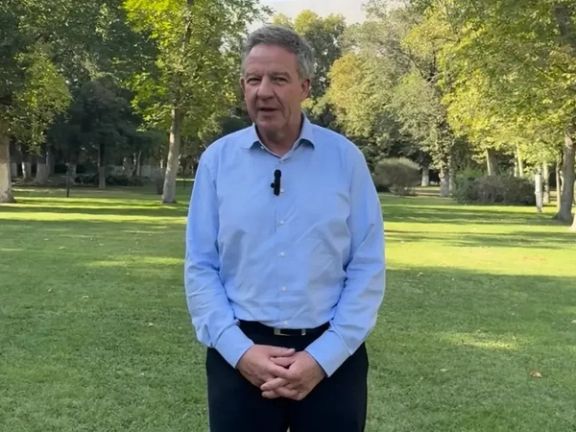
Markus Potzel, German Ambassador in Iran in his farewell message in Persian, posted on Instagram

Germany’s ambassador to Iran Markus Potzel announced he is ending his mission in Tehran for "personal reasons," and that the visa section is now operating at reduced capacity.

Potzel said the embassy would reduce its staff, which will lead to stricter visa issuance for applicants inside Iran.

“I’ve seen many changes this year. Iran today is different from a year ago. I wish you all peace, stability, and the fulfillment of your dreams. I hope to return and see your aspirations fulfilled,” Potzel said.

The ambassador made the remarks in a farewell video on the German Embassy’s Instagram account, delivering a short message in Persian.

The announcement came one day after a group of Iranian visa applicants protested outside the German Embassy in Tehran, denouncing the embassy’s refusal to issue visas.

On August 13, more than 550 individuals — including activists, journalists, human rights defenders, and victims of eye injuries from the Woman, Life, Freedom movement — wrote to the German government urging the immediate resumption of visa processing for at-risk political and civil activists, trade unionists, journalists, and injured victims.

Several embassies and consulates in Iran suspended services in June during the 12-day war with Israel.

Citing security concerns, the German Embassy relocated some consular staff to other countries in the region but continues to provide limited services in Iran.

Austria on Thursday announced the suspension of all consular services in Iran until further notice.

“We are working to re-establish the conditions which would allow us to resume consular services at the Embassy in Tehran,” Alena Baur, deputy spokesperson for the Austrian foreign ministry in Vienna, told Iran International via email.

“As of today, there is no concrete indication when consular services will resume,” Baur said.

The embassies of Portugal, Switzerland, and the United Kingdom also suspended their activities in June due to Israel’s military campaign against Iran but have since resumed operations.

The Czech Embassy also halted services in June and has not yet resumed, though it announced plans to gradually restart operations in September.

The closure of foreign embassies in Tehran during and after the 12-day war left between 3,000 and 4,000 Iranian passports stuck in diplomatic missions, stranding visa applicants, Iranian officials said earlier this month.


Most Viewed

Iran negotiators ordered to return after internal rift over Islamabad talks
1
EXCLUSIVE

Iran negotiators ordered to return after internal rift over Islamabad talks

2
ANALYSIS

US blockade enters murky phase as tankers spoof signals and buyers hesitate

3
ANALYSIS

Why the $100 billion Hormuz toll revenue is a myth

4

US tightens financial squeeze on Iran, warns banks over oil money flows

5
ANALYSIS

US blockade targets Iran oil boom amid regional disruption

Banner
Banner

Spotlight

  • Hardliners push Hormuz ‘red line’ as US blockade tests Iran’s leverage
    INSIGHT

    Hardliners push Hormuz ‘red line’ as US blockade tests Iran’s leverage

  • Ideology may be fading in Iran, but not in Kashmir's ‘Mini Iran'
    INSIGHT

    Ideology may be fading in Iran, but not in Kashmir's ‘Mini Iran'

  • War damage amounts to $3,000 per Iranian, with blockade set to add to losses
    INSIGHT

    War damage amounts to $3,000 per Iranian, with blockade set to add to losses

  • Why the $100 billion Hormuz toll revenue is a myth
    ANALYSIS

    Why the $100 billion Hormuz toll revenue is a myth

  • US blockade targets Iran oil boom amid regional disruption
    ANALYSIS

    US blockade targets Iran oil boom amid regional disruption

  • Iran's digital economy battered by prolonged blackout
    INSIGHT

    Iran's digital economy battered by prolonged blackout

•
•
•

More Stories

Khamenei’s man rejects reformists’ call to halt uranium enrichment

Aug 22, 2025, 13:58 GMT+1

Ahmad Khatami, Tehran’s interim Friday prayer leader and a representative of the Supreme Leader, criticized the Reform Front’s recent manifesto, saying its proposal for suspending uranium enrichment mirrored US demands.

“Suspending enrichment is the American prescription in this statement,” Khatami told worshippers at Tehran’s Imam Khomeini Mosalla, according to state media.

He added: “Nuclear energy is the energy of the future, and people have repeatedly said nuclear energy is the nation’s inalienable right.”

Khatami also rejected the manifesto’s suggestion of direct talks with Washington, saying: “How can we negotiate with America, which martyred General Soleimani, attacked our country, violated all international agreements, and struck our nuclear centers?”

Iran’s Reform Front has urged sweeping political and foreign policy changes, including a temporary suspension of uranium enrichment, release of political prisoners, and direct negotiations with Washington in return for sanctions relief. The reformist push has drawn fierce backlash from conservatives.
  • 'If not treason, then what?' Iran hardliners torch reformists’ manifesto

    'If not treason, then what?' Iran hardliners torch reformists’ manifesto

  • Moderates tell Tehran to offer enrichment halt for sanctions relief

    Moderates tell Tehran to offer enrichment halt for sanctions relief

“The Iranian people will never surrender to America — hayhat minna al-dhilla,” he said, invoking a famous phrase from Shi’ite Islam Imam Hussein’s sermon on the day of Ashura, which means ‘far be it from us to accept humiliation.’ The expression, rooted in Hussein’s rejection of submission to Ibn Ziyad in 680 AD, has come to symbolize choosing death with dignity over life in disgrace.

Citing remarks by Ali Khamenei last year, Khatami said: “The Leader has already said negotiations with America are neither rational nor honorable. This statement recommends dishonor, and the Iranian nation will not accept such a humiliating recipe.”

Khatami further denounced the reformist document as divisive, calling it a “black letter that translates Netanyahu’s words into Persian.”

He argued that Iranians had voted 47 times since the 1979 revolution and dismissed claims of repression of dissent, insisting that media and social networks were active and free.

A recent survey conducted by a Netherlands-based institute found that the majority of Iranians would vote for either a regime change or a structural transition away from the Islamic Republic.

Iran warns Europe snapback would trigger ‘armed negotiations’

Aug 22, 2025, 11:33 GMT+1

A senior Iranian diplomat warned Europe that triggering the UN’s “snapback” mechanism to restore sanctions would squander its leverage and harden Tehran’s nuclear stance.

Deputy Foreign Minister Saeed Khatibzadeh told Germany’s Frankfurter Allgemeine Zeitung on Thursday that Europe had no right to reimpose lapsed sanctions under the 2015 nuclear deal.

“Such an action would only waste Europe’s last card and further diminish its credibility as a mediator,” he said.

He warned that any future talks on Iran’s nuclear program would be “armed negotiations.” “If we return to negotiations, it will be an armed negotiation. We will all have our fingers on the trigger, because we do not trust the other side,” he said.

Khatibzadeh rejected again US demands for “zero enrichment.” “Iran will not be treated as an exception to international law. The right to enrichment is non-negotiable, although the level and details can be discussed,” he said.

Tehran insists it will resist pressure and has warned that activating snapback sanctions could push it to leave the Nuclear Non-Proliferation Treaty.

Britain, France and Germany — the so-called E3 — have warned Iran that unless it returns to nuclear talks by the end of August, they will trigger the mechanism that could reimpose all UN sanctions lifted under the 2015 nuclear deal.

Tehran has accused Washington of seeking through diplomacy what it failed to achieve with June’s military strikes, with Foreign Minister Abbas Araghchi saying this week that talks with the United States have not yet reached a “mature stage.”

Israel’s June 13 offensive and subsequent US strikes on Esfahan, Fordow and Natanz ended oversight of Iran’s facilities, though Araghchi said limited cooperation with the IAEA will continue under tighter national controls.

He warned that UN snapback sanctions could return, but said Iran is coordinating with Russia and China on countermeasures.

Iran said Friday that Araghchi would hold a telephone conference call with his French, German and British counterparts.Parallel to planned call, International Atomic Energy Agency officials are due to meet Iranian counterparts in Vienna.

Iran briefly closes western airspace for military drills

Aug 22, 2025, 10:58 GMT+1

Iran temporarily closed large sections of its western airspace early on Friday to allow military drills, before restoring flights several hours later, local media reported.

Fars News Agency said the restrictions were imposed from midnight until 6 a.m. local time, covering parts of Zanjan, Hamedan, Arak, Yasuj, Iran’s western borders, and airspace over the western Persian Gulf.

Several domestic outlets reported that the exercise was carried out by the Islamic Revolutionary Guard Corps (IRGC) and involved both missile and drone operations across several regions.

The move came as regional media reported heightened security. Al-Hadath television said two planes — one Iraqi and one Iranian — due to depart Baghdad for Tehran were prevented from taking off during the restrictions. No official explanation was given.

Iran has issued separate notices to airmen (NOTAMs) in recent weeks closing parts of eastern provinces, including North, Razavi and South Khorasan, for live-fire drills until the end of summer.

NOTAM-Iran-August (file)
100%

Earlier this week, Iran’s navy test-fired Nasir, Qadir, and Ghader cruise missiles during large-scale drills in the Gulf of Oman and northern Indian Ocean, state media said.

The exercises, called Sustainable Power 1404, involved launches from coastal batteries and warships including the Genaveh missile boat and Sabalan destroyer. Officials said the radar-evading, high-precision missiles struck their targets at sea.

The drills came a month after joint Iran-Russia naval maneuvers in the Caspian Sea -- Casarex 2025.

Iranian hardliner says Israel plotting to install ex-president Rouhani as leader

Aug 22, 2025, 09:49 GMT+1

A prominent Iranian conservative figure alleged that Israel seeks to orchestrate leadership change in Tehran by assassinating members of the Assembly of Experts to pave the way for former president Hassan Rouhani, Iranian media reported on Thursday.

Mohammad-Hassan Ghadiri Abyaneh, Iran’s former envoy to Australia, said: “The assassination of members of the Assembly of Experts is part of Israel’s plan, and the individual favored by the enemies to head the system is Hassan Rouhani.” 

The Assembly of Experts is an 88-member clerical body empowered to appoint Iran’s Supreme Leader. Its members, elected for eight-year terms, are chosen from candidates vetted by the Guardian Council, whose members are themselves appointed directly or indirectly by the Supreme Leader. 

Abyaneh added, “They want to put someone like Rouhani at the top of the system in order to fragment Iran, and the fragmentation of Iran is among Rouhani’s goals.”

He also accused reformist politician Behzad Nabavi of advising President Masoud Pezeshkian to disrupt the economy deliberately to create leverage for negotiations with the United States.

He did not present any evidence for his claims.

His comments come as Rouhani and Iran’s Reform Front have urged sweeping political and foreign policy changes, including a temporary suspension of uranium enrichment, release of political prisoners, and direct negotiations with Washington in return for sanctions relief.

Rouhani said earlier in the month, “There is no way to save the country except for all of us to become servants of the people — to recognize that sovereignty belongs to the people.”

The reformist push has drawn fierce backlash from conservatives, with some likening it to a 2003 reformist manifesto that ended in arrests and bans.

Tasnim, an outlet linked to Iran’s Guards, warned that reformists’ calls for sweeping policy changes resembled a “Gorbachev moment,” arguing such concessions to foreign narratives risk weakening national interests and repeating mistakes that led to the Soviet Union’s collapse.

European powers have warned that unless Tehran resumes nuclear talks by the end of August, they are prepared to trigger the UN’s sanctions “snapback” mechanism, which could restore Security Council penalties. 
  • Tehran infighting escalates over moderates' push for change of course

    Tehran infighting escalates over moderates' push for change of course

  • Former president joins growing push for overhaul of Iran's rule

    Former president joins growing push for overhaul of Iran's rule

  • Iran hardline media warns reformists risk 'Gorbachev moment'

    Iran hardline media warns reformists risk 'Gorbachev moment'

  • 'If not treason, then what?' Iran hardliners torch reformists’ manifesto

    'If not treason, then what?' Iran hardliners torch reformists’ manifesto

  • Postwar calls for change rise in Iran—but how far can they go?

    Postwar calls for change rise in Iran—but how far can they go?

  • Netanyahu says Iran regime change must come from within

    Netanyahu says Iran regime change must come from within

  • Moderates tell Tehran to offer enrichment halt for sanctions relief

    Moderates tell Tehran to offer enrichment halt for sanctions relief

Hackers disrupt communications of dozens of Iranian oil and cargo ships

Aug 22, 2025, 08:22 GMT+1

A hacker group said it disabled communications on more than 60 Iranian oil tankers and cargo ships, severing links between the vessels, their ports, and the outside world in one of the largest cyberattacks on the country’s maritime sector.

The group, known as Lab-Dookhtegan (Sewn Lips), told Iran International that it hacked into the systems of the National Iranian Tanker Company (NITC) and the Islamic Republic of Iran Shipping Lines (IRISL), disrupting operations on 39 tankers and 25 cargo ships.

The hackers said the breach was carried out by infiltrating Fanava Group, an Iranian IT and telecoms holding company that provides satellite communications, data storage, and payment systems.

They said they obtained “root-level” access to the Linux operating systems running the ships’ satellite terminals, enabling them to stop Falcon, the control software at the heart of Iran’s maritime communications.

Stopping Falcon means complete disconnection between the ships and shore, the group said, adding that the hack rendered automatic identification system (AIS) tracking and satellite links inoperable.

NITC and IRISL targeted

The two state-linked companies are central to Iran’s sanctioned economy.

NITC, a subsidiary of the National Iranian Oil Company, is one of the Middle East’s largest tanker fleets with more than 46 vessels and a total annual capacity of 11 million tons. Its tankers, such as the Amber, Apama, Deep Sea, Fortune and Faxon, transport Iranian crude globally, often switching off tracking systems to evade sanctions.

IRISL, with a fleet of about 115 vessels, is Iran’s largest cargo operator and ranked the world’s 14th biggest shipping line by Alphaliner in 2022. Its ships, including Abyan, Avang, Parisan, Radin and Touska, have been sanctioned by the US, EU and UN for their role in supporting Iran’s nuclear and missile programs.

Both companies were sanctioned by the US Treasury in 2020 for aiding the Islamic Revolutionary Guard Corps’ Quds Force, the extraterrestrial wing of the IRGC.

This is not the first time Iranian shipping has been targeted. In March 2025, Lab-Dookhtegansaid it disrupted the communications of 116 vessels belonging to the same two firms. At the time, the group claimed the attack was timed to coincide with US operations against Iran-backed Houthis in Yemen.

US and European sanctions have already limited Iran’s access to advanced maritime technology, insurance, and international ports, leaving the fleets more exposed to cyber and physical threats.

Fanava Group, founded in 2003 and headquartered in Tehran, has yet to respond to requests for comment.

The cyberattack comes as Iran faces growing scrutiny of its shipping and oil-export networks. Western governments accuse Tehran of using its maritime fleet to mask oil sales to China and others, while also supplying weapons to proxy groups including Hezbollah and Yemen’s Houthis.

In the latest effort to stop Tehran's oil exports, the US sanctioned 13 companies and eight vessels over suspected ties to Iran, the Treasury Department said on Thursday.