• العربية
  • فارسی
Brand
  • Iran Insight
  • Politics
  • Economy
  • Analysis
  • Special Report
  • Opinion
  • Podcast
  • Iran Insight
  • Politics
  • Economy
  • Analysis
  • Special Report
  • Opinion
  • Podcast
  • Theme
  • Language
    • العربية
    • فارسی
  • Iran Insight
  • Politics
  • Economy
  • Analysis
  • Special Report
  • Opinion
  • Podcast
All rights reserved for Volant Media UK Limited
volant media logo

Iran warns Europe snapback would trigger ‘armed negotiations’
Aug 22, 2025, 11:33 GMT+1
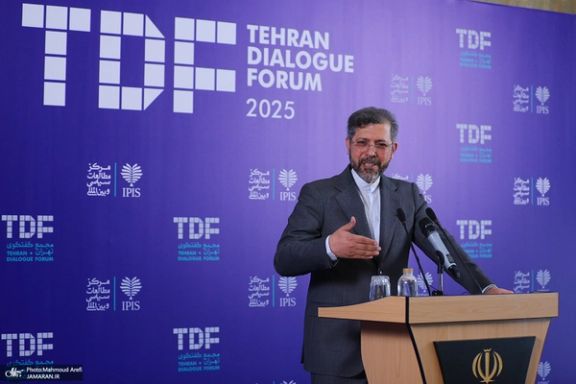
Iran's Deputy Foreign Minister Saeed Khatibzadeh during an event in Tehran

A senior Iranian diplomat warned Europe that triggering the UN’s “snapback” mechanism to restore sanctions would squander its leverage and harden Tehran’s nuclear stance.

Deputy Foreign Minister Saeed Khatibzadeh told Germany’s Frankfurter Allgemeine Zeitung on Thursday that Europe had no right to reimpose lapsed sanctions under the 2015 nuclear deal.

“Such an action would only waste Europe’s last card and further diminish its credibility as a mediator,” he said.

He warned that any future talks on Iran’s nuclear program would be “armed negotiations.” “If we return to negotiations, it will be an armed negotiation. We will all have our fingers on the trigger, because we do not trust the other side,” he said.

Khatibzadeh rejected again US demands for “zero enrichment.” “Iran will not be treated as an exception to international law. The right to enrichment is non-negotiable, although the level and details can be discussed,” he said.

Tehran insists it will resist pressure and has warned that activating snapback sanctions could push it to leave the Nuclear Non-Proliferation Treaty.

Britain, France and Germany — the so-called E3 — have warned Iran that unless it returns to nuclear talks by the end of August, they will trigger the mechanism that could reimpose all UN sanctions lifted under the 2015 nuclear deal.

Tehran has accused Washington of seeking through diplomacy what it failed to achieve with June’s military strikes, with Foreign Minister Abbas Araghchi saying this week that talks with the United States have not yet reached a “mature stage.”

Israel’s June 13 offensive and subsequent US strikes on Esfahan, Fordow and Natanz ended oversight of Iran’s facilities, though Araghchi said limited cooperation with the IAEA will continue under tighter national controls.

He warned that UN snapback sanctions could return, but said Iran is coordinating with Russia and China on countermeasures.

Iran said Friday that Araghchi would hold a telephone conference call with his French, German and British counterparts.Parallel to planned call, International Atomic Energy Agency officials are due to meet Iranian counterparts in Vienna.


Most Viewed

Iran negotiators ordered to return after internal rift over Islamabad talks
1
EXCLUSIVE

Iran negotiators ordered to return after internal rift over Islamabad talks

2
ANALYSIS

US blockade enters murky phase as tankers spoof signals and buyers hesitate

3
ANALYSIS

Why the $100 billion Hormuz toll revenue is a myth

4

US tightens financial squeeze on Iran, warns banks over oil money flows

5
ANALYSIS

US blockade targets Iran oil boom amid regional disruption

Banner
Banner

Spotlight

  • Hardliners push Hormuz ‘red line’ as US blockade tests Iran’s leverage
    INSIGHT

    Hardliners push Hormuz ‘red line’ as US blockade tests Iran’s leverage

  • Ideology may be fading in Iran, but not in Kashmir's ‘Mini Iran'
    INSIGHT

    Ideology may be fading in Iran, but not in Kashmir's ‘Mini Iran'

  • War damage amounts to $3,000 per Iranian, with blockade set to add to losses
    INSIGHT

    War damage amounts to $3,000 per Iranian, with blockade set to add to losses

  • Why the $100 billion Hormuz toll revenue is a myth
    ANALYSIS

    Why the $100 billion Hormuz toll revenue is a myth

  • US blockade targets Iran oil boom amid regional disruption
    ANALYSIS

    US blockade targets Iran oil boom amid regional disruption

  • Iran's digital economy battered by prolonged blackout
    INSIGHT

    Iran's digital economy battered by prolonged blackout

•
•
•

More Stories

Hackers disrupt communications of dozens of Iranian oil and cargo ships

Aug 22, 2025, 08:22 GMT+1

A hacker group said it disabled communications on more than 60 Iranian oil tankers and cargo ships, severing links between the vessels, their ports, and the outside world in one of the largest cyberattacks on the country’s maritime sector.

The group, known as Lab-Dookhtegan (Sewn Lips), told Iran International that it hacked into the systems of the National Iranian Tanker Company (NITC) and the Islamic Republic of Iran Shipping Lines (IRISL), disrupting operations on 39 tankers and 25 cargo ships.

The hackers said the breach was carried out by infiltrating Fanava Group, an Iranian IT and telecoms holding company that provides satellite communications, data storage, and payment systems.

They said they obtained “root-level” access to the Linux operating systems running the ships’ satellite terminals, enabling them to stop Falcon, the control software at the heart of Iran’s maritime communications.

Stopping Falcon means complete disconnection between the ships and shore, the group said, adding that the hack rendered automatic identification system (AIS) tracking and satellite links inoperable.

NITC and IRISL targeted

The two state-linked companies are central to Iran’s sanctioned economy.

NITC, a subsidiary of the National Iranian Oil Company, is one of the Middle East’s largest tanker fleets with more than 46 vessels and a total annual capacity of 11 million tons. Its tankers, such as the Amber, Apama, Deep Sea, Fortune and Faxon, transport Iranian crude globally, often switching off tracking systems to evade sanctions.

IRISL, with a fleet of about 115 vessels, is Iran’s largest cargo operator and ranked the world’s 14th biggest shipping line by Alphaliner in 2022. Its ships, including Abyan, Avang, Parisan, Radin and Touska, have been sanctioned by the US, EU and UN for their role in supporting Iran’s nuclear and missile programs.

Both companies were sanctioned by the US Treasury in 2020 for aiding the Islamic Revolutionary Guard Corps’ Quds Force, the extraterrestrial wing of the IRGC.

This is not the first time Iranian shipping has been targeted. In March 2025, Lab-Dookhtegansaid it disrupted the communications of 116 vessels belonging to the same two firms. At the time, the group claimed the attack was timed to coincide with US operations against Iran-backed Houthis in Yemen.

US and European sanctions have already limited Iran’s access to advanced maritime technology, insurance, and international ports, leaving the fleets more exposed to cyber and physical threats.

Fanava Group, founded in 2003 and headquartered in Tehran, has yet to respond to requests for comment.

The cyberattack comes as Iran faces growing scrutiny of its shipping and oil-export networks. Western governments accuse Tehran of using its maritime fleet to mask oil sales to China and others, while also supplying weapons to proxy groups including Hezbollah and Yemen’s Houthis.

In the latest effort to stop Tehran's oil exports, the US sanctioned 13 companies and eight vessels over suspected ties to Iran, the Treasury Department said on Thursday.

US Treasury issues new sanctions targeting Iran's oil exports

Aug 21, 2025, 20:23 GMT+1

The United States imposed sanctions on 13 companies and eight vessels over suspected ties to Iran, the Treasury Department said on Thursday, in the latest effort to stop Tehran's oil exports in violation of US sanctions.

The designations target Greek national Antonios Margaritis and his network of companies, including Marant Shipping and Trading, Square Tanker Management, Comford Management and United Chartering, which Washington said had facilitated Iranian petroleum shipments for years.

“Today’s action against Margaritis and his network degrades Tehran’s ability to fund its advanced weapons programs, support terrorist groups, and threaten the safety of our troops and our allies,” Secretary of the Treasury Scott Bessent said in a statement.

"He (Antonios Margaritis) has most recently been involved in the operations of OFAC-sanctioned vessel MS ENOLA and MS ANGIA, which has carried Iranian oil," the Treasury said.

“Treasury remains determined to hold accountable all those who seek to aid the Iranian regime and threaten global security," he added.

The companies sanctioned on Thursday are based in Hong Kong, China, the United Arab Emirates and the Marshall Islands, according to the Treasury.

The Treasury accused Changbai Glory Shipping of moving more than four million barrels of Iranian oil to China on the LAFIT since March, Regal Liberty of delivering about two million barrels on the GIANT, and U Beacon Shipping of transporting over a million barrels on the ADELINE G.

It also accused Hong Kong Hangshun Shipping of shipping millions of barrels on the KONGM, and Ares Shipping of moving nearly ten million barrels on the ARES, often via ship-to-ship transfers with already sanctioned tankers.

UAE-based Ozarka Shipping was also sanctioned for managing vessels that transported Iranian petroleum products to China, while additional Hong Kong firms, including U Beacon Shipping, Hong Kong Hangshun Shipping and Ares Shipping, were sanctioned for their role in moving Iranian oil.

Austria suspends all consular services in Iran until 'return to normalcy'

Aug 21, 2025, 19:55 GMT+1

The Austrian Embassy in Iran has suspended all consular services citing an “insurmountable obstacle” but giving no further details or timeline for reopening.

According to the embassy’s official website, all consular services are suspended until further notice, which means that even previously submitted applications cannot be processed.

The announcement also said that existing appointments for residence and settlement services are canceled until the end of September, advising applicants to “book new appointments as soon as the situation has returned to normal.”

No further details were provided about what prompted the decision.

The Austrian foreign ministry told Iran International it was "working to re-establish the conditions which would allow us to resume consular services at the Embassy in Tehran."

However, it said "there is no concrete indication when consular services will resume."

Several embassies and consulates in Iran suspended services in June during the 12-day war with Israel.

The Czech Embassy suspended its services in June and has not yet resumed its operations, though it announced plans to gradually restart services in September.

The German Embassy, citing security concerns, relocated some consular staff to other countries in the region, but continues to provide services in Iran.

Embassies of Portugal, Switzerland, and the United Kingdom also suspended services in June but have since resumed full operations.

The closure of foreign embassies in Tehran during and after the 12-day war left between 3,000 and 4,000 Iranian passports stuck in diplomatic missions, stranding visa applicants, Iranian officials said earlier this month.

Omid Mohammad-Alikhan, a member of Iran’s Association of Travel Agencies, told state news agency IRNA that with some embassies halting tourist visa issuance, between 40,000 and 50,000 people remain in limbo.

The disruption has hit hardest those needing to travel on fixed dates, such as students who must arrive for the start of the academic year and athletes travelling to competitions or training camps.

Iran currently faces a deadline from France, Germany, and the United Kingdom to reach a deal with world powers on its disputed nuclear program by the end of August or face the return of UN sanctions through the so-called "snapback" mechanism.

Iran's foreign minister said on Wednesday that the UN sanctions could return, but that Tehran was working with Russia and China to prepare for such a scenario.

IAEA to meet US officials amid concerns over Iran’s missing uranium - Bloomberg

Aug 21, 2025, 13:00 GMT+1

International Atomic Energy Agency (IAEA) officials will travel to Washington next week for consultations with the United States as concerns grow over their inability to account for Iran’s stockpile of near-bomb grade uranium, Bloomberg reported.

Citing diplomats familiar with the matter, the report said the move follows the failure of IAEA safeguards chief Massimo Aparo to secure Iranian approval earlier this month to resume monitoring after Israel and Iran’s 12-day conflict in June.

Inspectors were expelled during the fighting, effectively halting international oversight of Tehran’s nuclear program. A few days after the war ended, Iran’s parliament passed a bill suspending cooperation with the agency, including inspections.

Diplomats told Bloomberg that Iran has continued to deny access to its main nuclear-fuel complex, citing chemical and radiological hazards from US and Israeli strikes. Tehran has suggested limited access may be possible to unaffected facilities, including its Russian-built Bushehr nuclear power plant on the Persian Gulf.

Iran’s Foreign Minister Abbas Aragchi said in an interview published Wednesday by state media: “We have not reached the point of cutting off cooperation with the agency, but future cooperation will certainly not resemble the past.”

The IAEA has not verified Iran’s inventory of highly enriched uranium since June 13, when Tehran informed inspectors it was prepared to move 409 kilograms of material enriched up to 60% to an undisclosed location, Bloomberg said.

Iran has repeatedly denied seeking nuclear arms, and both IAEA inspectors and US intelligence agencies have said there is no evidence of a weapons program since the early 2000s.

The consultations in Washington come as European powers warn Tehran that failure to resume negotiations and allow inspections by the end of August could trigger the snapback of UN sanctions.

Iran has dismissed the threat and warned it could withdraw from the Nuclear Non-Proliferation Treaty if sanctions are restored.

According to Bloomberg, the IAEA is compiling a dossier highlighting inspector experience working in hazardous environments, citing precedents from Fukushima and Ukraine. But the agency faces budget strains, with member states questioning whether the $23 million earmarked for Iran monitoring should continue if inspections remain suspended.

Britain sanctions son of Khamenei aide and four Iran-linked companies

Aug 21, 2025, 12:23 GMT+1

Britain imposed sanctions on Hossein Shamkhani, the son of a close aide to Iran’s Supreme Leader Ali Khamenei, and four companies accused of supporting hostile Iranian activity, a government notice showed on Thursday.

The Foreign, Commonwealth and Development Office said Shamkhani, son of former national security chief Ali Shamkhani, had “facilitated and provided support to hostile activity by the Government of Iran, namely activity which is intended to cause the destabilization of the United Kingdom or any other country including Israel and Ukraine.”

"Iran’s reliance on revenues from trading networks and connected organisations enables it to carry out its destabilising activities, including supporting proxies and partners across the region and facilitating state threats on UK soil," read a statement. "Disrupting Iran’s malign influence and keeping the British people safe remains our number one priority."

Shamkhani, listed under multiple aliases including “Hector,” was among five new entries added to the UK Sanctions List, which freezes their assets and bars UK nationals and firms from doing business with them.

The companies designated were Admiral Shipping Group, Milavous Group, Ocean Leonid Investments, and Iran’s Petrochemical Commercial Company. Britain said some of the firms were acting on behalf of Shamkhani and had provided logistical and financial support for Iran’s destabilizing activities abroad.

The measures come weeks after Washington announced its largest Iran-related sanctions package since 2018, targeting what it described as Shamkhani’s “global shipping empire” that moved Iranian and Russian oil, generating billions of dollars.

The US Treasury accused the Shamkhani family of leveraging political influence to evade sanctions, using false identities, shell companies, and frequent vessel reflagging to conceal ownership.

“The Shamkhani family’s shipping empire highlights how the Iranian regime elites leverage their positions to accrue massive wealth and fund the regime’s dangerous behavior,” US Treasury Secretary Scott Bessent said at the time.

Ali Shamkhani, a former defense minister and longtime secretary of Iran’s Supreme National Security Council, was sanctioned by the United States in 2020. He remains a senior adviser to Khamenei.

  • US sanctions Shamkhani 'shipping empire' for moving Iranian oil

    US sanctions Shamkhani 'shipping empire' for moving Iranian oil