• العربية
  • فارسی
Brand
  • Iran Insight
  • Politics
  • Economy
  • Analysis
  • Special Report
  • Opinion
  • Podcast
  • Iran Insight
  • Politics
  • Economy
  • Analysis
  • Special Report
  • Opinion
  • Podcast
  • Theme
  • Language
    • العربية
    • فارسی
  • Iran Insight
  • Politics
  • Economy
  • Analysis
  • Special Report
  • Opinion
  • Podcast
All rights reserved for Volant Media UK Limited
volant media logo

Israeli strike on Evin prison was 'war crime,' Human Rights Watch says
Aug 14, 2025, 12:54 GMT+1Updated: 03:38 GMT+0
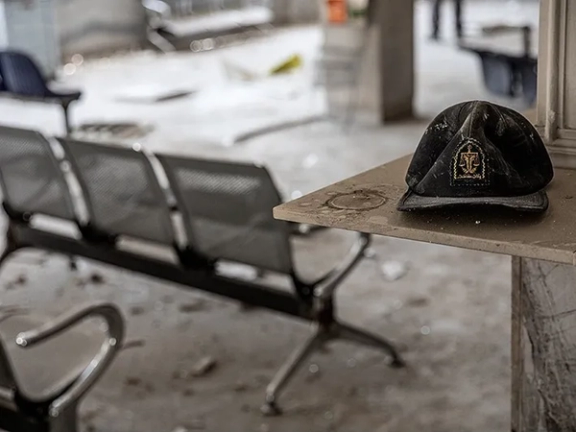
A picture showing the aftermath of the attack on Evin Prison

Israel’s June airstrike on Tehran’s Evin prison showed no regard for distinguishing between military and civilian targets and is a war crime, Human Rights Watch said on Thursday.

“Israel’s strikes on Evin prison on June 23 killed and injured scores of civilians without any evident military target in violation of the laws of war and is an apparent war crime,” said Michael Page, the rights group's deputy Middle East director said.

“The Israeli attack placed at grave risk the already precarious lives of Evin’s prisoners, many of them wrongfully detained dissidents and activists.”

More than 1,500 people were believed to be held in Evin at the time, including political activists imprisoned in violation of their rights by the Iranian government, the group added.

The attack which took place during visiting hours caused extensive damage to the visitation hall, the central kitchen, the medical clinic, and sections where prisoners — including political detainees — were held.

Citing official Iranian figures, Human Rights Watch said at least 80 people were killed, including prisoners, their family members, and prison staff. Iran’s judiciary announced that at least 71 people were killed, also citing the victims to be a mix of prison personnel, prisoners, visiting relatives, and nearby civilians.

Former Iranian political prisoner and student activist Motahareh Gounei said in July that the government wanted the inmates, many of whom are political prisoners, "to be buried under the rubble of war” .

At the time of the attacks, the office of the Israeli defense minister, Israel Katz, released a statement announcing the strikes.

"The IDF is now attacking with unprecedented force regime targets and government repression bodies in the heart of Tehran, including the Basij headquarters, Evin prison for political prisoners and opponents of the regime, the 'Israel Destruction' clock in Palestine Square, the internal security headquarters of the Revolutionary Guards, the ideology headquarters, and other regime targets," the statement said on June 23.

Under international humanitarian law, prisons are considered civilian infrastructure.

Human Rights Watch said the laws of war prohibit “attacks that target civilians and civilian objects, that do not discriminate between civilians and combatants, or that are expected to cause harm to civilians or civilian objects disproportionate to any anticipated military advantage.”

On the day of the strike, amid massive criticism from rights groups, Israel's military spokesman Brig. Gen. Effie Defrin said the attack was carried out “in a pinpoint manner, to avoid harm to those uninvolved.”

Among the critics was Nobel Prize laureate Narges Mohammadi, a former inmate and dissident, who said at the time: "Attacking a prison when the inmates are standing behind closed doors and they are unable to do the slightest thing to save themselves, can never be a legitimate target.”

More than 600 political prisoners were transferred back to Tehran’s Evin Prison earlier in August with some political prisoners saying Iran used brute violence during the process.


Most Viewed

Iran negotiators ordered to return after internal rift over Islamabad talks
1
EXCLUSIVE

Iran negotiators ordered to return after internal rift over Islamabad talks

2
ANALYSIS

US blockade enters murky phase as tankers spoof signals and buyers hesitate

3
ANALYSIS

Why the $100 billion Hormuz toll revenue is a myth

4

US tightens financial squeeze on Iran, warns banks over oil money flows

5
ANALYSIS

US blockade targets Iran oil boom amid regional disruption

Banner
Banner

Spotlight

  • Hardliners push Hormuz ‘red line’ as US blockade tests Iran’s leverage
    INSIGHT

    Hardliners push Hormuz ‘red line’ as US blockade tests Iran’s leverage

  • Ideology may be fading in Iran, but not in Kashmir's ‘Mini Iran'
    INSIGHT

    Ideology may be fading in Iran, but not in Kashmir's ‘Mini Iran'

  • War damage amounts to $3,000 per Iranian, with blockade set to add to losses
    INSIGHT

    War damage amounts to $3,000 per Iranian, with blockade set to add to losses

  • Why the $100 billion Hormuz toll revenue is a myth
    ANALYSIS

    Why the $100 billion Hormuz toll revenue is a myth

  • US blockade targets Iran oil boom amid regional disruption
    ANALYSIS

    US blockade targets Iran oil boom amid regional disruption

  • Iran's digital economy battered by prolonged blackout
    INSIGHT

    Iran's digital economy battered by prolonged blackout

•
•
•

More Stories

Iran, Iraq discussed tighter curbs on Kurdish groups in Larijani visit, sources say

Aug 14, 2025, 11:24 GMT+1

Iranian and Iraqi officials discussed ways to increase pressure on Iranian Kurdish opposition groups during a recent visit to Baghdad by Iran’s National Security Council Secretary Ali Larijani, sources from Iranian Kurdish parties told Iran International.

A senior figure from Iranian Kurdish parties in Sulaymaniyah told Iran International that “one of the topics discussed between Iran and Iraq during Ali Larijani’s trip to Baghdad was the increase of pressure and further restrictions on Kurdish parties.”

Separately, an opposition figure based in Erbil said that “after Larijani’s visit to Iraq, sources in the Kurdistan Regional Government warned all parties that if Israel attacks the Islamic Republic again, the likelihood of threats from Iran against the Kurdistan Region and these parties is serious.”

Both sources confirmed to Iran International that “in the event of a possible next Israeli attack on Iran, the Islamic Republic will react against the Kurdistan Region of Iraq.”

On Wednesday night, Iraq’s National Security Advisory issued a statement saying that the document signed between Baghdad and Tehran during Larijani’s trip was a “security memorandum of understanding for cooperation on border affairs and confronting Iranian Kurdish opposition.”

The statement noted that Iraq already had a security protocol with Iran, signed in March 2023, known as the Joint Security Agreement. That agreement covered “border security and measures to neutralize the activities of Iranian Kurdish opposition forces present in the Kurdistan Region of Iraq.”

According to the advisory, the memorandum signed this week was the result of earlier coordination to convert the existing protocol into a formal memorandum of understanding with the same content, including “matters concerning the five Iranian Kurdish opposition parties.”

The statement added that the document was prepared before recent hostilities between Israel and Iran, had been approved by Iraq’s Council of Ministers, and was signed during Larijani’s visit in the presence of Prime Minister Mohammed Shia al-Sudani.

The advisory stressed that “there is no security agreement between the two countries; rather, it is a security memorandum of understanding.”

According to information obtained by Iran International, another goal of Larijani’s trip was to encourage Shi’ite factions to push for parliamentary approval of a Popular Mobilization Forces (PMF) bill.

The PMF, or Hashd al-Shaabi, is an umbrella organization of Shi’ite militias formed under the direct supervision of Qasem Soleimani, the late commander of the IRGC Quds Force.

In March 2025, the Iraqi parliament introduced draft legislation seeking to reform the PMF by placing it more firmly under the authority of the prime minister as commander-in-chief, explicitly aiming to limit external influence, including from Iran.

Syria denied Iran security chief’s flight passage en route to Lebanon – Israeli paper

Aug 14, 2025, 10:37 GMT+1

Syria’s government barred a plane carrying Iran’s top security official Ali Larijani from using its airspace en route to Lebanon this week, forcing the aircraft to reroute over Iraq and Turkey, Israel’s Maariv newspaper reported on Thursday.

The reported flight diversion comes amid strained ties between Tehran and Damascus following the ouster of former Syrian President Bashar al-Assad late last year. His successor, Ahmed al-Shara, has criticized Iran’s military role in Syria as destabilizing.

Iran International could not independently verify the Israeli media report on the flight route.

Larijani, secretary of Iran’s Supreme National Security Council, arrived in Beirut on Wednesday for meetings with senior Lebanese officials, including President Joseph Aoun, Parliament Speaker Nabih Berri and Hezbollah leader Naim Qassem.

Aoun told Larijani that no group in Lebanon should bear arms or seek foreign support, warning against interference in the country’s internal affairs.

Larijani responded that Iran respects decisions taken by the Lebanese government and does not interfere in its domestic matters.

During his visit, Larijani reaffirmed Tehran’s backing for Lebanon and its “resistance” against Israel – a term he used to refer to Tehran-backed groups such as the Shi’ite group Hezbollah, and offered assistance in reconstruction efforts.

The visit came days after Lebanon’s cabinet instructed the army to present a plan to disarm Hezbollah by the end of August, a move Tehran has publicly opposed.

Lebanon’s foreign ministry last week condemned remarks by a senior Iranian official rejecting the disarmament plan as “unacceptable interference.”

Ball in Iran’s court as risk of snapback sanctions approaches, UK says

Aug 14, 2025, 10:21 GMT+1

UK Foreign Secretary David Lammy has warned that the ball is in Iran’s court after Britain, France, and Germany signaled readiness to reimpose UN sanctions if Tehran fails to agree to a nuclear deal by the end of August.

In a joint letter to UN Secretary-General Antonio Guterres and the Security Council, the three countries confirmed they are prepared to trigger the snapback mechanism if diplomatic efforts stall.

“We have made it clear that if Iran is not willing to reach a diplomatic solution before the end of August 2025, or does not seize the opportunity of an extension, E3 are prepared to trigger the snapback mechanism,” the ministers wrote.

In a separate article, British foreign minister David Lammy told the Jewish News that the group has offered Iran a limited extension to UN sanctions relief subject to clear conditions.

Among those is Iran resuming negotiations with the US and ensuring full cooperation with the International Atomic Energy Agency.

“The UK has long been clear that Iran’s nuclear program is a threat to international peace and security, with its failure to produce credible assurances regarding the nature of the program," Lammy said.

The E3 said their offer “remained unanswered by Iran” and warned they would act if no deal or extension was secured before the deadline. “Iran still has the choice to resume diplomacy, and we urge Iran to do so,” Lammy said. “The ball is now in Iran’s court.”

Talks in Istanbul last month aimed at securing compliance ended without agreement. Sanctions relief, granted under the 2015 nuclear deal, is due to expire in October. The United States withdrew from the agreement in 2018 during President Donald Trump’s first term, reinstating all US sanctions.

The E3 maintain they are committed to using “all diplomatic tools” to ensure Iran does not develop a nuclear weapon, which Tehran insists it is not seeking.

Iran says Israeli attacks on nuclear facilities threaten regional stability

Aug 14, 2025, 09:56 GMT+1

Iran’s foreign ministry said on Thursday that Israeli attacks on its nuclear facilities pose a threat to regional stability, citing concerns raised by United Nations human rights rapporteurs.

Foreign ministry spokesperson Esmail Baghaei told state media that UN rights experts had warned such actions were particularly worrying because Israel is the only holder of nuclear weapons in the Middle East.

He said the experts compared the reported assaults to the atomic bombings of Hiroshima and Nagasaki, which mark their 80th anniversary this year.

In a post on the social media platform X, Baghaei said the UN rapporteurs had expressed “deep concern” over attacks in Gaza and warned that Israel’s strikes against several neighbors, including recent attacks on Iranian nuclear facilities, undermine stability across the region.

The UN experts condemned the attacks in June, saying, “These attacks represent a flagrant violation of fundamental principles of international law, a blatant act of aggression and a violation of jus cogens norms—peremptory rules of international law from which no derogation is permitted.”

On June 13, Israel launched land and air strikes targeting senior Iranian military leaders, nuclear scientists, and politicians, while damaging or destroying Iranian air defenses and nuclear facilities. Iran retaliated with missile and drone attacks on Israeli cities and military sites. On the ninth day of fighting, the United States bombed three Iranian nuclear sites. Iran then struck a US base in Qatar.

A US-brokered ceasefire was reached on June 24. Both sides claimed victory, with Israel and Washington saying they had significantly degraded Iran’s missile and nuclear programs -- claims Tehran denied. Independent assessments remain limited due to the secrecy surrounding Iran’s nuclear activities.

Khamenei envoy says Israel, not Iran, seeks to impose its will on Lebanon

Aug 13, 2025, 21:44 GMT+1

Iran’s security chief Ali Larijani said on Wednesday that Israel, not Iran, was seeking to impose its will on Lebanon, after President Joseph Aoun warned against foreign interference in the country’s affairs.

“Dear friends, who else attacked your country besides Israel?" Larijani told reporters in Beirut on Wednesday. So be careful that Israel does not impose something else on you through other means."

"Do not let it use other forms of pressure to force on you what it could not achieve through war. Do not mistake friend for enemy; resistance is your national asset,” he added.

Larijani said that Iras no intention in interfering in the affairs of Lebanon.

His remarks come a week after the Lebanese government ordered the army to devise plans by the end of the year to disarm the Iran-backed Hezbollah militant group, prompting sharp criticism from Tehran.

Tense rhetoric

Ali-Akbar Velayati, senior foreign policy adviser to Supreme Leader Ali Khamenei, called the disarmament “a dream that won’t come true,” describing it as a policy dictated by Israel and Washington.

“Whatever conclusion it (the Lebanese government) reaches, we will also accept. Those who interfere in Lebanon’s affairs are the ones who give you plans, set timelines for actions, and come from thousands of kilometres away. We have not given you any plans,” he added.

Lebanon’s foreign ministry condemned the comments on X as “a flagrant and unacceptable interference in Lebanon’s internal affairs.”

Lebanese President Joseph Aoun also criticized remarks by Iranian officials, stressing that no group has the right to bear arms or seek foreign support.

“It is forbidden for anyone to bear arms and to use foreign backing as leverage,” Aoun told Larijani during their meeting, according to a statement from the president’s office posted on X.