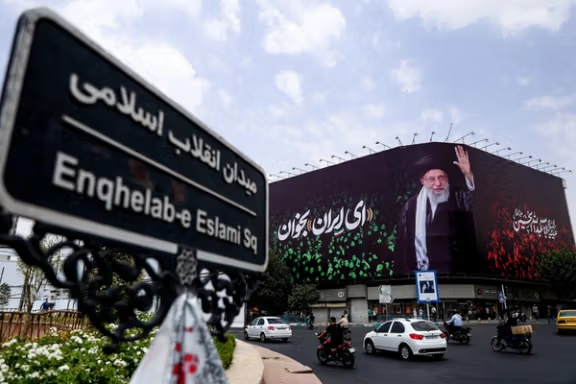
A billboard in Tehran's central Enghelab (Revolution) square, featuring supreme leader Ali Khamenei and his post-war patriotic messaging
Ali Larijani’s reappointment as secretary of Iran’s Supreme National Security Council (SNSC) may appear to mark a return to moderation, but it is better understood as a tactical facelift.
Behind the tailored suits and diplomatic polish lies the same system preparing for confrontation, not compromise.
The SNSC, one of the Islamic Republic’s most powerful institutions, is ultimately controlled by Supreme Leader Ali Khamenei. All senior appointments fall under his direct authority.
Larijani, who previously served as SNSC secretary from 2005 to 2007 and was parliament speaker for over a decade, is one of the regime’s most enduring insiders. A longtime adviser to Khamenei, he has often served as a bridge between rival factions.
With his neatly trimmed beard, sharp gaze, and preference for suits over uniforms, Larijani offers a stark contrast to his predecessor, Rear Admiral Ali Akbar Ahmadian of the IRGC Navy, who often appeared in fatigues and had a distinctly harder edge.
But the change is stylistic, not strategic. Tehran’s broader posture remains intact.
Image over substance
The reshuffle comes as Iran faces mounting pressure over its nuclear program and prepares for the possibility of renewed military conflict with Israel or the United States.
Even journalists aligned with the reformist camp have voiced skepticism over Larijani’s return, calling it “too little, too late.” That skepticism is echoed by Nour News, affiliated with former SNSC chief Ali Shamkhani, who issued a thinly veiled warning on Wednesday:
“National security bodies complement the decision-making process, not replace it. If management and structural changes at a national security body are paired with unrealistic expectations, it will lead to the institution losing its operational credibility.”
Contained rivalries
Larijani and Shamkhani represent rival power centers within the Islamic Republic, each vying for influence over national security and foreign policy.
They may trade blows in public—or, in Iranian political parlance, compete for a bigger “share of the revolution’s spoils.” But when faced with internal unrest or foreign threats, such rivalries are quickly subordinated to regime survival.
Three veterans of Iran's security establishment Ali Larijani (left), Ali Shamkhani (right), Mohsen Rezaei (front) at an event to mark the death of President Ebrahim Raisi, Tehran, Iran, May 31, 2025
Their behavior is captured by a Persian proverb: “We might tear each other limb from limb, but we are brothers. Therefore, we will always bury the bones.”
The Islamic Republic’s first supreme leader Ruhollah Khomeini put it more bluntly: “Preserving the regime is everyone’s highest religious duty—even more important than the life of the (Promised Savior).”
Echoing the Supreme Defense Council of the 1980s, the new body is tasked with streamlining security decision-making in wartime.
It will be chaired by the president—or an SNSC member appointed by him—and will include the heads of Iran’s three branches of power, the intelligence minister, the chief of the General Staff, commanders of the IRGC and Artesh, two Supreme Leader representatives, and the head of the Khatam al-Anbia Central Headquarters.
The formation of the new body is a sign that Tehran sees confrontation as imminent.
Larijani’s return should be viewed in that context: not the return of a moderate to power, but the placement of a loyal, presentable veteran into a structure recalibrating for crisis.
As another Persian proverb puts it: “When the adversary rains arrows down on you, take shelter. Rush from one column to another, and buy yourself time—until chance provides you with an opening to fight or flee.”
Lebanon's Hezbollah supporters gather to attend a ceremony to honour fighters killed in the recent escalation with Israel, on the day of Hezbollah leader Sayyed Hassan Nasrallah address, in Beirut's southern suburbs, Lebanon, November 3, 2023
Hezbollah on Wednesday lambasted a push by the Lebanese government to disarm the Iran-backed group and vowed to ignore the US-backed effort, saying it leaves the country defenseless against Israel.
“The government of Nawaf Salam has committed a grave sin by making a decision that strips Lebanon of the weapons of the Resistance against the Israeli enemy,” Hezbollah said in a statement.
Lebanon's cabinet on Tuesday tasked the national army with establishing a state monopoly on weapons and confiscating the arms of any other groups. Though Hezbollah was not explicitly mentioned, it was the clear focus of the move.
A punishing war with Israel late last year left long-time Hezbollah leader Hassan Nasrallah dead, scores of leaders maimed by booby traps and much of the group's missile cache destroyed.
The conflict destroyed large parts of Beirut’s southern suburbs and southern Lebanon, killing and displacing thousands of people. Israel suffered only minimal casualties and damage.
'Ready to talk'
Once Iran's most fearsome ally in the region, Hezbollah lost a key lifeline to Tehran with the ouster of the Assad dynasty by Sunni Islamist rebels in neighboring Syria and now faces an uncertain future under its ageing clerical leader Naim Qassem.
Prime Minister Nawaf Salam mandated that the plan to collect weapons from non-state actors be completed by year's end. Hezbollah vowed to spurn the initiative.
“We will treat this decision as though it does not exist,” Hezbollah added. “We are ready to discuss a national security strategy, but not under the sound of aggression.”
Israel routinely launches drone and air strikes inside Lebanon against targets it deems a security threat while it maintains a limited presence on the country's soil.
Hezbollah has vowed never to disarm until Israel fully withdraws from what it deems Lebanese territory.
'Surrender'
The group further criticized the United States special envoy Tom Barrack, saying the Lebanese government move heeded his “diktats".
“What the government has decided is part of a surrender strategy and a clear abandonment of the fundamentals of Lebanon’s sovereignty,” Hezbollah said.
Founded in 1982 by Iran's Islamic Revolutionary Guard Corps, Hezbollah is blamed for deadly bomb attacks on US and French military personnel based in Lebanon during the country's civil war.
Its guerrilla campaign ultimately ejected an Israeli occupation in the country's South but ultimately its arms crumpled in the face of its arch-foe's attacks last year.
Hezbollah is designated as a terrorist group by the United States, United Kingdom and Germany, while receiving extensive military and financial support from Iran.
Hardline voices in Tehran have slammed the Lebanese initiative.
“The wish to disarm Hezbollah will go to your grave,” security journalist Hossein Saremi posted on X.
A session of the Iranian parliament on August 3, 2025
Two senior Iranian lawmakers have welcomed the creation of a new Defense Council under the Supreme National Security Council (SNSC), calling it a timely move to streamline military decision-making in what they described as wartime conditions.
“The formation of this council was necessary given the current wartime situation and possible conditions in the future,” said Alaeddin Boroujerdi, a veteran parliamentarian and member of the National Security and Foreign Policy Committee.
“Due to the wartime conditions we are in, the establishment of this council and the concentration of military and defense decisions can create coordination and coherence in decision-making and execution in critical situations.”
Boroujerdi said the council’s focus on defense matters would complement the broader remit of the SNSC.
“Since the Supreme National Security Council deals with numerous security, national and foreign policy issues, there was a need for military and defense developments to be followed in a concentrated manner in one council,” he said, adding that its inclusion of senior armed forces commanders could “greatly strengthen our decision-making and policy-making in wartime.”
Esmaeil Kowsari, another member of the committee and a former Revolutionary Guards commander, said the council’s establishment met a necessity that emergedduring the recent war and would speed up the chain of command.
“In wartime it is necessary for decisions to be taken quickly, so there must be a headquarters or council where decisions are made with greater speed and decisiveness,” he said. “This council can play an important role in the country’s defense policies.”
Kowsari, recalling the 1980–88 Iran-Iraq war, said that rapid, centralized decision-making had been essential then and would be so again.
“We have never initiated a war and have always defended our country firmly and decisively, but we must be fully prepared,” he said. “The decisions and actions of this council must be designed in such a way as to have the ability to surprise the enemy and, with timely strikes, suppress threats.”
The SNSC approved the Defense Council’s formation on Aug. 3 under Article 176 of the constitution.
Chaired by the president, the council will include the heads of the judiciary and parliament, senior military commanders, and key ministers. Officials say its mandate is to serve as a standing wartime command center, enabling swift, centralized responses to military crises.
On Tuesday, Iran's Supreme Leader Ali Khamenei appointed conservative politician Ali Larijani to lead to lead the country’s top security body, the SNSC.
Iran's president Masoud Pezeshkian alongside Army chief Abdolrahim Mousavi (right) and ground forces commander Kioumars Heydari, Tehran, Iran, April 18, 2025
Iran has established a new Defense Council under the Supreme National Security Council (SNSC), aiming to centralize military decision-making and prepare for crises ranging from war to potential leadership transition.
According to the SNSC Secretariat’s August 3 announcement, the council’s core responsibility is to enable swift, centralized defense decisions in wartime or national emergencies.
While it functions under Article 176 of Iran’s constitution alongside other SNSC sub-bodies—analysts say its timing and composition signal deeper institutional concerns.
Why now?
The move comes amid heightened tensions with Israel and the United States, and growing doubts over Iran’s ability to respond quickly in moments of crisis.
Abdulrasool Divsalar of the United Nations Institute for Disarmament Research said on X that Iran’s delayed response to Israel’s June attacks exposed “a crisis in the strategic military decision-making structure.”
Without secure digital infrastructure, he said, assembling the full SNSC during wartime could be dangerously slow and vulnerable to decapitation strikes.
The new council, by concentrating authority in a smaller group of key officials, is designed to reduce those risks.
MP Mohammad-Esmaeil Kowsari told Jamaran the Defense Council avoids the SNSC’s sluggish consensus model, replacing it with a “smaller, more focused group—allowing for faster and more effective decision-making.”
Lawmaker Mohammad Seraj added that in wartime, “any decision made by the Defense Council is equivalent to one made by the SNSC.”
Function and composition
The council will be chaired by the President and include the heads of the Judiciary and Parliament, two SNSC representatives appointed by the Supreme Leader, the Intelligence Minister, and the Chief of the General Staff.
A key difference from the SNSC is the Defense Council’s permanent inclusion of the top commanders of the Army, the IRGC, and the Khatam-al-Anbia Central Headquarters, which oversees joint military operations.
Though officially a sub-body, some observers see the council as more than a bureaucratic fix.
Writing in Ham Mihan, journalist Ahmad Zeidabadi called it “a move to re-centralize fragmented political authority amid a time of crisis,” alluding to doubts over what might happen if Supreme Leader Ali Khamenei becomes incapacitated.
In that case, the President—who chairs both the SNSC and Defense Council—would be the highest-ranking official in the country.
Institutional context
While the SNSC has long held final authority over Iran’s national security matters, its broad membership—spanning political, military, and economic leaders—makes it unwieldy in urgent situations.
Several lesser-known sub-councils already function under its umbrella, including the Passive Defense Council for critical infrastructure, the Intelligence Coordination Council made up of agency chiefs, and the National Security Council chaired by the Interior Minister.
The Defense Council is distinct in its mandate and composition: focused exclusively on defense, it aims to function as a standing wartime command center. Like the SNSC, its decisions require final approval from the Supreme Leader.
Ali Larijani next to Iran's supreme leader Ali Khamenei
Veteran powerbroker Ali Larijani has been reappointed as Secretary of Iran’s Supreme National Security Council (SCNS), returning to a role from which he resigned two decades ago after clashes with ultra-hardline President Mahmoud Ahmadinejad.
His comeback underscores not only his enduring relevance in Iran’s power circles but also a career defined by strategic shifts, navigating factions and consistent loyalty to the country’s ultimate authority Supreme Leader Ali Khamenei.
For much of his career, Larijani was known as a staunch conservative.
He vocally opposed reformist President Mohammad Khatami and the broader reform movement, using his position as head of the state broadcaster IRIB to discredit Iranian intellectuals.
The program Hoviat ("Identity") targeted cultural figures like poet Ali Akbar Saeedi Sirjani, some of whom were later victims of the Intelligence Ministry’s multiple targeted murders.
‘Problem solver’
Yet by 2015, Larijani emerged as a key supporter of the Iran nuclear deal, helping secure its approval in parliament in under 20 minutes despite conservative opposition. The move aligned him with then-president Hassan Rouhani and marked a dramatic pivot from his earlier hardline stance.
Khamenei publicly praised Larijani at the time as a "problem-solver," though his growing closeness to Rouhani reportedly raised eyebrows in the Supreme Leader’s inner circle.
Larijani was blocked twice from running for president in 2021 and 2024
Throughout these shifts, Larijani remained attuned to the political winds.
His alliances with Presidents Akbar Hashemi Rafsanjani and Khatami cooled as soon as Khamenei distanced himself from them—underscoring a deeper, more consistent alignment with the Supreme Leader over any political faction.
Return to the fold
Despite being sidelined in recent presidential elections—disqualified by the Guardian Council in both 2021 and 2024 allegedly over his daughter studying abroad—Larijani has evidently regained the trust of Iran's theocrat.
Following President Ebrahim Raisi’s death last yer, he was handed two sensitive tasks: overseeing the Iran-China strategic accord and acting as an intermediary with Russia after Israeli strikes on Iranian soil.
While many establishment figures kept a low profile during the crisis, Larijani reemerged as a visible supporter of the Islamic Republic and its top leadership.
An operator without a party
Though courted by moderate conservatives to form a party during Rouhani’s presidency, Larijani resisted. One reason may be his limited popular base.
In parliament, he represented Qom, where a few thousand votes suffice to win a seat—far fewer than the million-plus votes typically needed in Tehran.
Larijani’s political instincts appear rooted more in elite maneuvering than popular mobilization, consistent with his background in a deeply clerical family tied to the seminaries of Qom and Najaf.
The Larijani legacy
Ali Larijani is part of one of Iran’s most influential political dynasties. His father, Hashem, was a respected cleric who steered clear of politics, but his sons embraced the Islamic Republic’s institutions.
Ali's four brothers have held senior roles across Iran’s judicial, legislative and security branches. Ali, the only full-time politician in the family, carved out a career that included 12 years as Speaker of Parliament, top roles in the media and culture ministries and ongoing membership in the Expediency Council.
Educated at the Qom Seminary and Tehran University—where he earned a PhD in Western philosophy—Larijani blends ideological training with technocratic credentials.
He is married to the daughter of Ayatollah Morteza Motahari, a key architect of the Islamic Republic, further cementing his position within Iran’s ruling elite.
A Loyal chameleon
While Larijani now often echoes hardline rhetoric against the United States, he has occasionally voiced cautious support for dialogue.
Deeply skeptical of Europe but pragmatic when necessary, he remains one of the few establishment figures with the credentials and adaptability to help steer Iran toward diplomatic de-escalation, should that path ever open.
Few Iranian politicians have changed stripes as fluidly as Larijani. Yet through all the turns—from hardliner to moderate broker, from sidelined veteran to high-level envoy—his loyalty to Khamenei has never wavered.
In a system where ideological purity is often less important than proximity to the Supreme Leader, Larijani has mastered the art of staying close to the only power that truly matters.
A high-profile conservative seen as close to Iran's Supreme Leader Ali Khamenei has been appointed to lead Iran’s newly revamped Supreme National Security Council, Tasnim News reported on Tuesday.
Ali Larijani replaces Ali Akbar Ahmadian, who is due to take on an unspecified new role in the administration of President Masoud Pezeshkian, Tasnim added.
Larijani previously served three terms as speaker of parliament, secretary of the Supreme National Security Council, head of the Islamic Republic of Iran Broadcasting (IRIB), Minister of Culture and Islamic Guidance and advisor to the Supreme Leader.
His appointment may signal a doubling down on Tehran's traditional confrontational stance with Israel and the United States after a punishing 12-day war with Israel in June capped off by US airstrikes on Iranian nuclear sites.
Still, Larijani registered three time to run for president in Iran but was disqualified on two occasions by Iran's hardliner-dominated Guardian Council. His political stances on diplomacy and domestic affairs appear to have softened in recent years.
Larijani ran as a candidate in the ninth presidential election of Iran, held in 2005. He lost the race, finishing sixth out of seven candidates.
The appointment comes with some institutional changes following a 12-day war with Israel in June.
President Pezeshkian will chair the council, which will include the heads of the executive, legislative and judiciary branches, as well as top military commanders and key cabinet ministers, the report added.