• العربية
  • فارسی
Brand
  • Iran Insight
  • Politics
  • Economy
  • Analysis
  • Special Report
  • Opinion
  • Podcast
  • Iran Insight
  • Politics
  • Economy
  • Analysis
  • Special Report
  • Opinion
  • Podcast
  • Theme
  • Language
    • العربية
    • فارسی
  • Iran Insight
  • Politics
  • Economy
  • Analysis
  • Special Report
  • Opinion
  • Podcast
All rights reserved for Volant Media UK Limited
volant media logo

Trump says Iran is ‘stupid’ to insist on uranium enrichment after US strikes

Jul 27, 2025, 18:08 GMT+1
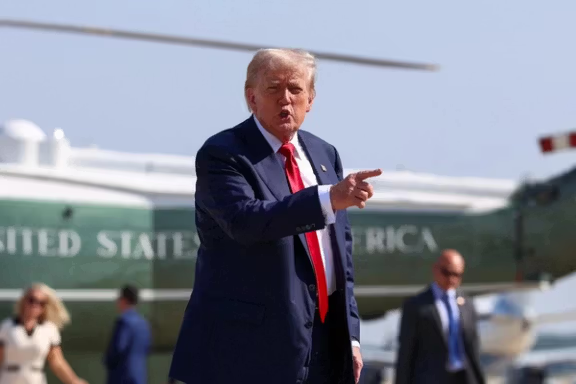
President Donald Trump gestures after disembarking Marine One, as he departs for Scotland, at Joint Base Andrews, Maryland, on July 25, 2025.

US President Donald Trump on Sunday expressed surprise at Tehran’s continued insistence on uranium enrichment despite last month’s American airstrikes on its nuclear facilities, vowing to block any attempt by Iran to maintain the program.

"Iran has been very nasty with their words, with their mouth. They got the hell knocked out of them, and they, I don't think they know it. I actually don't think they know," Trump told reporters on the sidelines of his meeting with the president of the European Commission.

"The whole thing's a con job. We have a lot of con jobs going on. But Iran was beaten up very badly, for good reason. We cannot have them have a nuclear weapon," he added.

On June 22, Trump ordered airstrikes against Iran's nuclear sites in Fordow, Esfahan and Natanz, capping off a surprise military campaign by Israel which killed hundreds of people, including military personnel, nuclear scientists, and civilians.

The 12-day Israeli war on Iran was launched following the 60-day deadline set by Trump for Iran to reach a deal with the West over its disputed nuclear program.

Uranium enrichment was one of the US conditions for the possible deal, but Iran has long been insisting on maintaining its enrichment program, even in the aftermath of last month’s conflict.

Iranian Foreign Minister Abbas Araghchi told Fox News earlier this week that the country will not abandon its uranium enrichment program, calling it both a scientific achievement and a matter of national pride.

“Our enrichment is so dear to us,” he said. “Obviously we cannot give up our enrichment, because it is an achievement of our own scientists and now more than that, it is a question of national pride.”

Trump on Sunday expressed surprise at Iran's insistence on enrichment after what Araghchi called "serious and severe" damage to its nuclear infrastructure.

"They still talk about enrichment. I mean, who would do that? You just come out of something that's so bad, and they talk about, we want to continue enrichment. Who would say that? How stupid can you be to say that?"

Trump vowed that his administration is "not going to allow that to happen."

Iran’s uranium enrichment program has long been a source of international tension. While Tehran maintains that the program is for peaceful purposes, the UN nuclear watchdog argues that enriching uranium to high levels of purity lacks any civilian justification.

Most Viewed

Iran negotiators ordered to return after internal rift over Islamabad talks
1
EXCLUSIVE

Iran negotiators ordered to return after internal rift over Islamabad talks

2
ANALYSIS

US blockade enters murky phase as tankers spoof signals and buyers hesitate

3
ANALYSIS

Why the $100 billion Hormuz toll revenue is a myth

4

US tightens financial squeeze on Iran, warns banks over oil money flows

5
ANALYSIS

US blockade targets Iran oil boom amid regional disruption

Banner
Banner

Spotlight

  • Hardliners push Hormuz ‘red line’ as US blockade tests Iran’s leverage
    INSIGHT

    Hardliners push Hormuz ‘red line’ as US blockade tests Iran’s leverage

  • Ideology may be fading in Iran, but not in Kashmir's ‘Mini Iran'
    INSIGHT

    Ideology may be fading in Iran, but not in Kashmir's ‘Mini Iran'

  • War damage amounts to $3,000 per Iranian, with blockade set to add to losses
    INSIGHT

    War damage amounts to $3,000 per Iranian, with blockade set to add to losses

  • Why the $100 billion Hormuz toll revenue is a myth
    ANALYSIS

    Why the $100 billion Hormuz toll revenue is a myth

  • US blockade targets Iran oil boom amid regional disruption
    ANALYSIS

    US blockade targets Iran oil boom amid regional disruption

  • Iran's digital economy battered by prolonged blackout
    INSIGHT

    Iran's digital economy battered by prolonged blackout

•
•
•

More Stories

UK, French, German leaders threaten Iran with renewed sanctions

Jul 26, 2025, 19:49 GMT+1

Iran will face the return of UN sanctions unless it resumes cooperation with nuclear inspectors and returns to talks, the leaders of Britain, France and Germany agreed on Saturday during a phone conversation.

UK Prime Minister Keir Starmer, French President Emmanuel Macron and German Chancellor Friedrich Merz "agreed that unless Iran co-operated with the IAEA and returned to diplomacy, sanctions would be reinstated at the end of August," according to the British government's readout of the joint call.

The three European powers have until October to trigger the so-called snapback mechanism under UN Security Council Resolution 2231, which would restore all international sanctions on Iran lifted by the 2015 nuclear deal.

Once invoked, if the UN Security Council fails to unanimously agree within 30 days to continue waiving the sanctions, the previous UN measures will automatically be reinstated.

Negotiators from Iran and the three European powers held a fresh round of nuclear talks in Istanbul on Friday. In the meeting, Iran pushed back on an alleged proposal by Europe to extend the deadline for triggering the snapback mechanism.

Friday's talks marked the first round of nuclear negotiations following the US-Israeli airstrikes on Iran. Washington was not part of the talks, as Tehran has said it is not currently willing to engage in further talks with the Trump administration.

'No talks with US without guarantees'

Iran’s Deputy Foreign Minister Majid Takht Ravanchi said on Saturday Tehran had conveyed messages to the US via intermediaries and would not re-enter talks without firm guarantees against further attacks.

“Before a new round of talks, we must receive guarantees that we will not face similar attacks again,” Turkish outlet Haberturk quoted him as saying.

Citing Israeli and US strikes, he said more than a thousand people had been killed. “These acts must be condemned,” he said.

He confirmed discussions with the E3 are ongoing and centered on uranium enrichment and sanctions relief. “In any agreement, enrichment must be preserved. That is a key element of our position,” he said. “Sanctions must be lifted fully. This is an essential requirement.”

Takht Ravanchi rejected Western demands to limit enrichment, calling them incompatible with Iran’s rights under the Non-Proliferation Treaty.

“Zero enrichment is not acceptable. Our nuclear program is peaceful, conducted on our soil, and in line with the NPT,” he said.

No date has been set for the next E3 round, though Takht Ravanchi said Turkey remains Iran’s preferred venue.

Sacred fire still burns as many Zoroastrians quit Iran for America

Jul 26, 2025, 17:10 GMT+1
•
Niloufar Rostami

A small fire is lit at dawn and quenched at dusk at the Zoroastrian center in Orange County, California in imitation of sacred fires in worshippers' home temples of Yazd and Tehran which have burned uninterrupted for centuries.

In recent years, Iran’s Zoroastrian community has been leaving in greater numbers, with the United States becoming the primary destination.

The latest census in 2016 indicated nearly 20,000 Zoroastrians, despite legal restrictions, strive to keep the tradition of the “sacred fire” alive in their homeland.

The tradition faces new challenges in the United States. Maintaining an eternal flame is no easy task. A shortage of mobads or Zoroastrian clerics, combined with the high cost of building fire temples, has led many to settle for small, gas-lit flames.

“We only light the fire during hours when we’re present at the center. There’s no other choice. We adapt to time and place,” said mobad Ashkan Bastani, grandson of Iran’s last High Mobad, who has lived in Orange County for over 20 years.

Iran’s Zoroastrian community, a small minority, faces profound challenges after migration, not only the loss of homeland but also of roots and rituals.

Migration was not our choice

Following the 1979 revolution in Iran, the confiscation of Zoroastrian-owned property and businesses, along with the imposition of Islamic laws governing all aspects of public life, triggered a wave of migration.

“My grandfather would look over his shoulder every few steps in Yazd. He was afraid of shadows,” recalled one Zoroastrian. “At age ten, he accidentally stepped onto a Muslim neighbor’s farmland and was punished by having his feet tied to stocks.”

Later in his 40s, he was attacked from behind at a pistachio market because, according to some Muslims, the presence of a gabr (a pejorative term for Zoroastrians) would bring bad luck to the bazaar.

Since the Islamic Republic’s founding, officially declaring one’s religion became mandatory, not just in the census but for routine processes like banking, school enrollment, insurance and job applications.

The consequences of this requirement have gone far beyond statistics; a single answer could either open doors or close them entirely, curbing the ambitions of minorities.

Until the late 1990s, Zoroastrian migration was largely individual or family-based. Since then, with help from NGOs like the Hebrew Immigrant Aid Society (HIAS), migration became more organized.

By 2017, in the early days of President Donald Trump's first term, hundreds of Iranian Zoroastrians had emigrated to the United States

In 2024, amid fears which soon materialized of Trump again barring travel from Iran, various minorities in partnership with HIAS saw another wave of Zoroastrians managing to migrate to the United States.

Population decline, low birthrates

According to Iran’s 1996 census, the Zoroastrian population stood at nearly 28,000. By 2006, it had dropped to 19,823. The 2016 census recorded 23,109 Zoroastrians in Iran.

“Many Muslims interested in Zoroastrianism claim to be Zoroastrians during the national census,” said a former member of the Tehran Zoroastrian Association on condition of anonymity.

“Meanwhile, official Zoroastrian leaders avoid stating the real numbers out of fear of government backlash. They want to appear large perhaps as a show of strength but we know our true numbers are far fewer,” he said.

“Zoroastrian families in Iran are reluctant to have children, which is common with the rest of population in Iran due to economic hardship and destitute. But our migrants abroad aren’t facing such issues and are willing to grow their families,” he added.

The Didban news website cited Kourosh Niknam, a mobad and former lawmaker, as saying Iran's Zoroastrian population had halved over the past three decades amid migration and low birth rates.

Zoroastrians in the United States

There are no official numbers for the Zoroastrian population in the US. The World Zoroastrian Federation estimates the number between 10,000 and 15,000, while the North American Zoroastrian Association puts it closer to 20,000, including both Iranian Zoroastrians and Indian Parsis.

Parsis, or Parsees, are descendants of Zoroastrians who fled Iran after the Islamic conquest and found refuge in India.

The largest communities in the United States are in California particularly Los Angeles, Orange County, and San Diego with smaller populations in New York and Texas.

Wealthy Zoroastrians have helped establish community centers and temples in these cities, and Parsis have built a fully traditional fire temple in Houston, Texas.

Islands of solitude

Depending on location and population size, many Zoroastrians in the United States may feel isolated from religious and social life. Their faith may only be expressed through ceremonial Nowruz tables or private wedding and funeral rituals.

“Since I arrived here, I haven’t attended a single Zoroastrian ceremony. I don’t think there’s another Zoroastrian in this state. I miss our small gatherings in Iran,” said Anahita, a Zoroastrian living in Nebraska.

But mobad Ashkan Bastani in California strives to keep the faith alive.

“At the Orange County Zoroastrian Center, we hold religious education classes for children and celebrate all the festivals and traditions. Everyone is welcome, regardless of religion,” he said.

“At some of our well-known festivals like Mehregan and Sadeh, many Muslims also attend, enjoy our food, and dance with us,” Bastani added.

The shadows

While there have been improvements in how Zoroastrians are perceived in Iran, many still struggle to move past the fear and marginalization.

“Public attitudes have improved. Terms like ‘unclean’ and ‘fire-worshipper’ are rarely heard now,” said one community leader in Iran. “But we’re still stunned by remarks from some officials. We can’t tell if they truly believe what they say or are just asserting control. Some things have changed—but some haven’t.”

The Zoroastrian migration story is not just about relocation. It is a narrative of perseverance, of holding onto identity, tradition, and a sacred flame that has symbolized life and light for centuries, whether in Yazd, California, or the quiet solitude of Nebraska.
Australia, UK ministers rap Iran over human rights violations

Jul 25, 2025, 22:00 GMT+1

The defense and foreign ministers of Australia and Britain hit out on Friday at what they called Iran's rising use of the death penalty and ongoing repression of women, girls and human rights defenders.

“Ministers condemned Iran’s unjust detention of foreign nationals and raised ongoing concerns over the human rights situation in Iran,” said the joint statement by the four ministers, who met for consultations in Sydney on Friday.

It cited “the escalation of the use of the death penalty as a political tool during the 12-day conflict, and the ongoing repression of women, girls, and human rights defenders.”

Their broad remarks also covered shared policy toward many other countries.

Iran’s judiciary chief announced on Wednesday that around 2,000 people were arrested during and after the 12-day war with Israel. Some detainees, accused of collaborating with Israel, could face the death penalty.

“Some of these individuals face severe punishments, including the death penalty, while others may receive lighter sentences,” Judiciary Chief Gholamhossein Mohseni Ejei said in an interview with state TV.

The UN Special Rapporteur on human rights in Iran Mai Sato urged Tehran last month to end what they described as a “post-ceasefire crackdown.”

Australia and the UK also called on Iran to fully cooperate with the International Atomic Energy Agency (IAEA) and “refrain from actions that would compromise efforts to address the security situation in the Middle East.”

Iranian deputy foreign ministers met with officials from France, Germany, and the United Kingdom in Istanbul on Friday.

Iranian Foreign Ministry spokesperson Esmail Baqaei said a senior IAEA official is expected to visit Tehran in the coming weeks to discuss a new cooperation framework.

“Ministers stated their determination that Iran must never develop a nuclear weapon,” the UK-Australia joint statement added.

Iran says it pushed back on sanctions threat in Europe nuclear talks

Jul 25, 2025, 15:43 GMT+1

Iran challenged European powers over their threat to renew UN sanctions during nuclear talks in Istanbul on Friday, Deputy Foreign Minister Kazem Gharibabadi said, in the first negotiations since Israeli and US attacks last month.

Gharibabadi said he and Deputy Foreign Minister Majid Takht Ravanchi led what he called “serious, frank, and detailed” discussions with Britain, France and Germany. The meeting focused on sanctions relief and the future of the 2015 nuclear deal, with both sides presenting specific proposals and agreeing to continue consultations.

“We explained our principled positions, including on the so-called snapback mechanism,” Gharibabadi wrote on X, adding that Tehran strongly criticized the E3’s stance on last month’s military strikes.

Iran’s Foreign Ministry spokesman Esmail Baghaei said earlier in the day that the talks were a “test of realism” for the E3 and warned against any effort to extend UN Security Council Resolution 2231, which expires in October.

Baghaei said the three powers had “no legal standing” to pursue such a move and accused them of aligning with the United States and Israel and Israel.

Iran did not reject a European offer to extend the UN resolution tied to the 2015 nuclear deal during talks in Istanbul on Friday, The Wall Street Journal’s Laurence Norman reported citing a European diplomat.

Norman said the meeting produced no breakthrough or breakdown and involved meaningful discussion as the E3 and EU offered a clear diplomatic proposal, with the European side prepared to pursue snapback sanctions but also expressed openness to an extension if Iran takes certain steps.

“There was a sense until recently that Iran seemed uninterested in any extension. Today that seems to have shifted,” Norman said on X, describing the talks as a potential turning point ahead of a decision expected by the end of August.

The Financial Times cited Western diplomats as saying that the E3 is considering offering Iran a delay in reimposing sanctions if Tehran resumes cooperation with the International Atomic Energy Agency and engages with Washington. Without progress, the snapback could be triggered by mid-September.

Gharibabadi said a technical IAEA team will travel to Tehran in the coming weeks, but inspections of nuclear facilities are not planned. Any future cooperation, he added, will depend on Iran’s Supreme National Security Council and laws passed in response to the June strikes.

Sanctions reloaded: what’s at stake for Iran as snapback looms?

Jul 25, 2025, 14:33 GMT+1
•
Umud Shokri

The triggering of international sanctions on Iran threatened by Europe could unleash a cascade of new challenges on the country's energy sector, from shrinking oil exports, blocked payments, halted infrastructure upgrades and deeper isolation from global markets.

Originally designed as a safeguard within the 2015 Joint Comprehensive Plan of Action (JCPOA), so-called snapback allows any member of the United Nations Security Council to unilaterally reimpose sanctions if Iran is found to be in serious noncompliance.

The mechanism cannot be blocked by a Security Council veto.

What’s at risk?

If activated, snapback would reintroduce bans on Iran’s banking, insurance, shipping, and, most crucially, oil and gas sectors.

Iran’s already limited energy exports would be further squeezed, particularly as China—the country’s top customer—faces its own pressure from US secondary sanctions.

The blow wouldn’t stop at exports. Renewed sanctions would also block access to international banking systems, complicating payments and deterring investment.

With infrastructure already aging, efforts to modernize production facilities or increase capacity would stall. Crucial imports of equipment, spare parts, and technology would dry up, making basic maintenance difficult—let alone expansion.

Ripple effects

The reimposition of sanctions wouldn’t just hit Iran—it would ripple across global energy markets. A sharp decline in Iranian exports could tighten supply and drive up oil prices, especially in Asia and Europe.

Investors and insurers are already wary. A full snapback would only raise the stakes.

More concerning is Tehran’s potential response.

Iranian officials have warned that reactivating the snapback mechanism could trigger a shift in military posture, an exit from the Non-Proliferation Treaty (NPT), or an acceleration of its nuclear program.

The risk isn’t just economic—it’s strategic.

A more isolated Iran might double down on asymmetric tactics, expand regional proxy activities, or escalate maritime disruption in the Gulf.

The symbolic weight of snapback could also undercut any remaining diplomatic channels and push Tehran further from the negotiating table.

Iran’s energy goals on the brink

Despite sanctions, Iran has managed to modestly expand oil production—targeting an increase of 600,000 barrels per day by 2025—and made incremental gains in natural gas output, including at South Pars Phase 11.

But snapback could freeze or reverse this progress.

Refinery upgrades are already underway, but vulnerable to supply chain disruptions. Without access to critical technology or parts, domestic fuel production could falter, forcing greater reliance on crude exports just as export channels are closing.

Meanwhile, renewable energy remains marginal, and any growth in that sector would likely be stifled by sanctions-induced isolation.

Endurance and limits of pressure

Iran’s shadow export network has proven resilient.

Since 2022, an estimated 42 million barrels have moved via sanctioned tankers. Strategic ties with China have helped cushion the impact, and Tehran’s evasion playbook is growing more sophisticated.

Still, the economic toll is real.

Iran loses billions of dollars annually due to reduced crude sales. And snapback could widen that gap—though it may not deliver the decisive blow some expect.

Fragmented global enforcement, selective compliance by neighboring states, and geopolitical shifts toward multipolarity all chip away at the tool’s practical effect.

Reactivating the snapback mechanism would undoubtedly raise pressure on Iran’s economy, particularly its energy sector. But it may also entrench defiance, destabilize the Persian Gulf and weaken the very diplomatic leverage it’s meant to reinforce.

Whether it isolates Iran or backfires will depend not only on Tehran’s response, but on how fractured and fatigued the global sanctions consensus has become.