• العربية
  • فارسی
Brand
  • Iran Insight
  • Politics
  • Economy
  • Analysis
  • Special Report
  • Opinion
  • Podcast
  • Iran Insight
  • Politics
  • Economy
  • Analysis
  • Special Report
  • Opinion
  • Podcast
  • Theme
  • Language
    • العربية
    • فارسی
  • Iran Insight
  • Politics
  • Economy
  • Analysis
  • Special Report
  • Opinion
  • Podcast
All rights reserved for Volant Media UK Limited
volant media logo

Iran calls snapback baseless as nuclear deal is defunct for years

Jul 22, 2025, 08:45 GMT+1Updated: 06:29 GMT+0
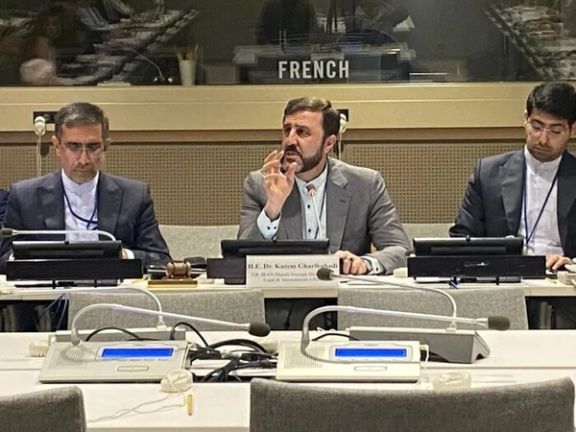
Kazem Gharibabadi, Iran’s deputy foreign minister for legal and international affairs, during a meeting in New York on July 21, 2025

A senior Iranian diplomat dismissed European efforts to trigger the reimposition of United Nations sanctions under the 2015 nuclear deal as legally baseless, arguing that the accord has not been in effect for seven years.

"The JCPOA has not been implemented for seven years, and the European countries halted their obligations after the United States withdrew from the deal," said Kazem Gharibabadi, Iran’s deputy foreign minister for legal and international affairs, in remarks to state news agency IRNA from New York on Tuesday.

"Did they themselves fulfill their commitments under the JCPOA that they now expect the Islamic Republic of Iran to do so?"

Gharibabadi's comments come ahead of a scheduled meeting on Friday in Istanbul between Iranian officials and representatives of the European E3—France, Germany, and the United Kingdom—to discuss recent diplomatic tensions and European statements regarding the activation of the so-called “snapback” mechanism.

The snapback would restore UN sanctions lifted under the Joint Comprehensive Plan of Action (JCPOA), from which the US unilaterally withdrew in 2018.

'Snapback will complicate nuclear standoff'

Gharibabadi said that reimposing international sanctions on Iran would make the situation over its nuclear program more complex.

“Any move to activate the snapback mechanism and revive terminated Security Council resolutions has no legal basis and will only complicate the situation further,” Gharibabadi said. “The responsibility will lie with the Western parties.”

Speaking about the upcoming Istanbul meeting, Gharibabadi said, “We will discuss diplomatic matters and the snapback mechanism. Of course, we will present our positions. Our goal is to explore what joint solutions we can reach to manage the current situation.”

He described the European effort to reinstate UN sanctions as “an entirely illegal action” with “no legal basis whatsoever.”

According to Gharibabadi, the meeting was arranged following outreach by the foreign ministers of the E3 countries and the High Representative of the European Union for Foreign Affairs Kaja Kalla to Iran’s Foreign Minister Abbas Araghchi.

Iran criticizes UN Security Council

Separately, on Monday in New York, Gharibabadi addressed representatives from UN member states at a closed-door briefing, where he accused the United States and Israel of violating Iran’s sovereignty and threatening global peace.

"Iran has been subjected to aggression by two regimes that possess nuclear weapons. Yet, the United States and its allies have blocked efforts to pass a resolution condemning these acts in the Security Council and the IAEA Board of Governors," Gharibabadi said.

“If the Security Council is unable to fulfill its responsibilities, then which body is accountable for maintaining international peace and security?”

Gharibabadi concluded with a warning about the future of the global non-proliferation regime.

“Does this dangerous silence not send a message to countries like Iran that if you are not a member of the Non-Proliferation Treaty, not only will you not be held accountable, but you may also benefit from immunity and privileges?”

The JCPOA, signed in 2015, offered Iran sanctions relief in exchange for limits on its nuclear program. The US withdrawal under former President Donald Trump in 2018 triggered a gradual unraveling of the deal, with Iran scaling back its commitments and European parties failing to deliver promised economic benefits.

Most Viewed

Iran negotiators ordered to return after internal rift over Islamabad talks
1
EXCLUSIVE

Iran negotiators ordered to return after internal rift over Islamabad talks

2
ANALYSIS

US blockade enters murky phase as tankers spoof signals and buyers hesitate

3
ANALYSIS

Why the $100 billion Hormuz toll revenue is a myth

4

US tightens financial squeeze on Iran, warns banks over oil money flows

5
ANALYSIS

US blockade targets Iran oil boom amid regional disruption

Banner
Banner

Spotlight

  • Hardliners push Hormuz ‘red line’ as US blockade tests Iran’s leverage
    INSIGHT

    Hardliners push Hormuz ‘red line’ as US blockade tests Iran’s leverage

  • Ideology may be fading in Iran, but not in Kashmir's ‘Mini Iran'
    INSIGHT

    Ideology may be fading in Iran, but not in Kashmir's ‘Mini Iran'

  • War damage amounts to $3,000 per Iranian, with blockade set to add to losses
    INSIGHT

    War damage amounts to $3,000 per Iranian, with blockade set to add to losses

  • Why the $100 billion Hormuz toll revenue is a myth
    ANALYSIS

    Why the $100 billion Hormuz toll revenue is a myth

  • US blockade targets Iran oil boom amid regional disruption
    ANALYSIS

    US blockade targets Iran oil boom amid regional disruption

  • Iran's digital economy battered by prolonged blackout
    INSIGHT

    Iran's digital economy battered by prolonged blackout

•
•
•

More Stories

Trump says US will attack Iran again if necessary

Jul 22, 2025, 03:50 GMT+1

The United States will strike Iran again if necessary, President Donald Trump said on Monday night, responding to recent remarks by Iran’s foreign minister about the severe damage caused by Washington’s June strikes on Iran’s nuclear sites.

“Iran’s Foreign Minister, Abbas Araghchi, on the Iran Nuclear Sites, ‘Damages are very severe, they are destroyed.’ Of course they are, just like I said — and we will do it again, if necessary!” Trump said in a post on Truth Social.

Trump also attacked CNN for reporting — based on preliminary intelligence — that Iran’s nuclear program had not been fully dismantled by last month’s US strikes.

“As interviewed by Bret Baier. Fake News CNN should immediately fire their phony ‘reporter’ and apologize to me and the great pilots who ‘OBLITERATED’ Iran’s nuclear sites. CNN is a major ratings loser, as is MSDNC!” Trump wrote.

The US Operation Midnight Hammer targeted three major Iranian nuclear sites using B-2 stealth bombers equipped with 30,000-pound “bunker buster” bombs.

In an interview with Fox News anchor Bret Baier, Iranian Foreign Minister Abbas Araghchi confirmed the extent of the destruction caused by the operation.

“Our facilities have been damaged, seriously damaged... as far as I know they are seriously damaged,” Araghchi added.

Despite the strikes, he insisted Iran would not abandon its uranium enrichment program, calling it a matter of national pride.

“Our enrichment is so dear to us,” he said. “Obviously we cannot give up our enrichment, because it is an achievement of our own scientists and now more than that, it is a question of national pride.”

Iran maintains its nuclear program is for peaceful purposes, but the UN’s nuclear watchdog has warned that the levels of uranium enrichment Tehran is pursuing have no civilian justification.

At a White House press briefing Monday, Press Secretary Karoline Leavitt said the administration remains open to diplomacy.

“The president has been very clear when it comes to his priorities for Iran — he obliterated their nuclear capability, and I understand that the administration continues to be open to talks with Iran if we deem them necessary,” Leavitt said.

Iran is expected to meet with European powers for nuclear talks on Friday, but the United States will not be participating.

Khamenei warns Muslim states against aiding Israel, blocking Gaza aid

Jul 21, 2025, 22:16 GMT+1

A post on the X account of Iran’s Supreme Leader on Monday warned Muslim states against aiding Israel or blocking Gaza aid, as Iran's foreign minister accused the Jewish state of imposing starvation on civilians and described its actions as war crimes.

“Today isn’t the time to remain silent regarding Gaza,” the post on Khamenei's official X account. “Muslim governments have heavy responsibilities. If any Muslim government backs the Zionist regime in any form and blocks aid to Palestine, they must know with certainty that an eternal mark of disgrace will stain their reputation.”

His comments came amid a worsening humanitarian crisis in Gaza, during a war that began after Hamas-led militants attacked Israel on October 7, 2023.

The Hamas-run health ministry in Gaza warned Sunday that hundreds could die as hospitals fill with patients weakened by hunger and collapsing aid access, while the UN said civilians face starvation without urgent assistance.

According to the ministry, at least 67 Palestinians were killed by Israeli fire as they waited for UN aid trucks in northern Gaza on Sunday. The Israeli military campaign in Gaza has since killed over 58,000 Palestinians, according to local health officials.

Iranian Foreign Minister Abbas Araghchi condemned the incident in a post on X on Monday, calling it “a blatant example of war crimes and crimes against humanity.”

Araghchi said Israel had used measures such as depriving civilians of water, medicine, and food, and blamed both the United States and Israel for what he called “death traps” at aid distribution sites.

In a separate statement on Telegram, Araghchi said he spoke with Turkish Foreign Minister Hakan Fidan, who currently chairs the Organization of Islamic Cooperation (OIC), and called for an emergency OIC summit to address what he described as “genocide in Gaza” and “Israeli aggression in the region.”

US still open to talks with Iran, White House says

Jul 21, 2025, 22:10 GMT+1

The Trump administration remains open to talks with Tehran, the White House said on Monday, as Iran and Washington’s European allies prepare for a new round of nuclear negotiations on Friday — without the United States.

“I understand that the administration continues to be open to talks with Iran if we deem them necessary,” White House Press Secretary Karoline Leavitt told reporters.

Leavitt also said that the US airstrikes on Iran's atomic sites last month "obliterated their nuclear capability."

On June 22, the US carried out airstrikes on Iran’s key nuclear sites at Fordow, Natanz, and Isfahan. The full extent of the damage remains unclear. Assessments continue to conflict, and Iranian authorities have not released a comprehensive evaluation.

Speaking to Fox News anchor Bret Baier, Iranian Foreign Minister Abbas Araghchi said multiple enrichment sites had been “severely and seriously damaged,” though he said the extent of the impact is still being assessed by Iran’s Atomic Energy Organization.

The US operation, dubbed Operation Midnight Hammer by President Trump, involved B-2 stealth bombers armed with 30,000-pound Massive Ordnance Penetrators—so-called “bunker busters” designed to penetrate fortified underground facilities. The US strikes followed an earlier Israeli offensive known as Operation Rising Lion.

Iran won't give up enrichment

Araghchi told Fox News that the country will not abandon its uranium enrichment program, calling it both a scientific achievement and a matter of national pride.

“Our enrichment is so dear to us,” he said. “Obviously we cannot give up our enrichment, because it is an achievement of our own scientists and now more than that, it is a question of national pride.”

Iran’s uranium enrichment program has long been a source of international tension. While Tehran maintains that the program is for peaceful purposes, the UN nuclear watchdog argues that enriching uranium to high levels of purity lacks any civilian justification.

Rampant electricity outages take toll on frustrated Iranians

Jul 21, 2025, 21:12 GMT+1

A surge in electricity outages across Iran has caused severe disruption to daily life and economic activity, leaving Iranians frustrated and businesses paralyzed, videos and voice memos sent to Iran International's submissions line show.

In a display of outrage, a poultry farmer dumped dead chickens in front of the Electric Distribution Management Center in Kohgiluyeh and Boyer-Ahmad province, blaming the power outage for their deaths.

"Since this morning, there has been no electricity. At least inform us so we can use generators," the farmer says.

A baker also posted a video showing spoiled bread dough, saying that three separate outages in a single day caused the dough to go bad, forcing him to throw it all away.

A construction worker shared footage of cement bags hanging midair on a stalled hoist, explaining that the outage had brought their work to a halt.

"It’s been less than an hour since we started, and already we can’t continue. We can’t access the cement, and the entire operation is stopped — not just for us but for others too," he said in the video.

Sanctions, age and mismanagement have taxed Iran's energy infrastructure, and the country has long faced blackouts especially in summer months when water and electricity demand surge.

However, conditions appear to have worsened following the 12-day war with Israel, with Iranians reporting more frequent and severe blackouts.

Businesses and services are also struggling, with one factory worker filmed a halted production line saying: "We can’t do anything — there’s no electricity."

In another video, a shop in the Tabriz bazaar was shown operating on a generator during an outage.

Disrupted daily life

The blackouts are affecting not only businesses but also social and domestic life.

A student filmed herself using a kettle heated on a gas burner to iron her scarf, saying, "There’s no electricity, but since we still have gas, we find ways to manage."

"It’s 2025 — while most countries have stable electricity, I’m heating a kettle to iron my scarf before heading to university," she added ruefully.

Another video from the city of Ahvaz shows a man standing in 122-degree heat, complaining about the power outage and turning on a faucet to show that the lack of running water.

A member of the Iran's Electricity Market and Exchange Commission warned that if current trends in electricity supply and consumption continue, Iran will face managed blackouts for at least four more years.

"The total nominal capacity of the national power grid is 94,500 megawatts, but actual production is just over 63,400 megawatts," Ali Shahmohammadi told Shargh daily in June.

"Over the past five years, electricity demand has grown by about 5.5 percent, while power generation capacity has increased by only 2.2 percent up to 2024 — a figure that highlights the severity of the crisis," Shahmohammadi added.

Not even daily commutes to and from affected homes and workplaces provide a respite from the blackouts, with a video from the city of Mashhad showing heavy traffic caused by disabled traffic lights.
Iranian Shahed drones overwhelm Ukraine’s air defenses – FT

Jul 21, 2025, 19:43 GMT+1

Iranian-designed Shahed drones now manufactured in Russia are overwhelming Ukraine’s air defenses and increasing the success rate of attacks, the Financial Times reported on Monday.

According to data released by Ukraine’s Air Force, Russia is intensifying drone swarm attacks while limiting their targets to two or three locations.

On Monday alone, Ukraine reported what it described as 200 Shahed-type strikes on its official Telegram channel.

The Shahed-136 drone was originally designed and manufactured in Iran. Russia has begun producing the drone domestically, giving it a Russian name and modifying it for greater speed to evade air defenses.

Russian-manufactured Shahed drones are called Geran, or Geranium, in keeping with a Soviet-era tradition of naming weapons after flowers.

Russia often uses Shahed drones in combination with ballistic missile barrages to overwhelm Ukrainian air defense systems.

Ukraine counters drone attacks through electronic jamming of guidance systems and the use of anti-aircraft guns.

Financial Times analysis shows that the likelihood of Shahed drones hitting their targets has tripled over the past month.

The United States has imposed multiple rounds of sanctions on Iran’s drone production and procurement networks.

In February, the Trump administration sanctioned six entities in Hong Kong and mainland China for facilitating the acquisition of components used in Iranian armed drones.