• العربية
  • فارسی
Brand
  • Iran Insight
  • Politics
  • Economy
  • Analysis
  • Special Report
  • Opinion
  • Podcast
  • Iran Insight
  • Politics
  • Economy
  • Analysis
  • Special Report
  • Opinion
  • Podcast
  • Theme
  • Language
    • العربية
    • فارسی
  • Iran Insight
  • Politics
  • Economy
  • Analysis
  • Special Report
  • Opinion
  • Podcast
All rights reserved for Volant Media UK Limited
volant media logo

Air defenses replaced after damage in war with Israel, Iran says
Jul 20, 2025, 11:08 GMT+1Updated: 06:35 GMT+0
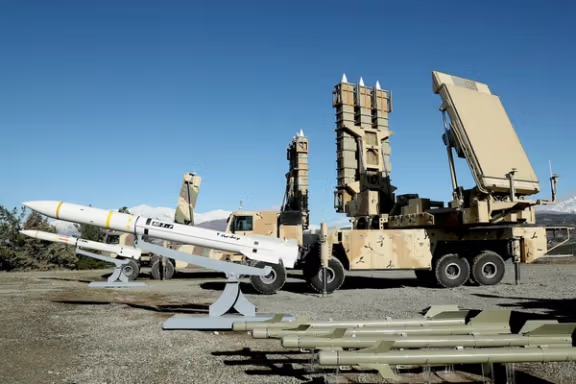
The long-range air defence system called Arman is displayed during an unveiling ceremony in Tehran, Iran, in this picture obtained on February 17, 2024.

Iran has replaced air defense systems damaged during last month's conflict with Israel, said Mahmoud Mousavi, the army’s deputy for operations.

"Some of our air defenses were damaged, this is not something we can hide, but our colleagues have used domestic resources and replaced them with pre-arranged systems that were stored in suitable locations in order to keep the airspace secure," Mousavi added.

During the June conflict, Israel's air force took control of Iranian airspace, delivering a significant blow to the country's air defenses, while Iran's armed forces responded with successive waves of missile and drone attacks on Israeli territory.

“We were able to cover the skies using existing and new systems, securing the airspace of our dear Iran,” he said. “The enemy, despite its desperate efforts, failed to achieve its goals.”

Major General Abdolrahim Mousavi, Chief of Staff of the Armed Forces, also echoed that message. “Air defense proved on the front lines of protecting Iran’s skies that it will resist any level of threat,” he said. “Downing so many enemy aircraft shows the courage and will of our defenders.”

Iran says it has downed several Israeli fighter jets but has not provided any footage or additional details.

Israeli forces struck targets across Iran freely during the 12-day war, including in and around the capital.

Israeli military officials say that 120 air defense systems were destroyed or disabled since the first wave of attacks—around a third of Iran’s pre-war total. Long-range systems, including Russian-supplied S-300s and Iran’s Bavar-373 batteries, were among those targeted.

“Iran relied on a fragmented mix of Russian S-300s, Chinese batteries, and local Bavar-373 systems – none of which were adequately integrated… The air defense radar was Russian and Chinese made, which have known issues of target discrimination, without any integration among bases and military units,” wrote the Global Defense Corp.

The short-range air defence system Azarkhsh is displayed during an unveiling ceremony in Tehran, Iran, in this picture obtained on February 17, 2024.
100%
The short-range air defence system Azarkhsh is displayed during an unveiling ceremony in Tehran, Iran, in this picture obtained on February 17, 2024.

Mossad operations and precision strikes

In late June, Israeli Defense Minister Israel Katz directed the military to prepare an enforcement plan against Iran, which includes maintaining air superiority, blocking missile development, and deterring Iran's regional activities.

The plan, according to Katz’s, aimed to ensure Israel can respond kinetically to future threats.

A security source speaking to N12 also said Mossad operatives inside Iran played a central role in shaping the battlespace, deploying loitering munitions and attack drones, and establishing a covert launch site in the heart of Iran to suppress air defenses.

The War Zone website, a resource for the defense industry, released more details of Iran’s defense being destroyed.

“Among the targets reportedly prosecuted by Israeli operatives within Iran was an air defense site near Tehran. Shortly before the operation began, Israeli drones launched from within Iran struck surface-to-air missile launchers there, clearing the way for the larger strike, which also involved Israeli Air Force (IAF) fighter jets."

"This would also explain the apparent inactivity by Iranian air defense sites during the Israeli bombardment. At the same time, the IAF has also been flying suppression and destruction of enemy air defenses (SEAD/DEAD) operations that the service says have destroyed “dozens of radars and surface-to-air missile launchers,” wrote the website.

Airspace remains exposed

Iran’s geographic scale -- roughly 1.6 million square kilometers -- poses a constant challenge for integrated air defense. The Islamic Republic lacks a modern fighter fleet to complement its missile systems and has relied on Cold War-era aircraft. Several of these have been destroyed on the ground in recent strikes, according to Israeli military imagery.

After limited Israeli strikes targeted Iranian missile factories last October, Iran later showcased Russian-made air defenses and its Bavar-373 system to project defensive strength, but Israeli aircraft, including F-35 stealth fighters, encountered little documented resistance during the 12-day conflict.


Most Viewed

Iran negotiators ordered to return after internal rift over Islamabad talks
1
EXCLUSIVE

Iran negotiators ordered to return after internal rift over Islamabad talks

2
ANALYSIS

US blockade enters murky phase as tankers spoof signals and buyers hesitate

3
ANALYSIS

Why the $100 billion Hormuz toll revenue is a myth

4

US tightens financial squeeze on Iran, warns banks over oil money flows

5
ANALYSIS

US blockade targets Iran oil boom amid regional disruption

Banner
Banner

Spotlight

  • Hardliners push Hormuz ‘red line’ as US blockade tests Iran’s leverage
    INSIGHT

    Hardliners push Hormuz ‘red line’ as US blockade tests Iran’s leverage

  • Ideology may be fading in Iran, but not in Kashmir's ‘Mini Iran'
    INSIGHT

    Ideology may be fading in Iran, but not in Kashmir's ‘Mini Iran'

  • War damage amounts to $3,000 per Iranian, with blockade set to add to losses
    INSIGHT

    War damage amounts to $3,000 per Iranian, with blockade set to add to losses

  • Why the $100 billion Hormuz toll revenue is a myth
    ANALYSIS

    Why the $100 billion Hormuz toll revenue is a myth

  • US blockade targets Iran oil boom amid regional disruption
    ANALYSIS

    US blockade targets Iran oil boom amid regional disruption

  • Iran's digital economy battered by prolonged blackout
    INSIGHT

    Iran's digital economy battered by prolonged blackout

•
•
•

More Stories

Two US senators urge continued pressure to block Iran’s nuclear path

Jul 20, 2025, 09:23 GMT+1
•
Marzia Hussaini

Washington must maintain pressure to stop Iran from building nuclear weapons, two US senators told Iran International, expressing support for further sanctions and potential military action against the Islamic Republic.

“I support making sure the Iranian regime never becomes a nuclear power,” Senator Ron Johnson of Wisconsin said.

“It’s unfortunate they continue to pursue a nuclear weapons program. I don’t think they’ve ever stopped.”

Speaking separately on Capitol Hill, Senator Jim Risch of Idaho said, “Obviously, the program has been decimated. People say it’s just a setback, but substantial damage has been done — much more than has been publicly reported.”

He was referring to the impacts of US and Israeli attacks on Iranian nuclear infrastructure in recent months.

Risch, the chairman of the Senate Foreign Relations Committee, added that any renewed effort by Tehran to produce a bomb would provoke further action.

“If the regime tries to build a nuclear weapon, the same thing is going to happen again,” he said. “Prime Minister Netanyahu has said so. President Trump has said so. And they mean it.”

Both senators expressed confidence that continued Western pressure, especially from Israel and the United States, would keep Iran from crossing the nuclear threshold.

Asked about recent reports that President Donald Trump’s campaign raised millions in donations following an alleged Iranian-linked plot to assassinate him, Risch underlined a distinction between Iran’s rulers and its people.

“Anything the regime does, we don’t ascribe to the Iranian people,” he said. “We know they’re good people who want to be free.”

Senator Johnson also welcomed reports that France and Germany are now backing a snapback of UN sanctions against Iran.

The snapback, created under UN Security Council Resolution 2231, lets any party to the 2015 nuclear deal restore UN sanctions if Iran is found non-compliant. If no resolution is passed within 30 days to extend sanctions relief, all previous measures return automatically.

Israeli air strikes and drone attacks during the 12-day war killed hundreds of Iranians including civilians, military personnel and nuclear scientists. Iran's retaliatory missile strikes also killed 27 Israelis.

On June 22, the United States joined the war by striking Iran’s nuclear sites in Isfahan, Natanz, and Fordow using long-range bombers and submarine-launched missiles.

A US-brokered ceasefire was announced on June 24 between Iran and Israel after Tehran launched a retaliatory airstrike against a US airbase in Qatar.

Israel discloses details behind attacks on Iran - Israeli media

Jul 20, 2025, 09:18 GMT+1

Israel’s June attacks on Iran had been planned since November following serious warnings about the advancement of Tehran's nuclear program, according to Israeli media reports approved by the country’s military censor.

Details released Saturday night -- despite tight security censorship in Israel over last month’s conflict with Iran -- revealed that in January, the military intelligence team issued an early warning following advances in Iran’s weapons program.

"The nuclear team in the Control Department issues a concrete warning about the launch of a coordinated project to produce the final stage required for launching a nuclear missile in Iran," it said.

Around the same time, the research division of Israel’s military intelligence also issued a warning, identifying a covert team of Iranian nuclear scientists allegedly working on previously undeveloped components needed to complete the final stage of a nuclear missile launch.

The head of military intelligence, Shlomi Binder, established a special team with several tech experts with an emphasis on nuclear weapons to plan the attacks on Iran's nuclear infrastructure. They also focused on how to do simultaneous assassinations of the country's military and nuclear chiefs.

In May, Binder issued his own warning to the political echelon: "I would like to alert decision-makers to disturbing developments in the field of nuclear weapons in Iran. It appears that Iran is continuing to make determined progress that is shortening the technological and cognitive distance required to complete the development of a nuclear weapons device.”

On June 13, Israel launched a series of surprise attacks which led to the deaths of around 30 military commanders and nuclear scientists and a 12-day war which caused widespread destruction to both sides.

As the fragile ceasefire holds by a thread, the United States is now awaiting Iran’s return to the negotiating table for a new nuclear agreement. Both Washington and Tel Aviv have warned that failure to reach a deal could trigger further military strikes.

Nobel laureate rejects Iran referendum call, says it won't lead to democracy

Jul 19, 2025, 18:50 GMT+1

Iranian Nobel Peace Prize laureate Shirin Ebadi has cast doubt on the Green Movement leader's call for a referendum on Iran's political future, saying any vote under Iran’s current constitution cannot bring about democratic change.

“The precondition for any referendum is the removal of power from the Islamic Republic,” Ebadi wrote, rejecting Mir Hossein Mousavi’s recent call for a national vote to reform the state’s political structure.

Earlier this month, Mousavi said in a statement that the current structure of the Islamic Republic “does not represent all Iranians.”

“The twelve-day war (with Israel) showed that the only guarantee for the nation’s survival is respect for every citizen’s right to self-determination,” the former prime minister added.

Mousavi, under house arrest since 2009, had urged the formation of a constitutional assembly through a public vote. His message was endorsed by over 800 civil and political figures who demanded the release of political prisoners and the drafting of a new constitution based on democracy and human rights.

But Ebadi, a prominent critic of the Islamic Republic, said such a process is legally unworkable within the current framework. She said Iran’s constitution explicitly bars changes to core principles such as clerical rule, Islamic law, and the system’s Islamic identity.

“Such a structure rules out the formation of a democratic and secular government,” she said.

She dismissed the latest wave of endorsements for Mousavi’s initiative as driven by sentiment rather than strategy.

“The recent statement signed by over 800 activists seems driven more by Mousavi’s political charisma than by any viable solution to Iran’s crisis."

Referendum seen as a trap

Ebadi also warned that a referendum sanctioned by the ruling establishment could become a tool to legitimize its hold on power.

“Any government is legally bound by its own constitution and cannot hold a referendum against its own existence. Therefore, such a request from the government is baseless,” she wrote.

Ebadi called instead for a UN-supervised referendum to manage a transition away from the Islamic Republic, citing a 2018 statement she co-authored with 14 other dissidents advocating for a full political break.

Along with cleric Mehdi Karroubi, Mousavi was a candidate in the disputed 2009 presidential election and challenged the results, leading large protests dubbed the Green Movement for months before he was arrested and placed under house arrest.

His wife Zahra Rahnavard and Karroubi were also accused of sedition against the Islamic Republic and remain under house arrest.

No victory, no collapse: why Iran’s postwar narratives fall short

Jul 19, 2025, 17:10 GMT+1
•
Mohammad Ghaedi

Existing narratives competing to shape Iran’s future after the war with Israel offer little clarity, calling for a sober reassessment that confronts the questions of power, leadership and a potential transition from the Islamic Republic.

Following the recent twelve-day war with Israel, many Iranians are asking: What truly happened? Where do we stand now? And what is the realistic path forward?

Prevailing narratives misdiagnose the crisis. They fall into three categories:

The government’s narrative casts Iran as victorious. Yet the facts suggest otherwise.

Iran suffered serious losses: senior military figures were killed, defense systems degraded, and critical parts of its nuclear and missile infrastructure were hit. In return, Iran’s retaliatory strikes did not shift the balance.

Misrepresenting this as triumph only reinforces poor decisions.

Regime-change advocates imagine foreign military pressure will fracture Iran’s security apparatus and cause collapse. But this view underestimates the cohesion of Iran’s coercive institutions and the self-interest of foreign powers, who are unlikely to commit to regime change.

The assumption that mass defections would yield democratic transition lacks grounding.

Structuralist perspectives also misplace blame.

One variant cites imperialism and calls for confrontation with the West. Another urges nuclear armament to balance power. But both ignore domestic dysfunction and corruption, and the risks of pursuing nuclear weapons now.

National strength requires more than deterrence—it needs capable, legitimate governance.

Understanding the crisis

The Islamic Republic has become a driver of national weakness. Two trends define this: a confrontational US posture and a disrupted power balance weakening Iran.

Decades of mistrust between Tehran and Washington—rooted in the 1953 coup and 1979 hostage crisis—have been worsened by missed diplomatic openings.

Supreme Leader Ali Khamenei consistently rejected efforts by moderate president Ali Akbar Hashemi Rafsanjani and others to improve ties, viewing diplomacy as infiltration.

Even after the 2015 nuclear deal, his stance blocked normalization. Similarly, Iran’s hardline stance on Israel has drained resources and diplomacy, disconnected from national interests.

Key missteps have weakened Iran's power since the theocracy's inception: from purging the military after the revolution to abandoning arms deals, and taking aggressive anti-Western positions.

The "Look East" strategy, replacing Western ties with China and Russia, has brought limited gains.

These ties emerged from isolation, not strategy. Russia withheld arms and reversed support for Iran’s enrichment rights. China has complied with sanctions and avoided defense ties.

These partnerships reflect weakness, not strength.

The core of the problem

Iran’s political structure is inseparable from the Supreme Leader.

Khamenei has shaped nearly all key decisions for over three decades. Velayat-e Faqih concentrates power in an unelected cleric, undermining accountability.

Why should governance belong to clerics? Democracies allow voters to remove failed leaders. In Iran, the Supreme Leader claims divine legitimacy beyond electoral scrutiny.

The 1989 constitutional revision gave him unchecked power, while the Assembly of Experts is functionally powerless.

Khamenei has deepened internal divisions—between loyalists and critics, and between state-enforced norms (like forced hijab) and citizens who reject them.

The state spends resources policing women and dissent rather than addressing threats. The result: emigration of skilled professionals, unqualified loyalists in office, and decisions made by an isolated circle.

This erodes Iran’s capacity and sovereignty.

A path forward?

Recent gestures in Tehran—nationalistic concerts and reformist figures, recently reappearing on state TV after years of exclusion—don’t address the crisis’s roots. Iran needs internal transformation and rebuilding of national power through institutional change.

Change must come from within—via elite and popular pressure—not foreign intervention, which would prolong the crisis and invite geopolitical rivalry.

One path is sustained pressure compelling Khamenei to step down and transfer power to a transitional authority.

During this interim period, a constituent assembly could draft a democratic constitution. That authority could then oversee a national referendum and free elections.

Institutions that block broad participation—like the Guardian Council—should be dissolved. Only fully open elections, inclusive of all political currents, can restore national sovereignty.

Democratic governance—paired with efforts to rebuild military, economic, and institutional capacity—offers a viable path.

A legitimate, inclusive state can deter threats, foster cohesion, and let Iranians shape their future.

Iran doesn’t need another myth. It needs a transformation grounded in realism, responsibility, and renewed commitment to national power through democratic means.

Tehran residents urged to buy water tanks as outages spread across Iran

Jul 19, 2025, 15:55 GMT+1

Water shutoffs have spread across Iran, especially Tehran, amid growing reports of silent rationing—claims denied by officials who attribute the issue to a mere drop in pressure.

Citizen reports of water outages in the capital began surfacing on Tuesday and continued into the following days.

On Thursday, Ham-Mihan, a Tehran-based newspaper, described the situation as “silent water rationing” and noted that officials had so far refused to acknowledge any interruption in service.

“The water company denies cuts and only mentions low pressure,” the paper wrote. “Still, its own managing director has now urged residents to purchase water tanks.”

Mohsen Ardakani, managing director of the Tehran Province Water and Wastewater Company, said on Wednesday that no cuts were taking place.

“If there are 20 percent savings in water use, there will be no outages. Without it, we will enter the stage of water cuts,” he added.

Outages concentrated in southern Tehran

Field reports indicate that southern and peripheral districts of Tehran are most affected. Residents of Salehiyeh, Pishva, and villages around Kahrizak and Baghershahr, all around Tehran, have faced recurring shutoffs in recent weeks, often occurring at night and appearing to follow a pattern.

In February, as complaints over weak flow mounted, Hesam Khosravi, deputy director of operations at Tehran Water and Wastewater Company, said the company was only responsible for supplying pressurized water to the second floor of buildings. Residents on higher floors, he added, should install pumps and tanks to meet their own needs.

Denial echoes past blackout policy

The pattern recalls the government’s approach to managing electricity shortages. During a period of rotating blackouts in Tehran, officials admitted to cutting power less frequently in wealthier or central neighborhoods to avoid unrest, while southern and marginal areas endured longer outages.

Similar disparities are now emerging in water supply. Reports received by Iran International confirm worsening water quality and intermittent cuts not only in Tehran but also in West Azarbaijan, Razavi Khorasan, and Khuzestan provinces.