• العربية
  • فارسی
Brand
  • Iran Insight
  • Politics
  • Economy
  • Analysis
  • Special Report
  • Opinion
  • Podcast
  • Iran Insight
  • Politics
  • Economy
  • Analysis
  • Special Report
  • Opinion
  • Podcast
  • Theme
  • Language
    • العربية
    • فارسی
  • Iran Insight
  • Politics
  • Economy
  • Analysis
  • Special Report
  • Opinion
  • Podcast
All rights reserved for Volant Media UK Limited
volant media logo
INSIGHT

Post-war explosions, smoke plumes addle Iranians

Maryam Sinaiee
Maryam Sinaiee

Iran International

Jul 15, 2025, 18:12 GMT+1Updated: 07:25 GMT+0
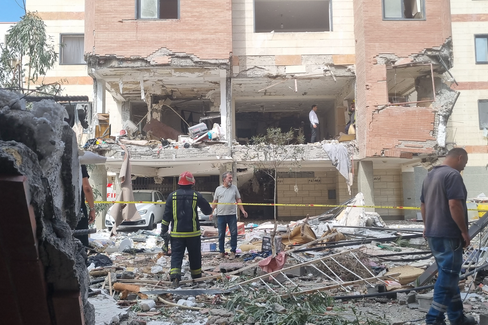
Explosion at residential building in Qom attributed to gas leak. July 14, 2025

Recent fires and explosions across Iran have captured widespread attention and many remain skeptical of official explanations attributing them to routine accidents, especially gas leaks.

Since a June 24 ceasefire ending a punishing war with Israel, a string of blasts and fires has struck residential buildings, airports, and sites described as commercial warehouses in cities including Tehran, Karaj, Qom, Mashhad and Tabriz.

In every case, government officials and state media have rushed to downplay the events, describing them as isolated incidents caused by routine factors.

Israeli air strikes and drone attacks during the 12-day war killed hundreds of Iranian military personnel and nuclear scientists, along with with hundreds of civilians.

The most recent explosion occurred at a residential complex in Qom, injuring seven people.

Footage from the scene showed extensive damage to ground- and first-floor apartments as well as nearby vehicles. Authorities attributed the blast to a gas leak.

That same day, additional incidents were reported: explosions and fire near Karaj; a fire at Mashhad Airport; a large blast in a desert area near Semnan; an explosion in Tabriz; and a fire in a commercial building in central Tehran.

No immediate explanations were offered for most. A Civil Aviation Organization official claimed the smoke at Mashhad Airport was due to "planned burning of weeds."

Government blames media panic

Iranian officials insist the incidents are routine and accuse foreign-linked media of spreading fear. Even minor events now trigger public suspicion.

When a car caught fire on a Tehran motorway on Monday, some compared it to Israeli operations targeting Hezbollah vehicles—despite no visible signs of an attack.

Speaking to the IRGC-linked Fars News Agency, an unnamed official accused “anti-Revolutionary media and Zionist-linked accounts” of connecting natural events to war in order to cause panic.

“People should not worry about this type of news fabrication,” he said.

But with each blast, more Iranians appear to be tuning out the official narrative—and asking harder questions.

Public unease and satire

“Every time something blows up, they say it’s a gas leak,” one user posted on X. Others shared footage with sarcastic captions questioning the frequency of incidents and the speed of official responses.

Satire has become a vehicle for disbelief.

After a July 10 explosion at a residential tower in Tehran’s Chitgar district, an X user named Mehran joked: “Call the Tehran gas company right now and someone picks up saying, ‘Shalom, how can I help you?’”

During the recent 12-day conflict, Israel targeted Iranian military figures and nuclear scientists at their homes.

In prior years, explosions at sensitive sites were later revealed as acts of sabotage—including the 2020 assassination of nuclear official Mohsen Fakhrizadeh with a remote-controlled weapon.

Some Iranian users on social media have been joking that the state may be deliberately turning a blind eye to Israeli involvement—because officially acknowledging it would compel a response and risk dragging the country back into war.

Others see it in darker terms, comparing Iran to Lebanon and its mounting vulnerability.

“It’s gotten to the point where smoke suddenly rises from Vanak (Square) at noon, someone says it was an explosion, someone else says it was nothing. But no one really asks what happened anymore; people are used to it,” wrote a popular user going by the name @NR2OH on X.

“Tehran has become like Beirut: anything can blow up at any moment, but life carries on like nothing happened,” they added.

Most Viewed

Iran negotiators ordered to return after internal rift over Islamabad talks
1
EXCLUSIVE

Iran negotiators ordered to return after internal rift over Islamabad talks

2
ANALYSIS

US blockade enters murky phase as tankers spoof signals and buyers hesitate

3
ANALYSIS

Why the $100 billion Hormuz toll revenue is a myth

4

US tightens financial squeeze on Iran, warns banks over oil money flows

5
ANALYSIS

US blockade targets Iran oil boom amid regional disruption

Banner
Banner

Spotlight

  • Hardliners push Hormuz ‘red line’ as US blockade tests Iran’s leverage
    INSIGHT

    Hardliners push Hormuz ‘red line’ as US blockade tests Iran’s leverage

  • Ideology may be fading in Iran, but not in Kashmir's ‘Mini Iran'
    INSIGHT

    Ideology may be fading in Iran, but not in Kashmir's ‘Mini Iran'

  • War damage amounts to $3,000 per Iranian, with blockade set to add to losses
    INSIGHT

    War damage amounts to $3,000 per Iranian, with blockade set to add to losses

  • Why the $100 billion Hormuz toll revenue is a myth
    ANALYSIS

    Why the $100 billion Hormuz toll revenue is a myth

  • US blockade targets Iran oil boom amid regional disruption
    ANALYSIS

    US blockade targets Iran oil boom amid regional disruption

  • Iran's digital economy battered by prolonged blackout
    INSIGHT

    Iran's digital economy battered by prolonged blackout

•
•
•

More Stories

Iran's Khorramabad Valley added to UNESCO World Heritage List

Jul 15, 2025, 18:05 GMT+1

The prehistoric sites of the Khorramabad Valley in Iran, including five caves and one rock shelter, have been added to the United Nations Educational, Scientific and Cultural Organization (UNESCO) World Heritage List.

Located in the Zagros Mountains, the Khorramabad Valley was inscribed as Iran’s 29th World Heritage site on July 10, during the 47th session of the UNESCO World Heritage Committee held in Paris.

Human presence in the valley dates back 63,000 years. The site is described as a key piece of the puzzle in understanding early human evolution and the migration from Africa to Eurasia.

Much of the area remains unexplored, offering potential for future archaeological excavations and discoveries.

Khorramabad Valley is located in Lorestan Province, which boasts over 5,000 historical sites—more than 2,600 of which are nationally registered in Iran.

An artist's rendering of a prehistoric scene at the caves, courtesy of the National Museum of Iran
100%
An artist's rendering of a prehistoric scene at the caves, courtesy of the National Museum of Iran

Fereydoun Biglari, head of the Paleolithic Department at Iran’s National Museum who led excavations at one of the caves underscored the historical importance of the sights, according to remarks cited by Archaeology News magazine.

“All five sites yield strong evidence for Neanderthal occupation and offer valuable insight into their material culture, subsistence strategies, and interactions with early Homo sapiens who migrated to the Zagros around 45,000 years ago,” Biglari said.

Khorramabad was also one of the major cities in western Iran during the Sassanid era. The Falak-ol-Aflak Castle, also known as Shapurkhast Fortress, is a surviving monument from that period and serves as a symbol of the city. The city also served as a capital for the Hazaraspid and Al-e Hasanuyah dynasties.

Iranian Minister of Cultural Heritage, Tourism, and Handicrafts also provided an update on the status of Falak-ol-Aflak Castle, saying it is on track to be added to the UNESCO list.

“The UNESCO resolution also referenced the status of Falak-ol-Aflak Castle. The deficiencies previously identified by international experts are being addressed, and with the necessary requirements being met, this prominent fortress is expected to be included alongside the Khorramabad Valley and inscribed as a World Heritage site in next year’s session,” said Reza Salehi Amiri in an interview with state TV on July 10.

The last addition to Iran's World Heritage List came in 2023, when the country’s caravanserais were inscribed.

Iran’s president accused of coup plans as post-war rift widens

Jul 15, 2025, 16:34 GMT+1
•
Behrouz Turani

Iran’s political fault lines are widening in the aftermath of the 12-day war with Israel, with President Masoud Pezeshkian facing accusations of attempting a coup against Supreme Leader Ali Khamenei.

More than 30 lawmakers have called for his dismissal, signaling a deepening power struggle masked only briefly by calls for post-war unity.

Hardliners accuse relative moderate Pezeshkian of overstepping his authority and plotting to steer the Islamic Republic toward normalization with Israel, without citing any evidence.

“The Pezeshkian administration will end the Islamic Revolution before the conclusion of his term,” MP and former ambassador Abolfazl Zohrevand said in a video that has gone viral.

“They believe that by ending the revolution and terminating Khamenei’s rule, they can begin a new era and join the Abraham Accords,” he added.

When asked if this amounted to a coup, Zohrevand replied, “What else could this be if not a coup d’état?”

While such rhetoric may appear extreme, it reflects a broader anxiety in Tehran about the future of the theocracy post-Khamenei—a question brought to the fore by his unprecedented absence from public life during and after Israeli strikes on Iran.

Presidential pushback

Pezeshkian himself has alluded to the infighting.

“We are not allowed to impose our views on others,” he told staff on July 13 according to an official readout. “Those who oppose us are not necessarily our enemies … We should not favor insiders over outsiders through coercion.”

A close adviser to Khamenei also addressed the clash—notably disapproving of the growing pressure on Pezeshkian.

“(Some) groups of Iranian politicians and political organizations are attempting to challenge the President’s political competence,” news outlet Asr-e Iran quoted Mohammad Mokhber as saying. “(It’s) a wrong move.”

Reformists sound the alarm

Some reformist voices now warn that what is unfolding is not post-war unity but dangerous fragmentation.

“The dust has not settled after the explosions, yet the sound of polarization is louder than the missile blasts,” former government spokesman Ali Rabiei wrote in Etemad Daily on July 10. “Let’s prevent societal fragmentation—this is precisely what the aggressors want.”

Nuclear scientist and ex-MP Ahmad Shirzad echoed the warning, calling for a more inclusive approach that would reconcile a largely alienated population.

“We need to return to the people and secure their partnership in governance. They must be able to see the government as their own,” Shirzad wrote in the reformist daily Arman Melli.

Calls for “national reconciliation” now function less as policy proposals than as signals of alarm: the war may have ended, but the political reckoning has only begun.

“The government must not dismiss societal demands,” Reform Front spokesperson Javad Emam said.

“It should release all political prisoners, invite political participation, and declare a general amnesty to facilitate the return of Iranian expatriates.”

Watching war from afar: Iranian diaspora grief is real

Jul 15, 2025, 11:44 GMT+1
•
Farnaz Farrokhi

Watching Iran burn from afar creates a unique kind of anguish—a sense of guilt that you’re free and safe while your homeland is in pain.

As someone who lived through the Iran-Iraq War and now works as a trauma-informed grief and anxiety counselor, I’ve felt both sides of this reality—the trauma of conflict and the quiet torment of safety, watching loved ones suffer from a distance.

For many Iranians in the diaspora, the images flooding our screens—of women removing their hijabs, of protesters facing violence, of families torn apart—rekindle our own memories of fear and loss.

If you’ve fled to safety and now witness the struggle through your screen, know this: your pain is real, your feelings valid. You are not alone.

The surreal reality of distance

There’s something disorienting about watching your homeland’s suffering while living in freedom. You might scroll through news obsessively, heart racing with each update.

Drinking your morning coffee while reading about another protester’s death or celebrating your child’s milestones while Iranian children face fear can create a jarring emotional split.

You may feel guilty for the freedoms you now enjoy, relive past traumas or find yourself emotionally transported back to earlier moments of fear and helplessness.

For many, simply navigating daily life while carrying the emotional weight of a distant crisis can be overwhelming.

Understanding diaspora trauma

The trauma felt in exile is layered and often misunderstood. Relief and guilt coexist—grateful to be safe, yet emotionally anchored to a country still suffering.

This survivor’s guilt is hard to shake when the crisis back home hasn’t ended.

Photos of crackdowns, arrests, or even the Iranian flag may evoke grief. Persian news broadcasts, protest chants or traditional music can trigger memories of fear or loss.

Well-meaning comments like “at least you’re safe” may feel dismissive and isolating. And the challenge of reconciling your identity with how Iran is portrayed in the media can deepen the sense of disconnection.

Survivor’s guilt, silent shame

You may wonder why you deserve freedom when others don’t. Everyday joys—walking outside unveiled, speaking freely, or laughing aloud—can feel laced with shame.

The belief that you’re not doing “enough” to help those still struggling can intensify that guilt. The privilege of safety and agency, once hard-won, may suddenly feel too heavy to carry.

Even in safety, your body may react as if under threat.

This is secondary trauma—when witnessing violence affecting your community triggers real psychological responses: flashbacks, insomnia, numbness, anxiety.

Your body is trying to stay connected to those you’ve left behind, even if it can’t protect them.

Grounding in the present

When emotions become overwhelming, grounding techniques can help return you to the present moment.

One simple method is the 5-4-3-2-1 sensory technique, which gently anchors you through what you can see, touch, hear, smell, and taste:

Five things you can see: A window, a tree, a book, a rug, etc. 4 things you can touch: Clothing, floor, cup, chair. 3 things you can hear: Birds, traffic, your breath. 2 things you can smell: Tea, candle, your shirt. 1 thing you can taste: Water, gum, tea.

It’s especially helpful when anxiety or distress feel like too much to bear. Each sensory cue offers a small reminder: you are here, and you are safe.

Breath and affirmation

Another powerful tool for managing intense emotion is breathwork paired with gentle affirmations.

Begin by placing a hand on your chest or belly. Inhale slowly through your nose to a count of four, pause for a moment, then exhale gently through your mouth for a count of six. Let your breath settle into a rhythm.

As you breathe, repeat calming words to yourself: I am here. I am safe. This is now. You might remind yourself, My freedom honors those still fighting, or My survival is not betrayal—it is resilience.

These affirmations are not meant to erase the pain, but to acknowledge it—and to help you stay rooted in your reality. You carry Iran in your heart.

You can grieve and still build a meaningful life. Breath by breath, you remind your nervous system that you are allowed to heal.

Healing together

Living between two worlds can be confusing and lonely—but healing doesn’t mean letting go of who you are. Both identities can coexist.

Making Persian food while playing Googoosh or Dariush, dancing along with pop videos, or wearing a necklace from home can be quiet acts of memory and resilience. They allow you to choose when to share your story and when to simply carry it.

And in that space, both sorrow and joy can safely exist together.

The light that enters

Survivor’s guilt is the shadow of resilience—proof that you care deeply. It’s a heavy ache, a reminder that freedom comes at a cost. But when you name that grief, you create space for compassion, purpose, and solidarity.

As Rumi wrote: “The wound is the place where the light enters you.”

Let that wound become your strength. You are not broken. You are connected. And you are allowed to move forward—carrying Iran with you as you do.

Iran doubts Israel ceasefire and is ready for combat, defense minister says

Jul 14, 2025, 22:10 GMT+1

Iran's defense minister on Monday said the Islamic Republic does not trust the current ceasefire with Israel and has prepared multiple military scenarios in anticipation of renewed hostilities.

“The Islamic Republic does not trust the ceasefire,” Aziz Nasirzadeh said in a phone call with Turkey’s defense minister Yasar Guler on Monday, according to the state-run IRNA news. “We have therefore anticipated various scenarios for any new adventurism.”

“We are not seeking to expand war and insecurity in the region, but we are ready to give a firm and regret-inducing response to any act of aggression,” he added.

Nasirzadeh also criticized the timing of the strikes, saying, “The attack on Iran took place during negotiations. We have proven to the world that we are not opposed to dialogue and negotiation.”

On June 13, Israel launched a large-scale surprise air campaign against Iran, striking multiple nuclear and military sites as part of the opening phase of what became a 12‑day conflict.

Hundreds of Iranian civilians were killed in the Israeli airstrikes. Iranian missile attacks also killed 27 Israeli civilians.

Following the Israeli strikes, Iran–US nuclear talks scheduled for June 15 in Muscat were called off.

The United States joined the offensive on June 22 with its own strikes—dubbed Operation Midnight Hammer—involving B‑2 bombers and Tomahawk cruise missiles targeting Natanz, Fordow, and Isfahan.

A ceasefire came into effect on June 24, brokered by US President Donald, marking the end of the fighting. While the ceasefire ended the air war, its long-term viability remains in doubt.

Last month, Iran’s reformist daily Shargh described the ceasefire as legally fragile and unpredictable.

“The ceasefire is not based on any international legal standards, regulations, or the rules of official global organizations and institutions,” the newspaper wrote.

“In fact, it is a temporary and ambiguous ceasefire, and there can be no serious certainty about its durability.”

Last week, Prime Minister Benjamin Netanyahu said in an interview that Israel had rolled back Iran's nuclear program but implied the Jewish state had not yet finished its confrontation with the Islamic Republic.

In rare riposte, Khamenei’s office lashes out at Israeli ex-defense minister

Jul 14, 2025, 21:53 GMT+1

Ali Khamenei’s office has responded to an open letter sent by former Israeli defense minister Yoav Gallant to Iran's Supreme Leader, calling it propaganda and a “full-scale psychological operation.”

In an op-ed published Monday on Khamenei’s official website, his office issued a rare rejoinder to Israeli officialdom in which it dismissed Gallant's assertions of overwhelming Israeli military and intelligence superiority.

The statement described Gallant's message as part of “a conflict whose primary battlefield is not border zones, but public perception and the realm of awareness.”

Gallant’s letter, dated July 9, highlighted what he described as Israel’s supremacy over Iran which had unraveled the Islamic Republic's long-held strategy.

“What unfolded in June 2025 was not merely a military campaign. It was the strategic collapse of a system you spent four decades constructing,” Gallant wrote, referring to the 12-day Iran-Israel war last month.

Israel launched a series of strikes on June 13 which pounded military and nuclear sites, assassinated senior commanders and killed hundreds of civilians. Iranian missiles killed 27 Israeli civilians.

Gallant warned Khamenei that Israel has full access to Iran’s inner workings, including military planning and high-level decision-making.

“We knew your schedules. Your sites. Your communications. Your conversations with your closest allies — most of whom are no longer with you — in Beirut, Damascus, and Tehran. Your timelines. Your fallback plans. And your blind spots,” he wrote.

The letter also highlighted weaknesses in Iran’s air defenses and warned that any attempt to restore the nuclear program would invite future attacks.

“Abandon your war against a small, determined country a thousand miles from your border," Gallant said, "and focus instead on the welfare and future of your own people.”