• العربية
  • فارسی
Brand
  • Iran Insight
  • Politics
  • Economy
  • Analysis
  • Special Report
  • Opinion
  • Podcast
  • Iran Insight
  • Politics
  • Economy
  • Analysis
  • Special Report
  • Opinion
  • Podcast
  • Theme
  • Language
    • العربية
    • فارسی
  • Iran Insight
  • Politics
  • Economy
  • Analysis
  • Special Report
  • Opinion
  • Podcast
All rights reserved for Volant Media UK Limited
volant media logo

Tel Aviv resident arrested in alleged Iranian spy plot, Israel says

Jul 7, 2025, 13:02 GMT+1Updated: 07:54 GMT+0
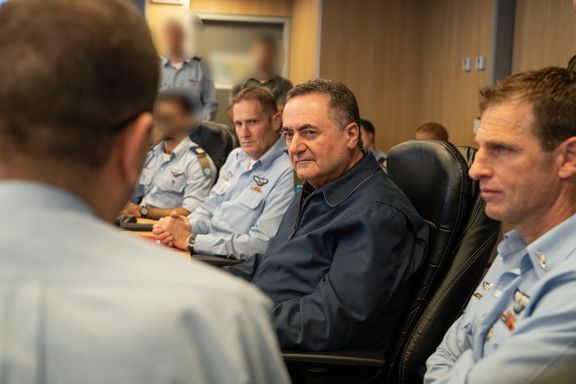
Israeli Defense Minister Israel Katz, a target of alleged spy plots

Israeli security services have arrested a Tel Aviv resident accused of being involved in an Iran-backed plot targeting the country’s politicians and military bases, as the number of cases continues to rise.

In a statement, Israel Police said: “The Shin Bet and the police emphasize: Iranian agents are trying to recruit Israelis on social media - any suspicious contact should be reported.”

In a paper for the Jerusalem Center for Security and Foreign Affairs, Oded Ailam, a former head of Mossad’s counter terrorism unit, wrote: “Through aggressive mass campaigns on social media, thousands of Israelis are being approached."

"Messages like 'Want to earn some easy cash?' now pepper the digital landscape. No serious screening or background checks, just a Telegram or email message offering money for a 'simple task.' Track a senior figure. Snap a photo of a base. Willing to try? You’re in.”

The latest case is a 27-year-old Tel Aviv resident. Israel Police said he was arrested “on suspicion of carrying out tasks for an Iranian agent, including documenting the homes of elected officials and military bases - in exchange for payment in virtual currencies”.

A prosecutor's statement was filed against him on Monday.

Ailam said that Iran’s Islamic Revolutionary Guard Corps has discarded the slow, resource-heavy traditions of classical espionage.

“No more lengthy vetting, grueling training, or elaborate cover stories. Instead, they’ve embraced a model that’s raw, direct, and disturbingly effective. This is Iran’s version of digital marketing applied to espionage: blanket targeting, no filters."

“And like any marketing effort, only a tiny fraction need to respond for the campaign to succeed. To Tehran, even a one percent success rate from a thousand messages is worth it. It’s a chillingly rational approach: volume will eventually produce the quality they seek. And sadly, it works.”

Last year, Israel saw a 400% spike in alleged Iran-backed spy cases, arresting 27 Israeli citizens in 13 separate cases.

This year, cases continue, with plots including a planned attack on Defense Minister Israel Katz, believed to have been the 20th case since the start of the Gaza war.

In February, two army reservists were caught passing classified information on the country’s Iron Dome defense system to an Iranian operative.

Most Viewed

Iran negotiators ordered to return after internal rift over Islamabad talks
1
EXCLUSIVE

Iran negotiators ordered to return after internal rift over Islamabad talks

2
ANALYSIS

US blockade enters murky phase as tankers spoof signals and buyers hesitate

3
ANALYSIS

Why the $100 billion Hormuz toll revenue is a myth

4

US tightens financial squeeze on Iran, warns banks over oil money flows

5
ANALYSIS

US blockade targets Iran oil boom amid regional disruption

Banner
Banner

Spotlight

  • Hardliners push Hormuz ‘red line’ as US blockade tests Iran’s leverage
    INSIGHT

    Hardliners push Hormuz ‘red line’ as US blockade tests Iran’s leverage

  • Ideology may be fading in Iran, but not in Kashmir's ‘Mini Iran'
    INSIGHT

    Ideology may be fading in Iran, but not in Kashmir's ‘Mini Iran'

  • War damage amounts to $3,000 per Iranian, with blockade set to add to losses
    INSIGHT

    War damage amounts to $3,000 per Iranian, with blockade set to add to losses

  • Why the $100 billion Hormuz toll revenue is a myth
    ANALYSIS

    Why the $100 billion Hormuz toll revenue is a myth

  • US blockade targets Iran oil boom amid regional disruption
    ANALYSIS

    US blockade targets Iran oil boom amid regional disruption

  • Iran's digital economy battered by prolonged blackout
    INSIGHT

    Iran's digital economy battered by prolonged blackout

•
•
•

More Stories

Israel says it captured Iranian Quds Force cell in Syria

Jul 7, 2025, 12:48 GMT+1

The Israeli military said on Monday it had detained members of an Iranian Quds Force cell — the foreign operations arm of Iran's Revolutionary Guards — in Syria during an overnight raid, the second such operation in a week.

In a statement Monday, the military said that the cell was arrested in the Tel Kudna area of southern Syria, though it did not give further details.

“For the second time in the past week, the division’s troops completed a targeted overnight operation and apprehended several operatives who posed a threat in the area,” the statement said.

The Wall Street Journal reported in January that following the fall of former Syrian president Bashar al-Assad, most Iranian forces and their allies had withdrawn from Syria.

On Monday, the Syrian Observatory for Human Rights reported that multiple operations from Israeli forces had happened Sunday, with convoys searching homes across several villages before making arrests.

“The number of people arrested by Israeli forces in the Quneitra countryside rose to six people, including two children, following an incursion carried out by the forces in the villages of Suwaysa and the vicinity of the town of Nab' al-Sakhr in the central Quneitra countryside,” a statement said.

It comes as the Israeli military carried out overnight attacks on Iran’s Yemeni allies, the Houthis, which continue to carry out regular missile attacks against the Jewish state in its campaign in allegiance with Iran-aligned Hamas in Gaza.

Defense Minister Israel Katz said on X that Houthi infrastructure was targeted.

“The fate of Yemen is the same as the fate of Tehran," he said, referring to a recent Israeli campaign targeting Iran.

"As part of Operation Black Flag, the IDF has now forcefully struck terror targets of the Houthi terror regime in the ports of Hodeidah, Al-Salif, and Ras Isa, the Ras Katib power station, and the ship Galaxy Leader, which was hijacked by the Houthis about two years ago and is currently used for terror activities in the Red Sea.”

The Israeli military said that approximately 20 fighter jets used over 50 munitions in the operation.

A statement from the Houthis’ Telegram channel said the group had repelled the attack.

“Our air defense succeeded in confronting the Zionist aggression against our country and thwarting its plan to target a number of Yemeni cities. This was achieved by forcing a number of combat formations participating in the aggression to leave the airspace, preventing them from launching raids,” the statement said.

The Israeli military said two missiles were launched by the Houthis in the early hours of Monday morning in response, though it had not confirmed an interception.

The Houthi statement said the operation used 11 missiles and drones targeting Tel Aviv’s Ben Gurion Airport, Ashdod Port, Ashkelon power station and the port of Eilat on Israel’s Red Sea coast.

Air pollution in Tehran, Karaj spark health warnings

Jul 7, 2025, 12:14 GMT+1

As air quality in Tehran and much of neighboring Alborz province reaches hazardous levels, medical experts are advising the vulnerable to stay indoors, with preparations underway for an emergency response.

In the capital, levels had reached 260 in the past 24 hours with other areas exceeding 300, entering the 'hazardous' category, the highest state of alert in the country's pollution indexes which range between zero and 500.

Health officials have advised people with existing medical conditions, children, and pregnant women to avoid outdoor exposure.

In neighboring Alborz province, conditions have worsened further. Kamran Haghi, acting head of the provincial meteorological office, confirmed that air quality in most areas had entered the hazardous category overnight.

“Pollution levels in parts of the province surpassed 300, and strong winds carrying dust will continue through the end of the week,” he said. He urged residents to keep windows shut and use filtered masks.

Mohammadreza Fallahnejad, acting director of Alborz’s crisis management office, linked the deterioration to low seasonal rainfall. “With reduced precipitation this year, the situation is intensifying each day,” he said.

The provincial environmental department has called on hospitals and emergency services to prepare for a rise in respiratory cases.

The recent dust affecting the country stems from both domestic and foreign sources, which operate independently of each other, said Behzad Raygani, acting secretary of the National Headquarters for Dust Storm Policy and Coordination, as reported by Tasnim.

“Part of this dust has entered from Syria and parts of Iraq, impacting our western provinces and parts of the central region. These sources have become particularly active in Syria,” he added.

“Aside from the western half and parts of central Iran, most provinces are dealing with dust due to internal and local sources.”

UK report warns of Iranian plots as Italy reveals covert influence network

Jul 7, 2025, 10:43 GMT+1

A parliamentary report in the UK is set to warn that Iran remains one of the gravest state-based threats to British security, according to The Telegraph, while a separate investigation in Italy has uncovered a vast influence network supporting the Islamic Republic.

“The Telegraph understands the findings will conclude that Iran remains one of the biggest state-based threats to the UK, in the same bracket as China and Russia,” the article said ahead of the release of the Intelligence and Security Committee’s report, based on classified intelligence and interviews with British agencies.

Ken McCallum, the director-general of British intelligence service MI5, last year revealed the extent of Iranian threats on UK soil.

“Since January 2022, with police partners, we have responded to 20 Iran-backed plots presenting potentially lethal threats to British citizens and UK residents," he said.

He warned that “Iranian state actors make extensive use of criminals as proxies—from international drug traffickers to low-level crooks.”

The upcoming report, signed off by Prime Minister Keir Starmer, will also detail cyber attacks against UK companies and threats against journalists. “Those familiar with the report’s contents expect it to be a wake-up call for ministers about the persistent threat of Iran and its ability to act within the UK,” the Telegraph added.

‘Surveillance and soft power’ in Italy

Meanwhile, Italy’s Linkiesta published the findings of a months-long investigation into the Islamic Republic's influence network.

“There is a silent Iran that runs through the meshes of Italian society, not the one in war chronicles or official press releases, but an Iran that acts under the radar," the outlet wrote.

They called the Cultural Center of the Iranian Embassy in Rome "an operational hub that coordinates events, conferences and exhibitions with specific political purposes: building consensus around the regime and promoting an image of Iran as a spiritual, anti-imperialist and tolerant state".

The investigation found that since 2009, Iranian investments in academic programs across Italy have exceeded one million euros. These include joint centers and exchange agreements with universities in Rome, Milan, Florence, and Turin.

Iranian religious centers in Rome and Milan have hosted events commemorating Hezbollah leaders and promoting Tehran’s political ideology.

Testimonies from Iranian dissidents in Italy have also revealed the ongoing targeting of Iranians abroad. One woman said: “After some protests in Rome, I was followed for days and my family members in Iran were subjected to house searches. They begged me to stop supporting the movements against the regime."

Another activist said: “Once, during a sit-in, an official from the Iranian embassy approached us and said: ‘We are monitoring you, and your loved ones back home will cry."

According to Linkiesta, a dedicated unit of 15 to 20 operatives inside the Iranian embassy in Rome oversees three areas: cyber surveillance, field monitoring, and intelligence reporting to Tehran. The unit works closely with Iran’s Ministry of Intelligence and the Revolutionary Guard’s foreign branches.

Weakened Iran brings cautious relief in Persian Gulf states

Jul 7, 2025, 03:00 GMT+1

Persian Gulf states are quietly relieved that the 12-day war with Israel has weakened the Islamic Republic, security experts told Iran International, though Tehran's Arab rivals prefer a declawed Iran to a regime change that would lead to instability.

The surprise Israeli attacks that started on June 13 were publicly condemned by Persian Gulf states which oppose Iranian hegemony in the region but seek calm to boost domestic growth agendas.

“These disruptions are of significant concern to Emirati policymakers who place a premium on regional calm and continuity,” said a senior security expert in the United Arab Emirates.

“The UAE remains concerned about the broader implications of regional conflict, economically, socially as well as politically," the expert told Iran International on condition of anonymity due to political sensitivities.

The United Arab Emirates, along with Morocco and Bahrain, is a party to the US-brokered Abraham Accords in 2020 which normalized relations between Israel.

Collective unease with Iran contributed to the historic shift toward normalization, experts say.

Last month, Abu Dhabi publicly condemned the Israeli attacks as a violation of Iran's sovereignty, but the attacks degraded the military might of a rival whose nuclear ambitions its neighbors long feared.

The campaign saw Israel gain control of Iran's airspace within days as it assassinated top military leaders and degraded Iranian missile capabilities.

However, any prolonged conflict or upheaval inside Iran would be viewed as a potential risk to the regional countries' tourism, trade and foreign investment, a taste of which was offered by the closing of air space across the Persian Gulf and crashing stock markets amid the conflict.

The United Arab Emirates is also home to around 500,000-800,000 Iranians who have been a historic force in the country’s trade and commerce concentrated in Dubai.

Interest in relative calm puts Arab capitals potentially at odds with some Iranians' hopes for fundamental change in the wake of the war, which does not appear to be forthcoming despite the punishing air war.

“The UAE takes a pragmatic approach and recognizes that broad systemic change in Iran is unlikely to be externally driven," the expert added.

Risks of regime change in Iran

Iran's southern neighbors are pleased with Tehran's chastisement but will maintain good relations for the sake of regional peace, said Emirati political commentator and academic Abdulkhaleq Abdulla.

The region "is better off now that Iran lost most of its bargaining power, namely its regional proxies, nuclear and missile powers,” he told Iran International.

“But even a weakened Iran remains a key threat to (Persian) Gulf security so the Arab states will continue with their policy of opening up to Iran and show solidarity with its people.”

The fragile ceasefire and the vulnerability of Iran's ruling system is likely to preoccupy Iran's neighbors.

Aimen Dean, of Bahraini-Saudi descent but famous for his deep work for the British spy agency MI6 embedded inside Al Qaeda, said the truce was no panacea.

“The relief isn’t here yet. Not a single government here in this region wants a regime change at least for now,” the managing director of Five Dimensions Consultants in Dubai said.

“They are afraid of two particular scenarios. The first is that an uprising happens and you end up with defections in the army and then the whole country collapses into civil war," Dean added, warning of refugee crisis on Arab shores.

The alternative scenario feared is the possibility of an ethnic breakup of Iran if the government should fall. “Nobody wants that as that also will result in a major flow of refugees and a failed state where people have access to nuclear materials,” Dean explained.

Instead, in the halls of power in the Persian Gulf, from regional juggernaut Saudi Arabia to the tiny island nation of Bahrain, Dean said there is the hope that a “defanged and declawed Iran” would be better contained within its own borders.

“That’s the ideal outcome.”
Danish-Afghan man secretly visited Iran after spying on Jewish targets - Bild

Jul 6, 2025, 21:20 GMT+1

An Afghan-Danish national arrested in Denmark for spying on behalf of Iran’s Revolutionary Guards had traveled covertly to Iran after gathering intelligence on Jewish sites in Berlin, German newspaper Bild reported Sunday.

According to Bild, the 53-year-old suspect, identified as Ali S., entered Iran in June 2025 under the cover of a family trip to Turkey.

He allegedly delivered surveillance photos, videos, and detailed information about potential targets in Berlin to a Quds Force officer in Tehran. He then left Iran using forged documents, avoiding any entry or exit stamps in his Danish passport.

The intelligence, Bild reported, included back entrances, security patrols, and suggested locations for placing incendiary devices or explosives. German authorities now believe he was planning or facilitating attacks on Jewish institutions in Germany.

According to the report, Ali S. had traveled to Berlin between June 4 and 6 with his wife and children, during which time German intelligence monitored him closely.

Bild said investigators observed him photographing at least ten sites, including the German-Israeli Society, the office of Josef Schuster—head of the Central Council of Jews in Germany—an Israeli restaurant, and a kosher supermarket near Kurfürstendamm.

Danish intelligence services first flagged the suspect after intercepting online messages between him and a known Quds Force officer.

German authorities then launched full surveillance and bugged his residence in Aarhus. After returning from Iran on June 23, he told his family he had handed over the intelligence to his handler in Tehran—information captured through wiretaps, according to Bild.

Germany’s Federal Prosecutor Jens Rommel issued an arrest warrant on June 24, saying Ali S. is “strongly suspected of working for a foreign intelligence service.” He now faces charges of espionage and planning attacks in Germany.

Bild report said the case is considered one of the most significant discoveries of Iranian intelligence activity on German soil in recent years.