• العربية
  • فارسی
Brand
  • Iran Insight
  • Politics
  • Economy
  • Analysis
  • Special Report
  • Opinion
  • Podcast
  • Iran Insight
  • Politics
  • Economy
  • Analysis
  • Special Report
  • Opinion
  • Podcast
  • Theme
  • Language
    • العربية
    • فارسی
  • Iran Insight
  • Politics
  • Economy
  • Analysis
  • Special Report
  • Opinion
  • Podcast
All rights reserved for Volant Media UK Limited
volant media logo

Iran launches retaliatory missile attacks on US base in Qatar

Jun 23, 2025, 18:00 GMT+1Updated: 15:54 GMT+1

Iran has launched a direct missile attack on US forces stationed at Al Udeid Air Base in Qatar in a dangerous new escalation that followed the American airstrikes against three Iranian nuclear facilities.

Missiles were fired at the base as part of what Iran's state television is calling “Operation Herald of Victory".

Qatari air defense systems intercepted the Iranian missile attack, Al Jazeera reported, citing the Qatari defense ministry.

Doha condemned the Iranian airstrikes against US forces in Al Udeid, saying it reserves the right to respond directly and in accordance with international law.

It also confirmed that the attack resulted in no fatalities.

The US president is at the White House Situation Room, discussing a possible response to the Iranian attack, according to CNBC.

According to the New York Times and Reuters, Iran had coordinated the attack with Qatari officials and the United States in advance and gave early notice to help minimize casualties.

In a statement, Iran's Supreme National Security Council gave Doha an assurance that the targeted US base was located far from residential areas and posed no danger to “the brotherly and friendly country of Qatar and its people.”

Tehran emphasized that it remains committed to maintaining its “warm ties with Qatar.”

The situation remains fluid as US officials assess the damage and prepare for possible further retaliation. Al Udeid is the largest US military base in the Middle East, hosting thousands of American personnel and serving as a strategic hub for regional operations.

Most Viewed

Iran negotiators ordered to return after internal rift over Islamabad talks
1
EXCLUSIVE

Iran negotiators ordered to return after internal rift over Islamabad talks

2
ANALYSIS

US blockade enters murky phase as tankers spoof signals and buyers hesitate

3
ANALYSIS

Why the $100 billion Hormuz toll revenue is a myth

4

US tightens financial squeeze on Iran, warns banks over oil money flows

5
ANALYSIS

US blockade targets Iran oil boom amid regional disruption

Banner
Banner

Spotlight

  • Hardliners push Hormuz ‘red line’ as US blockade tests Iran’s leverage
    INSIGHT

    Hardliners push Hormuz ‘red line’ as US blockade tests Iran’s leverage

  • Ideology may be fading in Iran, but not in Kashmir's ‘Mini Iran'
    INSIGHT

    Ideology may be fading in Iran, but not in Kashmir's ‘Mini Iran'

  • War damage amounts to $3,000 per Iranian, with blockade set to add to losses
    INSIGHT

    War damage amounts to $3,000 per Iranian, with blockade set to add to losses

  • Why the $100 billion Hormuz toll revenue is a myth
    ANALYSIS

    Why the $100 billion Hormuz toll revenue is a myth

  • US blockade targets Iran oil boom amid regional disruption
    ANALYSIS

    US blockade targets Iran oil boom amid regional disruption

  • Iran's digital economy battered by prolonged blackout
    INSIGHT

    Iran's digital economy battered by prolonged blackout

•
•
•

More Stories

Radiation risks from US strikes on Iran’s nuclear sites seen as minimal

Jun 23, 2025, 16:15 GMT+1
•
Negar Mojtahedi

US airstrikes on Iran’s nuclear facilities are unlikely to cause serious radioactive fallout, nuclear experts told Iran International despite fears of a nuclear disaster.

Their assessments come as Iran threatens retaliation, and the International Atomic Energy Agency (IAEA) holds an emergency meeting on Monday in response to the escalating crisis.

“For most facilities the impact of direct strikes will, to a large extent, most likely be very localized,” said Dr. Kathryn Higley, distinguished professor of nuclear science and engineering at Oregon State University and president of the National Council on Radiation Protection and Measurements told Iran International.

“While enriched uranium is radioactive, it is not terribly so. If the uranium is present and released as hexafluoride, that could also pose a serious but still localized hazard due to the fluorine in the compound being reactive," she said.

Dr. David Albright, founder of the Institute for Science and International Security, told Iran International that concerns over radiation from a strike on Fordow are overblown when compared with past incidents.

“One way to understand the low radiological risk of bombing Fordow is from a comparison to the underground Natanz enrichment site with over 15,000 centrifuges and many tons of uranium,” he said.

“It was attacked with earth penetrators and there is no off-site radiation risk. Fordow has about 2,700 centrifuges and much less uranium, and is more deeply buried underground. Hard to expect worse than Natanz.”

Albright emphasized that the design and location of Iran’s underground enrichment sites inherently limit the spread of radioactive.

Temporary contamination risks are primarily limited to areas near uranium conversion and enrichment plants, according to Andrea Stricker, a research fellow at the Foundation for Defense of Democracies (FDD).

“Response teams going near the destroyed facilities, for example, would need to wear protective gear temporarily due to risks of inhaling or ingesting aerially dispersed uranium chemical compounds,” said Stricker. “There is not concern for dispersal beyond the immediate plants.”

The US strike on the heavily fortified Fordow facility has likely trapped radioactive material underground, limiting any broader hazard, Stricker said.

Iran's response: 'no signs of contamination'

Their comments follow US President Donald Trump’s announcement on Sunday that American forces had struck Iran’s Fordow, Isfahan, and Natanz nuclear sites, which he described as “completely and fully obliterated.”

While Iran confirmed the strikes, it insisted its nuclear program would continue undeterred.

Iran’s National Nuclear Safety System reported that radiation detectors at the affected facilities showed “no signs of contamination” and stated, “There is no danger to the residents living around the aforementioned sites," according to Iran State media.

The IAEA said it had observed “no increase in off-site radiation levels” and would continue monitoring the situation.

Director General Rafael Grossi announced an emergency meeting of the agency’s 35-member board of governors. In response, Iran’s nuclear chief Mohammad Eslami called for an investigation and accused Grossi of “inaction and complicity.”

Isfahan and Natanz—both previously targeted by Israeli airstrikes—have not shown any evidence of radiation release, according to IAEA monitoring.

Experts say Bushehr not likely to be targeted

Bushehr, Iran’s only operational nuclear power reactor, is not expected to be targeted.

“Israel will not have the Bushehr nuclear power plant on its target list, as striking the reactor would cause a radiological disaster in the region,” Stricker said.

Bushehr is used for civilian energy production, not enrichment. The plutonium it generates is not suitable for nuclear weapons, and spent fuel is required to be returned to Russia.

Still, the plant contains significant quantities of nuclear material, and Grossi has warned that an attack on Bushehr could have the most serious radiological consequences of any site in Iran.

Tehran continues to maintain that its nuclear program is for peaceful purposes, but Trump and Israeli officials argue Iran is moving dangerously close to weapons capability.

“There will either be peace," Trump said during a national address following the strikes, "or there will be tragedy for Iran."


Historic chance for change in Iran—but only if strategy follows, experts warn

Jun 23, 2025, 15:33 GMT+1
•
Negar Mojtahedi

The US and Israel may have altered the trajectory of the Mideast with military strikes on Iran’s nuclear infrastructure—but without a broader strategy for internal change, the window of opportunity could quickly close, experts told Iran International.

Over the weekend, US forces carried out unprecedented airstrikes targeting Iran’s Fordow, Natanz, and Isfahan nuclear facilities. B-2 stealth bombers and Tomahawk cruise missiles were used in a mission that involved more than 120 aircraft—making it one of the largest US military operations against the Islamic Republic in decades.

“This marks a dramatic and consequential shift in the region’s strategic balance,” said Dr. Eric Mandel, founder of the Middle East Political Information Network (MEPIN), a think tank focused on US foreign policy and national security in the Middle East. But he warned military strikes alone were not a strategy for lon-term success.

Mandel emphasized that lasting success depends on political vision, regional coordination, and tangible support for the Iranian people—including support for dissident networks, and a clear set of US conditions for any future negotiations.

The removal of nuclear capabilities from “the world’s most dangerous regime” makes the world safer, argued Jonathan Harounoff, spokesperson for Israel’s Mission to the United Nations and author of Unveiled: Inside Iran’s #WomanLifeFreedom Revolt.

'Rare opportunity' for change

Harounoff, whose family is of Iranian origin, said the Iranian people “deserve a government that cares more about their social and economic wellbeing and safety than in pouring hundreds of millions of dollars into constructing a dangerous foreign policy, a destructive nuclear program and a web of terror proxies across the Middle East.”

“The door has been opened to make sure Iran cannot continue its pursuit of nuclear weapons,” said former US Ambassador John Craig, who was part of the Carter administration’s mission to assess the Shah’s position just prior to the 1979 revolution. While it’s too early to predict long-term outcomes, Craig said Iran’s leadership is now under enormous pressure to either return to negotiations or risk further escalation.

“Iran is in a very, very bad place. The leadership has very few options,” said Craig.

Craig added that internal discontent is growing—but warned that the international community must consider who can credibly lead a push for regime change from within. “Time for the mullahs to go,” he said. “But who leads the way is the real question.”

Experts agree that Israel’s initial strikes—combined with US firepower—shattered the Islamic Republic’s sense of impunity. But they caution that without a coherent American strategy, this moment could be lost.

Unless the United States now moves with strategic clarity—disrupting Iran’s centers of power and actively supporting the Iranian people—this rare opportunity for meaningful change could slip away, Mandel warned.

Houthis say they are joining Iran war: can they make any difference?

Jun 23, 2025, 15:00 GMT+1

The US and Israel are preparing for a renewed wave of Houthi attacks on American shipping and Israeli territory, following the US nuclear strikes in Iran, as the Iran-backed group announced it had officially entered the war.

The Houthis' official X account posted in Hebrew on Sunday morning, warning Israelis to “leave the country immediately”, with a video of a missile launching and scenes of destruction in Israel from Iran’s recent missile attacks.

Houthis recently brokered a ceasefire with the Trump administration and agreed to cease attacks on US ships and assets in the Red Sea region. In the early hours of Sunday, the ceasefire was over.

"We will officially enter the war - keep your ships away from our territorial waters," an announcement from the group said.

The Houthis had been waging a maritime blockade since the early weeks of the Gaza war in 2023, in what it says is allegiance with the Palestinians in Gaza.

An Israeli intelligence source told Iran International that given the complexity of striking US assets, the Houthis, designated a foreign terrorist organization by the US and others, are more likely to target Israel first.

'Not a big deal'

“It’s a bit early to say but the Houthis would prefer to target Israel first, it’s less complex at this stage, but it’s hard to tell. The next 24 hours will be revealing,” he said.

“There is no major threat from the Houthis,” the intelligence source added. “They’re limited in their capability and while they will try to retaliate for the current situation, it is not a big deal.”

The Israeli military says that more than 40 surface-to-surface missiles have been fired towards Israel since the Gaza war began, with one barely missing Israel’s biggest airport, Ben Gurion, just weeks ago.

Another 320 UAVs had been fired towards Israel, over 100 of which intercepted with two effective hits as of January data. The remainder fell in open areas, failed to reach Israeli territory or caused no significant damage.

Yemeni military journalist Rashid Maarouf, based in Marib city, told Iran International on Sunday that the Houthis' next steps will depend on the extent of the impact of the American strikes on Iran's nuclear reactors.

Targeting Arab nations

He also agrees the group's capabilities are limited. “They are launching missiles at Israel, but the Houthis' missiles are limited. They do not have a large number to launch a large salvo like Iran does. Even if the Houthis struck Israel, they would not be able to strike with more than two to three missiles a day.”

Abdul Basit Al-Baher, the spokesman for Yemen's military in the governorate of Taiz, told Iran International: "The Houthis are in the crosshairs of the US-Iranian escalation, between the tool and the victim."

He says the US attacks on Iran will require the Houthis to launch new attacks on American or associated ships, using drones or missiles, in an attempt to divert attention from the US strike on Iran and to pressure Washington to halt any potential escalation against Tehran.

It may also trigger attacks on Saudi or Emirati targets, the two nations strong US allies, Al-Baher said.

"They are expected to attempt to expand the scope of the confrontation by targeting Arab coalition countries, particularly Saudi Arabia, to send a message that any targeting of Iran will destabilize the entire region," he said.

He warns that the most dangerous scenario would be full engagement in a "proxy war", Iran activating its regional military allies.

"If Iran decides to respond forcefully, it may use the Houthis as an offensive force against Western interests in the Red Sea," he said, including special attacks on commercial and military vessels or even an attempt to threaten oil and energy corridors."

Israel hits Evin Prison, key security institutions in Tehran on 11th day of war

Jun 23, 2025, 14:46 GMT+1

Israeli airstrikes on Monday targeted multiple sites linked to internal security and political control in the heart of Tehran, including the administrative and courtroom sections of Evin Prison — a facility long seen as a symbol of state repression.

The strikes, carried out under the direct orders of Israeli Prime Minister Benjamin Netanyahu and Defense Minister Yisrael Katz, focused on “regime targets and government repression bodies,” according to the Israeli Ministry of Defense.

Among the locations hit were the main gate and administrative buildings of Evin Prison.

There were no reported casualties among inmates, although several staff members were killed, according to information shared with Iran International.

Sources inside the facility confirmed to Iran International that office buildings, visitation areas, and judicial chambers were damaged in the strike.

Following the attack, families of political prisoners and local residents attempted to approach the site, according to witness accounts shared online.

Evin Prison, constructed in the 1970s, has long been associated with political detention and has housed journalists, activists, and dual nationals.

Strikes target multiple security bases

In addition to Evin, Israeli forces also struck a number of other prominent security and ideological institutions across Tehran and its suburbs.

Iran and Israel have not released an official list of the targets. Witness reports said they included the Basij headquarters, part of the IRGC’s paramilitary force, involved in controlling protests; the Tharallah Base (also known as Sarallah Base), an elite IRGC unit responsible for managing civil unrest in the capital; and the Seyyed al-Shohada IRGC base, a key provincial force in Alborz province, as well as the Intelligence Directorate of the national police.

Additionally, Iranian media reported strikes on the state media complex “9 Dey”, a technical hub for Iran’s national broadcasting system, including TV and radio transmission facilities.

Israel says goal is not regime change — but won’t rule out consequences

Israeli officials said on Monday again that the objective of the strikes is deterrence. “Our objective in Iran is not regime change,” a government spokesperson said on Monday. “But that may be the byproduct.”

Israeli Defense Minister Katz added, “For every shot fired at the Israeli home front, the Iranian dictator will be punished, and the attacks will continue with full force. We will continue until our war objectives are fully achieved.”

While Israel has previously struck infrastructure linked to Iran’s domestic security apparatus — including the headquarters of the Special Forces unit of the Islamic Republic’s Internal Security Forces and a main building of the state broadcaster IRIB — the latest campaign marks an escalation in the scope and scale of such attacks.

This wave of airstrikes has more explicitly targeted what Israeli officials describe as the “repression infrastructure” of the Islamic Republic— the institutions at the core of political surveillance, ideological enforcement, and suppression of dissent.

Tensions in the region remain high, with commercial shipping already diverting away from the Strait of Hormuz and Western governments reviewing security postures amid fears of a broader escalation.

According to data collected by rights group HRANA, 950 people were killed and 3,450 injured across Iran as of Monday. In Israel, 24 people were killed and over 2,500 injured.

Iran holds off hitting US as Trump hints at regime change

Jun 23, 2025, 02:21 GMT+1

Iran into Monday had so far held off retaliating against the United States for its surprise attack by submarine missiles and heavy bombers the previous day, as Supreme Leader Ali Khamenei saved his threats for Israel.

"The punishment continues," a post on the 86-year old leader's X account wrote.

"The Zionist enemy has made a grave mistake, committed a major crime; it must be punished—and it is being punished. It is being punished right now. #AllahuAkbar".

No mention was made of the United States in his remarks, the first since US President Donald Trump proudly declared his forces had bombed three nuclear sites.

His post came as Israeli military authorities said only a single missile was fired at it by Iran in an attack overnight, in a possible sign of depleted power.

The day after the attack, the hawkish president upped the ante yet again, suggesting regime change would be welcome if Tehran could not "Make Iran Great Again".

"It’s not politically correct to use the term, 'Regime Change,' but if the current Iranian Regime is unable to MAKE IRAN GREAT AGAIN, why wouldn’t there be a Regime change??? MIGA!!!" Trump wrote.

Protests

People attend a protest against the U.S attack on nuclear sites, amid the Iran-Israel conflict, in Tehran, Iran, June 22, 2025.
100%
People attend a protest against the U.S attack on nuclear sites, amid the Iran-Israel conflict, in Tehran, Iran, June 22, 2025.

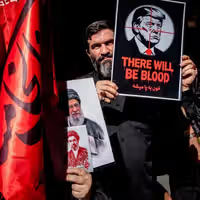
Protests were held on Sunday in far-flung cities against the US attack on Iran's nuclear sites, including in Los Angeles, Karachi and outside a NATO meeting at The Hague.

Russia's United Nations ambassador Vassily Nebenzia hit out a what he called a rerun of the US Iraq War, based on weapons of mass destruction which were never found.

"Again we're being asked to believe the US's fairy tales, to once again inflict suffering on millions of people living in the Middle East," Nebenzia said.

US President Donald signaled he would accept little opposition as he tore into a lawmaker critic from his own Republican party on social media.

Kentucky congressman Thomas Massie had called out Trump, saying on X:"This is not America First folks.

What war wrought

Israel's attacks on Iran have so far killed 950 people and injured 3,450, human rights group HRANA reported on Sunday.

Meanwhile no clear picture had yet emerged on the impact of US attacks and whether it achieved its goal of ending Iran's nuclear ambitions.

The UN nuclear watchdog said Sunday that entrances to underground tunnels at Iran’s Isfahan nuclear complex were damaged in the strikes.

“We have established that entrances to underground tunnels at the site were impacted,” the International Atomic Energy Agency (IAEA) said in a statement.

The IAEA chief Rafael Grossi told CNN it was too early to assess the underground damage to Iran's Fordow site.

Iranian defiance

A graphic shows the timeline of "Operation Midnight Hammer", a U.S. strike on Iran's nuclear facilities, released by the U.S. Defense Department in Washington, D.C., U.S. June 22, 2025.
100%
A graphic shows the timeline of "Operation Midnight Hammer", a U.S. strike on Iran's nuclear facilities, released by the U.S. Defense Department in Washington, D.C., U.S. June 22, 2025.

Iran's foreign minister arrived in Moscow for talks with Russian President Vladimir Putin after appearing to vow Iranian retaliation in Turkey.

"The US crossed a very big red line by attacking Iran’s nuclear facilities," Abbas Araghchi said. Speaking in Istanbul, Araghchi said the US bore full responsibility.

“The attack on peaceful nuclear installations marks a dangerous precedent and will not go unanswered."

Relative moderate President Masoud Pezeshkian also promised a rejoinder.

“The US has attacked us. What would you do if you were in our position? Naturally, they must receive a response to their aggression,” Pezeshkian said.

Veteran security insider Ali Shamkhani said the strikes would not sink Iran's nuclear enterprise.

“Even if nuclear sites are destroyed, the game isn’t over... enriched materials, indigenous knowledge, and political will remain,” Shamkhani said on X.

“The initiative is now with the side that plays smart, avoids blind strikes. Surprises will continue!”