• العربية
  • فارسی
Brand
  • Iran Insight
  • Politics
  • Economy
  • Analysis
  • Special Report
  • Opinion
  • Podcast
  • Iran Insight
  • Politics
  • Economy
  • Analysis
  • Special Report
  • Opinion
  • Podcast
  • Theme
  • Language
    • العربية
    • فارسی
  • Iran Insight
  • Politics
  • Economy
  • Analysis
  • Special Report
  • Opinion
  • Podcast
All rights reserved for Volant Media UK Limited
volant media logo

Exiled opposition group says Iran hid nuclear weapons hub in desert
Jun 10, 2025, 21:47 GMT+1Updated: 08:05 GMT+0

An exiled opposition group on Tuesday accused Tehran of operating a covert nuclear weapons program in the Semnan desert, an assertion that has not been independently verified.

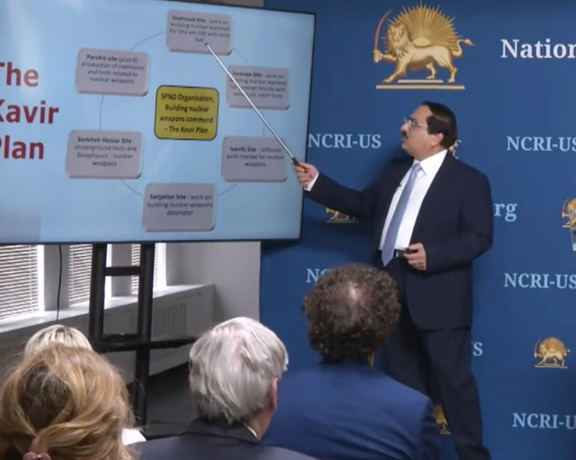
The National Council of Resistance of Iran (NCRI) said the desert zone, now designated a restricted military area, hosts the core of what it called the Kavir Plan—a successor to the earlier Amad project.

The United States accused Iran of seeking a nuclear weapon as part of the shadowy Amad Project scrapped before 2004, an effort Washington says was overseen by Iran’s Organization of Defensive Innovation and Research (SPND).

“Development, testing and nuclear weapons activities (are) hidden deep in the desert, under intense security measures,” the group’s spokesperson said at a press conference in Washington DC.

The announcement came as Tehran and Washington are negotiating over Iran's nuclear program to reach a deal to curb the program in return for the lifting of sanctions.

Washington has assessed that Iran is not building nuclear weapons and its Supreme Leader has not approved them but recent discourse in Tehran urging the acquisition a bomb is emboldening advocates for such a move.

US President Donald Trump on Tuesday said Iranian negotiators have become “much more aggressive” in recent weeks, confirming nonetheless that the sixth round of talks would take place this week.

Kavir Plan

NCRI’s leading faction, the Mojahedin-e-Khalq (MeK), said it had obtained new evidence from inside Iran.

MeK spokesperson Alireza Jafarzadeh said the Kavir Plan involves at least six sites in Semnan province—Shahrud, Eyvanaki, Semnan, Sanjarian, Sorkheh Hesar and Parchin site in coordination with the SPND headquarters in Tehran—all directed by the Ministry of Defense and Revolutionary Guards.

“The Kavir Plan is not just a replacement for the Amad Plan, but it’s a more advanced, more sophisticated and more secure plan than the original one,” Jafarzadeh said.

100%

According to NCRI, SPND serves as the coordinating body for Kavir activities. SPND was named in a 2011 IAEA report and sanctioned by the US in 2014 for proliferation efforts.

Jafarzadeh said over 400 nuclear specialists have been transferred from Iran’s Atomic Energy Organization to SPND operations under the Defense Ministry.

Among the sites, Shahrud was identified as a launch complex for Ghiam-100 solid-fuel missiles, allegedly disguised as a satellite facility. Sanjarian focused on explosive bridge wire (EBW) detonators—components critical for weaponizing a bomb, the opposition group added.

Iran has repeatedly denied pursuing nuclear weapons, dismissing MeK reports as fabrications.

"Building nuclear warheads"

The NCRI maintains that the Kavir Plan mirrors the Amad Plan’s goals—specifically, building five nuclear warheads designed for Shahab-3 missiles.

In 2002, the NCRI revealed for the first time a uranium enrichment facility at Natanz and a heavy water plant at Arak. In 2003, the group also disclosed the Lavizan-Shian Technological Research Center in northeastern Tehran as an undeclared nuclear site.

The Lavizan-Shian site was cited again in the UN nuclear watchdog’s May 2025 report for noncompliance and the presence of undeclared nuclear material.

100%

Shayan Samiee, a national security expert, said the new report would heighten political pressure.

“I doubt that the intelligence and security apparatus of the US and Europe had no clue about this information. Surely they did,” he told Iran International TV.

“This report will put pressure on the House and Senate to push President Trump to either shut down negotiations with Iran or adopt a tougher stance.”

On Monday, Iran’s Supreme National Security Council said it had acquired sensitive documents linked to Israel’s nuclear program.

Tehran warned it will use those files to hit Israel’s clandestine nuclear facilities if the Jewish state attacks Iran.


Most Viewed

Iran negotiators ordered to return after internal rift over Islamabad talks
1
EXCLUSIVE

Iran negotiators ordered to return after internal rift over Islamabad talks

2
ANALYSIS

US blockade enters murky phase as tankers spoof signals and buyers hesitate

3
ANALYSIS

Why the $100 billion Hormuz toll revenue is a myth

4

US tightens financial squeeze on Iran, warns banks over oil money flows

5
ANALYSIS

US blockade targets Iran oil boom amid regional disruption

Banner
Banner

Spotlight

  • Hardliners push Hormuz ‘red line’ as US blockade tests Iran’s leverage
    INSIGHT

    Hardliners push Hormuz ‘red line’ as US blockade tests Iran’s leverage

  • Ideology may be fading in Iran, but not in Kashmir's ‘Mini Iran'
    INSIGHT

    Ideology may be fading in Iran, but not in Kashmir's ‘Mini Iran'

  • War damage amounts to $3,000 per Iranian, with blockade set to add to losses
    INSIGHT

    War damage amounts to $3,000 per Iranian, with blockade set to add to losses

  • Why the $100 billion Hormuz toll revenue is a myth
    ANALYSIS

    Why the $100 billion Hormuz toll revenue is a myth

  • US blockade targets Iran oil boom amid regional disruption
    ANALYSIS

    US blockade targets Iran oil boom amid regional disruption

  • Iran's digital economy battered by prolonged blackout
    INSIGHT

    Iran's digital economy battered by prolonged blackout

•
•
•

More Stories

Former Iranian diplomat floats interim deal as US talks falter

Jun 10, 2025, 19:24 GMT+1
•
Behrouz Turani

As the sixth round of nuclear talks approaches and earlier hopes of a breakthrough fade, some in Tehran are quietly promoting a limited interim agreement to defuse tensions and avert a deeper crisis.

Former diplomat Ramin Mehmanparast told the reformist Etemad daily that both Iran and the United States may ultimately settle on a limited, temporary agreement since the other two options—a full deal and war— are unlikely and undesirable.

“The third scenario is a middle-ground option: no comprehensive agreement, and no military conflict,” he said, asserting that an interim deal could see Iran addressing concerns about the nature of its nuclear activities in return for sanctions relief.

“(This) is the most likely, as the US believes it can sustain maximum pressure without going to war—tightening sanctions to economically squeeze Iran and force concessions,” he said, adding that Arab states would favor this outcome as it avoids escalation while containing Tehran’s regional power.

The cautious optimism on both sides appears to have faded in recent weeks.

US President Donald Trump on Tuesday said Iranian negotiators have become “much more aggressive” in recent weeks, confirming nonetheless that the sixth round of talks would take place this week.

Mixed assessments

Sensing troubled waters ahead if talks collapse, some moderates in Iran are becoming more vocal in urging flexibility, while hardliners push for an even tougher stance to deter the West.

“Iran must show mild and flexible responses … as confrontation could have destructive consequences,” political analyst and former diplomat Ali Bigdeli was quoted as saying by reformist daily Etemad.

In another interview with the conservative website Nameh News, he urged Tehran to seek Western concessions in return for agreeing to enrichment levels between 1% and 2.5%.

These proposals come as the International Atomic Energy Agency (IAEA) intensifies scrutiny of Iran’s nuclear program.

At the IAEA Board of Governors meeting in Vienna on Monday, Director General Rafael Grossi warned that Iran still has not explained uranium traces found at undeclared sites and has reduced transparency, obstructing monitoring efforts.

Etemad warned in a commentary that a formal IAEA rebuke could revive the six UN Security Council resolutions suspended under the 2015 deal.

In Nameh News, analyst Mohammad Javad Jamali Nobandegani argued that Grossi’s statement marked a first step toward such a resolution, asserting that further pressure could push Iran to quit the Non-Proliferation Treaty altogether.

“If the trigger mechanism is activated,” he warned, “there will be no reason for Iran to cooperate with the IAEA.”

Nobandegani accused the IAEA of calibrating its position based on the status of Iran–US talks, softening when negotiations are active and siding with Israel when they are not.

"Iran must act in a way that the heavy consequences of triggering the snapback mechanism are factored into the calculations of the US and Europe,” he concluded. “If they do not sense any deterrent response, they will move toward reinstating sanctions."

US Mideast commander says 'desperate' Iran leaning into nuclear deterrence

Jun 10, 2025, 17:58 GMT+1

The top US military commander in the Middle East told Congress on Tuesday that Iranian weakness offers Washington a historic opportunity to advance its interests but a vulnerable Tehran may seek deterrence in nuclear weapons.

"We can seize the initiative to optimize our posture to defend the Homeland, strengthen our economic outlook, take back our right to freedom of navigation, and sustain the upper hand against an increasingly desperate Iran," US Central Command (CENTCOM) chief Army General Michael Kurilla said.

"Iranian leadership understands their acute vulnerability, and the precision of Israel’s response demonstrates that Iran will remain critically exposed to future Israeli operations, even if their former defenses are reconstituted," Kurilla said in a statement to the US House Armed Services Committee.

Israel launched air strikes on Iran in October in response to a missile attack on its soil, in an operation it said knocked out Iranian air defenses and missile production capacity.

"Significantly weakened, Iran finds itself with fewer options," Kurilla added. "In addition to an active chemical weapons program, there is one remaining pillar the Regime may consider its best chance at restoring deterrence and imposing its will on the Region – the threat of developing a nuclear weapon."

The US intelligence community assesses that Iran is not building a nuclear weapon nor has such a move been authorized by its Supreme Leader yet but that a taboo on discussing the bomb in public discourse was eroding.

Iran's proxies in Middle East

Kurilla said Tehran's attempt to capitalize on the Palestinian armed group Hamas's attack on Israel on Oct. 7, 2023 has largely failed after serial military setbacks.

"After Hamas's attack on Israel, Iran operationalized its entire proxy network and arsenal of standoff capabilities – two pillars of their strategic approach – in pursuit of one goal: to seize a once-in-a-generation opportunity to reshape the region to its advantage."

Iran's losses could be the United States' gain, Kurilla suggested, without mentioning any specific course of action.

"We now have an unprecedented opportunity to advance the vision of a
prosperous and integrated Middle East in which US national interests are advanced
and Iran’s violent attempts to upend this peaceful order are defeated."

Republican hawks clashing with Trump's MAGA movement over Iran - Politico

Jun 10, 2025, 15:25 GMT+1

Republican advocates of a harder line on Iran are increasingly clashing with US President Donald Trump's more non-interventionist MAGA movement over nuclear talks with Tehran, Politico reported on Tuesday.

Influential conservatives are ramping up a lobbying campaign to end a push for a nuclear deal with Tehran and instead allow its nemesis Israel to strike Iran's nuclear sites, Politico reported citing informed sources.

Those lines were advocated by popular right-wing talk show host Marc Levin in a private lunch with Trump at the White House on Wednesday also attended by the US envoy for the talks Steve Witkoff - whom Levin has frequently criticized.

Rupert Murdoch's media empire has also begun piling pressure on the outreach, Politico wrote, and the New York Post which he owns has lambasted Witkoff and suggested the real estate billionaire is beholden to Qatar.

“They’re trying to push the president to make a decision that’s not what he wants,” Politico quoted a senior Trump administration official as saying.

“There’s clearly a lobby for war with Iran vs. those who are more aligned with the president, that know he is the one that has been able to bring them to the negotiating table.”

Tucker Carlson, a top conservative commentator, became aware of Levin's White House meeting and blasted his efforts as likely to embroil the United States in a war that could draw in other powers and result in American defeat.

White House press secretary Karoline Leavitt told the Politico that Trump listens to a broad array of voices but makes his own policy judgments.

“With respect to Iran, President Trump has made his own opinion clear: he would like to pursue diplomacy and make a deal, but IF Iran makes a deal impossible, President Trump has other options on the table,” she said.

The Make America Great Again movement founded by Trump prioritizes populist issues like jobs and economic growth over foreign entanglements, which the president has said led to defeat and disrepute for the country.

Stalwart MAGA influencers Charlie Kirk and Jack Posobiec have advocated for diplomacy to their broad online followings.

A longtime Trump ally quoted by the outlet questioned the wisdom of attempting to pressure the anti-war president into a conflict.

“The president is not going to support war… But I’m telling you, these guys won’t take no for an answer. This is why there’s a breach in the Bibi-President Trump relationship. ... Israel isn’t reading the room. The MAGA movement doesn’t support military operations.”

The latest US proposal in the nuclear talks proposed an international consortium to enrich uranium in which Tehran would take part in order to produce nuclear fuel.

Politico quoted a senior Trump administration official as saying the offer may provide a way for compromise: “It is a very creative proposal that allows both sides to claim a win."

Israel says 13-year-old arrested in relation to Iranian spy operation

Jun 10, 2025, 12:37 GMT+1

In the youngest case yet, a 13-year-old boy from Tel Aviv has been arrested in connection with spying for Iran, including being asked to photograph Israel’s Iron Dome defense system, according to Israel Police.

“During his police interrogation, it became clear that Iranian officials had recently contacted the minor, a resident of Tel Aviv, via the Telegram app, and asked him to perform several tasks in exchange for a sum of money,” a statement said on Tuesday.

The case mirrors dozens of others uncovered since the Gaza war, involving the arrests of Israelis for what the state alleges are Iranian-backed plots, some with aims to assassinate top military and political figures.

Suspects are recruited via social media, initially offered payment for seemingly innocuous tasks like spraying graffiti, then progressed to more serious activities, including intelligence gathering on the country's nuclear and defense facilities.

“The minor … sprayed graffiti in the Tel Aviv area and in return received sums of money. In addition, the minor was asked to photograph the Iron Dome system, but ultimately did not carry out this task," the police added.

He is now under house arrest.

Oded Ailam, a former head of counter-terrorism at Mossad, said that the legal system’s failings are making the deterrence strategy for Israel more challenging amid a wave of plots in the country.

“The Shin Bet does impressive work uncovering and thwarting these plots time and again. But once a case reaches the courtroom, the system falters. Weak evidence claims, outdated legal frameworks, and lenient sentencing all contribute to a breakdown in deterrence,” he wrote in a paper for the Jerusalem Center for Security and Foreign Affairs.

“Today’s espionage doesn’t involve trench coats and dead drops, it happens on Facebook, paid in dollars. Yet the legal response still treats it like a relic of another era.”

Iran amputates hands of two thieves in Isfahan

Jun 10, 2025, 12:15 GMT+1

Iran has carried out amputation sentences on two people convicted of theft in Isfahan Central Prison, the head of the Isfahan Justice Department announced on Tuesday.

Asadollah Jaafari, who did not identify the two men, described them as "professional thieves” with multiple convictions as well as crimes such as destruction and intentional harm.

He added that the sentences were carried out "after undergoing legal procedures in the prosecutor's office, the preliminary court, and the provincial appeals court, with final confirmation of the verdict by the Supreme Court."

However, Jaafari did not provide specific details regarding the specific charges.

International human rights organizations have consistently condemned such punishments.

In April, Mai Sato, the UN Special Rapporteur on Human Rights in Iran, told Iran International in an interview that "corporal punishment, including amputation, is absolutely prohibited under international law. And if executed, will amount to torture or ill-treatment."

The International Covenant on Civil and Political Rights (ICCPR), to which Iran is a signatory, explicitly prohibits inhumane or degrading punishments. Human rights advocates argue that amputation sentences violate the fundamental principle of human dignity enshrined in international law.

At least 237 individuals in Iran were sentenced to amputation between 1 January 2000 and 24 September 2020, with at least 129 of those sentences carried out, according to Ravina Shamdasani, spokesperson for the UN Human Rights Office.

According to Gholamhossein Mohseni Ejei, Iran's judiciary chief, "If theft is proven under the conditions set by Islam, the thief's fingers must be amputated."