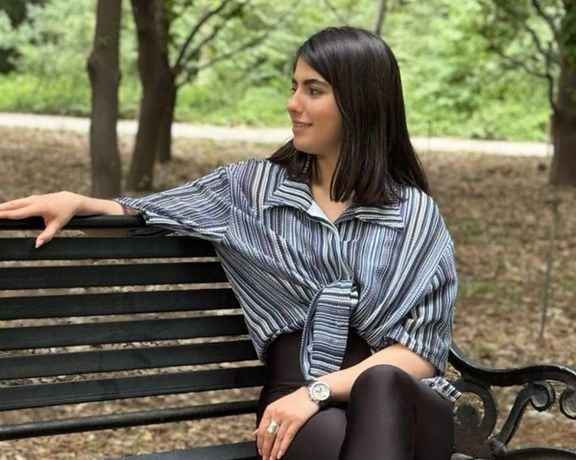
Elaheh Hosseinnejad's murder has sparked public outcry
The murder of 24-year-old Elahe Hosseinnejad gripped Iran, sparking grief and anger over gender violence, legal discrimination and the state’s failure to protect women.
Hosseinnejad, a nail technician from Eslamshahr, south of Tehran, vanished on May 25 after leaving work to care for her younger brother.
Her disappearance quickly drew attention after her family raised the alarm on social media, prompting thousands to share her photo in hopes of locating her.
Instagram posts by Hosseinnejad show a determined young woman supporting her family, expressing sympathy for executed protesters and backing the Woman, Life, Freedom movement.
On June 5, police arrested a man in his early 30s in connection with her death. Authorities said he operated an unlicensed taxi and had a criminal record.
Public reaction
The response was immediate. Messages of sorrow poured in from citizens, artists, and public figures.
“One murder victim and 90 million wounded,” many posted on social media.
Zahra Behrouz-Azar, vice president for women and family affairs, wrote on Telegram that the reaction sent a clear message: preventing violence against women is a national demand.
She cited “cultural and economic crises, weaknesses in preventive infrastructure, and gaps in legal and support systems” as causes.
State and police criticized
After her disappearance, many accused the authorities of systemic failure to protect citizens—especially women.
“How is it that thousands of agents and surveillance cameras are present across cities to harass Iranian women for improper veiling, but no measures (are taken) to ensure the safety of citizens, especially women?” activist and former political prisoner Hossein Ronaghi asked on X before Hosseinnejad’s body was found.
Hours after the arrest, police released two videos of the suspect’s interrogation and confession.
In the footage, he admits to trying to steal Hosseinnejad’s phone, stabbing her when she resisted and abandoning her body near Tehran’s airport. One video shows him on the floor during interrogation, recoiling after being slapped.
“The videos of the arrest and interrogation of Elaheh Hosseinnejad’s murderer are enough on their own to make me lose all hope in the improvement of security in this country,” digital rights activist and entrepreneur Nima Namdari posted on X.
“Justice will never be established in a country where the rights of the accused and the principles of fair trial are not respected. As long as there is no justice, there will be no security,” he added.
Murder is punishable by death, but if a man kills a woman, the victim’s family must first pay half the value of full blood money (diyeh)—set annually by judicial authorities—to the killer’s family before the execution can proceed.
This does not apply when both victim and perpetrator are male, reinforcing what activists call a system that devalues women’s lives.
“Why should the victim and their family bear the cost of the inequality in the law?” user @mynamefarshad posted on X.
Supporters of Sharia-based laws say the system allows flexibility. In high-profile cases, the state can pay the blood money itself to proceed with execution under Islamic jurisprudence.
Police released Hosseinnejad’s body to her family on Friday. Citizen reports say she was buried immediately, under strict security, without a public announcement in Eslamshahr.
A woman walks pulling along her shoppings, Hamedan, Iran, June 8, 2025
People in Iran are often accused of contributing to the country’s economic woes through wasteful habits—not just by officials, but by one another. But how much truth is there to these claims?
People in Iran are often accused of contributing to the country’s economic woes through wasteful habits—not just by officials, but by one another. But how much truth is there to these claims?
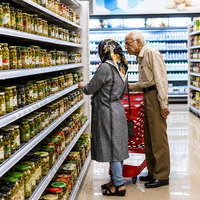
One common claim is that Iranians use far more electricity than other nations. But data from Iran’s Energy Ministry shows that per capita household electricity consumption is about 1,100 kilowatt-hours per year—40% lower than the EU average, and well below usage in the US, Canada, Japan, or even many neighboring countries.
It’s the same story with food.
Iran’s agriculture minister recently criticized Iranians for “excessive consumption” of sugar and cooking oil, asserting that government subsidies are being squandered.
But that assertion appears to contradict data from the UN’s Food and Agriculture Organization (FAO), which shows that Iran’s per capita consumption of both items is below the global average and significantly lower than in nearby countries like Turkey.
Last year, Iranians consumed 2.3 million tons of cooking oil, compared to 3.5 million tons in Turkey, which has a similar population. On a per capita basis, Iranian consumption is 30% lower than the global average.
The minister also claimed that 90% of Iran’s cooking oil is imported at subsidized rates, yet FAO data puts the figure closer to 56%, with imports steadily declining over the past three years.
Sugar tells a similar story. Iranians consume about 10% less than the global average, and nearly half as much as Turks. Far from being excessive, these levels reflect increasing constraints on household consumption.
Chasing the basics
These accusations also overlook a crucial fact: food inflation in Iran is out of control. The price of cooking oil surged 20% in just three months, according to a report by economic outlet Tejarat News on Monday.
Iran’s Statistical Center reports annual inflation of 31% for cooking oil and 41% for sugar.
Such price spikes make basic goods increasingly unaffordable for most households. And the toll is visible in declining food security.
FAO data shows that per capita meat consumption in Iran has fallen by 40% over the past decade, while dairy consumption has dropped by 30%.
A senior food industry official said last week that the average Iranian now consumes 7–10 kilograms of meat per year—consistent with FAO’s estimate of just over 8 kilograms, down from 12 kg just a few years ago.
“Meat consumption in Iran is deeply unequal—some eat nothing, while others manage 20 kilograms a year,” said Masoud Rasouli, secretary of the Meat Production and Packaging Association, adding that the global average is 32 kilograms.
The figures don’t lie: Iranians are not consuming too much—they’re getting by with less.
Contrary to the official line—and even public opinion—excess is not a national trait. It’s an alien concept to the majority chasing the basics.
Kazem Sedighi (right) and Supreme Leader Ali Khamenei
Prominent Iranian cleric Kazem Sedighi's son and daughter-in-law have been arrested on corruption charges, Iranian state media reported on Sunday, more than a year after the hardline cleric himself was implicated in a land grab scandal.
The two were detained by the Revolutionary Guard's Intelligence Organization two weeks ago on charges of misconduct and collusion, the IRGC-affiliated Fars News Agency reported.
"The case of the accused is being pursued with great care and sensitivity, and the judiciary will handle the case in a fully professional and independent manner," the report said citing an informed source. "The violators will receive a firm response, and the final results will be officially announced after the completion of legal procedures."
Sedighi, known to critics as “the weeping sheikh,” was accused last year of illegally appropriating public land in northern Tehran.
Leaked documents indicated that he and his associates had seized a 4,200-square-meter garden originally owned by a seminary. The property, estimated to be worth $20 million, was reportedly transferred to an entity controlled by Sedighi and his family.
After initially denying the allegations and claiming that his signature on the documents had been forged, Sedighi’s defense unraveled as more evidence emerged.
Eventually, he issued a public apology addressed to Supreme Leader Ali Khamenei, revealing that the land had been returned to the seminary. Despite the scandal, Sedighi continued serving as the interim Friday Prayer Imam of Tehran.
In the case of Sedighi's son and daughter-in-law, "have the collusions taken place independently of their father's position as the Friday Prayer Leader appointed by the Supreme Leader and head of the Promotion of Virtue Headquarters"? asked BBC Persian journalist Hossein Bastani.
"What happened to Kazem Sedighi’s own 1,000-billion-toman land grab case?" Bastani added in a post on X.
Sedighi’s case has triggered widespread backlash, particularly on Iranian social media platforms. Many Iranians have expressed frustration over what they see as a lack of accountability and transparency among high-ranking officials and clerics.
People walk through a park in Tehran, Iran, March 30, 2021.
Iranian prosecutors have expanded a ban on dog walking to more than 20 cities across the country, building on similar restrictions first introduced in the capital Tehran in 2019.
The ban has now spread to at least 25 cities, including Kermanshah, Ilam, Hamadan, Kerman, Boroujerd, Robat Karim, Lavasanat, and Golestan, according to a report by Tehran-based reformist-leaning outlet Faraz News on Sunday.
While no national legislation has been passed, judicial authorities are enforcing the ban through local directives and police orders, citing various articles of Iran’s Penal Code and Constitution.
These include Article 638 on public morality, Article 688 on threats to public health, and Article 40 of the Constitution, which prohibits harm to others.
Several prosecutors across various provinces announced the new bans over the weekend.
Kashmar, a city in northeastern Iran’s Razavi Khorasan province, is among the latest to implement the ban.
“Dog walking has been prohibited in this county in order to safeguard public hygiene and the physical and psychological safety of the public,” the city’s public prosecutor said on Sunday.
Khalkhal’s public prosecutor Mozaffar Rezaei in northwest Iran’s Ardabil province announced the ban came into effect on June 6. “Offenders will face consequences if they are seen walking dogs in parks, public spaces, or carrying them on their vehicles,” Rezaei said in remarks to Islamic Republic News Agency (ILNA) published Sunday.
"In addition to the financial and physical damages, religious rulings and cultural considerations must be taken into account, as this practice reflects the promotion of a Western lifestyle," he added.
In Ilam, western Iran, authorities imposed a dog walking ban on Saturday, warning that anyone seen walking dogs in parks, public areas, or transporting them in vehicles would face legal action. Police have also been instructed to impound vehicles involved in violations, according to provincial judicial chief Omran Ali Mohammadi.
In Isfahan, central Iran, the ban was announced last week by Mohammad Mousavian, the city’s public prosecutor who also ordered police to impound vehicles carrying dogs and shut down pet shops and unauthorized veterinary clinics.
A group of animal rights activists gathered outside the governor’s office in Isfahan on Sunday, calling for an end to what they described as municipal dog culling.
Iran’s average meat consumption has dropped to as little as seven kilograms per person annually from an average of 18, with some citizens eating none at all, according to Masoud Rasouli, secretary of the Meat Production and Packaging Association.
“Meat consumption in Iran is deeply unequal—some eat nothing, while others manage 20 kilograms a year,” Rasouli said on Sunday, pointing to the vast economic inequalities in the country.
Iran once averaged 18 kilograms of meat consumption per person annually, while the global average remains around 32 kilograms, he added.
“In some countries, especially in South America, people consume up to 100 kilograms of meat per year,” Rasouli said.
Rasouli added that a kilogram of mutton now costs about 10 million rials—around $13—while the average monthly income in Iran is just $200 to $250. With the rial trading near 830,000 to the dollar, even basic food items have become inaccessible for many.
Rasouli added that processed items like sausages and cold cuts have become more expensive than fresh meat.
After years of crippling inflation, averaging around 40 percent annually for five consecutive years, over 30 percent of the population now lives below the poverty line. Food, housing, and healthcare costs have risen sharply, cutting deeply into household consumption.
In April, a World Bank brief about Iran said that with a projected contraction in per-capita GDP, poverty is expected to increase to 20 percent in 2025-2026.
"Poorer households are disproportionately rural, uneducated, female-headed, and have not historically benefited from periods of economic expansion," the report said.
A report released in September by The Statistical Center of Iran showed that since 2022, the divide between rich and poor in Iran continues to widen.
Iran uses its overseas missions to covertly surveil dissidents and fund influence operations via state-backed cultural initiatives, multiple former Iranian diplomats and embassy staff members told Iran International.
Their accounts document a sprawling overseas network operating under direct orders from the Supreme Leader’s office and the Islamic Revolutionary Guard Corps intelligence arm well out of step with common diplomatic practice.
“Every embassy has a list. People to watch. People to engage. People to silence,” an Iranian former diplomatic employee told Iran International.
“It’s not foreign policy—it’s field execution,” another told Iran International. “The people sent abroad are on assignment, not appointment.”
Their account outlines a foreign service shaped not by diplomacy but by ideology, surveillance and illicit finance.
According to these individuals—whose names are withheld for their safety—Iran’s diplomatic missions double as intelligence gathering hubs tasked with tracking dissidents, surveilling student communities and delivering cash and equipment under the protection of diplomatic immunity.
UK authorities detained eight men in May, including three charged under the National Security Act for surveilling Iran International journalists on behalf of Tehran between August 2024 and February 2025.
It was not clear whether the charges related in any way to the Iranian embassy in London.
Iran’s foreign ministry denounced the charges as politically motivated, but former officials say such actions are core to the Islamic Republic’s overseas agenda.
Iran’s embassies maintain the outward structure of any diplomatic mission—ambassadors, attachés and advisers—but according to the sources, the roles often serve as cover.
“A person listed as a translator might actually coordinate funds for proxy groups,” said one of the former diplomats. “Titles are just for appearances.”
In one high-profile case, Iranian diplomat Asadollah Asadi used his status to transport explosives intended for an opposition rally in Paris. His 2021 conviction in Belgium exposed how far such dual roles can go.
Former Iranian diplomat Assadollah Assadi arrived in Tehran on May 26, 2023 after he was released from a jail in Belgium.
Another ex-staffer recalled colleagues arriving in Istanbul and Baku with briefcases of undeclared dollars. “They know no one will search their bags,” he said.
Cultural attachés, especially those linked to the Islamic Culture and Communications Organization, are said to organize religious events abroad that double as screening grounds for potential recruits.
Germany shuttered the Islamic Center of Hamburg in July over its ties to Tehran and what the Interior Ministry called promotion of extremism and antisemitism.
Mourning Ceremony for the third Shia Imam at the Embassy of Iran in Muscat, Oman on July 8, 2024.
The diplomatic corps itself, sources say, is dominated by the sons of clerics and system insiders.
“Your father is a Friday prayer leader? Your uncle is close to the Supreme Leader? You’re in,” said one.
Posts rarely align with professional background; language skills and experience are often secondary to loyalty.
Though often expelled or exposed, the structure endures. Loyal staff are rotated across continents with little interruption.
Iranian ambassadors meet with Supreme Leader Ali Khamenei on May 20, 2023.
“Each post is a mission. If you complete it to the system’s satisfaction, you’re held in reserve for the next,” one former diplomat said.
The network’s reach is enhanced by front organizations. The Imam Khomeini Relief Foundation has been linked to Hezbollah financing. The Iranian Red Crescent has faced accusations of being used by Quds Force operatives for weapons transport. IRGC members have admitted posing as aid workers during the Bosnian war.
File photo of the Imam Khomeini Relief Committee in Herat
IRIB outlets—Press TV, Al-Alam, Hispan TV—have functioned as propaganda arms and intelligence fronts. France expelled one of their journalists in 2011 for spreading state messaging.
The Iranian Red Crescent and the IRGC officially denied these remarks, saying that any such actions were unauthorized and not representative of their organizations.
Hekmatollah Ghorbani receives a warm welcome at Tehran airport after being recalled following sexual misconduct.
Despite the rhetoric of resistance, many live in luxury. One former ambassador’s Paris residence cost over €40,000 per month.
“They send their kids to secular schools while preaching Islamic values,” said another. Leaked records show senior envoys receiving up to $12,000 monthly, with generous stipends and ceremonial budgets.
“It’s both reward and insulation,” an ex-diplomatic employee said. “The system buys loyalty with luxury—and distances them from the reality of ordinary Iranians.”
What emerges is not a diplomatic corps, but a global extension of Iran’s security state—trained, titled, and deployed to safeguard the Islamic Republic, not represent it.