• العربية
  • فارسی
Brand
  • Iran Insight
  • Politics
  • Economy
  • Analysis
  • Special Report
  • Opinion
  • Podcast
  • Iran Insight
  • Politics
  • Economy
  • Analysis
  • Special Report
  • Opinion
  • Podcast
  • Theme
  • Language
    • العربية
    • فارسی
  • Iran Insight
  • Politics
  • Economy
  • Analysis
  • Special Report
  • Opinion
  • Podcast
All rights reserved for Volant Media UK Limited
volant media logo
ANALYSIS

Can Trump really cut Iran’s oil exports to zero?

Dalga Khatinoglu
Dalga Khatinoglu

Oil, gas and Iran economic analyst

Feb 7, 2025, 16:02 GMT+0Updated: 20:03 GMT+0
The Elva oil tanker believed to be involved in transporting Iranian oil to China.

The economic impact of the so-called maximum pressure on Iran will be significant, with a zero-exports goal set by US president Donald Trump.

On Tuesday, Trump signed a directive reinstating the "maximum pressure" policy from his first term, warning of "catastrophic" consequences if Tehran doesn't reach a deal on its nuclear program. His goal of eliminating Iran’s oil exports is particularly alarming for Tehran, as it would eliminate nearly half of the government's revenues during a seven-year economic crisis.

In its first move, the US Treasury Department on Thursday imposed sanctions on an international network, alleging that it has facilitated the shipment of Iranian oil to China. In a coordinated step, the Treasury and State Departments announced sanctions targeting networks involved in shipping Iranian oil to China. The measures cover multiple countries, including China, India, and the United Arab Emirates, and affect several vessels linked to Iran's oil exports.

While the impact of this order, if fully implemented, would be significant for Iran’s oil exports, there is doubt as to whether it will actually reduce the oil exports to zero or to the levels seen in 2020, the final year of Trump's previous presidency. In 2017, before US sanctions were imposed, Iran exported 2.5 million barrels per day (bpd). By 2020, this figure had plummeted to around 350,000 bpd.

As Joe Biden took office in 2021, Iran’s oil exports rebounded, peaking at nearly 1.9 million bpd in the summer of 2024. After President Biden administration’s imposed sanctions on dozens of tankers involved in smuggling Iranian oil, exports dropped by 500,000 bpd in the final quarter of 2024.

Yet, in January this year, exports once again surged to 1.6 million bpd.

The ship-tracking company Tanker Trackers told Iran International that the recent fluctuations in Iran’s oil exports are typical, noting that such variations are common. "We saw a similar drop during the final months of Biden's presidency, followed by a rebound. There's nothing unusual about it. The average for crude oil exports over the past year is 1.572 million barrels per day, and since January, it has been 1.567 Mbpd. So, it's too early to draw conclusions," the company said.

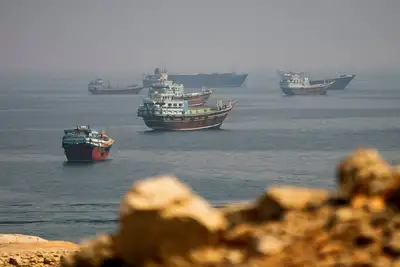
Iran's Kharq Island in the Persian Gulf  is the main loading point for Iranian oil. Undated
100%
Iran's Kharq Island in the Persian Gulf is the main loading point for Iranian oil.

Regarding Iran's logistical challenges, Tanker Trackers explained, "There are policies, and then there are logistics. We’re not yet convinced that Iran’s oil exports will drop to the levels seen in May 2019 (439 Kbpd), mainly because there wasn’t an extensive global dark fleet available back then, unlike what we have today."

The United Against Nuclear Iran (UANI) organization, a non-profit group dedicated to preventing Iran from acquiring nuclear weapons, in collaboration with tanker-tracking companies, has identified nearly 400 vessels involved in smuggling Iranian oil, collectively known as the "dark fleet." However, fewer than half of these vessels have been sanctioned.

These tankers attempt to smuggle Iranian oil covertly by turning off their automatic identification systems (AIS).

Currently, China is virtually Iran’s only oil customer. However, it does not purchase oil directly from Iran. Instead, Iranian oil is sold through intermediaries and changes ownership documentation, being rebranded as oil from Iraq, the UAE, Oman, and especially Malaysia before being sold to China’s small, independent refineries.

Tanker Trackers noted that China has already stated repeatedly that importing oil is a matter of national security, regardless of the source.

Meanwhile, the energy consultancy firm Wood Mackenzie told Iran International that the recent drop in Iranian crude oil exports is due to a combination of tighter sanctions on tankers imposed by former President Biden and China’s Shandong port declaring that sanctioned vessels will not be allowed to discharge their cargoes to independent refinery clients.

Wood Mackenzie said that given the recent US sanctions on China and Beijing’s retaliatory tariffs, we do not expect China to comply with Trump’s ‘maximum pressure’ policy on Iran.”

Senior commodity analyst Homayoun Falakshahi from Kpler, a commodities intelligence firm, told Iran International that Iran’s daily oil exports stood at 1.66 million bpd last month. However, he predicted that due to the reinstatement of Trump’s maximum pressure policy, exports could fall to around 500,000 bpd in the coming months.

He added that the extent of this decline depends on Beijing’s cooperation with US sanctions.

China and the US conduct $750 billion in annual commodity and service trade, heavily favoring China. However, Trump recently ordered an increase in tariffs on Chinese imports, prompting Beijing to threaten retaliation.

While China has repeatedly stated that it does not recognize US unilateral sanctions against Iran, its recent ban on US-sanctioned vessels docking at its ports suggests that it takes Washington’s sanctions somewhat seriously.

Iran’s share of China’s oil imports exceeds 10%, with an annual value of around $40 billion. China is also the largest buyer of sanctioned Iranian goods, including metals and petrochemical products. Additionally, a significant portion of Iranian refined petroleum products, such as fuel oil (mazut) and liquefied petroleum gas (LPG), is shipped to China.

Iranian customs data shows that, excluding crude oil, the country exported $12.3 billion worth of goods to China and imported $14.4 billion from China in the first ten months of the current Iranian calendar year (which began on March 21, 2024).

Most Viewed

Iran negotiators ordered to return after internal rift over Islamabad talks
1
EXCLUSIVE

Iran negotiators ordered to return after internal rift over Islamabad talks

2
EXCLUSIVE

Iran’s central bank warns economy may take 12 years to rebuild after war

3
INSIGHT

Iran's digital economy battered by prolonged blackout

4
ANALYSIS

US blockade enters murky phase as tankers spoof signals and buyers hesitate

5
ANALYSIS

Why the $100 billion Hormuz toll revenue is a myth

Banner
Banner

Spotlight

  • Hardliners push Hormuz ‘red line’ as US blockade tests Iran’s leverage
    INSIGHT

    Hardliners push Hormuz ‘red line’ as US blockade tests Iran’s leverage

  • Ideology may be fading in Iran, but not in Kashmir's ‘Mini Iran'
    INSIGHT

    Ideology may be fading in Iran, but not in Kashmir's ‘Mini Iran'

  • War damage amounts to $3,000 per Iranian, with blockade set to add to losses
    INSIGHT

    War damage amounts to $3,000 per Iranian, with blockade set to add to losses

  • Why the $100 billion Hormuz toll revenue is a myth
    ANALYSIS

    Why the $100 billion Hormuz toll revenue is a myth

  • US blockade targets Iran oil boom amid regional disruption
    ANALYSIS

    US blockade targets Iran oil boom amid regional disruption

  • Iran's digital economy battered by prolonged blackout
    INSIGHT

    Iran's digital economy battered by prolonged blackout

•
•
•

More Stories

Iran daily urges Pezeshkian to respond promptly to Trump’s overtures

Feb 7, 2025, 13:53 GMT+0
•
Maryam Sinaiee

The Ham-Mihan newspaper in Tehran has cautioned President Masoud Pezeshkian that delaying a response to US President Donald Trump for direct talks would be more detrimental than making a poor decision.

Pezeshkian has downplayed the importance of the memorandum that Trump signed on Tuesday to intensify sanctions enforcement by reducing Tehran's oil exports to zero. However, Trump also expressed a wish to hold direct talks with his Iranian counterpart and preferably reach an agreement rather than activate maximum pressure measures.

The Iranian president argued that sanctioning a country which has many neighbors and friends would not be easy and expressed confidence that "Iran could overcome its difficulties with everyone’s help and the wisdom of the Leader of the Revolution.”

"They believe our economy depends entirely on oil and aim to block our exports, but there are many ways to counter their efforts," Pezeshkian said Wednesday. However, he has previously acknowledged on multiple occasions that Iran's economy would suffer significantly if sanctions remain in place.

On Thursday, he also reiterated that proving that Iran's nuclear program is peaceful would be an easy task.

“These statements will not solve any problems,” Ham-Mihan wrote in an editorial titled “Delayed Decision Worse Than Making a Bad Decision. ” The paper urged Pezeshkian to clearly announce Iran’s position by Friday, after securing the Supreme Leader’s agreement and approval.

“Otherwise, we will be paying the costs of a ‘delayed decision’ which would be higher than the cost of making a ‘bad decision’," the editorial stated, arguing that the future of Iran-US relations could only be evaluated once Iran announces a final and official decision.

Several other reformist media outlets on Thursday similarly stressed the importance of seizing the opportunity to avoid further economic strain and escalating tensions. The moderate-conservative news website Asr-e Iran also echoed the need for decisive action in an editorial titled “Mr. Pezeshkian, Call Trump.”

The piece argued that the best response to Trump’s overtures would be for Pezeshkian to initiate a direct phone call to discuss a potential deal, focusing solely on the nuclear issue. The editorial emphasized that Trump likely expects a prompt response.

Hardline media such as Kayhan and the Revolutionary Guards-linked Javan, however, have staunchly rejected any direct talks with the Trump administration as before.

Trump’s approach and US Policy

Trump has extended multiple overtures to Iran, including dismissing rumors of a joint US-Israel military strike as “greatly exaggerated.” He expressed his preference for a "Verified Nuclear Peace Agreement," which he claims would allow Iran to grow and prosper peacefully.

However, a White House fact sheet released Tuesday, after Trump signed a National Security Presidential Memorandum (NSPM) reinstating maximum pressure on Iran, outlined a stringent policy. The NSPM mandates that Iran must be denied nuclear weapons and intercontinental ballistic missiles, its terrorist networks neutralized, and its development of missiles and other weaponry curbed.

Trump has also said he does not care who takes the first step to begin negotiations despite other people’s advice to let Iranians be the ones who reach out to the US.

Criticism of vague messages

Ham-Mihan also criticized government officials for sending vague messages including the government spokeswoman, Fatemeh Mohajerani’s vague statement that Iran's position would be decided based on the principles of “dignity, wisdom, and expediency”. 

Vice-President Mohammad-Reza Aref also said on Wednesday that engaging in talks with Trump is not currently on Iran's agenda although a meeting between “two human beings” is not impossible.

Experts’ opinions

Speaking to the reformist Shargh daily, Kourosh Ahmadi, a former Iranian diplomat to the UN, noted that Trump’s decision to sign a memorandum rather than issuing a new executive order reflects an effort to pressure Iran into negotiations. Ahmadi described this as a small window of opportunity for Iran to reach an agreement before the full effects of maximum pressure measures take hold.

Abolghasem Delphi, Iran’s former ambassador to Serbia, also urged the government to act swiftly. He advocated for practical steps to initiate talks with both Europe and the United States. Delphi observed that while Trump’s current focus is on the nuclear issue, he may adopt a similar framework to address other contentious topics in the future.

UN rapporteur urges Iran to halt imminent execution of Kurdish woman

Feb 7, 2025, 13:00 GMT+0

The UN Special Rapporteur on Iran, Mai Sato, has sounded the alarm after Iran’s Supreme Court denied a judicial review for Pakhshan Azizi, a Kurdish political prisoner and humanitarian worker facing a death sentence.

“Her imminent execution would violate international human rights law,” Sato wrote on Friday on X, urging Iranian authorities to “immediately halt her execution.”

Azizi was arrested in August 2023 and sentenced to death for armed rebellion against the state after an Islamic Revolutionary Court trial in Tehran last July.

Rights groups say the charges are politically motivated and linked to her humanitarian work helping women and children displaced by Islamic State attacks in northeast Syria.

Azizi's lawyer, Amir Raisian, wrote on X that they will file another retrial request and appeal to Iran's judiciary chief in a last-ditch effort to stop the execution.

Amnesty International also slammed the decision, saying, “The Iranian authorities must halt the execution of arbitrarily detained humanitarian aid worker Pakhshan Azizi, who was sentenced to death following a grossly unfair trial,”

The organization's deputy director for the Middle East and North Africa Diana Eltahawy also pointed to reports that Azizi was tortured by authorities and faced gender-based violence in detention.

Other rights groups have warned that Azizi’s case reflects a broader pattern of the Iranian state arbitrarily wielding the death penalty to suppress dissent—especially in the wake of the nationwide 2022 protests demanding the government's downfall.

US envoy says Hezbollah’s 'reign of terror' in Lebanon is over

Feb 7, 2025, 12:51 GMT+0

US Deputy Special Envoy for the Middle East, Morgan Ortagus, said on Friday that Hezbollah's "reign of terror" in Lebanon and the region is over, crediting increased US pressure on Iran for the group's decline.

Speaking after meeting with newly elected Lebanese President Joseph Aoun in Beirut, Ortagus said Hezbollah’s involvement in Lebanon’s new government crosses a clear red line for Washington.

"We are committed to making sure that Hezbollah is not a part of this government in any form and that Hezbollah remains disarmed and militarily defeated. That starts with the pressure President Trump is placing on the Islamic Republic of Iran so they can no longer fund their terror proxies in the region," Ortagus said.

Her remarks come as Lebanon’s political landscape experiences what experts have called a seismic shift, with the election of US- and Arab-backed Aoun as president and Hezbollah reeling from its bruising defeats at the hands of Israel.

"The end of Hezbollah’s reign of terror in Lebanon and around the world has started, and it’s over," she said.

Ortagus emphasized that the US will continue efforts to prevent Iran from achieving nuclear capabilities and from destabilizing countries across the Middle East. "Iran was allowed to inflict chaos and harm in this country and so many others for decades, that ends with President Trump," Ortagus said.

Hezbollah suffered its most significant setbacks in years during Israeli strikes last year, with coordinated attacks in September and October decimating thousands of its operatives through precision airstrikes and targeted explosions. The killing of key figures, including Hassan Nasrallah, the group's longtime secretary-general, shattered Hezbollah’s leadership core and left its command structure in disarray.

Keen to limit Hezbollah's influence, Washington is reportedly exerting significant pressure on Lebanon’s political leadership.

As Prime Minister-designate Nawaf Salam works to form his cabinet, US officials are urging Beirut to block Hezbollah and its allies from securing key posts, particularly the finance ministry.

Citing sources, Reuters reported that Washington relayed that Lebanon could face difficulties securing foreign financial aid crucial for post-war reconstruction if Hezbollah or Amal—a Shia political party and longtime Hezbollah ally—were to select the country's next finance minister.

Munich Security Conference reinstates invitation to Iranian prince

Feb 7, 2025, 12:38 GMT+0

The Munich Security Conference has restored an invitation to Iranian exiled prince Reza Pahlavi after it rescinded it under pressure from the German Foreign Ministry, Iran International has learned.

"We can confirm that the invitation to Mr. Pahlavi to the MSC 2025 will be maintained," an MSC spokesperson wrote in an email to Iran International.

"As in the past, the voices of Iranian civil society and opposition will be represented at MSC 2025," the spokesperson added.

Pahlavi said in a post on X on Thursday that the German Foreign Ministry had blocked his participation in the annual security conference.

Two sources with direct knowledge of the matter told Iran International this week that Christoph Heusgen, the Chairman of the MSC, initially extended the invitation to Pahlavi on January 17, but retracted it about two weeks later under pressure from the German Foreign Ministry.

Berlin's concern about bilateral ties with Tehran

On Thursday, the German Foreign Ministry told journalists that it had no role in the withdrawal of the invitation to Prince Reza Pahlavi.

A German Foreign Ministry spokesperson also told Iran International that "the Munich Security Conference decides independently on its invitations," without offering any further details.

However, an informed source told Iran International the German Foreign Ministry had asked the organizers of the Munich Security Conference to withdraw the invitation, as it believed it would harm its relations with the Islamic Republic.

"The German government was concerned that inviting Prince Pahlavi could endanger the situation of German dual-national prisoners in Iran," the source added.

Pahlavi took to X on Friday to confirm that the MSC had told him his invitation remains in place.

"This conference, like all public engagements, was always about my compatriots and having their voices heard on the world stage. So I will go with a message from the Iranian people: our fight is not just to free Iran, but the world, from the terror and blackmail of the Islamic Republic," Pahlavi wrote.

No invitation for Iran officials

The German news website Zeit cited a conference spokesman saying that the Iranian government has not received an invitation "at this point in time".

The conference did not invite any officials from the Islamic Republic in 2023. However, Iranian diplomat Mohammad Javad Zarif—now Iran's vice president—was a regular invitee when he served as Tehran's foreign minister.

The conference, which is scheduled to begin later in February, has previously welcomed speakers that have criticized the Iranian government.

According to a list of invitees to the Munich Security Conference seen by Iran International, political activist Masih Alinejad has also been invited to the conference.

Pressure continues

The Munich Security Conference was also under pressure in 2023 to withdraw its invitation to Reza Pahlavi, Karim Sadjadpour, a senior fellow at the Carnegie Endowment for International Peace, said in an interview with Aasoo website last year.

"A few days before the Munich conference, one of the organizers—who used to be my student at Georgetown—told me they were under pressure to revoke Reza Pahlavi's invitation," Sadjadpour added.

"He said leftist groups in Germany opposed his presence, and even the German embassy in Tehran had called, warning that if Reza Pahlavi was given a platform, regime hardliners might attack the embassy."

Iranian diplomats in Europe signal readiness for talks as US ramps up 'maximum pressure'

Feb 7, 2025, 10:00 GMT+0

Iran's ambassadors to France and the UK say they remain open to negotiations with the West, despite new US sanctions targeting Iran's oil exports and the reimposition of Trump-era maximum pressure policies.

“We do not reject negotiations, but we demand engagement on equal footing and with mutual respect,” Mohammad Amin Nejad, the Iranian ambassador to France said in an interview with French online media platform Thinkerview.

While acknowledging the impact of US-led sanctions on Iran's economy, he asserted that the country has become adept at self-reliance.

“After the US withdrawal from the JCPOA, we faced severe economic pressures, but the Iranian people are resilient, and the country continues to progress,” Nejad added.

US President Donald Trump reinstated his maximum pressure policy on Iran this month, issuing a directive followed by the first wave of sanctions on Thursday.

These sanctions came after decades of the Iranian state's mismanagement, corruption, and the prioritization of funneling money to terrorism, which had already severely damaged Iran's economy before the US sanctions compounded the crisis.

In London, Ali Matinfar, the Iranian Embassy's chargé d'affaires, echoed similar sentiments to his colleague in France during a ceremony marking the upcoming 46th anniversary of the Islamic Revolution.

The diplomat insisted that Tehran remains committed to the nuclear deal, despite the US withdrawal in 2018 and what he described as Europe's failure to uphold its obligations.

“The Islamic Republic of Iran has continued to adhere to its commitments and has only taken compensatory measures within the framework of the agreement,” Matinfar said on Saturday.

Referring to recent talks with the UK, France, and Germany in Geneva, Matinfar said there is hope for the potential of renewed diplomatic progress.

“Following serious and constructive negotiations, it is hoped that a clearer outlook for future diplomatic engagements will emerge. However, the realization of this depends entirely on the goodwill and confidence-building measures of the Western parties, particularly the United States,” he said.

Iran's Supreme Leader, Ali Khamenei, the country's ultimate authority, said on Friday that negotiating with the US would be neither wise, intelligent, nor honorable.

This follows an ongoing internal divide within the country in recent weeks, with varying factions offering conflicting views on the potential for talks with Washington,

During Trump’s first term, Iran’s oil exports were slashed to almost zero after he re-imposed sanctions that had been lifted under the 2015 nuclear deal between Tehran and world powers.

After the US withdrew from the agreement, there were few attempts at negotiations between Washington and Tehran until the Biden administration took office in 2021, signaling a renewed effort to revive the nuclear deal, but ultimately, no new agreement was reached.