• العربية
  • فارسی
Brand
  • Iran Insight
  • Politics
  • Economy
  • Analysis
  • Special Report
  • Opinion
  • Podcast
  • Iran Insight
  • Politics
  • Economy
  • Analysis
  • Special Report
  • Opinion
  • Podcast
  • Theme
  • Language
    • العربية
    • فارسی
  • Iran Insight
  • Politics
  • Economy
  • Analysis
  • Special Report
  • Opinion
  • Podcast
All rights reserved for Volant Media UK Limited
volant media logo
INSIGHT

Sanctions snapback power gives central role to Europe in Iran-US talks

Maryam Sinaiee
Maryam Sinaiee

Iran International

Apr 29, 2025, 15:15 GMT+1Updated: 08:19 GMT+0
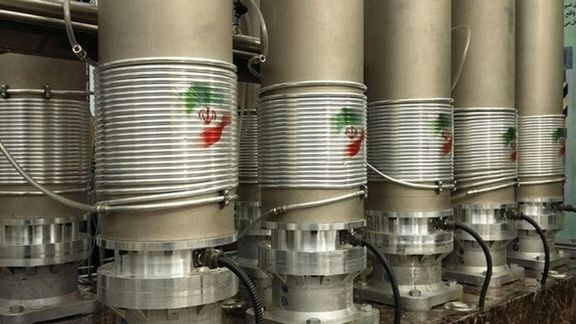
Iranian centifuges at the Fordo nuclear facility

Iran is stepping up diplomatic outreach to the E3 group of countries—France, Britain and Germany—in an effort to delay or prevent their activation of the so-called snapback mechanism built into a 2015 deal if nuclear talks with the United States fail.

The so-called snapback of UN sanctions on Iran can technically be restored automatically if any party to the Joint Comprehensive Plan of Action (JCPOA) deems Iran to be non-compliant.

But after US President Donald Trump pulled the United States out of the deal in 2018, Washington cannot itself trigger the snapback but those European countries can, giving them key leverage as the high-stakes diplomacy rumbles on.

Appearing to recognize their clout, Tehran has proposed a meeting with the E3 in either Rome or in Tehran on the Friday before the US talks are due to enter their fourth round, Reuters reported citing diplomatic sources.

An Iranian official cited by the news agency said the E3 had yet to respond.

The initiative follows Iranian Foreign Minister Abbas Araghchi’s public offer last week to travel to Britain, France, and Germany for nuclear discussions with his counterparts. None have formally responded to his proposal yet.

French Foreign Minister Jean-Noel Barrot on Monday warned that the E3 would not hesitate to trigger the snapback clause if Iran’s nuclear escalation was deemed a threat to European security.

“Iran is on the verge of acquiring nuclear weapons,” Barrot told reporters. “There is no military solution to the Iranian nuclear problem. There is a diplomatic path to achieve it, but it is a narrow road.”

Barrot added that the E3 remains in close contact with US Secretary of State Marco Rubio on the issue, who said before the US-Iran talks began this year that Trump sought the snapback of sanctions.

Tehran faces tight deadline before JCPOA sunset

The three powers are currently negotiating with Iran about future steps to salvage the agreement, and they last met in January in Geneva.

In March, the E3 issued a joint statement expressing concerns over Iran's nuclear activities, including unprecedented enrichment levels, advanced centrifuge deployment, lack of transparency and threats to non-proliferation.

With UN Security Council Resolution 2231—which enshrined the JCPOA—set to expire in October 2025, Iran has a narrow window to persuade the countries not to trigger the sanctions.

Tehran has warned that it may withdraw from the Nuclear Non-Proliferation Treaty (NPT) in retaliation if the sanctions are triggered.

As with North Korea in 2003, leaving the NPT would lift Iran’s legal obligation to remain a non-nuclear weapons state and allow it to end IAEA inspections and monitoring entirely.

Such a move would escalate tensions dramatically, raising the risk of preemptive military action by Israel or the United States and potentially sparking a regional arms race if countries like Saudi Arabia seek to develop their own nuclear programs.

How the snapback mechanism works

Under UN Security Council Resolution 2231, any JCPOA participant—the E3, Russia, China or the United States —could file a non-compliance complaint with the UN Security Council.

The other participants in the JCPOA have argued that the United States can no longer enforce the snapback mechanism because it withdrew from it in 2018.

If no resolution is adopted to continue sanctions relief within 30 days, all previous UN sanctions are automatically reimposed, including cargo inspections on Iranian shipments, Reinstated arms embargoes and restrictions on missile-related technologies.

This automatic snapback process cannot be vetoed—even by permanent members like Russia or China, which have boosted ties with Iran in recent years and whose relationship with the West is increasingly adversarial.

Although both countries may oppose the move politically, they lack the power to stop it once initiated.

To avert snapback, the Council must pass a resolution during the 30-day review period to continue sanctions relief. But any permanent member can veto it—meaning if the US or E3 object, the resolution will fail, and sanctions will snap back by default.

Most Viewed

Iran negotiators ordered to return after internal rift over Islamabad talks
1
EXCLUSIVE

Iran negotiators ordered to return after internal rift over Islamabad talks

2
ANALYSIS

US blockade enters murky phase as tankers spoof signals and buyers hesitate

3
ANALYSIS

Why the $100 billion Hormuz toll revenue is a myth

4

US tightens financial squeeze on Iran, warns banks over oil money flows

5
ANALYSIS

US blockade targets Iran oil boom amid regional disruption

Banner
Banner

Spotlight

  • Hardliners push Hormuz ‘red line’ as US blockade tests Iran’s leverage
    INSIGHT

    Hardliners push Hormuz ‘red line’ as US blockade tests Iran’s leverage

  • Ideology may be fading in Iran, but not in Kashmir's ‘Mini Iran'
    INSIGHT

    Ideology may be fading in Iran, but not in Kashmir's ‘Mini Iran'

  • War damage amounts to $3,000 per Iranian, with blockade set to add to losses
    INSIGHT

    War damage amounts to $3,000 per Iranian, with blockade set to add to losses

  • Why the $100 billion Hormuz toll revenue is a myth
    ANALYSIS

    Why the $100 billion Hormuz toll revenue is a myth

  • US blockade targets Iran oil boom amid regional disruption
    ANALYSIS

    US blockade targets Iran oil boom amid regional disruption

  • Iran's digital economy battered by prolonged blackout
    INSIGHT

    Iran's digital economy battered by prolonged blackout

•
•
•

More Stories

About half of Israelis back strike on Iran's nuclear facilities, poll shows

Apr 29, 2025, 13:56 GMT+1

A new poll showed that nearly half of Israelis support a strike on Iran's nuclear facilities, even without US support, though divides between the Jewish and Arab demographic were stark.

Asked whether Israel should carry out a military strike on Iran’s nuclear facilities, even without American backing, 45% of Israelis believe Israel should do so and 41.5% do not.

Within the Jewish population, support for potential attacks reached 52% among proponents, with 34.5% expressing opposition. A significantly different perspective prevails among Arabs, where 76% are against the attacks and only 9% are supportive.

The data came from the April 2025 Israeli Voice Index, conducted by the Viterbi Center for Public Opinion and Policy Research.

Additionally, against the backdrop of talks between the United States and Iran on the Iranian nuclear program, 45.5% of Israelis think that Israel's security will be among President Trump's main considerations, while 44% think it will not.

Last month, US President Donald Trump openly threatened to bomb Iran if it did not agree to a new nuclear deal. It has since emboldened Israel to step up its rhetoric.

Earlier this week, Israeli premier Benjamin Netanyahu said, “A real deal that works is one that removes Iran’s capacity to enrich uranium for nuclear weapons... Dismantle all the infrastructure of Iran’s nuclear program. That is a deal we can live with.”

Iran's Parliament Speaker Mohammad Bagher Ghalibaf dismissed the remarks on Tuesday. “Netanyahu, in a desperate attempt to avoid political extinction, has resorted to threats. These worthless tirades are not taken seriously,” he said.

Tehran's red lines dominate parliament's closed-door session on US talks

Apr 29, 2025, 09:57 GMT+1

Iran's parliament convened a closed-door session on Tuesday to review the ongoing indirect negotiations between Tehran and Washington, with lawmakers expressing firm red lines on domestic nuclear enrichment, lifting of sanctions and foreign oversight.

Speaking to reporters after the session, Abbas Goudarzi, spokesperson for the Iranian Parliament's presiding board, said the meeting included a briefing from the National Security and Foreign Policy Committee, emphasizing the Islamic Republic’s core demands in the talks.

“Iran remains committed to negotiations as long as the other side remains committed,” Goudarzi said. “Our emphasis is on peaceful domestic enrichment. Our definition may differ from the Americans; enrichment means internal production, not the import of enriched material.”

He underlined that any final deal must include the removal of sanctions, unfreezing of blocked assets, and restoration of banking ties. “These are fundamental pillars of our position,” he said.

Goudarzi added that regional issues, Iran’s defensive capabilities, and the suspension of enrichment are not open for negotiation. “The talks are strictly nuclear in scope. We reject any inspection outside of those by the International Atomic Energy Agency,” he added.

Parliament Speaker Mohammad Bagher Ghalibaf echoed this stance, saying that the legislature’s role is supervisory. “The government must remain within the framework of the Strategic Action Law to lift sanctions and protect the Iranian nation’s interests,” he said.

The Strategic Action Law to Lift Sanctions and Safeguard the National Interests of Iran, passed in 2020 and aimed at more parliamentary influence on nuclear policy, mandated a rapid escalation of nuclear activities and a significant reduction in IAEA monitoring in reaction to the US' withdrawal from the JCPOA and the subsequent reimposition of sanctions in 2019.

Ghalibaf also addressed recent remarks by Israeli Prime Minister Benjamin Netanyahu, who has stepped up rhetoric against Iran, dismissing the comments as attempts to influence the Iran-US talks.

Earlier this week, Netanyahu said, “A real deal that works is one that removes Iran’s capacity to enrich uranium for nuclear weapons... Dismantle all the infrastructure of Iran’s nuclear program. That is a deal we can live with.”

Ghalibaf brushed off the remarks. “Netanyahu, in a desperate attempt to avoid political extinction, has resorted to threats. These worthless tirades are not taken seriously”, he said.

Drawing attention to the alignment between US and Israel, Ghalibaf said, "The Zionist regime cannot take independent action without US permission," in spite of threats.

However, it is US President Donald Trump who has said outright that if Iran does not agree to a nuclear deal, the US will bomb Iran.

Ghalibaf also delivered a stark warning: "Should even a fraction of these threats be executed, Iran’s response will be decisive. Any aggression would be akin to igniting a powder keg, putting not just the Zionist regime, but all US bases in the region squarely in the crosshairs of Iranian retaliation."

France warns of renewed Iran sanctions as IAEA chief says time running out

Apr 29, 2025, 08:44 GMT+1

France warned on Monday that it would reimpose sanctions on Iran if European security interests are not guaranteed under the expiring nuclear deal, while the head of UN nuclear watchdog said time was running out to prevent military conflict over the issue.

"We will not hesitate for a second to reapply all the sanctions that were lifted ten years ago," French minister for Europe and Foreign Affairs Jean-Noel Barrot told reporters, referring to the snapback mechanism that can reactivate sanctions lifted under the 2015 nuclear deal, set to expire in October.

"These sanctions would then permanently close Iranian access to European technologies, investments and markets, with devastating effects on the country’s economy."

IAEA Director General Rafael Grossi, speaking alongside Barrot, stressed the urgency of the situation, saying, "It's not a matter of months or years. It's perhaps a matter of weeks whether we can really come to something that is doable, is feasible, and above all, avoids the spectre of more military conflicts."

Barrot, however, said there was no military solution to the Iranian nuclear issue, calling the diplomatic path "a bumpy road" but necessary as France is coordinating closely with Britain, Germany, and US Secretary of State Marco Rubio to support the ongoing dialogue with Iran.

"Iran is on the verge of acquiring nuclear weapons. Ten years ago, Iran made a commitment to the international community to contain its nuclear activities," Barrot said.

"Today, Iran has exceeded all the thresholds to which it committed itself. According to IAEA reports, Iran now has 6,000 kilograms of enriched uranium, thirty times more than the limit set by the agreement ten years ago," Barrot added.

Last week, speaking at the US-based think tank Council on Foreign Relations, Grossi said Iran has enough enriched uranium to produce several nuclear warheads and could do so within months.

Iran and the United States opened a third round of nuclear negotiations in Oman over the weekend with the next round expected to be held in Rome on Saturday.

Iran, Israel race to court Azerbaijan as rivalry in Caucasus heats up

Apr 28, 2025, 19:33 GMT+1
•
Umud Shokri

The Iranian president’s visit to Azerbaijan, soon to be followed by the Israeli prime minister's trip, highlights Baku’s sophisticated geopolitical maneuvering as Tehran and Tel Aviv vie for influence in the strategically vital South Caucasus.

It is a region where energy corridors, security alignments, and infrastructure ambitions increasingly converge.

President Masoud Pezeshkian’s trip—the first by an Iranian president since 2022—marks a cautious effort to mend a strained relationship.

Restoring Iran-Azerbaijan ties

Central to the distrust is Tehran’s long-standing fear that Azerbaijan could serve as a launchpad for Israeli operations against Iran, given Baku’s deepening military cooperation with Tel Aviv.

Relations further deteriorated after the 2023 attack on Azerbaijan’s embassy in Tehran, prompting a mutual expulsion of diplomats.

Equally important is Baku's accusation that Iran's Revolutionary Guards (IRGC) seeks to destabilize Azerbaijan through groups like the Huseyniyyun. Azerbaijani authorities assert that these groups have been involved in plotting attacks, fomenting unrest, and targeting foreign officials.

Another flashpoint is the Turkish-backed Zangezur Corridor, a proposed route connecting mainland Azerbaijan to Nakhchivan via Armenia.

Iran opposes the project, viewing it as a threat to its regional influence and access to Armenia. However, signs of de-escalation include joint Iranian-Azerbaijani naval drills in the Caspian Sea in late 2024 and progress on the North-South Transport Corridor with Russia.

While the Zangezur dispute remains unresolved, Pezeshkian’s visit focuses on practical cooperation, particularly in energy, rather than contentious territorial issues.

Israel's strategic countermove

Israeli Prime Minister Benjamin Netanyahu’s upcoming visit reflects Israel’s intention to bolster Azerbaijan’s role as a regional partner amid escalating tensions with Iran. The timing of this trip appears as a direct counter to Tehran's outreach.

Israel seeks to deepen its footprint near Iran’s borders, using Azerbaijan’s strategic geography as both a listening post and an energy partner.

Key goals of Netanyahu's visit include strengthening intelligence-sharing on Iran’s nuclear program, encouraging Baku to formalize its long-covert security ties with Israel, and leveraging Azerbaijani diplomacy to ease Turkish-Israeli frictions.

Expanding the Abraham Accords network to include Azerbaijan remains an aspirational longer-term objective.

Competing regional visions

These high-profile visits reflect a broader contest for influence across the South Caucasus.

Turkey and Israel favor the Zangezur Corridor as a means to enhance connectivity and weaken Iranian leverage, while Iran views the project as a direct challenge to its regional role.

Israel has consistently backed Azerbaijan’s position in the Nagorno-Karabakh conflict, while Iran—historically closer to Armenia—has taken a more pragmatic approach toward Baku.

In Syria, Israel and Turkey seek to curb Iranian entrenchment. Armenia’s gradual alignment with the West further deepens Tehran’s strategic anxiety.

For Israel, Azerbaijan offers a critical hub for intelligence gathering and diversification of energy supplies, anchoring its evolving South Caucasus strategy.

Enduring tensions, strategic risks

Despite gestures toward normalization, structural tensions between Iran and Azerbaijan remain deep.

The $9.3 billion in arms deals signed by Baku and Tel Aviv between 2020 and 2024 remains a major obstacle to trust. Iran has repeatedly threatened military action if the Zangezur Corridor advances without its involvement, underscoring how infrastructure projects have become proxies for larger geopolitical rivalries.

Meanwhile, regional flashpoints—such as Israel’s military operations in Gaza and Iran’s nuclear escalation—could further complicate Azerbaijan’s delicate balancing act.

As external pressures mount, Baku’s strategy of engaging both Tehran and Tel Aviv becomes increasingly fraught with risk.

Pezeshkian’s visit signals Iran’s pragmatic attempt to recalibrate its relationship with Azerbaijan after years of estrangement. It is less a breakthrough than a tactical reassessment in response to shifting regional dynamics.

Netanyahu’s impending trip adds another layer to the strategic competition, reinforcing Azerbaijan’s emergence as a pivotal mediator between rival powers.

Ultimately, the interaction between these two visits will shape not only the future of Iran-Azerbaijan ties but also the broader geopolitical realignment underway in the South Caucasus.

Iran, US continue talks but major hurdles complicate a deal

Apr 28, 2025, 17:35 GMT+1
•
Ali Afshari

Negotiations between Iran and the United States are making cautious progress, but the outcome remains highly uncertain as fundamental divisions persist and any overlap between the two sides’ red lines remains elusive.

The third round of talks took place in Muscat on Saturday, marking the first time that technical experts engaged directly.

Although the initiation of technical discussions is a positive development, addressing detailed issues exposed deep divisions, slowing the momentum. Statements by Oman’s Foreign Minister Badr al-Busaidi and Iran’s Foreign Minister Abbas Araghchi were notably cautious, signaling limited optimism.

Araghchi emphasized the substantial gap between the two sides' demands, noting that goodwill alone will not bridge it. Talks are scheduled to continue next week at both expert and chief negotiator levels.

Potential breakthrough?

Despite the uncertainties, a deal could be easier to forge compared to the one in 2015, for several reasons:

  1. Regional dynamics have shifted, with Arab states now largely supporting an agreement.
  2. Iran’s frozen assets are significantly lower—$10–20 billion today, compared to $80–150 billion in 2015.
  3. Iran’s regional influence through proxy groups has weakened.
  4. Domestic unrest has eroded the IRI’s internal position, increasing its incentive to negotiate.
  5. The reduced intensity of US-Russia rivalry removes a complicating factor.
  6. The US-China trade war may hamper Washington’s ability to apply maximum pressure.

Both Washington and Tehran prefer a diplomatic outcome over military confrontation. However, historical, political, and ideological differences complicate the path forward.

Core obstacles

First, the legacy of mistrust remains deep. Decades of conflict, sanctions, and failed diplomacy have hardened suspicions on both sides.

President Trump's withdrawal from the 2015 deal heightened Iranian concerns about American reliability. Meanwhile, US officials remain wary of Iran’s actions. Any agreement would require both sides to genuinely believe that commitments will be honored—an especially tall order given the political volatility in both countries.

Second, Tehran is unwilling to fully dismantle its nuclear infrastructure, resisting a repeat of Libya’s disarmament model. It may agree to reduce uranium enrichment and degrade highly enriched stockpiles but will preserve advanced centrifuge capabilities.

Iran’s regional influence, although waned, still concerns Washington, particularly with regard to Israel. Many in Benjamin Netanyahu's cabinet believe the current window offers a rare chance to cripple Iran’s nuclear capabilities and may push for covert or limited military operations to derail negotiations.

European powers are another factor. Britain, Germany, and France, alarmed by Iran’s growing military cooperation with Russia, are considering reimposing UN sanctions if no progress is made. Though not directly involved in current talks, their support will be critical to any final agreement.

Sanctions are another obstacle. While economic pressure has hurt Iran deeply, many sanctions, particularly those linked to terrorism, were codified by Congress and cannot be lifted by the administration alone. A complex framework for phased sanctions relief will be necessary.

Interim agreement?

In sum, while opportunities for a breakthrough exist, formidable challenges remain. Mistrust, nuclear safeguards, regional tensions, domestic politics, and sanctions enforcement all complicate diplomacy.

An interim agreement—laying the groundwork for a broader, binding deal—appears the most realistic short-term path.