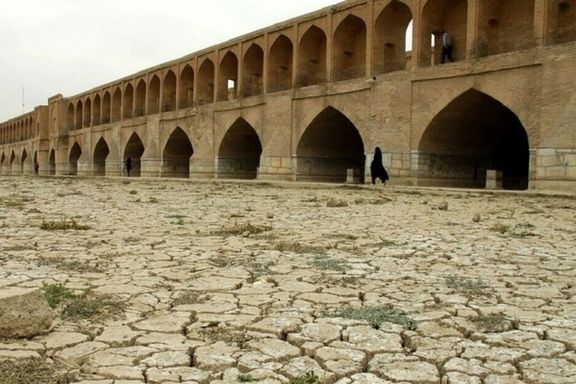
The dry bed of Zayandeh Rud in Isfahan and the city's historical Khajoo Bridge
A month-long protest by farmers in the central Iranian province of Isfahan over their water rights has once again brought the country’s growing water crisis into sharp focus.
Farmers' protests in Isfahan culminated last week in the sabotage of water transfer infrastructures and the cutting of drinking water supplies to the neighboring province of Yazd, highlighting the growing potential for civil unrest and national security risks linked to water scarcity.
Over 95 percent of Iran is currently experiencing prolonged drought. Yet experts argue that the root causes of the crisis go beyond climate, pointing to decades of mismanagement, poor resource planning, and development strategies that ignored environmental realities.
Among the most contentious issues is the concentration of water-intensive industries—such as steel and ceramics—in already water-stressed provinces like Isfahan and Yazd.
Environmental geologist and activist Nikahang Kowsar, who has been warning of a looming water catastrophe since the early 2000s, blames government policies stretching back to the reformist era of President Mohammad Khatami.
Khatami’s supporters, however, argue that plans to transfer water from Isfahan’s Zayandeh Rud to Yazd, Khatami’s hometown, began much earlier and were only completed during his presidency.
The video in the tweet shows the broken pipeline
Experts also cite excessive groundwater extraction for agriculture—pushed in the name of food security—as a major contributor to dropping water tables and land subsidence across much of the country.
Iran’s Supreme Leader Ali Khamenei has long championed agricultural self-sufficiency. In a March 2021 speech, he called for domestic production of key crops such as wheat, corn, and barley, asserting that the goal was both necessary and achievable. But critics say this policy has encouraged unsustainable water use, especially in arid regions.
Tensions in Isfahan flared last month as local farmers demanded the release of water from behind Zayandeh Rud Dam to the dry river to irrigate their parched lands. The government temporarily eased the standoff on April 5 by releasing water into the river for ten days, prompting celebratory gatherings of citizens along the dry riverbed.
Zayandeh Rud, once the lifeline of Isfahan, has not maintained a permanent flow since 2006. The decline is attributed to drought, upstream agricultural expansion in Chaharmahal and Bakhtiari Province, and the controversial diversion of water to Yazd.
Much warmer months, however, are ahead with temperatures exceeding 40 degrees celsius and both farmers and residents of the city are highly likely to face serious water issues for the irrigation of the crops and normal use, including the running of evaporative air conditioners.
Isfahan’s farmers claim that water diverted to Yazd is being used to support industrial operations, including a major steel plant and greenhouse agriculture such as the cultivation of cucumbers for export. Officials, however, maintain that the pipeline primarily supplies drinking water.
Isfahan Province is also a highly industrial city with a massive steel complex (Mobarakeh Steel Company). Local farmers also grow highly water-intensive crops such as watermelons and rice.
In recent days, angry demonstrators destroyed three pumping stations and damaged the main pipeline to Yazd. Supply of water has been partially restored. Government sources say full restoration of the pipeline could take up to two months.
The resulting emergency triggered a major water crisis in Yazd, forcing the government to announce the closure of government offices and educational facilities on Saturday and Sunday and to begin the distribution of drinking water with tankers to the city’s over half a million population.
The pipeline has long been a flashpoint. It was first sabotaged in 2012, and subsequent protests over water scarcity in Isfahan, Khuzestan, and Bushehr in 2018 and 2021 were met with a heavy government crackdown.
While protests in Isfahan temporarily subsided in Isfahan, the deeper crisis remains unresolved. Isfahan continues to suffer from some of the worst water stress in the country, even as it remains a hub for heavy industry.
Amid growing concerns, some officials have even floated the idea of relocating the capital from Tehranto the water-rich Makran region along the Gulf of Oman—a dramatic proposal that underlines the severity of Iran’s water crisis and its potential to destabilize the country’s future.
US Middle East envoy Steve Witkoff will lead talks with Iran in Oman
Iran insists that upcoming nuclear talks with the United States in Oman will be indirect, pushing back against US President Donald Trump’s announcement that direct negotiations will be underway.
The Iranian side, as reiterated by government spokeswoman Fatemeh Mohajerani and Foreign Minister Abbas Araghchi, maintains that Araghchi’s upcoming talks with US envoy Steve Witkoff in Oman will be conducted indirectly. However, Mohajerani did not explicitly rule out the possibility of direct negotiations, noting that Araghchi will lead Iran’s nuclear negotiating team as its highest-ranking official.
Both Araghchi and foreign ministry spokesman Esmaeil Baqaei had previously denied any negotiations were taking place—until Trump’s surprise Monday evening announcement during his meeting with Israeli Prime Minister Benjamin Netanyahu changed the calculus.
Shahram Kholdi, a Middle East and international relations expert, told Iran International TV that Iran’s insistence on indirect talks stems from Supreme Leader Ali Khamenei’s stance that direct negotiations with the US would be dishonorable.
Jason Brodsky, policy director at United Against Nuclear Iran (UANI), offered a different interpretation. In a post on X, he suggested that Tehran may have been caught off guard by Trump’s announcement. According to Brodsky, the announcement was likely meant “to pressure Tehran and make it look unreasonable should it reject the meeting.” He added that indirect negotiations might still occur on Saturday, but both sides would be creative in defining what counts as direct or indirect.
Meanwhile, Nour News, a website close to Iran’s Supreme National Security Council, dismissed suggestions that Iran was responding to US pressure. In a post on X, the outlet stated that Iran had set the time and location of the talks in Oman and communicated them to the US through Omani intermediaries. “No one-sided narratives—the initiative was in Tehran's hands,” the post read.
Ali Nasri, a Tehran-based foreign relations expert, criticized the ongoing obsession with terminology. “The bias regarding the words ‘direct’ or ‘indirect’ in the matter of negotiations does not benefit the lives of the Iranian people,” he wrote on X. “What matters is whether the negotiation process is effective or ineffective. Whichever method is more effective in securing national interests is the right path.”
Hossein Mousavian, Iran’s ex-ambassador to Germany (1990–1997) and a former senior nuclear negotiator, offered a historical analogy. In an X post, he recalled how negotiations during the Obama administration in Istanbul began under the supervision of EU’s supervision Catherine Ashton but soon transitioned to direct talks between Iranian and American officials. He predicted a similar setup in Oman. “It seems that Washington and Tehran have adopted a wise approach, and there is a chance for an agreement. Both negotiators [Witkoff and Araghchi] are capable, experienced, moderate, and wise,” he wrote.
Reza Nasri, another political commentator, argued that Iran has strategic reasons to consider negotiating with Trump. “Biden couldn’t deliver due to internal weakness and fear of the anti-Iran lobbies. Obama reached a deal, but Republicans killed it. Ironically, Trump may be the only U.S. president strong enough to defy the establishment, bypass Washington’s foreign policy elite, and strike a deal that actually lasts,” he posted on X.
The Iranian market has responded favorably to the prospect of talks, whether direct or indirect. Tehran’s Stock Exchange (TSE) rose by 59,000 points, reaching 2.8 million, while the rial rebounded slightly from last week’s record low, climbing to around 960,000 per dollar from 1,050,000.
Iran’s currency strengthened modestly on Tuesday, recovering from historic lows as anticipation grew over high-level indirect talks with the United States scheduled to take place this weekend in Oman.
The rial, which hit a record low of 1,050,000 per US dollar last month, bounced back to about 960,000 rials on Tuesday amid growing anticipation of renewed diplomacy between Tehran and Washington.
Iranian government spokesperson Fatemeh Mohajerani confirmed on Tuesday that the talks will be held indirectly, mediated by Oman’s Foreign Minister Badr bin Hamad Al Busaidi. “In the negotiation, what is important for the people and the national interests will be our focus,” she said.
The Iranian delegation will be led by Foreign Minister Abbas Araghchi, while the US side will be represented by Donald Trump’s Mideast envoy, Steve Witkoff, according to Iranian and US media reports.
While US President Donald Trump has said the talks will be direct and at a senior level, Iranian state-affiliated media said otherwise.
Nournews, a site close to Iran’s Supreme National Security Council, described Trump’s comments as part of a “psychological operation” meant to shift blame and shape public perception.
The rial’s gains follow a period of sharp decline, triggered by the absence of negotiations, ongoing US sanctions and Trump's 'maximum pressure' policy on Iran, and escalating regional tensions fueled by Iran's allies.
Inflation in food and other essentials has soared, with local producers citing rising packaging and transport costs as major drivers. Over one third of Iranians now live below the poverty line in the midst of the worst economic crisis since the founding of the Islamic Republic in 1979.
Iran’s currency has halved in value since President Masoud Pezeshkian took office in August.
Ultra-hardline managing editor of Kayhan newspaper, Hossein Shariatmadari
Iran's Press Supervisory Board issued a rare warning to the ultra-hardline Kayhan newspaper for threats of assassination against President Donald Trump for the 2020 killing of IRGC's Qasem Soleimani.
The supervisory board announced that it had issued an official warning to Kayhan’s managing editor following the publication of a provocative, anonymous daily column in Kayhan’s Saturday edition, written in a satirical style, that openly supported violent revenge against Trump. The piece mocked the US president’s past threats and invoked Soleimani’s death, declaring, “A few bullets are going to be fired into that empty skull of his.”
The board’s statement reiterated that the Islamic Republic’s official policy regarding revenge for Soleimani is the legal prosecution of his killers, particularly Trump, in an international tribunal.
The rhetoric was escalated further in a follow-up column on Sunday. "The shot hasn’t even been fired yet, and already a bunch of local lackeys and US bootlickers are totally freaking out …They’ve gotten scared because their skulls are as empty as Trump’s," the outlet wrote on Sunday referring to extensive criticisms voiced by public figures on social media.
Trump and several of his aides were placed on an Iranian hit list after Soleimani's killing. However, in recent months, the issue had somewhat faded amid Trump’s renewed 'maximum pressure' campaign and growing calls to renegotiate a new nuclear deal.
Though unattributed, the column, which often voices very controversial views, is widely believed to have been written by Kayhan’s ultra-hardliner editor-in-chief, Hossein Shariatmadari.
As the Supreme Leader’s official representative at Kayhan Publications, Shariatmadari’s statements are often seen—both inside and outside Iran—as indicative of the thinking of at least some elements within Ali Khamenei’s inner circle. He has held the position for 32 years and is widely known for his hardline views, including repeated calls to close the Strait of Hormuz and frequent threats against the United States, Israel, and regional countries such as Saudi Arabia and the United Arab Emirates.
"Such threats ring hollow the demands of Iranian officials for there to be ‘mutual respect’ during future negotiations with the United States," Jason Brodsky, the policy director of United Against Nuclear Iran (UANI), was quoted as saying in an article published by Fox News Digital on Saturday.
“Kayhan has been aligned with the regime’s past plots that US law enforcement has disrupted,” Brodsky added. He urged US officials to make it clear that negotiations are impossible while Iran is “threatening and plotting to kill American citizens.”
Referring to the Fox News article, Iranian media and public figures have widely criticized Kayhan newspaper and Shariatmadari for what they say is very damaging rhetoric to Iran's possible talks with the United States.
A commentary titled “Causing crisis, Shariatmadari style”, published by Rouydad 24 website in Tehran on Sunday, said when Shariatmadari speaks, “the story is different, and it boils down to creating a crisis." Another commentary described his statements as a "shooting diplomacy in the heart".
Ettela’at newspaper, also overseen by Khamenei's office, also sharply criticized Kayhan and other hardline media outlets for advocating nuclear armament, the assassination of Trump, and retaliatory attacks following Israel’s strike on Iran in October. “At such a critical juncture in Iran’s confrontation with the United States, these calls are damaging the credibility and stature of the armed forces and the government in both the media and public opinion,” the commentary said. “If this trend continues, we may find ourselves fighting a domestic fifth column masquerading as super-revolutionaries.”
The recent warning against Kayhan is notably mild compared to actions taken against reformist publications. In these cases, the board has suspended or revoked licenses and referred journalists for prosecution under national security charges. Such unequal enforcement has long fueled criticism that the board operates with double standards, cracking down harshly on reformist voices while tolerating or excusing hardline rhetoric.
Kayhan and Ettela’at, which is also under Khamenei's control, are among Iran’s oldest newspapers.
Both newspapers have a circulation of less than 5,000 and are mainly distributed to government offices, but carry political weight.
Defiance of hijab has significantly grown in Iran in the past few years
Iran's ultra-hardliners and vigilantes associated with them are increasingly warning that the Islamic Republic risks alienating its staunchest supporters if authorities continue suspending strict hijab enforcement.
In a viral video circulating on social media last week, ultra-hardliner lawmaker Mohammad-Mannan Raisi blasted the Supreme National Security Council (SNSC) for its mid-September decision to halt the implementation of the proposed Hijab and Chastity Law.
The proposed law had been slammed globally for its draconian measures, the UN branding it "gender apartheid".
“The new hijab law marks an intensification of state control over women’s bodies in Iran and is a further assault on women’s rights and freedoms,” the UN said at the time.
Raisi argued that the clerical rule’s “solid core” supporters have endured severe economic hardship out of loyalty to the Islamic Republic, expecting it to uphold the Sharia law. However, by showing indifference to religious beliefs and values, he claimed, authorities are behaving like a secular government and eroding trust among their most devoted base.
“The solid core of the system will be disillusioned if you suspend God’s commandments and fail to implement them based on unjustified expediency,” Raisi warned, suggesting these loyalists could lose their motivation to defend those in power whom they hold responsible for enforcing the Sharia.
The decision of the Supreme National Security Council (SNSC) not to enforce the controversial law could not have been made without the approval of Supreme Leader Ali Khamenei, who has avoided discussing the issue in his speeches for months despite his firm stance in April 2023, declaring that disregarding hijab was “religiously and politically haram (forbidden).”
Authorities appear to be treading carefully, as enforcing the controversial law—punishing violators, including businesses, with hefty fines and prison sentences—could spark fresh anti-government protests.
Defiance of hijab rules has significantly grown among Iranian women since the violently suppressed 2022-2023 protests that followed the death of the 22-year-old Mahsa Amini in the custody of morality police.
The young woman was arrested for not wearing her hijab properly, leading to a tidal wave of opposition to the decades-long law.
Many women now refuse to wear the compulsory head covering, long tunics, and trousers as dictated by the country's Shariah law. They are also now often seen singing and dancing in public in defiance of the religious establishment.
The crackdowns, which led to more than 500 deaths of protesters at the hands of security forces during the initial uprising, and thousands more arrests, have seen Iran levied with global sanctions, which come in addition to sanctions for its nuclear program and support of Russia's invasion of Ukraine.
Sanctions have seen Iran land in its worst economic crisis since the founding of the Islamic Republic, at least one-third of the country now living below the poverty line, and Iran increasingly isolated on the world stage.
Raisi, who led hardliner Saeed Jalili’s campaign in Qom during June’s snap presidential election, is closely aligned with the ultra-conservative Paydari (Steadfastness) Party and its allies, including Jebhe-ye Sobh-e Iran (Iran Morning Front).
His remarks came just days after an unprecedented police crackdown on pro-hijab vigilantes who had camped outside the Iranian parliament for over 45 days. While no arrests were reported, religious vigilante groups claim police used excessive force—an unexpected turn for those who have long operated with impunity and, at times, direct security force backing.
Hossein Allahkaram, a spokesman for the pro-hijab protesters, condemned the police response and vowed that demonstrations would resume after the Iranian New Year holidays.
Vigilante groups have historically played a key role in suppressing opposition movements and even participated in high-profile attacks like the storming of the British embassy in 2011 and the Saudi embassy in 2016—both of which triggered diplomatic crises.
Raisi’s warning has ignited intense debate on social media, with critics, particularly supporters of Parliament Speaker Mohammad-Bagher Ghalibaf, accusing him of issuing veiled threats against the authorities.
So far, most expressions of frustration from vigilante groups are directed at top officials. However, there are also some highly veiled complaints over Khamenei's silence, or approval, of the relative leniency shown in the hijab matter on domestic social media platforms such as Eitaa, a popular forum among ultra-hardliners and their associates.
Their waning influence has not gone unnoticed by those opposing their interference in national governance.
Former IRGC commander turned reformist figure, Ghorbanali Salavatian, wrote in an X post, “They constantly call themselves the ‘solid core’ of the system, as if the country would collapse without them and as if they alone have protected it".
US President Donald Trump looks on on the day of a meeting with US ambassadors at the White House in Washington, DC, US, March 25, 2025.
Iran’s ultra-hardline Kayhan newspaper, managed by a representative of the Supreme Leader, has repeated weekend calls to assassinate US President Donald Trump to avenge the 2020 killing of IRGC commander Qassem Soleimani.
On Sunday, the daily expressed support for what it described as revenge for the drone strike in Iraq, ordered by Trump during his first time in office, just one day after a piece had warned "a few bullets are going to be fired into that empty skull of his".
"The shot hasn’t even been fired yet, and already a bunch of local lackeys and US bootlickers are totally freaking out,... since their skulls are as empty as Trump’s, they’ve gotten scared," the outlet wrote on Sunday.
Since the assassination, Trump and several of his aides were put on a hit list but the issue of Soleimani's killing had been somewhat dulled down in recent months amid Trump's renewed campaign of 'maximum pressure' and calls to make a fresh nuclear deal.
The column, presented as a fictional conversation, called advocates of nuclear talks with the US “America’s bootlickers”. Iran's Supreme Leader continues to refuse to engage in direct talks, but has warmed to the idea of using mediation in the wake of Trump's warning that if a new nuclear deal is not reached within two months, the US will bomb Iran.
The former head of the Parliament's National Security Committee reacted to the newspaper's piece on Saturday, criticizing it as inflammatory while the situation remains so volatile.
Heshmatollah Falahatpisheh wrote on X, “Iranians hate those who promote war and terrorism. If you had the courage for war, you would’ve gone to Lebanon. If you have an assassination plan, don’t attribute your recklessness to Iran.
“The nation pays the price for the extremists’ warmongering and terroristic bluffs. The government must disavow this destructive movement.”
Tabnak website also criticized the article, warning of its costs to a nation already suffering a social and economic crisis.
"A newspaper, which happens to be state-affiliated, is publicly promoting a slogan whose cost will ultimately be paid by the people. It seems that if these ultra-revolutionary individuals truly have the motivation to sacrifice for the country, there are plenty of real opportunities to demonstrate that sacrifice," it wrote.
The paper said assassinating Trump would be “a good thing and would bring joy to Palestinians” and armed groups.
The US continues to confront Iran's Houthi militia in Yemen in the Red Sea region amid the group's maritime blockade on commercial shipping.
Ordered by the Supreme Leader in 2023 as a means to target Israeli shipping in order to force a ceasefire in Gaza, the blockade has since affected global shipping, with Trump vowing to tackle the group head on.