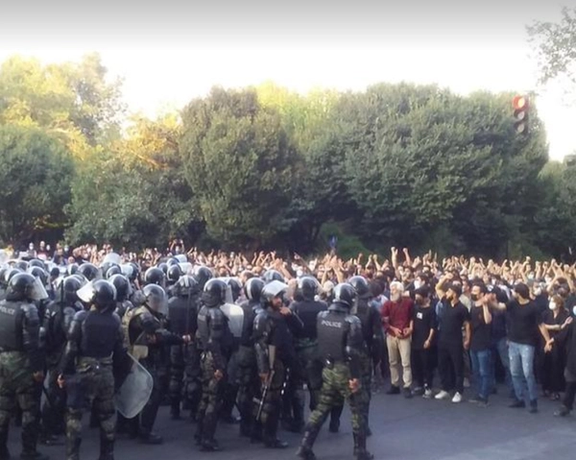
Mass protests break out in Iran in September 2022 over the killing of Mahsa Amini in police custody.
In his Eid al-Fitr sermon, Ali Khamenei once again voiced concern about the possible resurgence of anti-government protests in Iran, using his signature rhetoric to warn of a "new sedition."
But the fundamental question remains: who is the real seditionist? Is it the Iranian people protesting the country’s dire conditions—or is it Khamenei himself, who has held power for over three decades? Who is responsible for the current state of affairs that has him so worried? Who has ruled the country and made all major decisions over the past 36 years—ordinary citizens or Khamenei himself?
Khamenei labeling public protests as "sedition" and dismissing demonstrators as seditious is nothing new. This has always been his approach. He has never been willing to acknowledge that Iranian citizens are reacting to the country's deteriorating conditions, which are a direct result of his policies as supreme leader. He has consistently refused to recognize these protests as legitimate, branding them as riots in order to justify their suppression.
He views the citizens who took to the streets in dozens of cities during the 2017, 2019, and 2022 uprisings as being influenced by foreign enemies. But is this really plausible? Khamenei refuses to accept that these protests are domestic and popular in nature. He uses the label of unrest to delegitimize them.
If Khamenei is worried about new protests, he should understand that this fear stems from his own actions. The country’s current state—one that the majority of people reject—is the product of 36 years under his rule, and a decade before that under Khomeini.
Khamenei with top security and military officials. File photo
For 46 years, no one else has governed Iran. Even the monarchy, which the Islamic Republic continues to criticize and compare itself to, fares better in many metrics. In contrast, the Islamic Republic has dragged the country backward.
After 46 years in power, it is no longer acceptable for the Islamic Republic to measure itself against a government from half a century ago. And even when this comparison is made, in the minds of many Iranians, the Pahlavi era wins, while the Islamic Republic is clearly the loser.
While other nations have advanced in less time, Iran under the Islamic Republic has stagnated or regressed. Dubai and Qatar have achieved modern prosperity in under 46 years. China, now an economic superpower, began its development path after the Islamic Republic came to power—but unlike Iran, it made real progress. The Islamic Republic squandered these decades, pushed the country into ruin, and sacrificed three generations in the process—yet refuses to step aside. Meanwhile, those who object to these conditions are called seditious.
When Khamenei assumed power in 1989, the exchange rate was 1,200 rials to the US dollar. After 36 years of his leadership, it has surpassed one million—a depreciation of 87,000 percent. This isn't mere exaggeration; it’s verifiable with a basic calculation. And still, he labels public protests as sedition and threatens suppression—though such threats have long lost their force.
In just the past four years, the dollar has surged from around 200,000 rials to 1,040,000—more than a fivefold increase. So why wouldn’t people expect the currency to plunge further, possibly hitting one billion rials, if the current trajectory and war-driven policies continue?
Iran's government keeps printing money to make up for lack of revenues, fueling inflation.
Given this economic collapse—and the fact that widespread poverty and dissatisfaction are direct consequences of Khamenei’s rule—how can he possibly justify calling protesters seditious?
Even some of Khamenei’s own allies, like former deputy parliament speaker Mohammadreza Bahonar, have admitted that inflation has hovered at 40 percent for the past seven years. Inflation, in essence, is a legalized form of theft by the state—citizens go to sleep at night and wake up to find their savings eroded.
Even former president Hassan Rouhani, a figure deeply entrenched in Iran’s security apparatus, has openly stated that the people are unhappy.
When individuals who played key roles in cracking down on the 2017 and 2019 protests now speak of widespread dissatisfaction, how can Khamenei still claim these movements are foreign-led?
Many Islamic Republic officials have warned that the public will once again take to the streets—an outcome of the government’s own policies. If anything needs to change, it is the behavior of those in power, not the people.
Numerous insiders have acknowledged the failures of the Islamic Republic’s domestic and foreign policies, especially regarding the US and Israel. Khamenei and the Revolutionary Guard’s staunch anti-American and anti-Israeli stance has not only devastated the economy but also edged the country closer to a potentially catastrophic war.
Sanctions, largely driven by Tehran’s belligerent foreign policy, have primarily harmed ordinary Iranians—while enriching commanders of the Revolutionary Guard.
Mohammad Hossein Adeli, a former Central Bank governor, revealed that in just one year, efforts to circumvent sanctions—managed by the Revolutionary Guard—cost the country $50 billion.
Where did that money go? Beyond international middlemen, much of it ended up in the hands of IRGC commanders and oil smuggling networks. They call it “bypassing sanctions,” but in practice, it’s looting the nation while claiming sacrifice and heroism.
Naturally, the Guard will seek to protect this $50 billion racket—so it continues echoing anti-American policies. After all, it’s the people who pay the price, not the IRGC.
The reality is that through flawed domestic and foreign policies, the Islamic Republic has pushed Iran into a full-blown crisis. Public frustration and anger towards the ruling system is undeniable. The responsibility for this crisis rests squarely on Ali Khamenei and the government he leads.
Ultimately, public protests driven by economic collapse, corruption, and authoritarianism cannot be ignored—and they will inevitably erupt again. But the core question remains: in a country where even officials acknowledge the people's dissatisfaction, who is the real source of sedition—the people, or Ali Khamenei?
US President Donald Trump in the Oval Office at the White House in Washington, DC, March 31, 2025
Tehran and Washington have taken their exchange of threats to a new level, with the US president raising the prospect of bombing Iran and Tehran not only vowing to retaliate but also threatening to build nuclear weapons.
Iran’s threats have also included the far-fetched idea of targeting the US base at Diego Garcia in the Indian Ocean—a claim dismissed by military analysts, who argue that Iran lacks the capability to strike such distant targets. Still, Iran’s defense doctrine is rooted in asymmetrical warfare, and its commanders have often warned they could strike in unexpected ways.
Following Khamenei’s sharp response to Trump’s threat, Iran’s air force commander Amir Ali Hajizadeh noted that there are dozens of US targets within close range in the Persian Gulf region.
As tensions rose further, senior Khamenei adviser Ali Larijani suggested that Trump’s threats could push Iran toward building nuclear weapons. That message was quickly echoed by hardline MP Ahmad Naderi, a member of the parliament’s presidium, who argued that nuclear weapons have secured North Korea’s safety—and questioned why Iran should not follow the same path.
Larijani’s statement, however, carried a different weight. He has long been seen as a measured political figure—unlike the more impulsive military commanders or obscure ultraconservative lawmakers. As speaker of Iran’s parliament (Majles) for 12 years and one of the key architects of the 2015 nuclear deal with the West, Larijani played a central role in shaping Iran’s diplomacy. Hardliners still recall, often with resentment, how he pushed the JCPOA agreement through a predominantly hardline parliament in just 20 minutes.
At the same time, Larijani is a US-educated politician and a former IRGC officer, trusted by Khamenei both for his background and his lineage—he is the son of one of Iran’s highest-ranking clerics. He once oversaw Tehran’s nuclear file and only stepped down as Secretary of the Supreme National Security Council due to a personality clash with ultraconservative former President Mahmoud Ahmadinejad.
By allowing someone like Larijani to voice support for building nuclear weapons, Khamenei revealed one of the key complexities of Iranian politics. He is signaling to both Trump and the Iranian public that pressure to pursue the bomb is coming not just from hardline agitators in parliament, but also from figures seen as moderate and pragmatic. In doing so, he effectively sidelines his much-publicized fatwa banning nuclear weapons—though few ever believed it was an absolute or irreversible stance.
At the same time, Larijani’s statement—as a politician who often echoes Khamenei’s broader policy positions—renders previous threats about Iran leaving the Non-Proliferation Treaty (NPT) largely redundant. Once a country openly talks about building a nuclear bomb, it effectively signals its departure from the NPT, regardless of any formal announcement.
In a commentary on Larijani’s statement, Nour News—a media outlet affiliated with Iran’s Supreme National Security Council—wrote on Tuesday that Trump’s talk of bombing Iran has triggered serious concerns about national security. According to the commentary, this growing anxiety could shift public opinion in favor of changing Iran’s nuclear policy. It added that the United States should be held accountable for accelerating Iran’s potential turn toward developing nuclear weapons.
Nour News quoted Larijani as warning that any US or Israeli military strike aimed at ending Iran’s nuclear program could instead push Tehran toward the very path it has so far avoided.
The outlet also claimed that with the backing of Russia and China, Iran is no longer isolated on the international stage. Echoing Larijani’s remarks, it suggested that Yemen is now capable of responding to US aggression in ways that would prove costly for Washington and its allies.
According to Nour News, “The United States now faces two choices: either continue its hostile behavior and drag the region into an unprecedented security crisis, or change course to ease rising tensions.” The commentary added that Trump’s threats risk further complicating the situation, noting that “Iran has many options to defend its national security.” It concluded by stating that “Iran’s final decision will depend on future US actions.”
Meanwhile, Larijani’s brother-in-law, Ali Motahari, told the press that “there is nothing wrong with negotiating with the United States.” He went further, saying that “President Massoud Pezeshkian should have accepted Trump’s offer to negotiate”—though he did not mention that Pezeshkian lacked Khamenei’s approval to do so at the time.
Iran's Qom Salt Lake, a potential lithium resource
A recent report from Iran’s Ministry of Industries, Mines, and Commerce has reignited misleading social media claims that Iran ranks among the top countries in lithium resources.
According to the Revolutionary Guards (IRGC) linked Fars News Agency, the ministry reported high lithium concentrations in brine in Qom Salt Lake, Khor in Iran's Central Desert, and Tarud in Semnan Province.
Fars suggested that these findings could position Iran as a key player in the global lithium mining industry, although the scale of the discovered deposits pales in comparison to those controlled by the world's top ten lithium producers.
An official from the Presidential office’s Mines Working Group reported that with a lithium concentration of 60–70 ppm, this deposit would yield only 500–600 tons of lithium—far from the claim that Iran had discovered 20% of the world’s lithium.
The world’s major lithium reserves are found in the "Lithium Triangle" (Argentina, Bolivia, and Chile), while Australia leads in hard-rock lithium mining. The latest data ranks Bolivia as the top holder of lithium reserves, with an estimated 23 million tons. With usable reserves close to 14 million tons, the US ranks third in the world.
Due to security restrictions, Iranian government websites are inaccessible from outside Iran. However, Fars reported that the findings stem from a year-long study conducted in collaboration with Russian experts using advanced technologies such as ICP-OES. According to Fars, this study confirms the presence of lithium reserves with globally competitive concentrations.
The Fars report on March 12 has been widely republished by Iranian media and amplified on social media, especially by accounts linked to hardliners that claim Iran is on the brink of a "Green Lithium Revolution." Such claims are often used as a means to create optimism among the population as the country's economy continues to deteriorate.
This is not the first time that exaggerated claims about Iran’s lithium resources have circulated. In November 2024, a very well-known ultra-hardliner and vigilante, Hossein Allahkaram, said in an online debate that Iran held the fourth-largest reserves of lithium in the world, even suggesting that Elon Musk sought negotiations with Iran.
Similar misinformation spread in February 2023 when Iran’s official news agency IRNA quoted a ministry official, Ebrahim-Ali Molabeigi, claiming the discovery of 8.5 million tons of lithium in Hamedan Province.
Global excitement over the report faded after it was revealed to be a misinterpretation. The actual discovery was 8.5 million tons of hectorite clay containing lithium, not pure lithium reserves.
Lithium plays a crucial role in rechargeable batteries for electric vehicles, smartphones, laptops, and energy storage systems. While it is primarily extracted from salt lake brines and hard rock deposits, alternative sources such as clay deposits and geothermal brines are not yet widely used for commercial production.
More than 40 years after the 1979 revolution and despite persistent tensions between Tehran and Washington, American cars remain a prized symbol of prestige and nostalgia in Iran.
Classic American cars, often spotted cruising the streets of Iranian cities, serve as moving relics of a bygone era. For many Iranians, these cars are more than just a means of transportation; they represent cultural heritage, status and a deep-rooted admiration for American engineering.
Even Ayatollah Khomeini, Iran’s first supreme leader - the man who led the 1979 revolution and coined the term Great Satan for the United States - was driven in an American car upon his return to Iran from exile.
The 1977 Chevy Blazer disappeared soon after that momentous day and was found and restored only in 2025.
Iran's revolutionary leader Ayatollah Khomeini upon his return from exile, Tehran, Iran, Feb. 1979
Other prominent figures of the Islamic Republic have also been spotted riding American cars. Gholamali Haddad Adel, a former parliament speaker and a close relative of current leader Ali Khamenei, was often seen behind the wheel of a Chevrolet Caprice Classic in the 1990s.
Saeed Jalili, former chief nuclear negotiator and a hardline contender in the 2024 presidential election known for his staunch anti-US rhetoric frequently drove an Oldsmobile during his tenure at the Foreign Ministry’s watchdog bureau.
While Iran’s domestic auto industry spearheaded by Iran Khodro since the late 1950s has made strides in assembling European and Korean vehicles, American cars remain synonymous with distinction and exclusivity.
In a country where foreign imports are tightly restricted, owning a US-made vehicle is a luxury—an emblem of prestige often reserved for the elite.
'Good old days'
The appeal of American cars predates the 1979 revolution.
Three years previously the Iranian government launched the "Cadillac Iran" assembly line, producing nearly 2,500 Cadillac Seville luxury sedans. This venture blended local manufacturing with American craftsmanship, solidifying the place of US vehicles in Iranian automotive culture.
Screenshot of an Instagram page showing a young Iranian posing next to a Buick
Popular Iranian car vlogger and enthusiast Alireza jokingly claims that being a true driver in Iran requires either a German luxury car or an American gas-guzzler.
“If you can’t afford a Mercedes, you can’t call yourself a driver unless you’re behind the wheel of an American V8,” he quips. He also shares a favorite saying among Iranian classic car lovers: “A man must drive a Chevy for work, a Buick for leisure and only a Cadillac for a rendezvous.”
The admiration for American cars, particularly those from the 1960s and 1970s, is rooted in their durability, reliability, and timeless design. While the revolution led to a strict ban on American imports, the restriction only intensified their appeal and elevated them to the status of coveted classics.
Much like Cuba where vintage car restoration has become a national pastime Iran has seen a growing demand for mechanics skilled in repairing and maintaining American cars.
A mechanic in southern Iran promoting his work on old cars on Instagram
29-year-old Tehran mechanic Farhad Keshavarz inherited his shop from his father, who specialized in these vehicles long before the revolution.
“These cars demand the highest level of care, and their owners can’t wait to show off their roaring engines,” says Farhad, who receives daily requests for full overhauls and engine restorations.
For over four decades, American V8s in Iran have transcended political divides, symbolizing status, power and a golden age of automotive excellence.
While many Americans now associate reliability with Japanese brands like Honda and Toyota, in Iran, "Made in America" still carries a mystique.
Here, an American car is not just a machine—it is a statement, a status symbol, and a cherished link to an era when luxury and power ruled the open road.
Iran's Supreme Leader Ali Khamenei leading a Tehran Firday prayers, January 18, 1980
Many middle-aged and older Iranians associate Friday prayers with the iconic image of a cleric delivering a sermon four decades ago while holding a 1970s G3 assault rifle—once a symbol of revolutionary power and defiance.
In the 1980s, following Ayatollah Khomeini’s Islamic revolution and during the Iran-Iraq war, Friday prayers drew large crowds and held significant public appeal. Over time, however, attendance declined as the lineup of Friday prayer imams changed, and growing dissatisfaction with the Islamic Republic’s social restrictions and worsening economic conditions further eroded their popularity.
Today, Friday prayers resemble weekly political briefings, often attended by local military and civilian officials. Policy directives are routinely sent from Tehran to guide the content of the sermons, turning them into orchestrated political messaging platforms.
Since assuming power, Supreme Leader Ali Khamenei has restructured the Friday prayer apparatus, moving its coordinating headquarters from the religious center of Qom to Tehran. He also systematically removed the imams appointed by his predecessor, Ruhollah Khomeini, replacing them with younger clerics more aligned with his vision.
Facts and figures According to an investigation by the Iran International website:
- There are currently 850 Friday prayer imams across Iran.
- Around 85% of them were appointed after 2017.
- Most cities have two Friday prayer imams.
- The seven-member Friday Prayer Headquarters under Khamenei’s control appoints imams even in small towns with populations as low as 500.
- About 70% of the imams appointed since 2017 have served with Iran’s military forces or were embedded with military units in Syria.
- Only one imam appointed by Khomeini remains in his position today.
Leading the Friday prayers is only one of the responsibilities of the Imams. They also lead the local councils in charge of imposing Islamic social and cultural control. They also supervise Islamic tax organizations, they are jury members at the Press Courts, they are member of the trustees of the Islamic Azad University, member of the Educational Council and local security councils among many other responsibilities. Some have their own bureaucratic empire.
Khamenei introduces changes
When Ali Khamenei became Supreme Leader, he replaced four of the seven members of the headquarters overseeing Friday prayer imams. Ten months later, he renamed the body the Policy-Making Headquarters for Friday Prayers. Significant changes followed the 2018 nationwide protests, when Khamenei appointed a younger cleric, Mohammad Haji Ali Akbari, as its head. Haji Ali Akbari also serves as one of Tehran’s Friday prayer imams.
Unlike most cities, Tehran does not have a permanent Friday prayer leader. In each of Iran’s 31 provinces, the Friday prayer imam also serves as Khamenei’s official representative.
Kazem Nour Mofidi, the Friday prayer imam of Golestan province, is currently the only one still in office from Khamenei’s earlier appointments. Historically, many provincial imams were members of the Assembly of Experts—the body responsible for selecting the Supreme Leader’s successor. Of those appointed after 2017, however, only six hold seats in the Assembly. Most of the older imams were replaced due to political misalignment with Khamenei’s views.
The province of Isfahan has the largest number of Friday prayers imams (86) while two provinces, Qom and Kordestan have 8 imams each.
The imams, who enjoy Khamenei’s backing, in many cases wield a lot of political power in their city, adjudicating differences among officials, overseeing local government decisions and in times of civil unrest rally government forces and supporters against protesters.
What is Friday Prayer?
Muslims face Mecca five times a day every day to say their prayers. Muslims may do their mid-day prayers in congregations of at least five individuals as "Friday prayers." The imams deliver two speeches called sermons before the prayers. Friday prayers are compulsory in Sunni populated areas which the Shiites may or may not turn up for the congregation.
Khomeini never led Friday prayers while Khamenei used to lead the prayers regularly in his early years as Supreme Leader. However, he has been only occasionally taking part in Friday prayers in recent years.
Pro-hijab vigilantes protesting outside the Iranian Parliament. March 2025
An unprecedented police crackdown on pro-hijab protesters in Iran suggests a shift in priorities, signaling that defiance of higher authorities even by supporters will no longer be tolerated.
On Friday evening, hundreds of male and female police officers raided a makeshift vigilante camp outside the Iranian parliament, dispersing around two dozen protesters—mostly women—who had been stationed there for over 45 days. They were protesting the delay in enforcing a controversial hijab law.
While no arrests were reported, religious vigilante groups claim that police used excessive force. They called on their supporters to rally outside the parliament on Saturday afternoon. A spokesman, Hossein Allahkaram, announced later that the rally would be postponed until after the Nowruz holidays.
In the past, security forces have even protected radical supporters during high-profile actions, such as the storming of the British embassy in 2011 and the Saudi embassy in 2016—both of which triggered major diplomatic crises.
A defiance of the Supreme Leader and his policy shift?
In mid-September, Iran's Supreme National Security Council (SNSC) suspended the implementation of the hijab legislation, which imposes harsh penalties—including heavy fines and prison sentences—on women who violate strict dress codes and businesses that fail to enforce them. The decision was reportedly driven by concerns over public backlash and the risk of triggering anti-government protests.
Since the decision could not have been made without the approval of Supreme Leader Ali Khamenei, who has avoided discussing the issue in his speeches for months, criticism of the delay could be viewed as defiance of what appears to be a strategic shift in Khamenei’s approach.
Vigilantes continue to refer to Khamenei’s April 2023 speech, in which he took a firm stance. Khamenei declared in the speech that disregarding hijab was “religiously and politically haram (forbidden).” In the same speech, he accused foreign intelligence agencies of encouraging Iranian women to defy the mandatory hijab. However, he has conspicuously avoided addressing the hijab issue in recent months, including during his December 17 address to an all-female audience.
Rather than blaming Khamenei, vigilantes hold Mohammad-Bagher Ghalibaf responsible for the delay in enforcing the legislation and argue that he should be accountable for Friday’s crackdown. Hours before the crackdown, they chanted against Ghalibaf during his speech at Friday prayers in Tehran.
The Friday crackdown could also be seen as a warning to ultra-hardliners that opposition to Khamenei’s potential policy shifts— possibly including allowing engagement in direct talks with the Trump administration—will not be tolerated.
“Consider the recent actions against [pro-] hijab protesters as marking a shift in Iran’s political landscape,” a former aide to ex-President Mahmoud Ahmadinejad, Abdolreza Davari, posted on X, suggesting that authorities are now seeking to mend their relationship with the hugely disillusioned middle classes.
Debate over freedom of assembly
The police action has sparked debate over the right to assembly in Iran. Some opposition figures have criticized the crackdown.
Ali-Asghar Shafeian, chief editor of the reformist Ensaf News, argued in a tweet that the police response was unnecessary and contradicted President Masoud Pezeshkian’s stance on freedom of expression.
Others, including prominent Islamic law expert Mohsen Borhani, pointed out that the vigilantes—who had no permit for their sit-in—have consistently rejected the right of other political groups to protest, despite Article 27 of the Iranian Constitution protecting peaceful assembly.
Mahmoud Nabavian, a senior Paydari member who played a key role in drafting the hijab law, recently argued that the preservation of the Islamic Republic must take precedence over enforcing the law, given the multiple domestic and international crises that it is facing—implicitly acknowledging the risk of unrest.