• العربية
  • فارسی
Brand
  • Iran Insight
  • Politics
  • Economy
  • Analysis
  • Special Report
  • Opinion
  • Podcast
  • Iran Insight
  • Politics
  • Economy
  • Analysis
  • Special Report
  • Opinion
  • Podcast
  • Theme
  • Language
    • العربية
    • فارسی
  • Iran Insight
  • Politics
  • Economy
  • Analysis
  • Special Report
  • Opinion
  • Podcast
All rights reserved for Volant Media UK Limited
volant media logo

Water crisis deepens as farmers torch key pipeline amid protests in central Iran

Mar 30, 2025, 18:20 GMT+1Updated: 08:45 GMT+0
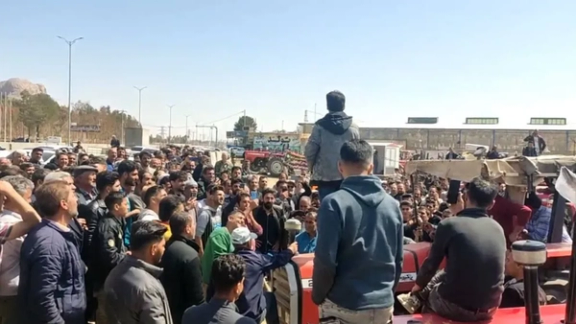
Protest over water shortage in Iran's Isfahan province on March 29, 2025.

Protests over water shortages in central Iran escalated over the weekend after demonstrators set fire to a key water transfer station in Isfahan province, disrupting the supply line that channels water to hundreds of thousands of Iranians in the province of Yazd.

Footage received by Iran International shows smoke rising from the pumping station early Saturday, following a rally by farmers demanding access to Zayandeh Rud water — a long-promised resource they say has been diverted elsewhere.

“There’s been no release of water into the river despite repeated promises,” said one farmer at the protest, adding that local agriculture has been devastated by years of inaction.

Farmers in Isfahan have repeatedly accused the government of diverting their water to other provinces, particularly Yazd, while their own access to Zayandeh Rud — once the lifeblood of regional farming — remains restricted. The issue has sparked protests for years, often met with a heavy security response.

The disruption has triggered a major water emergency in Yazd, which is now facing what officials describe as red-level shortages for the population of well over half a million.

Mohammad-Javad Mahjoubi, head of Yazd’s regional water authority, said the pipeline was completely shut off after the attack and warned there was no estimate for when it might resume.

Jalal Alamdari, the managing director of Yazd’s water utility, described the situation as critical and confirmed that 13 mobile tankers had been deployed across the province.

Isfahan is considered one of the most critically affected provinces in Iran in terms of water scarcity, and the people of this region have repeatedly gathered and protested against the inefficient management of the Islamic Republic in addressing the issue.

In some cases, the protests have been met with repression by Iran's security forces. The first major act of sabotage on the pipeline occurred in 2012, tensions only intensifying since.

Interior Minister Eskandar Momeni acknowledged the broader crisis last week, calling water scarcity a “serious national issue” and urging citizens to cut back on usage.

Most Viewed

Iran negotiators ordered to return after internal rift over Islamabad talks
1
EXCLUSIVE

Iran negotiators ordered to return after internal rift over Islamabad talks

2
ANALYSIS

US blockade enters murky phase as tankers spoof signals and buyers hesitate

3
ANALYSIS

Why the $100 billion Hormuz toll revenue is a myth

4

US tightens financial squeeze on Iran, warns banks over oil money flows

5
ANALYSIS

US blockade targets Iran oil boom amid regional disruption

Banner
Banner

Spotlight

  • Hardliners push Hormuz ‘red line’ as US blockade tests Iran’s leverage
    INSIGHT

    Hardliners push Hormuz ‘red line’ as US blockade tests Iran’s leverage

  • Ideology may be fading in Iran, but not in Kashmir's ‘Mini Iran'
    INSIGHT

    Ideology may be fading in Iran, but not in Kashmir's ‘Mini Iran'

  • War damage amounts to $3,000 per Iranian, with blockade set to add to losses
    INSIGHT

    War damage amounts to $3,000 per Iranian, with blockade set to add to losses

  • Why the $100 billion Hormuz toll revenue is a myth
    ANALYSIS

    Why the $100 billion Hormuz toll revenue is a myth

  • US blockade targets Iran oil boom amid regional disruption
    ANALYSIS

    US blockade targets Iran oil boom amid regional disruption

  • Iran's digital economy battered by prolonged blackout
    INSIGHT

    Iran's digital economy battered by prolonged blackout

•
•
•

More Stories

US behavior key to indirect talks after Trump letter, Iran says

Mar 30, 2025, 11:56 GMT+1

The future of indirect negotiations between Iran and the US hinges on Washington's behavior, the Iranian president said on Sunday following Tehran's response to a letter from President Donald Trump.

Masoud Pezeshkian told his cabinet, "In this response, although the issue of direct negotiation between the two sides has been rejected, it has been stated that the path of indirect negotiation is open."

He emphasized that Iran has never avoided negotiations, and that past issues arose from breaches of promises by the US that need to be rectified to rebuild trust.

"[In the response] it has been emphasized that Iran has never avoided negotiation, and it was only bad faith that caused problems in this path, which must be compensated and trust rebuilt; it is the behavior of the Americans that determines the continuation of the negotiation path," Pezeshkian said.

Earlier reports indicated that Trump's letter proposed discussions on Iran's nuclear program, while Iranian sources said their response reiterated long-standing positions, including a refusal to negotiate on its missile program or regional alliances.

Foreign Minister Abbas Araghchi also said on Thursday that Iran's response was conveyed through Oman, and that while direct talks were off the table under Trump’s so-called maximum pressure and military threats, indirect negotiations could continue.

Earlier on Sunday, Iran's Foreign Ministry emphasized the importance of maintaining the confidentiality of international negotiations and correspondence as it confirmed the exchange of messages with the United States.

How Khamenei shaped Friday prayers into another tool for control

Mar 30, 2025, 11:00 GMT+1
•
Amirhadi Anvari

Many middle-aged and older Iranians associate Friday prayers with the iconic image of a cleric delivering a sermon four decades ago while holding a 1970s G3 assault rifle—once a symbol of revolutionary power and defiance.

In the 1980s, following Ayatollah Khomeini’s Islamic revolution and during the Iran-Iraq war, Friday prayers drew large crowds and held significant public appeal. Over time, however, attendance declined as the lineup of Friday prayer imams changed, and growing dissatisfaction with the Islamic Republic’s social restrictions and worsening economic conditions further eroded their popularity.

Today, Friday prayers resemble weekly political briefings, often attended by local military and civilian officials. Policy directives are routinely sent from Tehran to guide the content of the sermons, turning them into orchestrated political messaging platforms.

Since assuming power, Supreme Leader Ali Khamenei has restructured the Friday prayer apparatus, moving its coordinating headquarters from the religious center of Qom to Tehran. He also systematically removed the imams appointed by his predecessor, Ruhollah Khomeini, replacing them with younger clerics more aligned with his vision.

Facts and figures
According to an investigation by the Iran International website:

- There are currently 850 Friday prayer imams across Iran.

- Around 85% of them were appointed after 2017.

- Most cities have two Friday prayer imams.

- The seven-member Friday Prayer Headquarters under Khamenei’s control appoints imams even in small towns with populations as low as 500.

- About 70% of the imams appointed since 2017 have served with Iran’s military forces or were embedded with military units in Syria.

- Only one imam appointed by Khomeini remains in his position today.

Leading the Friday prayers is only one of the responsibilities of the Imams. They also lead the local councils in charge of imposing Islamic social and cultural control. They also supervise Islamic tax organizations, they are jury members at the Press Courts, they are member of the trustees of the Islamic Azad University, member of the Educational Council and local security councils among many other responsibilities. Some have their own bureaucratic empire.

Khamenei introduces changes

When Ali Khamenei became Supreme Leader, he replaced four of the seven members of the headquarters overseeing Friday prayer imams. Ten months later, he renamed the body the Policy-Making Headquarters for Friday Prayers. Significant changes followed the 2018 nationwide protests, when Khamenei appointed a younger cleric, Mohammad Haji Ali Akbari, as its head. Haji Ali Akbari also serves as one of Tehran’s Friday prayer imams.

Unlike most cities, Tehran does not have a permanent Friday prayer leader. In each of Iran’s 31 provinces, the Friday prayer imam also serves as Khamenei’s official representative.

Kazem Nour Mofidi, the Friday prayer imam of Golestan province, is currently the only one still in office from Khamenei’s earlier appointments. Historically, many provincial imams were members of the Assembly of Experts—the body responsible for selecting the Supreme Leader’s successor. Of those appointed after 2017, however, only six hold seats in the Assembly. Most of the older imams were replaced due to political misalignment with Khamenei’s views.

The province of Isfahan has the largest number of Friday prayers imams (86) while two provinces, Qom and Kordestan have 8 imams each.

The imams, who enjoy Khamenei’s backing, in many cases wield a lot of political power in their city, adjudicating differences among officials, overseeing local government decisions and in times of civil unrest rally government forces and supporters against protesters.

What is Friday Prayer?

Muslims face Mecca five times a day every day to say their prayers. Muslims may do their mid-day prayers in congregations of at least five individuals as "Friday prayers." The imams deliver two speeches called sermons before the prayers. Friday prayers are compulsory in Sunni populated areas which the Shiites may or may not turn up for the congregation.

Khomeini never led Friday prayers while Khamenei used to lead the prayers regularly in his early years as Supreme Leader. However, he has been only occasionally taking part in Friday prayers in recent years.
IRGC agents stole millions during crypto fraud case, leaked files reveal

Mar 30, 2025, 10:15 GMT+1
•
Mojtaba Pourmohsen

Senior officers in Iran’s Revolutionary Guard's intelligence organization stole around $21 million in cryptocurrency while pretending to investigate a corruption case, Iran International has found.

The case centers on Cryptoland, a digital exchange shut down after the May 2021 arrest of its CEO, Sina Estavi.

At the time of his arrest, Estavi had no formal accusers, but once the news spread thousands of investors lodged complaints. Mizan news website, controlled by Iran's notorious Judiciary department, later reported over 51,000 plaintiffs.

The BRG token, which Estavi had developed, collapsed in value following his arrest. Blockchain records show that just a day after his detention, six billion BRG tokens were moved from his crypto wallet. This was before the general public was aware of a potential scandal.

These were then sold off by IRGC officers, generating tens of millions of dollars for the interrogators themselves.

A court-appointed expert identified two of the key figures: Mehdi Hajipour and Mehdi Badi, both senior interrogators in the IRGC’s economic branch. The expert’s report confirms that wallets controlled by Hajipour sold over $21 million in BRG tokens.

In March 2022, IRGC counterintelligence agents arrested Hajipour in a sting operation. He was caught accepting a $10,000 payment from Estavi, who had been led to believe he was buying back the stolen tokens from a third party — a fake identity Hajipour had created.

Cryptoland CEO Sina Estavi (Undated)
100%
Cryptoland CEO Sina Estavi

Court documents show that before the token theft, Hajipour’s assets were worth about 10 billion rials ($40,000 at the time). Four months later, his fortune had surged to 600 billion rials — spent on real estate, gold, and luxury vehicles. He was later held in Ward 66, a prison used for detained IRGC personnel.

The court document also reveals that Hajipour had a network of senior interrogators from the IRGC Intelligence Organization working alongside him.

The second suspect in this case is Mehdi Badi, a senior interrogator who operated under the alias Dr. Ebadi, whose name has appeared in many major cases labeled as IRGC economic corruption investigations.

He is the nephew of Ali Akbar Hosseini Mehrab, the former Deputy for Economic Anti-Corruption Affairs at the IRGC intelligence organization, who also served for a time as the Director General of Intelligence in Khuzestan and was later appointed as the governor of Khuzestan under the President Ebrahim Raisi administration.

According to the court document, two other interrogators from the IRGC intelligence organization, Majid Jahan Parto and Majid Tabatabaei, are also members of the corruption network, along with four others who assisted the group by forging documents.

There is no available information about the fate of the defendants in this case or the sentences they received, except that Hajipour’s appeal was rejected in September 2022.

However, Sina Estavi was sentenced to 15 years in prison and ordered to return the embezzled funds. He fled the country under pressure from the senior interrogators—who had in fact stolen the victims' money themselves.

Three months after Hajipour’s arrest, Hossein Taeb was dismissed from his position as head of the IRGC intelligence organization and replaced by Mohammad Kazemi.

Half of the victims in this case—whose money amounted to $14 million—were repaid from Estavi’s account while he was in prison, but around 25,000 others are still owed money. They are creditors of funds that were obtained and never returned by Hajipour, Badi, and the other members of the network.

Tehran's earthquake threat adds to city's woes

Mar 30, 2025, 08:59 GMT+1
•
Maryam Sinaiee

Recent tremors outside Tehran this month have underscored the threat of a catastrophic earthquake to the capital built on fault lines, adding to the dread of inhabitants also grappling with water shortages, power cuts, and pollution.

Two overnight earthquakes, measuring 3.0 and 3.3 in magnitude, struck Varamin—a densely populated and impoverished town southeast of Tehran—on March 14. While the tremors were felt in the southern parts of the capital, no casualties were reported.

Just a day before the incident, a member of Iran's International Institute of Earthquake Engineering and Seismology (IIEES) warned that Tehran was at greater risk than ever of experiencing a devastating earthquake.

Seismologist Fariborz Nateghollahi cautioned that a magnitude 7.0 earthquake could result in up to six million casualties. He also criticized the government’s crisis management efforts, highlighting the lack of preparedness and inadequate training for such a disaster.

Tehran’s seismic vulnerability

Greater Tehran, now home to over 10 million people, sits in a seismically active region with three major fault lines and many smaller ones.

A study conducted in collaboration with the Japan Cooperation Agency (JICA) a few years ago found that these fault lines have the potential to trigger earthquakes of magnitude 7.0 or higher, potentially destroying up to half of the city's buildings.

Seismologists, including Nateghollahi, have repeatedly warned that based on historical seismic cycles, any of these fault lines could become active at any time soon.

A 2018 IIEES study estimated a 40–70% probability of a major earthquake within a 100-kilometer radius of central Tehran in the next two to 12 years.

The last major earthquake in what is now Greater Tehran occurred in 1830, with a magnitude of 7.1, striking Shemiran—a small village at the time. Over the past few decades, Shemiran has transformed into one of the capital’s most affluent districts, now filled with high-rises, government buildings, and shopping malls.

High-risk areas

The southeastern part of Tehran, also situated on a major fault line, is considered the city’s most vulnerable area. It is characterized by densely packed old buildings and narrow streets, which would severely hinder rescue operations in the event of a major earthquake.

Additionally, the region has suffered from land subsidence due to a drastic decline in underground water levels over the past few decades.

A capital under strain

Authorities say the 47 percent drop in rainfall in Tehran province, the worst in the past 57 years, has seriously depleted the water reserves of several dams that supply the city’s drinking water. Images published in recent weeks showed that Karaj dam, one of the largest, had almost completely dried up. The dams also contributed to electricity generation to feed the capital, which has been experiencing regular power cuts in the past few months.

Iranian authorities, including President Masoud Pezeshkian, have on various occasions spoken of the need to relocate the country's capital due to its extreme vulnerability to major earthquakes.

In recent years, a shortage of water resources, land subsidence due to a decline in underground water levels, and air pollution have also become serious threats to the survival of the capital, established in 1786.

A history of devastation

Iran is one of the most seismically active countries in the world, with approximately 575 identified fault lines. Earthquakes of varying intensity are common, often resulting in significant casualties and destruction.

In 1990, a 7.4 magnitude earthquake struck Manjil and Roudbar in the Caspian mountains, killing between 35,000 and 50,000 people. Thirteen years later, a 6.6 magnitude earthquake devastated the southeastern city of Bam, claiming at least 34,000 lives.

President should resign if he can't resolve crises, Iranian pundit says

Mar 30, 2025, 08:39 GMT+1

Calls are growing for the Iranian president to fulfill promises made during his campaign or step down, as the administration faces accusations of inaction amid mounting public dissatisfaction.

“If he promised to remove internet restrictions and says he can, then he should. If he can’t, he should walk away,” political analyst Abbas Abdi said in comments published by Khabar Online on Saturday.

“There was no need for more meetings. He could have issued the order in the summer and the platforms would have been unblocked immediately.”

The sharp remarks come amid waning confidence in the president, elected on a platform that included commitments to ease Islamic restrictions on society, give more freedom to the media, and restore access to global platforms like Telegram, Instagram, and YouTube.

Voters also hoped Pezeshkian would help achieve a diplomatic breakthrough with the United States and ease the burden of crippling US sanctions. However, foreign policy is under the firm control of Supreme Leader Ali Khamenei and it is clear he is not willing to make sufficient concessions.

Nearly eight months into his presidency, critics say none of these objectives have been meaningfully pursued—and the economic situation has deteriorated further, with the national currency plunging to an all-time low.

Abdi argued that Pezeshkian’s declining popularity reflected the administration’s inaction. “His approval should have gone up since taking office. Instead, it’s halved,” he said.

The critique reflects broader disillusionment among segments of the Iranian public. Protests over economic hardship and social constraints have surged in recent months, and Abdi warned that the next wave could be more expansive. “Right now, each sector has had its own protests. Economic protests have come from the lower classes, while cultural and social protests have been led by women... Now, they’ve all come together. In my opinion, the next wave of protests will be very widespread—unless the political system decides to address and resolve some of these issues.”

Although Pezeshkian promised reforms, he also said he had no plans of his own and would follow Khamenei's policies.

Esmail Gerami-Moghaddam, another political figure aligned with the Reformist camp, echoed similar frustrations, urging Pezeshkian to “stand firmly against hardliners” and fulfill the mandate given to him by voters. “The public voted not for the endurance of hardline power, but for its curtailment,” he said.

Gerami-Moghaddam criticized Pezeshkian’s decision to retain conservative ministers and warned that ongoing economic woes, compounded by sanctions, will persist unless there is a shift in foreign and domestic policy. “No one can stabilize the economy without addressing the sanctions,” he said.

Both figures cited structural dysfunction as a key impediment.

Pezeshkian appears to lack clear solutions on pressing issues. Addressing Iran’s soaring prices, he recently admitted, "I have no idea whom to blame for the uncontrolled rising prices." His remark drew sharp criticism on social media, where many reminded him that, as president, he is ultimately responsible for the government's handling of the crisis.