• العربية
  • فارسی
Brand
  • Iran Insight
  • Politics
  • Economy
  • Analysis
  • Special Report
  • Opinion
  • Podcast
  • Iran Insight
  • Politics
  • Economy
  • Analysis
  • Special Report
  • Opinion
  • Podcast
  • Theme
  • Language
    • العربية
    • فارسی
  • Iran Insight
  • Politics
  • Economy
  • Analysis
  • Special Report
  • Opinion
  • Podcast
All rights reserved for Volant Media UK Limited
volant media logo

Khamenei skips mention of Iran-US talks in Nowruz address

Maryam Sinaiee
Maryam Sinaiee

Iran International

Mar 20, 2025, 09:07 GMT+0Updated: 08:48 GMT+0
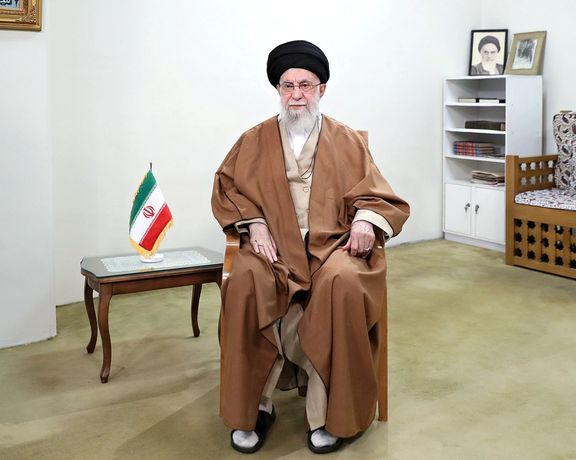
Iran's Supreme Leader Ali Khamenei during his Nowruz video message (March 20, 2025)

Iran's Supreme Leader made no reference to the possibility of negotiations with the United States in his annual New Year message. Instead, he reiterated his condemnation of the US for events in Gaza and Yemen.

In his pre-recorded message marking the start of the Iranian year 1404, Khamenei accused the US of responsibility for the war in Gaza, saying, “America, undoubtedly, bears responsibility for this disaster.”

He said that the attacks occurred either at Washington’s behest or with its approval and declared, “America is also a partner in this crime.” Drawing a parallel to Yemen, he condemned the strikes on civilians as a crime that must be stopped.

Since 1989, after assuming his position, Khamenei has traditionally visited his hometown of Mashhad for Nowruz, delivering a speech at the shrine of Imam Reza, the eighth Imam of Shia Islam.

These speeches were typically broadcast live on state television. However, for the second consecutive year, Nowruz has coincided with Ramadan, perhaps prompting him to remain in Tehran instead. During the COVID-19 lockdowns in 2020 and 2021, he similarly stayed in Tehran and issued pre-recorded messages.

Some observers, however, drew attention to the tense geopolitical conditions in the region and mentioned the possibility that Khamenei preferred to stay

The region's heightened geopolitical tensions raised questions about his decision to choose a safe and protected location.

In his address, Khamenei compared the previous year to 1981, a period of significant turmoil in the history of the Islamic Republic, when it was at war with Iraq.

He described 1403 as a challenging year for the Iranian people, citing major events such as the death of President Ebrahim Raisi in a helicopter crash in June and ongoing economic hardships.

In 1980, two years after the Islamic Revolution, Iran faced significant setbacks: territorial losses to Iraq in the southwest, the impeachment of President Abolhassan Banisadr, and the assassinations of President Mohammad-Ali Rajaei and Prime Minister Mohammad Bahonar by the Mujahedeen-e Khalq Organization (MEK).

Since 1998, Khamenei has assigned a theme to each new year in his Nowruz speeches, often focusing on economic issues.

Previous years' themes included 'National Unity,' 'Economic Jihad,' and 'Resistance Economy.' Last year focused on 'Leap in Production with People's Collaboration,' and this year's theme is 'Investment for Production,' as announced in his speech.

Khamenei conceded that the previous year had fallen short of expectations, emphasizing that the economy would be the central focus for the coming year.

He highlighted economic pressures and livelihood difficulties as other key events of the year, while praising the strength of will and spiritual morale of the Iranian people in facing these challenges.

He pointed to the swift presidential election and public aid to Lebanon and Palestine as demonstrations of this resilience.

Khamenei's address, devoid of Nowruz symbols and failing to offer new year greetings to people, highlighted the clear prioritization of religious observance, a theme echoed more boldly in the president's Nowruz message that also focused on Ramadan.

Most Viewed

Iran negotiators ordered to return after internal rift over Islamabad talks
1
EXCLUSIVE

Iran negotiators ordered to return after internal rift over Islamabad talks

2
ANALYSIS

US blockade enters murky phase as tankers spoof signals and buyers hesitate

3
ANALYSIS

Why the $100 billion Hormuz toll revenue is a myth

4

US tightens financial squeeze on Iran, warns banks over oil money flows

5
ANALYSIS

US blockade targets Iran oil boom amid regional disruption

Banner
Banner

Spotlight

  • Hardliners push Hormuz ‘red line’ as US blockade tests Iran’s leverage
    INSIGHT

    Hardliners push Hormuz ‘red line’ as US blockade tests Iran’s leverage

  • Ideology may be fading in Iran, but not in Kashmir's ‘Mini Iran'
    INSIGHT

    Ideology may be fading in Iran, but not in Kashmir's ‘Mini Iran'

  • War damage amounts to $3,000 per Iranian, with blockade set to add to losses
    INSIGHT

    War damage amounts to $3,000 per Iranian, with blockade set to add to losses

  • Why the $100 billion Hormuz toll revenue is a myth
    ANALYSIS

    Why the $100 billion Hormuz toll revenue is a myth

  • US blockade targets Iran oil boom amid regional disruption
    ANALYSIS

    US blockade targets Iran oil boom amid regional disruption

  • Iran's digital economy battered by prolonged blackout
    INSIGHT

    Iran's digital economy battered by prolonged blackout

•
•
•

More Stories

Iran summons UK, German envoys over human rights resolution

Mar 20, 2025, 07:39 GMT+0

Iran summoned the German ambassador and British charge d'affaires on Wednesday over their countries' role in drafting a resolution at the UN Human Rights Council to extend the mandate of a fact-finding mission on Iran's human rights record.

The Director-General for Women and Human Rights at Iran's Foreign Ministry, Forouzandeh Vadiati, described the move as provocative and irresponsible.

During the meeting with the German ambassador, Vadiati condemned the "instrumental use of the Human Rights Council and the abuse of human rights" to pressure Iran, citing Germany's past provision of chemical weapons to Saddam Hussein’s government during the Iran-Iraq war.

In the meeting with the British charge d'affaires, coinciding with the anniversary of Iran's nationalization of its oil industry, Vadiati criticized what she called Britain's long history of interventionist policies in Iran's internal affairs and its anti-Iranian position at the Human Rights Council.

Vadiati also accused Germany and Britain of aligning with US sanctions against Iran.

Tehran’s diplomatic protest comes as the UN special rapporteur on human rights in Iran, Mai Sato, warned the UN Human Rights Council of Iran's increasing use of executions to suppress dissent.

Sato's report highlighted a surge in executions, with at least 169 recorded in January and February alone, raising concerns that the total could exceed 1,000 this year.

The report also detailed ongoing discrimination against religious and ethnic minorities, lack of transparency in human rights cases, and continued crackdowns on protests.

The UN Human Rights Office has previously accused Iran of "weaponizing" criminal proceedings and the death penalty to punish protesters and stifle dissent.

Its Independent Fact-Finding Mission on Iran has also documented widespread human rights violations, including torture and sexual violence in prisons, which they say constitute crimes against humanity.

While countries like Germany, Switzerland, and others called on Iran to end executions and repression, Iran's allies, including Venezuela, North Korea, and China, dismissed the UN fact-finding mission as politically motivated and defended Iran's human rights record.

Trump sends New Year greetings as US-Iran tensions persist

Mar 20, 2025, 07:36 GMT+0

US President Donald Trump extended Nowruz greetings to those celebrating the Persian New Year, while tensions between the two nations over Iran's nuclear program escalate.

“Nowruz is a joyous occasion for the Persian people, marking the beginning of spring, and the Persian New Year. This long-standing tradition presents a time to reflect on the blessings of the previous year and prepare for the coming spring with a renewed spirit of optimism,” he said in a message published by the White House on Wednesday.

The US has one of the largest expatriate population of Iranians abroad with numbers estimated to be around 620,000 in California alone, according to the Harris Poll and UCLA research.

Research from the United Nations Population Division in 2019 found that the US is the most popular destination for Iranians living abroad.

100%

In his message, he highlighted the contributions of Iranians to various fields, saying, “The Persian people with their vibrant culture and exceptional talents in fields such as math, science, law, technology, and the arts, make many integral contributions to society.”

Trump’s statement comes amid a renewed policy of maximum pressure on Iran, including tough economic sanctions and diplomatic isolation.

A letter he sent to Iran’s Supreme Leader, Ali Khamenei, seemingly set conditions for de-escalation, calling for Tehran to dismantle its nuclear program, impose strict limits on missile development, and halt support for regional armed groups.

While Trump has voiced a preference for diplomatic means with Iran, he has not ruled out military options, while Khamenei has banned talks with the US under the current conditions.

Iran releases French tourist jailed on espionage charges after 887 days

Mar 20, 2025, 07:20 GMT+0

French citizen Olivier Grondeau was released from 887 days in detention in Iran, French President Emmanuel Macron announced on Thursday in a post on X.

“Our mobilization will not weaken: Cécile Kohler and Jacques Paris must be freed from Iranian jails,” Macron said, referring to other citizens still left behind.

Cécile Kohler and Jacques Paris were arrested in May 2022 while traveling in Iran as tourists, accused of espionage.

Grondeau’s release comes after months of pressure from Paris, which had been demanding the release of its citizens.

In January, Grondeau publicly revealed his identity for the first time in a recorded phone call from prison, aired by France Inter. He described his detention as arbitrary and unbearable.

The 34-year-old tourist, who was arrested on October 12, 2022, in Shiraz during a world tour, said he was a victim of political blackmail as France and Iran negotiated his case.

He was later sentenced to five years in prison for “espionage and conspiracy against the Islamic Republic” and was held in Evin Prison, in a section designated for foreign and dual-national detainees. Exact numbers of such prisoners rights groups brand 'diplomatic hostages', remain undisclosed.

During his phone call, Grondeau pleaded with French authorities to secure his release and expressed hope that his request for parole would be granted.

The French Foreign Ministry, which had already summoned Iran’s ambassador on January 10, denounced the detention conditions of Grondeau, Kohler, and Paris.

“Their situation is intolerable, with inhumane detention conditions that, in some cases, constitute torture under international law,” the ministry stated.

Grondeau shared a cell with 18 other detainees and had limited access to a library and books sent by the French embassy. He also highlighted the harsher conditions faced by Kohler and Paris in his message.

“You, who have the power to influence this matter, hear this truth,” Grondeau said, addressing French authorities.

“Cécile’s strength, Jacques’ strength, Olivier’s strength—it is all running out.”

“Your responsibility is called upon to ensure the survival of three human beings.”

The IRGC has arrested dozens of dual nationals and foreign citizens in recent years, mostly on espionage and security charges.

Most recently, an Italian journalist was released following an arrest that was widely seen as leverage to pressure Italy into freeing an Iranian imprisoned on terrorism charges.

Exiled prince calls for 'final action' against Iran's rulers

Mar 19, 2025, 19:07 GMT+0

Iran's exiled prince Reza Pahlavi urged all Iranians on the eve of their New Year to join forces to topple a ruling system that he said is on the verge of collapse.

“We enter the New Year at a time when the Islamic Republic is at its weakest and most ineffective," Pahlavi said in a video address to Iranians posted on X on Wednesday.

"A unique window of opportunity has emerged for major change and the liberation of Iran from religious tyranny," he added, citing the blows to Tehran's regional influence during the conflict with Israel in the year past.

"The coming year is the year of organizing for the final move."

The New Year in Iranian calendar begins on March 20th, when state media broadcast official address by Iran's president and supreme leader---who sets the agenda for the year ahead, usually with a phrase summing it up.

Pahlavi's message on the eve of the New Year is aimed to cement his position as a prominent opposition figure whose supporters see as Iran's best hope to undo the revolution that ousted his father Mohammad Reza in 1979.

"In the past year, at your call, I accepted the responsibility of leading the national revolution and the transition period," Pahlavi said in his address, calling for dissidents to put aside their differences.

Those supporting the exiled prince consider him to be peerless and above political groupings and coalitions. His critics among the opposition question this assertion and accuse Pahlavi's supporters of stifling debate by attacking those dissidents who do not follow him or criticize his father, the last Shah of Iran.

Pahlavi appeared to address this rift in his message.

"At the start of this new year, I urge all of you, my dear compatriots, to use this occasion to be kinder to one another and to stand more united against our common enemy—the Islamic Republic," he said.

Trump gave Khamenei two months to reach deal - Axios

Mar 19, 2025, 17:41 GMT+0

The letter sent by US President Donald Trump to Iran's Supreme Leader Ali Khamenei included a two-month deadline for reaching a new nuclear deal, Axios reported on Wednesday citing one US official and two sources briefed on the letter.

The letter was "tough" in tone, the sources said, and combined an offer for negotiations with a warning of consequences should Iran reject the overture and advance its nuclear program.
This is in line with Trump's messaging in public, asserting that he's not looking for war and only wants to ensure Tehran does not acquire nuclear weapons.

He is not willing to wait for long, however, according to Axios, which quoted cited sources as saying the US president made clear in his letter to Khamenei that he opposed open-ended talks.

Khamenei in his first speech after the letter was arrived in Tehran said Iran has never had any intention to make a nuclear bomb, or it would have already.

Latest reports by the United Nations' nuclear watchdog (IAEA) draws a less convincing picture, expressing concern about Iran's stockpile of near-weapons-grade uranium that the IAEA says cannot be justified outside a weapons program.

It's unclear when the reported deadline of two months kicks in---the day it was sent, received, or another date. Washington asserts the letter was dispatched on March 5; Tehran confirmed the receipt of letter a week later when a senior Emirati diplomat met Iran's foreign minister.

According to the Axios report, the White House briefed key US allies, including Israel, Saudi Arabia, and the United Arab Emirates, about the contents of Trump's letter before it was sent.

Iran's foreign ministry has said that any response would be private, criticizing Washington for sending mixed signals.

The official line from Tehran so far is one of unwillingness to engage with the Trump administration as long as the so-called maximum pressure campaign is in place, imposing harsh sanctions on the Islamic Republic.