• العربية
  • فارسی
Brand
  • Iran Insight
  • Politics
  • Economy
  • Analysis
  • Special Report
  • Opinion
  • Podcast
  • Iran Insight
  • Politics
  • Economy
  • Analysis
  • Special Report
  • Opinion
  • Podcast
  • Theme
  • Language
    • العربية
    • فارسی
  • Iran Insight
  • Politics
  • Economy
  • Analysis
  • Special Report
  • Opinion
  • Podcast
All rights reserved for Volant Media UK Limited
volant media logo

UN Security Council to meet over Iran's stockpile of uranium
Mar 11, 2025, 07:26 GMT+0Updated: 08:34 GMT+0
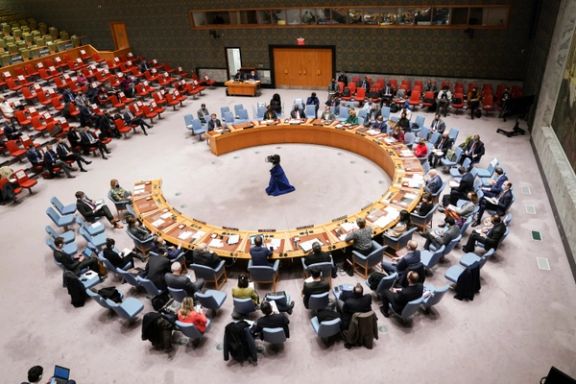
A file photo of the UN Security Council

The United Nations Security Council will meet behind closed doors on Wednesday over Iran's growing stock of nearly weapons grade uranium, diplomats said on Monday.

Six UN Security Council members—France, Greece, Panama, South Korea, Britain, and the US—called for the urgent meeting to discuss Iran's non-compliance with IAEA requests for information on undeclared nuclear material, the sources said.

They want Iran to provide the UN watchdog with "the information necessary to clarify outstanding issues related to undeclared nuclear material detected at multiple locations in Iran," diplomats said.

The request also calls for discussions on Iran's obligations under its safeguards agreement with the IAEA.

The IAEA has warned of Iran’s rapid uranium enrichment to up to 60% purity, close to the roughly 90% weapons-grade level.

Western states argue that uranium enrichment to such high levels is unjustifiable for civilian purposes and unprecedented outside of nuclear weapons programs.

Tehran has denied wanting to develop a nuclear weapon.

Iran’s UN mission has not commented on the news.

In 2015, Iran signed the Joint Comprehensive Plan of Action (JCPOA) with Britain, Germany, France, the US, Russia, and China, trading sanctions relief for nuclear program restrictions.

The US withdrew from the JCPOA in 2018 under President Trump, prompting Iran to scale back its commitments.

Britain, France, and Germany have informed the UN Security Council of their readiness to trigger a "snapback" of international sanctions to prevent Iran from acquiring nuclear weapons, a measure they will lose the ability to enact on October 18th.

Trump has instructed his UN envoy to collaborate with allies on reimposing sanctions.

On Monday, Moscow's envoy to the UN nuclear watchdog said that the JCPOA remains the cornerstone for future Iran nuclear talks.

Speaking to Izvestia, Mikhail Ulyanov warned that the current deadlock risks uncontrolled escalation, emphasizing the JCPOA's irreplaceable role as a starting point for new negotiations, despite its "half-disassembled state" and IAEA chief, Rafael Grossi, calling JCPOA "an empty shell" last month.


Most Viewed

Iran negotiators ordered to return after internal rift over Islamabad talks
1
EXCLUSIVE

Iran negotiators ordered to return after internal rift over Islamabad talks

2
ANALYSIS

US blockade enters murky phase as tankers spoof signals and buyers hesitate

3
ANALYSIS

Why the $100 billion Hormuz toll revenue is a myth

4

US tightens financial squeeze on Iran, warns banks over oil money flows

5
ANALYSIS

US blockade targets Iran oil boom amid regional disruption

Banner
Banner

Spotlight

  • Hardliners push Hormuz ‘red line’ as US blockade tests Iran’s leverage
    INSIGHT

    Hardliners push Hormuz ‘red line’ as US blockade tests Iran’s leverage

  • Ideology may be fading in Iran, but not in Kashmir's ‘Mini Iran'
    INSIGHT

    Ideology may be fading in Iran, but not in Kashmir's ‘Mini Iran'

  • War damage amounts to $3,000 per Iranian, with blockade set to add to losses
    INSIGHT

    War damage amounts to $3,000 per Iranian, with blockade set to add to losses

  • Why the $100 billion Hormuz toll revenue is a myth
    ANALYSIS

    Why the $100 billion Hormuz toll revenue is a myth

  • US blockade targets Iran oil boom amid regional disruption
    ANALYSIS

    US blockade targets Iran oil boom amid regional disruption

  • Iran's digital economy battered by prolonged blackout
    INSIGHT

    Iran's digital economy battered by prolonged blackout

•
•
•

More Stories

Russia may prove to be a spoiler in US-Iran nuclear mediation

Mar 10, 2025, 18:11 GMT+0
•
Sam Shahravi

As geopolitical priorities are scrambled and reordered worldwide in the early days of the Trump administration, a new role in mediating the US-Iran nuclear standoff may be set to give Russia a strong new card in the Middle East.

Bruised by its falling out with Europe and feeling encircled by US-led sanctions, Moscow is likely to act as a spoiler, neither allowing its Mideast ally to be decisively weakened nor fully insulated from Western demands over its nuclear program.

Russia said this week that it seeks an agreement along the lines of an international nuclear deal in 2015 it signed onto along with the United States, signaling it might join the effort to press Tehran on its escalating nuclear enrichment.

The remarks may suggest Moscow believes Iran might limit its nuclear activities in exchange for sanctions relief.

Russia has a vested interest in preventing this issue from escalating into a full-blown crisis. Moscow sees Iran’s economic collapse—driven by US sanctions and chronic mismanagement—as a liability, weakening Tehran’s regional influence.

Iran’s diminishing ability to project power in Syria and Iraq threatens Russia’s own strategic foothold, particularly in Syria, where it has invested heavily. A destabilized Iran could also complicate Russia’s broader geopolitical maneuvers, including its efforts to counter Western influence in the Middle East.

Leave Iran in limbo

Russia benefits from an Iran that is economically viable but not fully reintegrated into the global system—dependent enough on Moscow to remain aligned, yet stable enough to prevent regional turmoil.

100%

Iran is desperate for sanctions relief, but is unlikely to fully abandon its nuclear ambitions, which it views as a core element of national security. It could be persuaded by Russia, however, to limit certain aspects of its nuclear program in exchange for economic concessions without fully relinquishing its capabilities.

However, Supreme Leader Ali Khamenei remains firm in his opposition to direct negotiations with the US, a stance rooted in ideology and mistrust.

In 2013, his policy of “heroic flexibility” allowed for the eventual deal to come about in 2015—the Joint Comprehensive Plan of Action (JCPOA), as it’s known officially. But the context has since shifted. Trump’s withdrawal from the deal in 2018 as well as Iran’s deepening reliance on Russia and China have hardened his position.

Any renewed talks would require guarantees that Iran is unlikely to trust, making a diplomatic breakthrough more difficult.

Avoiding war

Meanwhile, Western powers are increasingly considering a snapback of UN sanctions in the next few months. That could escalate tensions to the point of military confrontation—particularly with Israel, which has consistently warned that it will not allow Iran to develop nuclear weapons.

A direct conflict involving Israel and the U.S. would not only destabilize the region but also undermine Russia’s influence, disrupt energy markets, and divert global attention from Moscow’s priorities, including its war in Ukraine.

Russia’s actual ability to mediate between Iran, Israel, and the U.S. is hard to gauge. US president Donald Trump says he has a good relationship with Russian counterpart Valdimir Putin, which can be a positive.

Israeli prime minister Benjamin Netanyahu is on good terms with Putin too. Although the relationship has been complicated with Moscow's growing military and economic partnership with Tehran, the Kremlin may still be in a position to discourage Tel Aviv from full-scale military action.

Ultimately, Russia’s interest lies in preventing an uncontrolled escalation that could disrupt its strategic ambitions. Moscow does not seek to resolve the Iran nuclear crisis but to manage it—keeping tensions high enough to maintain leverage over both Iran and the West while avoiding outright war.

2015 nuclear deal remains basis for Iran talks, Russia says

Mar 10, 2025, 13:40 GMT+0

The 2015 Joint Comprehensive Plan of Action (JCPOA) remains the essential foundation for any future negotiations on Iran's nuclear program, Moscow's envoy to the UN nuclear watchdog said on Monday.

In an interview with Russian daily Izvestia, Russia's Permanent Representative to International Organizations in Vienna, Mikhail Ulyanov, said that the JCPOA is irreplaceable and will serve as the starting point for new talks, warning that the current impasse risks uncontrolled escalation.

“The JCPOA is still in a half-disassembled state,” he said but noted that “the JCPOA will remain the starting point for new negotiations.”

Ulyanov added, "The current uncertain situation with the JCPOA is fraught with the risk of uncontrolled escalation. Therefore, we see the best way forward in the return of the main players to the negotiation table."

Ulyanov dismissed concerns over the recent increase in Iran's highly enriched uranium reserves, saying, "Such an increase in stockpiles is not critical, since production remains under the effective control of the agency [IAEA]."

He also acknowledged IAEA Director General Rafael Grossi's concerns, having called the JCPOA an "empty shell", but cautioned against making categorical judgments regarding the effectiveness of the agreement.

"There is nothing to replace it at the moment," Ulyanov said regarding the JCPOA. "Therefore, it is likely that we will now talk about some kind of modified agreement if the interested parties come to a consensus on the need to develop one."

He argued that the real threat to nuclear non-proliferation lies in "the inability of the main parties involved to find a common language and move from megaphone diplomacy to genuine diplomacy."

The JCPOA, signed by Iran, Russia, the United States, Britain, France, China, and Germany, aimed to lift sanctions on Iran in exchange for limitations on its nuclear program. However, the US withdrew from the deal in 2018, reimposing sanctions and prompting Iran to scale back its commitments.

Additionally, Ulyanov criticized Western nations for undermining progress, specifically citing a November 2024 anti-Iranian resolution at the IAEA Board of Governors, which he said largely undermined previous agreements.

Russia says Iran may agree to limit nuclear program if sanctions lifted

Mar 9, 2025, 19:25 GMT+0

Moscow does not rule out the possibility that its staunch allies in Tehran may consent to restricting their nuclear program and enhancing transparency in return for the lifting of Western sanctions, Haaretz reported citing the Russian foreign ministry spokeswoman.

In an interview published by the Israeli newspaper on Sunday, Maria Zakharova referred to the 2015 nuclear deal with Tehran and said, "A similar approach might be useful now in order to stabilize the situation."

"We are prepared for the closest cooperation with Tehran and with the other involved parties for the sake of reducing tension and finding sustainable solutions that will enable an effective and long-term accord," she was quoted as saying.

Iran had largely restricted its nuclear program in exchange for some sanctions relief as per the agreement it signed in July 2015 with world powers, officially known as the Joint Comprehensive Plan of Action (JCPOA).

However, the deal reached under US President Barack Obama was criticized by his successor Trump, who pulled out of the agreement, as too lenient on Tehran.

Trump warned on Friday that the situation with Iran had reached a critical stage, adding that he preferred to reach a deal over Tehran's nuclear program.

“We can’t let them have a nuclear weapon,” Trump told reporters at the Oval Office. “We are at final moments with Iran. Something’s going to happen very soon."

There’ll be some interesting days ahead, that’s all I can tell you. You know, we’re down to final strokes with Iran,” he added.

He also said he has sent a letter to Iran's supreme leader. However, Ali Khamenei on Saturday ruled out the possibility of negotiation with the United States, in his first public speech after Trump's remarks.

Iran says will never engage in talks aimed at dismantling its nuclear program

Mar 9, 2025, 15:55 GMT+0

The Islamic Republic will never participate in talks intended to dismantle its nuclear program, Iran's mission to the United Nations said on Sunday, a day after Supreme Leader Ali Khamenei rejected nuclear talks with world powers.

"If the objective of negotiations is to address concerns vis-à-vis any potential militarization of Iran’s nuclear program, such discussions may be subject to consideration," Iran's UN mission said in a post on its official X account.

However, it added, "should the aim be the dismantlement of Iran’s peaceful nuclear program to claim that what Obama failed to achieve has now been accomplished, such negotiations will never take place."

A few hours later, Iran's foreign minister appeared to revise the statement by Tehran's UN mission.

"Iran's nuclear energy program has always been—and will always remain—entirely peaceful. There is fundamentally no such thing as its 'potential militarization'," Abbas Araghchi said.

"We will NOT negotiate under pressure and intimidation. We will NOT even consider it, no matter the subject," he added in a post on his X account.

On Saturday, Khamenei dismissed the prospect of talks with the United States in his first public speech after President Donald Trump said he sent a letter to him.

"The insistence of some bullying governments on negotiations is not aimed at resolving issues but rather at asserting dominance and imposing their demands," Khamenei said in a meeting with Iranian officials in Tehran.

"The Islamic Republic of Iran will certainly not accept their demands," he added.

The White House, responding to Khamenei's comments, reiterated Trump's assertion that Tehran can be dealt with either militarily or by making a deal.

"We hope the Iran regime puts its people and best interests ahead of terror," White House National Security Council spokesman Brian Hughes said in a statement.

A State Department spokesperson also told Iran International the Trump administration will maintain its maximum pressure campaign on Iran if Tehran refuses to reach an agreement.

Trump warned on Friday that the situation with Iran had reached a critical stage, adding that he preferred to reach a deal over Tehran's nuclear program than turn to military force.

Iran’s nuclear program cannot be destroyed militarily, FM says

Mar 9, 2025, 11:11 GMT+0

Iran's foreign minister says the country’s nuclear program cannot be destroyed by military means, citing the program's widespread dispersion and robust protection.

During an interview at the Iranian consulate in Jeddah, Saudi Arabia on Friday, Foreign Minister Abbas Araghchi told AFP, “Iran's nuclear program cannot be destroyed through military operations" because the technology is ingrained, facilities are dispersed and protected, and Iran would retaliate proportionally.

He made the remarks as Israel has repeatedly threatened to bomb Iran’s nuclear sites. Later on Friday, US President Donald Trump said he had written to Iran warning it to open negotiations or face a military attack.

Araghchi said that “if the Israelis or others were sure that they would achieve their goals through a military attack, they would have done so by now, but such a possibility is not feasible.”

Araghchi dismissed the threat of war against Iran as mere rhetoric, warning that any attempt to act on it would pose a grave danger and ignite a widespread conflict.

“The threat of war against Iran is a threat that is just talked about. Implementing this threat would be a very big danger and would turn into a widespread fire.”