• العربية
  • فارسی
Brand
  • Iran Insight
  • Politics
  • Economy
  • Analysis
  • Special Report
  • Opinion
  • Podcast
  • Iran Insight
  • Politics
  • Economy
  • Analysis
  • Special Report
  • Opinion
  • Podcast
  • Theme
  • Language
    • العربية
    • فارسی
  • Iran Insight
  • Politics
  • Economy
  • Analysis
  • Special Report
  • Opinion
  • Podcast
All rights reserved for Volant Media UK Limited
volant media logo

Iran’s tourism industry on brink of collapse - Tehran-based daily

Dec 24, 2024, 13:02 GMT+0

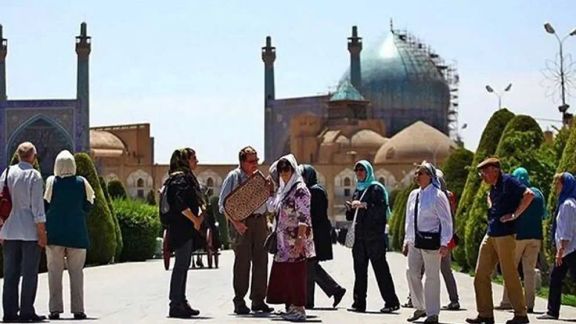
Iran's tourism industry has collapsed over the past five years, with one agency owner describing the situation as "the destruction of the tourism industry," Tehran-based Etemad newspaper reported.

The crisis has reportedly forced the US-designated Bonyad-e Mostazafan (Foundation of the Oppressed), a powerful state-run charitable organization that has expanded into various sectors, including tourism, to sell its hotels.

"The condition of this industry is so dire that Bonyad-e Mostazafan has been forced to sell its hotels," the agency owner said.

Last year in December, Ebrahim Pourfaraj, the head of the Association of Iranian Tour Operators, said Iran's tourism industry was at its lowest point.

Iran, historically known for its rich cultural and historical heritage as well as its natural beauty, has struggled to attract foreign tourists in recent years, exacerbated by the detention of foreigners and dual-nationals. Despite its allure, the country faced challenges such as strict dress codes for women and restrictions on alcohol and nightlife.


Most Viewed

Iran negotiators ordered to return after internal rift over Islamabad talks
1
EXCLUSIVE

Iran negotiators ordered to return after internal rift over Islamabad talks

2
ANALYSIS

US blockade enters murky phase as tankers spoof signals and buyers hesitate

3
ANALYSIS

Why the $100 billion Hormuz toll revenue is a myth

4

US tightens financial squeeze on Iran, warns banks over oil money flows

5
ANALYSIS

US blockade targets Iran oil boom amid regional disruption

Banner
Banner

Spotlight

  • Hardliners push Hormuz ‘red line’ as US blockade tests Iran’s leverage
    INSIGHT

    Hardliners push Hormuz ‘red line’ as US blockade tests Iran’s leverage

  • Ideology may be fading in Iran, but not in Kashmir's ‘Mini Iran'
    INSIGHT

    Ideology may be fading in Iran, but not in Kashmir's ‘Mini Iran'

  • War damage amounts to $3,000 per Iranian, with blockade set to add to losses
    INSIGHT

    War damage amounts to $3,000 per Iranian, with blockade set to add to losses

  • Why the $100 billion Hormuz toll revenue is a myth
    ANALYSIS

    Why the $100 billion Hormuz toll revenue is a myth

  • US blockade targets Iran oil boom amid regional disruption
    ANALYSIS

    US blockade targets Iran oil boom amid regional disruption

  • Iran's digital economy battered by prolonged blackout
    INSIGHT

    Iran's digital economy battered by prolonged blackout

•
•
•

More Stories

Iran says in talks to reopen embassy in Syria

Dec 24, 2024, 11:39 GMT+0

Tehran says it is in talks to reopen its embassy in Damascus even after it was sacked by rebels who took over the country and a staff member was killed in murky circumstances.

“Our approach to the embassy matter is fundamentally diplomatic. Both sides are prepared, and we are actively engaged in consultations to facilitate the reopening of embassies in both countries,” government spokeswoman Fatemeh Mohajerani said during a Tuesday press conference.

Speculation had followed a statement by the foreign ministry spokesman Esmaeil Baghaei last week, raising questions around the reopening.

“I prefer not to use the word ‘imminent,’” Baghaei said. “This is on the agenda, and as soon as the necessary conditions are met—both in terms of security and politics—we will move forward with reopening the embassy.”

The delay came on the back of the killing of a local employee of Iran's embassy, Davood Bitaraf, killed in a shooting. Baghaei blamed "terrorists" for the attack and urged the Syrian transitional government to bring the perpetrators to justice.

“The Ministry of Foreign Affairs is seriously pursuing the matter through appropriate channels and various diplomatic and international avenues,” he added.

Video footage from earlier this month, on the day President Bashar al-Assad fled to Moscow, showed militants storming the Iranian embassy, ransacking documents, and vandalizing the premises.

Shattered glass and broken furniture was scattered throughout the building. Iranian media reported that the staff had evacuated before the takeover.

Syria’s new de facto leader, Ahmed al-Sharaa, said in an interview with Asharq Al-Awsat that Iran’s influence in the region has been significantly weakened. Sharaa’s group, Hayat al-Tahrir Sham (HTS), recently defeated Assad’s forces in a rapid takeover, marking a turning point in Syria’s relationship with Iran, which had supported Assad since 2011 in the face of civil war.

“The Iranian project in the region has been set back by 40 years,” Sharaa said, threatening a key military and economic hub for Iran which had bases and forces spread across Syria.

Prominent Iranian political activist sentenced to two years in prison

Dec 24, 2024, 11:19 GMT+0

Prominent political activist Majid Tavakoli has been sentenced by an appeals court in Tehran to two years in prison, two years ban on social media activity, a ban on residing in Tehran, and a prohibition on leaving the country, his wife, Maryam Tabandeh, said on Tuesday.

Tavakoli, who was serving a six-year jail term since October 2023, was released on bail in July this year after his retrial request was accepted.

He was arrested in September 2022 at the outset of Iran’s nationwide Woman, Life, Freedom protests, sparked by the death in custody of Mahsa Amini, and was later released on bail on December 20, 2022.

Tavakoli was accused of attempting to "overthrow the Islamic Republic and establish a liberal system."

Tavakoli's activism traces back to his involvement in student protests following the disputed Presidential Election of 2009, during which he was arrested multiple times by Iranian intelligence authorities.

Syria suspends flights from Iran until late January, says Iranian aviation official

Dec 24, 2024, 09:48 GMT+0

Syria has suspended flights to and from Iran until January 22 amid regional tensions, the head of Iran's Civil Aviation Organization announced Tuesday.

Hossein Pourfarzaneh added that flights will remain suspended until after the New Year holidays.

He also noted, "Even during the tensions in Syria, Iranian flights continued with special permits," but he did not provide further details on these permits.

It remains unclear exactly when the suspension of flights was implemented.

Israeli news website Walla reported on Sunday that the new government of Syria had decided to prevent all Iranian planes - including civilian ones - from flying over Syrian skies.

Israel publicly admits killing Hamas leader Haniyeh in Tehran

Dec 23, 2024, 19:59 GMT+0

Israel's defense minister on Monday publicly admitted for the first time that the Jewish state assassinated Hamas leader Ismail Haniyeh in Tehran on July 31, 2024.

While Israel's role was already widely understood, its disclosure likely signals Israel is less concerned about provoking an Iranian response after the Islamic Republic and its allies in the region have been dealt harsh Israeli military blows in recent weeks.

"These days, when the Houthi terrorist organization is firing missiles at Israel, I want to convey a clear message to them at the beginning of my remarks: We have defeated Hamas, we have defeated Hezbollah, we have blinded Iran's defense systems and damaged the production systems, we have toppled the Assad regime in Syria, we have dealt a severe blow to the axis of evil, and we will also deal a severe blow to the Houthi terrorist organization in Yemen, which remains the last to stand," Israel Katz said during an evening honoring defense ministry personnel.

"We'll severely cripple the Houthis, damage their strategic infrastructure, and we will behead their leaders – just as we did to Haniyeh, Sinwar and Nasrallah in Tehran, Gaza and Lebanon – we will do it in Hodeidah and Sana'a," Katz added.

Haniyeh was a Palestinian politician who served as prime minister of the Palestinian National Authority for over eight years until 2014 and as chairman of the Hamas Political Bureau from May 2017 until his assassination in Tehran.

He had been attending the inauguration of newly elected Iranian President Masoud Pezeshkian when he was assassinated. At the time, Hamas said they were convinced Haniyeh was killed, along with one of his bodyguards, by an Israeli airstrike on his residence.

Iran's Islamic Revolutionary Guard Corps (IRGC), which was responsible for protecting Haniyeh, said in early August that Haniyeh was assassinated with a "short-range projectile with a warhead of approximately 7 kilograms".

"This action was designed and implemented by the Zionist regime and supported by the criminal government of America," the IRGC added.

Western media reports suggested that Haniyeh was killed by explosive devices planted well in advance in his room, possibly by agents recruited by Mossad, Israel's intelligence agency. A report by The Telegraph says the devices were placed in three separate rooms of the guesthouse, pointing to a meticulously planned operation.

The assassination was carried out despite heightened security measures due to the inauguration which took place one day earlier, underscoring a severe breach in Iran's security apparatus.

A report by the New York Times said at the time that over two dozen individuals, including senior intelligence officers, military officials, and staff at the guesthouse, had been detained in connection with the incident.

Haniyeh's assassination was soon followed by a series of Israeli attacks killing other leaders of Iran-backed groups including Hezbollah chief Hassan Nasrallah on September 27 and Haniyeh's successor Yahya Sinwar on October 16.
Iran's rial hits new low after minister acknowledges slide

Dec 23, 2024, 19:24 GMT+0

The Iranian currency hit yet another all-time low of 780,250 rials to the US dollar on Monday after the country’s economy minister acknowledged the significant devaluation of the currency.

In a statement during a session of the Iranian parliament's economic commission, Abdolnasser Hemmati said that under normal political and economic circumstances the rial should be trading somewhere close to 73,000 per dollar—a figure significantly higher than Iran’s official exchange rate.

"Of course, this calculation assumes normal economic conditions and stable political and security situations," Hemmati said.

Upheaval in Syria and tensions with Israel along with threats to the economy as US President-elect Donald Trump prepares to take office were among the causes, Hemmati said.

“Given 30% inflation, it is impossible to maintain a stable exchange rate,” Hemmati said.

While Iran has multiple exchange rates, including the open market rate and the official rate, the open market rate most accurately reflects the true value of transactions.

Hemmati further noted that while the government’s official exchange rate is 400,000 rials to the dollar, many goods are traded in the market within the 700,000 to 800,000 rials range.

The reaction to Hemmati’s remarks in Tehran’s currency market was swift and severe. Within hours, the dollar climbed by over 20,000 rials. According to data from Tehran exchange offices, the dollar traded at 780,250 rials, while the exchange rate for dollar remittances rose to 790,800 rials.

The minister later retracted his remarks and said his comments were misinterpreted and that a video of the session had been edited. However, his commentary was widely covered in local media, and currency traders interpreted his comments as a potential sign of further devaluation of the rial.

Hemmati is scheduled to appear before parliament on Tuesday, alongside other officials including the Central Bank’s governor, Iranian media reported. Lawmakers are set to discuss measures to address exchange rate fluctuations and improve economic stability.

The rial has depreciated by over 25% since September, driven by regional conflicts and Iran’s setbacks in Syria and Lebanon.

Since the establishment of the Islamic government in 1979, the Iranian currency has undergone an 11,000-fold decline in value.