• العربية
  • فارسی
Brand
  • Iran Insight
  • Politics
  • Economy
  • Analysis
  • Special Report
  • Opinion
  • Podcast
  • Iran Insight
  • Politics
  • Economy
  • Analysis
  • Special Report
  • Opinion
  • Podcast
  • Theme
  • Language
    • العربية
    • فارسی
  • Iran Insight
  • Politics
  • Economy
  • Analysis
  • Special Report
  • Opinion
  • Podcast
All rights reserved for Volant Media UK Limited
volant media logo

Tehran bristles at UN resolution condemning its human rights record

Dec 18, 2024, 18:08 GMT+0Updated: 15:17 GMT+0
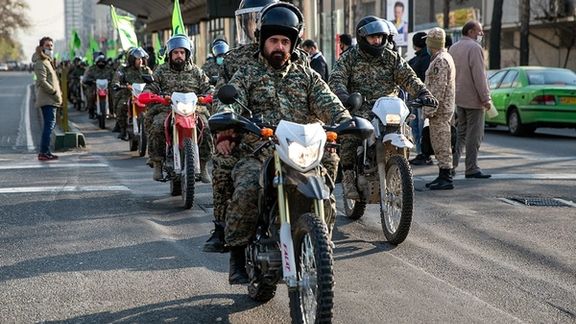
Members of Iran's domestic paramilitary force the Basij rally on motorcycles

Iran on Wednesday rejected a sweeping United Nations General Assembly resolution condemning Tehran's human rights record the day before, calling it shameful and hypocritical.

This riposte by Foreign Ministry Spokesman Esmail Baghaei came after the UNGA adopted the resolution which criticized the Islamic Republics treatment of prisoners, ethnic and religious minorities and women.

“The proponents of the anti-Iran resolution, including the Zionist regime, the United States, the United Kingdom and Canada, are major violators of human rights," Baghaei said. "This is a source of shame, and the Canadian officials who initiate such actions against our country every year are urged to focus on reforming their actions both inside and outside their country instead of accusing others.”

100%

The resolution, which passed with 80 votes in favor and 27 against, criticized the Iranian government’s unlawful use of the death penalty, arbitrary arrests, torture and its persistent suppression of peaceful protests.

It also condemned the Islamic Republic for discrimination against women, ethnic and religious minorities and minors.

Human rights advocates have expressed concern over these abuses and called Tehran’s actions a tool of political repression.

The UNGA called for an immediate halt to executions, many of which are carried out based on forced confessions extracted under torture and without the benefit of fair trials.

In particular, the resolution singles out the government’s pattern of executing political prisoners as evidence of its commitment to silencing dissent.

This marks a continuation of the crackdown on political opposition which has seen approximately 625 executions since the inauguration of Iran’s current president Masoud Pezeshkian in late July, including 22 women.

The resolution also underscored the Iranian government’s ongoing violations of women’s rights, pointing to restrictive laws that discriminate against females.

"(The UNGA) strongly urges the Islamic Republic of Iran to eliminate, in law and in practice, all forms of systemic discrimination and violence against women and girls, in public and private life," the resolution read.

"(It) urges the Islamic Republic of Iran to cease the widespread and systematic use of arbitrary arrests and detention ... (and) calls upon the Islamic Republic of Iran to release women human rights defenders imprisoned for exercising their rights."

The resolution further called for the suspension of all death sentences in Iran.

Baghaei defended his government’s actions and labeled the international accusations “baseless and politically motivated.”

Most Viewed

Iran negotiators ordered to return after internal rift over Islamabad talks
1
EXCLUSIVE

Iran negotiators ordered to return after internal rift over Islamabad talks

2
ANALYSIS

US blockade enters murky phase as tankers spoof signals and buyers hesitate

3
ANALYSIS

Why the $100 billion Hormuz toll revenue is a myth

4

US tightens financial squeeze on Iran, warns banks over oil money flows

5
ANALYSIS

US blockade targets Iran oil boom amid regional disruption

Banner
Banner

Spotlight

  • Hardliners push Hormuz ‘red line’ as US blockade tests Iran’s leverage
    INSIGHT

    Hardliners push Hormuz ‘red line’ as US blockade tests Iran’s leverage

  • Ideology may be fading in Iran, but not in Kashmir's ‘Mini Iran'
    INSIGHT

    Ideology may be fading in Iran, but not in Kashmir's ‘Mini Iran'

  • War damage amounts to $3,000 per Iranian, with blockade set to add to losses
    INSIGHT

    War damage amounts to $3,000 per Iranian, with blockade set to add to losses

  • Why the $100 billion Hormuz toll revenue is a myth
    ANALYSIS

    Why the $100 billion Hormuz toll revenue is a myth

  • US blockade targets Iran oil boom amid regional disruption
    ANALYSIS

    US blockade targets Iran oil boom amid regional disruption

  • Iran's digital economy battered by prolonged blackout
    INSIGHT

    Iran's digital economy battered by prolonged blackout

•
•
•

More Stories

Defendants in stabbing of Iran International presenter face court

Dec 18, 2024, 17:57 GMT+0

Two men accused of stabbing an Iran International TV presenter appeared in court on Wednesday in London, a day after being extradited from their native Romania.

The defendants, Nandito Badea, 19, and George Stana, 23, were arrested in Romania earlier this month at the request of British authorities.

They will appear at the Central Criminal Court of England and Wales on January 17, when their trial will officially begin. The defendants are charged with causing grievous bodily harm with intent.

Pouria Zeraati, a British-Iranian national, was attacked near his home in Wimbledon, southwest London, in March and was hospitalized with injuries to the leg. The incident raised concerns about threats to critics of the Iranian government, with British authorities investigating whether Zeraati was targeted due to his work.

Iran has denied any involvement in the attack.

Acting Commander Helen Flanagan from the Met’s Counter Terrorism Command emphasized the importance of the investigation and thanked Romanian authorities for their cooperation. She urged the public not to speculate on the case in order to allow the legal process to unfold.

“I would like to thank our Romanian counterparts for their cooperation on this matter, as well as colleagues from the CPS and NCA who have helped us to reach this point,” she said.

“Now that criminal proceedings are fully active here in the UK, I continue to ask people not to speculate about the case or motivation so that the criminal justice process can ran its course.”

Adam Baillie, a spokesperson for Iran International, previously welcomed the progress of the investigation, noting that the developments were reassuring for journalists facing similar threats.

Iran fuels Sudanese civil war with arms, seeks Red Sea base - Bloomberg

Dec 18, 2024, 17:34 GMT+0

Iran is backing Sudanese army forces with weapons and drones in a grueling civil war, according to a Bloomberg report, and Tehran along with Russia is seeking military bases in Port Sudan on the Red Sea.

Iran has delivered arms to Sudanese army forces and provided them with dozens of drones, the news outlet reported, helping tip the conflict against militia opponents.

Russia, which has provided fuel and weapons components, along with Iran have both been in talks with Sudan's generals on building military bases astride the Red Sea, Bloomberg reported citing Sudanese and Western officials.

The support puts Tehran and Moscow on the winning side of the war, in contrast to their epochal setback in Syria where their mutual ally Bashar al-Assad was toppled this month by rebels they had been fighting for years.

Iran re-established diplomatic ties with Sudan in late 2023 after a seven-year deep freeze after Khartoum joined a Saudi-led military intervention in Yemen against Tehran's allies in the armed Houthi movement.

Militias fighting the army felled a domestically crafted drone made with Iranian parts, Bloomberg reported citing Wim Zwijnenburg, a researcher at Dutch pro-peace organization PAX.

Zwijnenburg located an Iranian military drone on an air strip outside the capital earlier this year, Bloomberg wrote.

It cited the Conflict Observatory monitor saying at least seven flights operated by Qeshm Fars Air traveled between Tehran and Port Sudan in the first half of the year.

The firm, which is under US sanctions, is affiliated with the external operations arm of the Islamic Revolutionary Guard Corps (IRGC).

ECBA urges action after arrest of Iranian activist Reza Khandan

Dec 18, 2024, 13:55 GMT+0

The European Criminal Bar Association (ECBA) has issued an urgent request for international intervention on behalf of Iranian human rights activist Reza Khandan, the husband of prominent human rights lawyer Nasrin Sotoudeh.

Khandan was arrested on Friday after Iranian security forces raided his home. His daughter, Mehraveh Khandan, revealed in an Instagram post that her father was detained at his residence. The reason for his arrest has not been disclosed.

In its statement, the ECBA said Wednesday, “We call for an end to the judicial harassment of Reza Khandan and Nasrin Sotoudeh, in line with the UN Declaration on Human Rights Defenders and the UN Basic Principles on the Role of Lawyers.”

Khandan has been arrested in the past for his activism and his support of his wife’s campaign against Iran’s mandatory hijab laws.

Former Iranian President Rouhani: Hijab law neither just, Islamic, nor constitutional

Dec 18, 2024, 13:13 GMT+0

Former Iranian President Hassan Rouhani has criticized the newly approved hijab law, saying that it "aligns neither with the Constitution, nor with justice, nor with the Quran and Islamic culture."

"The Quran regards hijab as a means to ensure the safety of women, but unfortunately, some people view the issue of hijab as a tool for coercion," Rouhani said on Wednesday.

This comes as the Islamic Republic has officially postponed the implementation of the controversial hijab law, which imposes severe penalties on women and girls who defy veiling requirements, following significant backlash from both the public and the international community.

Iran's Supreme National Security Council, in a letter to the parliament on Saturday, requested that the process of implementing the Hijab and Chastity law be halted. A member of the Parliament's presiding board stated that the government intends to submit an amended bill to the parliament for further consideration.

Religious rules and abuse in Iranian schools drive suicides, students say

Dec 18, 2024, 10:40 GMT+0
•
Niki Mahjoub

Severe humiliation and abuse in schools are driving Iranian students to contemplate or attempt suicide, interviews conducted by Iran International reveal.

These firsthand accounts highlight the harsh conditions within the educational system under the Islamic Republic, where strict dress codes and conduct rules are strictly enforced. Students face extreme consequences for rule violations, often resulting in severe mental health struggles.

A survey referenced by the domestic Shargh media outlet in March, which included 46,000 students, revealed alarming figures: half of the students reported experiencing depression, 18% had attempted suicide, and 21% had contemplated suicide.

Since 2021, the Iranian Legal Medicine Organization has ceased publishing detailed suicide data, including age, gender, and dates, making it more challenging to assess the full scope of the crisis.

As of November, however, at least 31 school students in the country had attempted suicide over the previous eight months, with 26 fatalities, according to the HRANA rights group. Factors such as poverty, enforced hijab, forced marriage, and family conflicts have been cited as contributors to these attempts.

Iran’s teachers’ union recently stated that the latest suicide of a female student was part of a "harrowing cycle deeply rooted in flawed policies, systemic pressures within the education sector, ideological impositions, and the disregard of authorities for the growing mental health crisis in schools."

Amid this crisis, accounts by students, parents, and teachers shared with Iran International offer a glimpse into the emotional and psychological toll on teenagers in a school system that fails to support their well-being.

For security reasons, interviewees were provided pseudonyms, and all interviews with children were conducted with the consent of their parents or in their presence, ensuring that ethical and legal guidelines were followed.

According to several young female students, male school principals were often identified as the primary figures responsible for humiliating them, leaving them in severe emotional distress.

A 15-year-old girl shared how her principal’s violent behavior left her deeply traumatized.

“In the schoolyard, the principal shouted behind me, ‘How dare you come to school dressed like this? What do you think this is, Shahre-e-No?’” she said, referring to the red-light district that existed before the Islamic Revolution.

The principal berated her for her highlighted hair and manicured nails before physically pushing her. “Sit down! I’ll call your father and sort this out,” the principal said.

Her father described the aftermath: “The principal expelled my daughter and declared, ‘Shave her head completely!’”

In another case, a 16-year-old girl in Sanandaj, Kurdistan Province, shared how her school principal insulted her for shaping her eyebrows with her family’s permission.

“So, where’s your husband, then?” the principal taunted. After being slapped in front of classmates for complaining about the treatment, the girl contemplated suicide the same day. “If your parents cannot raise you properly, I will make you behave,” the principal told her.

In a northern Iranian city, a 14-year-old student was humiliated and shamed for wearing rainbow-colored trainers.

The principal forced her to remove her shoes in front of classmates and barred her from attending a class.

The child’s mother recalled the child’s distress, saying: “She broke down in tears and told me, ‘Mom, I want to die.’”

Systemic shortcomings in mental health support

The crisis is amplified by the severe shortage of mental health resources in Iranian schools, where students, already subjected to humiliation and abuse by staff, have no access to the support they need to recover from these often traumatic experiences.

Iran’s comprehensive counseling guidelines recommend having one counselor for every 12 students. However, the country’s schools currently employ only 13,000 counselors, leaving a significant gap of 37,000 professionals needed to meet this standard.

A psychotherapist in Tehran reported an increase in cases of children he had seen, contemplating suicide over the past year – with many experiencing depression due to abusive treatment in schools, including bullying by classmates or staff.

He noted that the severe shortage of counselors leaves many students without the support they desperately need.

“Not all families can afford the $60 to $90 per session for counseling. Iran lacks the infrastructure for suicide-related services,” he said. “Religious views and a lack of expertise mean this critical issue is either ignored or treated as a security matter.”

In contrast, other countries provide more robust support.

In neighbouring Turkey, psychological counseling and guidance services are available in many schools under laws aimed at safeguarding mental health, with some reports indicating these services are free of charge. Schools also contact families or relevant organizations when necessary.

The United Kingdom also mandates suicide prevention training for teachers, who are required to refer at-risk students to specialists. Support plans are created, and confidentiality is maintained unless the child’s life is at risk.

Hamed, a teacher in Tehran, believes the education system under the Islamic Republic is fundamentally broken.

“When the Supreme Leader of the Islamic Republic prevented the implementation of UNESCO’s 2030 Agenda, it was essentially a war on the minds and souls of the nation’s children,” he said.

The agenda’s goals include equal educational opportunities for girls, which were replaced with a national document prioritizing devout religious upbringing.

Hamed recounted the case of a student who attempted suicide two years ago after clerics at the school made inappropriate remarks about his family. Instead of addressing the issue, the school threatened the family, warning that speaking out would result in the student’s expulsion. Faced with this pressure, he said, the family decided to homeschool their child.

In addition to these pressures on students, experts have long noted the significant decline of Iran’s public education system under the Islamic Republic. Challenges such as reduced investments, increasing clerical control, and widening socioeconomic disparities have weakened the system.

Mass dropouts, declining academic performance, and the growing presence of clerics and Basij members—a paramilitary force under the IRGC tasked with enforcing ideological conformity—have further compounded the crisis, shifting the focus from education to ideological indoctrination.

Maryam, a teacher’s rights activist, said today’s educational atmosphere resembles the restrictive environment of the 1980s.

“Suicide is stigmatized in schools due to religious beliefs, and cultural factors also play a role. Society needs education on how to address this issue,” she said.

Another teacher activist stressed the need for widespread education on preventing suicide.

“These measures require funding, but neither the Ministry of Education, the Ministry of Health, nor the government is willing to invest,” he said. “The children of this land must enjoy mental health support to face future challenges. In Iran, however, it is considered either a luxury or a security matter.”

Although the “Student Social Care System” (NAMAD) was launched in the 2010s to address such issues, the program has been effectively abandoned, leaving students without adequate support.

Activists and educators warn that without urgent action, the mental health crisis among Iran’s youth will only deepen.