• العربية
  • فارسی
Brand
  • Iran Insight
  • Politics
  • Economy
  • Analysis
  • Special Report
  • Opinion
  • Podcast
  • Iran Insight
  • Politics
  • Economy
  • Analysis
  • Special Report
  • Opinion
  • Podcast
  • Theme
  • Language
    • العربية
    • فارسی
  • Iran Insight
  • Politics
  • Economy
  • Analysis
  • Special Report
  • Opinion
  • Podcast
All rights reserved for Volant Media UK Limited
volant media logo

Pezeshkian draws ire for suggesting relocation of Iran's capital

Maryam Sinaiee
Maryam Sinaiee

Iran International

Sep 19, 2024, 11:49 GMT+1Updated: 15:25 GMT+1
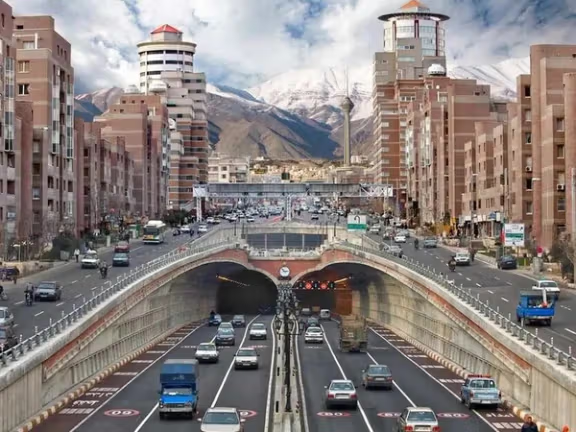
Famous view of Tehran with Alborz mountains in the background on a clear day

Iranian media and experts have criticized President Masoud Pezeshkian for proposing the relocation of the capital to the south, especially given the country's dire economic conditions.

“Tehran is facing problems that leave us no solution other than the relocation of the [political and economic] center,” he said during a visit to the Revolutionary Guards’ contracting arm, the Khatam ol-Anbiya Headquarters, earlier this month.

Pezeshkian highlighted several pressing issues, including water shortages, land subsidence, and air pollution, all of which have worsened over the years. “The fundamental solution is to relocate the country’s political and economic center,” he stated, suggesting the southern regions, where access to the waters of the Persian Gulf is more convenient, as a viable alternative.

This is not the first time government officials have brought up the need to relocate the capital. Iran has conducted at least six studies on relocating its capital since 1989.

The Parliament passed a law in 2014 that mandated the government to investigate the possibility of relocating the government from Tehran.

The Ministry of Roads and Urban Development was tasked with conducting a feasibility study. The study's findings were to be reviewed by a council comprising the president and relevant ministries. However, the council's sessions were halted by the pandemic in 2020 and have yet to resume.

The ministry’s study had concluded that relocation of the government was not an answer to the capital’s problems which would persist even if civil servants and their families were relocated and suggested administrative decentralization as an alternative.

Most critics agree with Pezeshkian that the Iranian capital is suffering from too many problems including a high risk of a major earthquake. The majority, however, have also reminded him that a highly ambitious project such as relocation requires huge resources that the country is simply unable to afford in the current circumstances.

Iran has yet to make sufficient investments in the oil and gas sectors, as well as other industries in the oil-rich southern regions, where many people live in poverty. This point was highlighted by the conservative Asr-e Iran news website in an article responding to Pezeshkian’s proposal to consider these southern areas as an alternative to Tehran.

“How can we provide the necessary infrastructure for millions in this region? Relocating large factories and establishing the required infrastructure for workers and employees demands significant capital. Additionally, these individuals would need to be persuaded to move to the south,” Asr-e Iran news website told Pezeshkian.

The Entekhab news website emphasized the financial constraints facing Pezeshkian, reminding him that his government is grappling with the budget deficit inherited from his predecessor, Ebrahim Raisi. The government has even had to withdraw funds from the National Development Fund to address its daily challenges.

“Mr. President said we couldn’t ask people to relocate while we remain here ourselves. My question is, where do you want to go?” Gholam-Hossein Karbaschi, a former reformist mayor of the capital, asked Pezeshkian, advocating for administrative decentralization and federalism.

“We have a centralized government, authoritarian in fact, that has concentrated all administrative, political, cultural, and economic decision-making in Tehran,” Karbaschi said.

As an example of such centralization, he pointed out that applications for launching a local newspaper or news website in a remote area of the country must be sent to the Islamic Guidance Ministry in Tehran by the local authorities for a decision.

“Our province governors must have authority if they are like presidents of the province,” Karbaschi said while emphasizing that governors have very little authority and have to let all decisions be taken in Tehran.

Most Viewed

Iran negotiators ordered to return after internal rift over Islamabad talks
1
EXCLUSIVE

Iran negotiators ordered to return after internal rift over Islamabad talks

2
ANALYSIS

US blockade enters murky phase as tankers spoof signals and buyers hesitate

3
ANALYSIS

Why the $100 billion Hormuz toll revenue is a myth

4

US tightens financial squeeze on Iran, warns banks over oil money flows

5
ANALYSIS

US blockade targets Iran oil boom amid regional disruption

Banner
Banner

Spotlight

  • Hardliners push Hormuz ‘red line’ as US blockade tests Iran’s leverage
    INSIGHT

    Hardliners push Hormuz ‘red line’ as US blockade tests Iran’s leverage

  • Ideology may be fading in Iran, but not in Kashmir's ‘Mini Iran'
    INSIGHT

    Ideology may be fading in Iran, but not in Kashmir's ‘Mini Iran'

  • War damage amounts to $3,000 per Iranian, with blockade set to add to losses
    INSIGHT

    War damage amounts to $3,000 per Iranian, with blockade set to add to losses

  • Why the $100 billion Hormuz toll revenue is a myth
    ANALYSIS

    Why the $100 billion Hormuz toll revenue is a myth

  • US blockade targets Iran oil boom amid regional disruption
    ANALYSIS

    US blockade targets Iran oil boom amid regional disruption

  • Iran's digital economy battered by prolonged blackout
    INSIGHT

    Iran's digital economy battered by prolonged blackout

•
•
•

More Stories

Israel says it foils Iranian plot to assassinate PM, defense minister, and Shin Bet chief

Sep 19, 2024, 09:47 GMT+1

Israel’s Shin Bet, the country's domestic intelligence service, has disclosed info about what it calls a thwarted Iranian assassination plot against Prime Minister Benjamin Netanyahu, Defense Minister Yoav Gallant, and Shin Bet Director Ronen Bar.

The plot escalated following the assassination of Hamas political leader Ismail Haniyeh in Tehran in July, according to Shin Bet.

The Iranian scheme also included plans to target former Prime Minister Naftali Bennett and other senior Israeli defense figures, although the details have not been confirmed.

The operation sought to exploit an Israeli businessman with extensive ties to both Turkey and Iran, leveraging his financial networks to facilitate the assassination attempts within Israel. The businessman was indicted on Thursday.

In April, Turkish citizens Andrei Farouk Aslan and Guneid Aslan contacted an Israeli businessman, involving him in financial transactions and inviting him to a meeting in the Turkish city of Samandag, according to the Jerusalem Post.

At the meeting, he was asked to travel to Iran where he met with a wealthy Iranian named Wadi and an Iranian security official named Haj. The Jewish businessman initially requested $1 million before agreeing to participate.

In August, during a second smuggled trip to Iran, he received €5,000 and was tasked with logistical and weapons-related activities for a plot, including converting a Mossad agent into a double agent and assisting in assassination plans against Israeli leaders.

He was also asked to film Israeli sites for intelligence purposes and deliver threats to Israelis working for Iran who weren't following orders.

Additionally, the businessman was approached about recruiting Russians and Americans to assassinate Iranian dissidents living in Europe and the US.

Last year, Mossad intelligence chief, David Barnea, revealed Israel had foiled multiple plots against Jewish or Israeli targets around the world but this is the highest level assassination attempt on Israeli soil.

It comes as Israel and Iran continue their shadow war, Iran's proxies surrounding the Jewish state with attacks from Yemen, Lebanon, Syria and Iraq amid the war in Gaza against Iran-backed Hamas.

For over a decade, Iran has been recruiting Israelis to carry out plots inside Israel. Most recently, in July, three Israelis were arrested for supporting a plot paid for by Iran.

Pezeshkian’s presidency: ‘New era or mirage?’ asks jailed critic

Sep 19, 2024, 07:21 GMT+1
•
Maryam Sinaiee

Mostafa Tajzadeh asserts that Supreme Leader Ali Khamenei is responsible for Iran's problems, and that Masoud Pezeshkian’s proposed ‘reforms’ will only be a mirage unless Khamenei agrees to fundamental changes.

In his recent note from Evin Prison entitled “New Era or Mirage” , the former advisor to reformist President Mohammad Khatami has outlined a long list of fundamental political and social reforms that only Khamenei can authorize. Without these changes, he believes, no real progress is possible.

These reforms include ending the Revolutionary Guard’s involvement in politics, economy, and diplomacy and a revision of the Constitution that would limit the powers of the Supreme Leader and his appointed bodies.

“I believe that changing governments without a shift in leadership strategies will not resolve the country’s issues or ensure the welfare of its citizens,” Tajzadeh asserted in his note. He also expressed support for some of the recent steps taken by Pezeshkian’s government, including several appointments.

He also insisted that Khamenei must make peace with the United States and end proxy wars in the region and give priority to the country’s economic and technological development in the same way that the first leader of the Islamic Republic, Ruhollah Khomeini, accepted UN Resolution 598, ending an eight-year war with Iraq in the 1980s.

Khomeini famously referred to the acceptance of the Resolution as drinking a “chalice of poison”.

Tajzadeh’s note comes amid ongoing debates among Iran's 'reformists' about whether Pezeshkian’s presidency marks a ‘new era’ or if his ‘national unity’ government—which he claims has Khamenei’s approval—is merely a scapegoat that will bear the blame if the country’s deep-rooted economic issues remain unresolved.

Prominent reformist journalist and politician Abbas Abdi is the leading proponent of the idea of a ‘new era’ with Pezeshkian’s presidency. Abdi argues that Khamenei has accepted the necessity of change and insists that reformists like Tajzadeh should not make ‘radical’ demands that may put him off.

Here’s an improved version:

Last week, Abdi called on the authorities to release Tajzadeh, who has been serving an eight-year sentence for his political activities over the past two years. This appeal came after Tajzadeh was informed of a new five-year sentence. Abdi himself has been convicted of “spreading lies and writing against the Constitution” and is currently awaiting sentencing.

There are also those who argue that Khamenei did not allow Pezeshkian—endorsed by most reformists—to win the Presidency in order to usher in a new era, and that he had no intention of initiating fundamental political, cultural, and social reforms.

Instead, they believe, the Supreme Leader only wants difficult and unavoidable economic "surgeries" including increasing the prices of fuel, electricity, and other subsidized commodities and services to be carried out by Pezeshkian’s government.

According to Tajzadeh, these critics argue that everyone—especially the ruling establishment—will benefit if the new government succeeds in making and implementing "difficult economic decisions." They suggest that if the government succeeds, the Leader will avoid criticism, while reformists will bear the blame if it fails.

Tajzadeh warned Khamenei in his note that he must never think he can “survive through crises” by giving a share in government to reformists and by implementing the difficult economic reforms that he knows cannot be avoided “without fundamental political, cultural, social, and diplomatic changes.”

State Department mishandled ex-Iran envoy’s security clearance - probe

Sep 18, 2024, 18:09 GMT+1

An internal probe obtained by Iran International reveals that the US State Department violated regulations by not reporting allegations against former Iran envoy Rob Malley to the department's watchdog.

The state department has yet to release details of these allegations which led to the revocation of Malley's security clearance, and effectively ended his mandate.

The report, initiated by the State Department's Inspector General months ago, highlights procedural lapses that likely allowed Malley to engage in activities beyond his authorized scope of work even after the suspension of his role.

Key issues highlighted in the report are the delay in notifying Malley of his clearance suspension and the department’s failure to inform other staff that Malley was no longer permitted to access classified materials.

The mismanagement allowed Malley to continue participating in sensitive work, including “the opportunity to participate in a classified conference call” after the suspension was approved.

Two influential congressmen suggested in May that Malley lost his security clearance because he had transferred classified documents to his personal email and cell phone, and the documents were then stolen by a hostile cyber actor.

According to the internal report, the State Department justified its decision to allow Malley to keep his access to sensitive but unclassified systems, citing concerns over his potential use of personal email. Use of personal email is prohibited at the state department for conducting official business.

'Hostile cyber actor'

Malley’s security clearance was suspended over a year ago due to alleged mishandling of classified information, sparking confusion over his duties and restrictions during the suspension period.

The FBI is conducting a criminal investigation into Malley's handling of classified material.

Some reports suggest that a "hostile cyber actor" may have compromised Malley’s email, raising concerns that foreign actors, possibly linked to Iran, may have accessed the information. Malley has denied any wrongdoing.

Appointed by President Biden in early 2021, Malley was tasked with leading the administration’s efforts to revive the 2015 nuclear deal with Iran which had been abandoned by Donald Trump in 2018. However, after nearly two years in the role, Malley was placed on leave and and his security clearance suspended, first reported by Iran International in June last year.

Republican lawmakers quickly sought clarity on Malley’s suspension circumstances but faced repeated refusals from the State Department. This led Senator Jim Risch, the Ranking Member of the Senate Foreign Relations Committee, to suggest during a hearing that a subpoena might be necessary to compel the department to release the requested information.

Initial revelations: the IEI

Iran International and Semafor revealed in September 2023 an alleged Iranian influence operation in Washington involving individuals connected to Malley. The Iran Expert Initiative (IEI) was created to promote Iran’s nuclear program in op-eds and media appearances.

In May 2024, Semafor reported that Malley may have shared classified information with unauthorized individuals as part of his diplomatic efforts. Documents on Malley’s personal devices were said to range from sensitive but unclassified to classified, and may have included detailed notes of his meetings with Iranian officials as well as information on the US government's response to the protests in Iran following the death of Mahsa Amini.

The revelations amplified the scrutiny surrounding his case, with the House Oversight Committee announcing plans to subpoena Malley as part of its investigation into US policies toward Iran.

The political ramifications of Malley's case have also caused anger in Washington. Republican lawmakers have pushed for more transparency from the administration. The introduction of the ROBERT MALLEY Act by Congresswoman Claudia Tenney reflects efforts to hold government agencies accountable for providing Congress with timely information about employee suspensions or furloughs.

Head of Iran's Supreme Court rebukes female journalist over morality police remarks

Sep 18, 2024, 17:31 GMT+1

The head of Iran's Supreme Court has made a veiled threat after a female journalist mentioned the morality police at President Masoud Pezeshkian’s inaugural press conference.

Mohammad Jafar Montazeri stated, "If the morality police are to be addressed, then the 'inappropriateness' of that journalist should also be considered," seemingly alluding to Maryam Shabani's headscarf, which revealed a small portion of her hair.

Iran has been named by Freedom House as the world's most oppressive nation for press freedom, with dozens imprisoned in the wake of the 2022 uprising.

At Pezeshkian's press conference on Monday, held a month after his coming to office, Shabani began her question by mentioning that she had to navigate various alleys and back routes to avoid encounters with the morality police on the streets.

In response, Pezeshkian downplayed the seriousness of her remarks, saying, "Are they still bothering you? They were supposed to stop that. We’ll tell them to stop."

Criticizing Pezeshkian's approach, Montazeri remarked that while Pezeshkian emphasizes national unity as his slogan, such “unity should not come at the expense of relinquishing our core beliefs and fundamental principles.”

Maryam Shabani, a journalist with Andisheh Pouya magazine, at President Masoud Pezeshkian's inaugural press conference on September 16, 2024.
100%
Maryam Shabani (R), Iranian President Masoud Pezeshkian (L), September 16, 2024.

During his pre-presidential campaign, Pezeshkian had criticized the presence of the morality police. However, the police have reaffirmed their commitment to Project Nour, the establishment's hijab enforcement initiative that has been in effect since April, insisting that it remains a binding law.

Despite scaling back for a short time after the death of Mahsa Amini in 2022 - a tragedy that sparked months-long protests in Iran known as the "Woman, Life, Freedom" movement - the morality police continue to maintain a presence on the streets.

Following Amini's death, more than 550 Iranians were killed as the government responded with full force to what has been the most significant challenge to the establishment's legitimacy since the founding of the Islamic Republic in 1979.

Badri before and after being shot by the police in July
100%
Badri before and after being shot by the police in July

The most recent publicized instance of the ongoing pressure on women in Iran involves 31-year-old Arezou Badri. After allegedly violating hijab rules, she was shot by police and suffered severe injuries to her spine and lungs. While hospitalized in extreme pain and unable to sit or eat, she was coerced into making a confession.

Two years after the protests ignited by Mahsa Amini’s death, a UN Fact-Finding Mission report released on Friday highlighted the persistent human rights violations in Iran, particularly targeting women.

Ahead of the anniversary, Amnesty International also raised alarms, condemning the Iranian authorities' brutal crackdown on the "Woman, Life, Freedom" movement. The organization emphasized the establishment's ongoing "war on women and girls," noting the intensified repression of those defying stringent veiling laws and the increased use of the death penalty to stifle dissent.

The rights group highlighted the country's persistent culture of impunity for crimes under international law.

Who will be Iran's next national security chief?

Sep 18, 2024, 10:35 GMT+1

Political observers in Tehran have been predicting changes at the Supreme Council of National Security (SCNS), the government body that makes key security and foreign policy decisions.

Khabar Online website speculated on Friday that former Security Chief Ali Shamkhani is likely to return to the Council despite reports about his son's involvement in oil trade and money laundering, as well as his own background that was revealed following the deadly collapse of a high-rise building in the city of Abadan in southern Iran in 2022. The owner of the building reportedly took advantage of his connections to Shamkhani to skirt safety regulations for the construction of the building.

Although the president chairs the Supreme Council of National Security, its decisions must be endorsed by Supreme Leader Ali Khamenei before they can be implemented. Khamenei typically grants the SCNS Secretary the right to vote, which positions the Council—comprising key military, security, and civilian officials—as the highest security organization in the Islamic Republic. Consequently, the head of its secretariat is considered a top security official.

Iranian media have mentioned several candidates for the position, including former Parliament Speaker Ali Larijani and former Intelligence Minister and government spokesman Ali Rabiei. However, President Masoud Pezeshkian has neither reinstated the current security chief, Ali Akbar Ahmadian, nor appointed a new head for the SCNS secretariat.

Since one of the key objectives of the Pezeshkian Administration is to advance negotiations aimed at ending sanctions against the Islamic Republic, appointing the head of the council is a crucial task that Pezeshkian must address.

Ahmadian represented Iran at the recent BRICS meeting in Russia earlier this month. However, for him to continue as Iran's security chief, he must receive an official appointment from Pezeshkian. Ahmadian, who succeeded Rear Admiral Shamkhani in June 2023, is a vice admiral and has previously served as the chief of the IRGC's Strategic Center and as a member of the Expediency Council.

Until 2013, the SCNS oversaw the nuclear negotiations. President Hassan Rouhani refused to officially re-instate Shamkhani as the Security Chief in his second term as President. But he stayed on until his removal in 2023.

Rouhani has said in his memoires that Shamkhani was his third choice for the post during his first term, as the first two refused to accept the job. He added that Khamenei did not like Shamkhani to become the security chief but Rouhani convinced him to accept Shamkhani. Subsequently, he replaced Saeed Jalili in 2013, during whose term of office Iran's nuclear negotiations with the West had reached a deadlock.

Before Jalili, Ali Larijani held the position but stepped down due to disagreements with former President Mahmoud Ahmadinejad. The longest-serving security chief of the Islamic Republic was Hassan Rouhani, who held the post from 1989 until 2005, when he resigned and handed the position to Larijani.

Although many observers believe Shamkhani is eager to return as security chief of the SCNS, speculation continues about Larijani and Rabiei being the most likely candidates. Pezeshkian opposes Shamkhani's return, as Shamkhani is reportedly against nuclear negotiations, allegedly due to his involvement in illicit oil exports under sanctions.

Other candidates mentioned by the Iranian press include Admiral Hosein Alai, former commander of the IRGC naval force; former Intelligence Minister Mahmoud Alavi; former diplomat and IRGC officer Iraj Masjedi; and former Justice Minister and presidential candidate Mostafa Pourmohammadi.