• العربية
  • فارسی
Brand
  • Iran Insight
  • Politics
  • Economy
  • Analysis
  • Special Report
  • Opinion
  • Podcast
  • Iran Insight
  • Politics
  • Economy
  • Analysis
  • Special Report
  • Opinion
  • Podcast
  • Theme
  • Language
    • العربية
    • فارسی
  • Iran Insight
  • Politics
  • Economy
  • Analysis
  • Special Report
  • Opinion
  • Podcast
All rights reserved for Volant Media UK Limited
volant media logo

Iranian Pop Singer Given Heavy Prison Sentence
May 19, 2024, 18:53 GMT+1Updated: 08:38 GMT+1
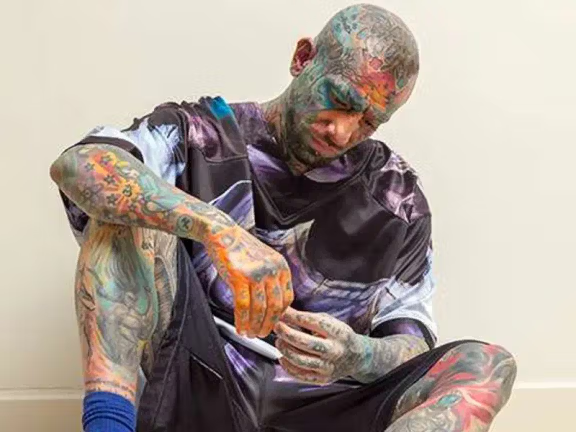
Iranian singer Amir-Hossein Maqsoudlou, known as Tataloo

Iranian singer Amir-Hossein Maghsoudlou, known by his stage name Tataloo, has been handed multiple prison sentences after being extradited from Turkey.

The 36-year-old underground musician, once a vocal supporter of the regime who had been living in Istanbul since 2018, was extradited back to Iran by Turkish authorities in December last year and has since been held in detention.

The trial, which commenced in March, accused Tataloo of several offenses including promoting "prostitution," disseminating "propaganda" against the Islamic Republic, and other broadly defined charges of "obscene content."

According to a Sunday report by the Telegram channel Fararuz News Magazine, Tataloo was sentenced to 10 years in prison for "encouraging people to corruption and debauchery," two years for "inviting people to gamble," and five years for "propaganda activities contrary to and disrupting the sacred law of Islam."

Additionally, Tataloo faced charges of "insulting the Prophet and the sanctities" in a criminal court in Tehran Province. He was acquitted of insulting the Prophet but received a three-year sentence for insulting the sanctities.

If the sentences are upheld upon appeal, the most severe punishment of 10 years in prison will be enforced.

Tataloo's attorney, Elham Rahimifar, criticized the sentences as “harsh” and reflective of the severe treatment her client has endured. She emphasized that the judgments are preliminary and subject to appeal.

Known for his distinctive tattoos and his fusion of rap, pop and R&B, Tataloo had previously found favor with conservative politicians looking to engage Iran’s young, progressive audience.

In 2017, he also participated in a televised meeting with the ultra-conservative Ebrahim Raisi, who is now the President of Iran.

In a notable moment in 2015, as the landmark nuclear deal between Tehran and world powers was unraveling, Tataloo released a song in support of Iran's nuclear program.


Most Viewed

Iran negotiators ordered to return after internal rift over Islamabad talks
1
EXCLUSIVE

Iran negotiators ordered to return after internal rift over Islamabad talks

2
ANALYSIS

US blockade enters murky phase as tankers spoof signals and buyers hesitate

3
ANALYSIS

Why the $100 billion Hormuz toll revenue is a myth

4

US tightens financial squeeze on Iran, warns banks over oil money flows

5
ANALYSIS

US blockade targets Iran oil boom amid regional disruption

Banner
Banner

Spotlight

  • Hardliners push Hormuz ‘red line’ as US blockade tests Iran’s leverage
    INSIGHT

    Hardliners push Hormuz ‘red line’ as US blockade tests Iran’s leverage

  • Ideology may be fading in Iran, but not in Kashmir's ‘Mini Iran'
    INSIGHT

    Ideology may be fading in Iran, but not in Kashmir's ‘Mini Iran'

  • War damage amounts to $3,000 per Iranian, with blockade set to add to losses
    INSIGHT

    War damage amounts to $3,000 per Iranian, with blockade set to add to losses

  • Why the $100 billion Hormuz toll revenue is a myth
    ANALYSIS

    Why the $100 billion Hormuz toll revenue is a myth

  • US blockade targets Iran oil boom amid regional disruption
    ANALYSIS

    US blockade targets Iran oil boom amid regional disruption

  • Iran's digital economy battered by prolonged blackout
    INSIGHT

    Iran's digital economy battered by prolonged blackout

•
•
•

More Stories

Iran's Leadership in Peril as President’s Chopper Vanishes in Crash

May 19, 2024, 17:17 GMT+1

Iranian President Ebrahim Raisi’s helicopter was reported missing earlier today amid dense fog, sparking a search and rescue operation that has extended into the night.

The ISNA news agency reported that based on unofficial sources some of the president's delegation have been killed, but official sources have yet to make any specific statements on the matter.

Two hardline news outlets claimed Raisi is alive and well, but later deleted the posts.

Other high profile members of the government on board include Foreign Minister Hossein Amir-Abdollahian. "We remain hopeful, but the incoming details are profoundly disturbing," revealed an Iranian official in a statement to Reuters.

The incident occurred at around 15:30 local time shortly after Raisi’s visit to a border area for a high-profile dam inauguration.

Search teams have finally reached the purported region where the crash occured near Varzaqan in the Jolfa region of East Azarbaijan province, as confirmed by the official IRNA news agency. However, there is no news about reaching the actual crash site.

However, severe fog continues to thwart their efforts, complicating the desperate hunt for the helicopter which remains missing.

A fleet of eight ambulances was dispatched from Tabriz to aid in the emergency operation.

Mohammad Ali Al-Hashem, the Friday Prayer Leader of Tabriz, was also reported to be on board the flight.

The incident unfolded just after the presidential delegation had left Khodabandeh, heading to Tabriz to inaugurate a major petrochemical complex.

Vice President Mohammad Mokhber has rushed to Tabriz to oversee the rescue efforts. Meanwhile, the Red Crescent Society has issued warnings to locals to steer clear of the crash area to prevent interference with the ongoing operation.

Contradictory reports from state TV about the nature of the incident – whether a crash or an emergency landing – only add to the current confusion surrounding the president's whereabouts and condition.

This report is being updated…

Iran’s Internet Speed Declines Amid Restrictions

May 19, 2024, 15:41 GMT+1
•
Iran International Newsroom

Recent data released by Speedtest for April reveals a decline in Iran's mobile internet speed amid deteriorating internet access under the Ebrahim Raisi government.

Despite promises of improvement, the average download speed dipped to 35.66 megabits per second, with upload speeds also faltering at 9.71 megabits per second. The stagnation comes at a time when the Ministry of Communications has mandated a hefty 34% increase in internet tariffs, purportedly to enhance service quality.

Iran's fixed broadband is ranked 156th among 181 countries in the Speedtest Global Index.

The ministry's ambitious claim in December required mobile operators to boost average speeds by 30% within six months. However, as the deadline approaches, improvements are yet to be materialized.

Further commitments made by operators—including increasing 4G coverage to 96% and expanding 5G sites to 10% by March 2025—also hang in balance, leaving consumers skeptical of any real progress.

Under the leadership of Isa Zarepour, Minister of Communications, internet accessibility has not only stagnated but has also become more restricted. The government has intensified its censorship efforts, routinely blocking access to popular platforms such as WhatsApp and Instagram and causing deliberate disruptions in service. These actions are part of a broader strategy to control information and restrict communication among the populace.

In a recent interview, Zarepour defended the repressive measures, praising them as "acceptable" practices of the Islamic Republic.

Despite mounting evidence of the disruptions, the Ministry of Communications has consistently dodged responsibility for the adverse effects on Iranian citizens' daily lives and economic activities. The situation could further deteriorate with the reintroduction of the Legislation to Protect Cyberspace Users in Parliament—a misnomer for a plan that likely aims to tighten the noose on internet freedom under the guise of protecting users.

Economic Turmoil Drives Iranian Pilots to Seek Work Abroad

May 19, 2024, 14:27 GMT+1
•
Iran International Newsroom

Iran's economic crisis is forcing a significant number of Iranian pilots to leave their jobs and seek better opportunities abroad.

The flight of talent includes 47 pilots from a private sector airline and 64 from the national carrier, Iran Air, as reported by the Etemad daily on Sunday.

“Before sanctions intensified in 2017, a pilot's average salary in Iranian airlines was about $8,000, but due to the plummeting national currency and the increasing economic mismanagement, their monthly earnings have drastically dropped to around $1,000. In contrast, pilots in neighboring regional airlines earn up to $14,000, depending on their flight experience,” wrote Etemad.

Over one third of Iranians now live under the poverty line with millions of middle class Iranians also now plunged into an economic catastrophe.

In a further illustration of the dire economic conditions, Ahmadreza Ameri from the Passenger Transport Companies Union highlighted in an ILNA interview in September that many highly educated professionals, including pilots, acquire commercial drivers' licenses as a potential route to migrate abroad.

Recent reports reveal a continued rise in emigration from Iran, driven by political unrest, economic instability, systemic corruption, and the harsh impacts of international sanctions. The USA hosts the largest Iranian expatriate community, with over 500,000 Iranian-born residents, followed by Canada, Germany, Turkey, and Sweden.

The mass exodus of skilled professionals, including teachers, doctors and nurses from Iran not only underscores the critical state of the Iranian economy but also poses a severe threat to the country's future as it continues to lose valuable human capital.

Iran Labels Rock Music Fans Satan Worshippers in Mass Arrest

May 19, 2024, 12:31 GMT+1
•
Iran International Newsroom

Iranian police arrested over 260 people at an underground music festival this weekend, branding the event a “satanist gathering”.

According to Iran International sources, police made the mass arrest in the Shahriar area of Tehran province Friday.
The semi-official Tasnim News Agency, linked to the Islamic Revolutionary Guards Corps (IRGC), reported that the attendees were adorned with "signs and symbols of Satanism" on their attire and accessories. The authorities also claimed they seized alcohol and psychedelic drugs.

The incident is part of a broader crackdown on rock and metal music in Iran, where such genres are frequently and baselessly associated with devil worship by the government.

Despite the heavy-handed tactics of the police and the IRGC intelligence, all individuals except for the event organizer have been released.

A group of Georgian musicians invited to perform, along with their manager, were handed over to their embassy in Tehran.

Iranians Not Convinced About Legitimacy of New Parliament

May 19, 2024, 11:48 GMT+1
•
Iran International Newsroom

A reformist politician in Tehran has harshly criticized the electoral system in the Islamic Republic, which is based on a biased vetting of the candidates favoring hardliner politicians.

Saeed Shariati told Etemad Online website that "Even some of the hardliners can no longer call this political purge an election." He said "the government is playing with people's minds when it asks them to choose between two likeminded hardline conservatives."

Prior to the March 1 parliamentary elections, the Guardian Council controlled by Supreme Leader Ali Khamenei, disqualified hundreds of candidates, paving the way for loyalist hardliners to gain a strong majority in the Majles. This partly contributed to the lowest turnout in the history of the Islamic political system.

The website noted that while the government considers the election over, the controversy surrounding it will persist due to unresolved issues. One of the most critical issues is the nature of the Iranian government, which is supposed to be a "Republic."

The website argued that the Iranian political system will no longer even resemble a republic with the disqualification of all “reformists, moderates, and independent candidates.”

Etemad Online quoted Shariati, who stated that election turnout in Iran has been consistently declining, even among conservative voters. In other words, the election system has failed to convince even the regime's religious-minded hardline conservative supporters.

Iranian politician and commentator Saeed Shariati
100%
Iranian politician and commentator Saeed Shariati

"While one of the most significant [initial] differences between the Islamic Republic and the previous regime was that political groups were able to win positions of power in a competitive situation, during the past 32 years, the arbitrary selection of all candidates by the Guardian Council has changed the reality and eliminated the element of competitiveness," Shariati said.

He quoted former Foreign Minister Javad Zarif, who said that the high turnout in the 1997 Iranian presidential election influenced the United States' decision not to attack Iran between 2001 and 2003, following the September 11 terror strikes. At the time, President George Bush called Iran part of an “axis of evil.”

Shariati added that biased and rigged elections since 2009 have rendered elections in Iran meaningless, as radical conservatives have taken over the government.

Meanwhile, Jomhouri Eslami newspaper wrote: " The government failed to take seriously the drop in turnout in the 2020 Majles election and continued the same biased vetting of candidates, barring reformists and moderates from running. As a result, the situation worsened in the 2024 parliamentary elections."

The conservative daily pointed out that “it is a catastrophe when someone who has entered the new parliament by winning only 5 percent of the vote in Tehran, now has a chance to become the Speaker of the Majles and lead the legislative power."

The daily added that a parliament elected by the minimum number of votes is neither desirable nor legitimate and cannot make key decisions.

Meanwhile, the government and ruling ultraconservatives are either in denial about the declining election turnouts or attempting to justify them.

Ultraconservative political activist Sadeq Koushki has done both. He blamed the state television for the low turnout, saying that the state TV, which has exclusive broadcasting rights in Iran failed to properly inform the nation about the elections.

Meanwhile, he stated that the low turnout in March was "natural" and accused critics of waging a psychological war by highlighting it. He added, "There is no reason for the government to be concerned about the situation."

The new parliament is set to open in less than two weeks, but complacent statements like the one made by Koushki are unlikely to convince the Iranian people that the parliament represents the majority of them.