• العربية
  • فارسی
Brand
  • Iran Insight
  • Politics
  • Economy
  • Analysis
  • Special Report
  • Opinion
  • Podcast
  • Iran Insight
  • Politics
  • Economy
  • Analysis
  • Special Report
  • Opinion
  • Podcast
  • Theme
  • Language
    • العربية
    • فارسی
  • Iran Insight
  • Politics
  • Economy
  • Analysis
  • Special Report
  • Opinion
  • Podcast
All rights reserved for Volant Media UK Limited
volant media logo

Iran International Awarded the 2024 Geneva Summit Courage Award
Iran International Newsroom
May 15, 2024, 17:11 GMT+1Updated: 16:56 GMT+0
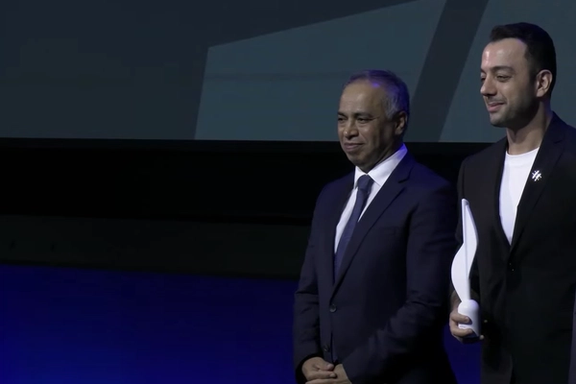
Iran International’s executive editor, Aliasghar Ramezanpoor and TV host Pouria Zeraati accepting the 2024 Geneva Summit Courage Award

Iran International was awarded with the 2024 Geneva Summit Courage Award on Wednesday for "fearlessly” uncovering the daily “abuses of the Islamic Republic of Iran."

Executive editor Aliasghar Ramezanpoor and television host Pouria Zeraati accepted the Award on behalf of the news network.

“This is an award to Iranian people who are the voice of what is happening inside,” Zeraati said.

After receiving the award, Ramezanpoor and Zeraati spoke on a panel with Brandon Silver, Director of Policy and Projects at the Raoul Wallenberg Centre for Human Rights (RWCHR).

During that conversation, they discussed Iran's grave humanitarian situation and why the Islamic Republic branded Iran International a terrorist organization.

“I think the reason the regime is against Iran International as a media organization is that they are afraid of the free flow of information, which cannot be stopped in the 21st century,” Zeraati said.

He explained the reason is twofold: the regime does not want people to know what they are deprived of, namely the social democratic values people desire, and it does not wish the rest of the world to know about the atrocities they commit inside their country.

Ramezanpoor drew attention to the grave situation of journalists inside Iran who bravely reported what was happening, particularly Elahe Mohamadi and Niloufar Hamedi, who broke the story of Mahsa Jina Amini for the first time.

22-year-old Mahsa Jina Amini died at the hands of the so-called morality police in September 2022. Her death sparked a monthslong nationwide protest, often dubbed the Woman, Life, Freedom movement, during which authorities killed at least 550 protesters and tens of thousands were detained – including scores of journalists.

The two female journalists were jailed for over a year for covering the death of Amini. While they were released on bail in January, they “technically are under house arrest and cannot do their work”, Ramzanpoor said.

During the panel discussion, Zeraati, who was stabbed while leaving his London residence in late March, said that what happened to him showed that the Western government's policy of diplomacy and negotiating with the regime doesn’t work.

“What they can do [the Western governments] is send a clear message to Tehran that if this is repeated, there will be severe and more serious consequences for you,” Zeraati said.

Pointing out to the sanctions the UK government imposed on the Islamic Republic after ITV revealed that there was a plot against two of Iran's International journalists that was foiled by British Security Services in 2022, Zeraati said: “What happened to me was about three months after those sanctions, That shows that those sanctions were not impactful enough.”

On the opening day of the summit, Zeraati also called for the designation of the Islamic Revolutionary Guard Corps (IRGC) as a measure to reduce the regime’s international impact.

Iranian government threats have targeted Iran International for years. After risks to staff reached a point where domestic security services could not ensure their safety, the news network temporarily relocated its London offices to Washington last year.

During the summit, which raises awareness about human rights situations that require urgent global action, Kylie Moore-Gilbert, an academic previously jailed in Iran for over two years, described her harrowing ordeal inside the Islamic Republic's prisons.

She also called on Western governments to stop their “empty words” and take action to support Iranians.

Moore-Gilbert said that shortly after the 2022 Woman, Life, Freedom movement in Iran was suppressed by the authorities, Western governments “rushed right back into business as usual mode in their dealings with Tehran” and “turned a blind eye to enforcing oil sanctions. Unfreezing Iranian assets to the tune of billions, issuing sanctions waivers, which enrich the regime by further billions.”

The Australian-British academic was arrested at Tehran Airport by Iran’s Islamic Revolutionary Guard (IRGC) on September 12, 2018. She was subsequently convicted of espionage in a closed-door trial, and sentenced to 10 years in prison.

Moore-Gilbert, a University of Melbourne lecturer in Islamic studies, was released in November 2020 in a prisoner swap with three Iranian prisoners in Thailand, two of whom had been convicted in connection with a bombing plot in Bangkok in 2012.

She also criticized the UK, Canada, and Australia for not designating the IRGC as a terrorist entity, in its entirety.

“To the Western governments, I say it's not too late to stand by the Iranian people in a meaningful, impactful way in their quest for freedom. Woman Life Freedom is not over. It's still boiling away. It will erupt again, and when it does, we can be ready.”

US-based advocate Gazelle Sharmahd shared her speech via video after she was informed that the regime in Iran may target her should she travel to Switzerland for the summit.

US-based advocate Gazelle Sharmahd shared her speech via video at the Geneva Summit for Human Rights and Democracy
100%
US-based advocate Gazelle Sharmahd shared her speech via video at the Geneva Summit for Human Rights and Democracy

Sharmahd, the daughter of German-American prisoner Jamshid Sharmahd, who has been sentenced to death in Iran, has long advocated for the release of her father.

“I wish I could be there with you today in person, but unfortunately, we live in a world where terrorists are invited on the red carpets and activists have to fend for their own lives. I was told it's not safe for me to travel because the Islamic regime is watching my every step, and I could be assassinated or kidnapped like my father.”

A 69-year-old California resident, Jamshid Sharmahd, was abducted by Iranian agents while visiting the United Arab Emirates in 2020. Iranian authorities sentenced him to death for “endangering national security” in February 2023, a verdict that the Supreme Court upheld.

Sharmahd, who holds German and Iranian citizenship, was convicted of heading a pro-monarchist group named Tondar, responsible for a deadly bomb attack that killed 14 people and injured 215 in Shiraz in 2008.

Sharmahd and his family deny the charges, and Iranian authorities have not provided evidence to support their accusations. Amnesty International has branded the Iranian judicial system’s trial a sham.

Gazelle Sharmahd also criticized Western governments for not supporting the Iranian diaspora, saying, “More activists and journalists are facing death threats as a nation plots kidnapping plots stabbings on American and European soil.”

“And when they ask their Western governments for protection, they're told to stop their activism. Don't go to rallies. Don't go to conferences or go into witness protection. So, in other words, shut up or protect yourself from terror plots,” Sharmahd added.


Most Viewed

Iran negotiators ordered to return after internal rift over Islamabad talks
1
EXCLUSIVE

Iran negotiators ordered to return after internal rift over Islamabad talks

2
ANALYSIS

US blockade enters murky phase as tankers spoof signals and buyers hesitate

3
ANALYSIS

Why the $100 billion Hormuz toll revenue is a myth

4

US tightens financial squeeze on Iran, warns banks over oil money flows

5
ANALYSIS

US blockade targets Iran oil boom amid regional disruption

Banner
Banner

Spotlight

  • Hardliners push Hormuz ‘red line’ as US blockade tests Iran’s leverage
    INSIGHT

    Hardliners push Hormuz ‘red line’ as US blockade tests Iran’s leverage

  • Ideology may be fading in Iran, but not in Kashmir's ‘Mini Iran'
    INSIGHT

    Ideology may be fading in Iran, but not in Kashmir's ‘Mini Iran'

  • War damage amounts to $3,000 per Iranian, with blockade set to add to losses
    INSIGHT

    War damage amounts to $3,000 per Iranian, with blockade set to add to losses

  • Why the $100 billion Hormuz toll revenue is a myth
    ANALYSIS

    Why the $100 billion Hormuz toll revenue is a myth

  • US blockade targets Iran oil boom amid regional disruption
    ANALYSIS

    US blockade targets Iran oil boom amid regional disruption

  • Iran's digital economy battered by prolonged blackout
    INSIGHT

    Iran's digital economy battered by prolonged blackout

•
•
•

More Stories

Cleric Urges Iranian Women to Question ‘Flaws’ in Western Women's Rights

May 15, 2024, 15:34 GMT+1
•
Iran International Newsroom

A high-ranking Iranian cleric has claimed Western views of women’s rights are “flawed” urging Iranian women to question the very rights they are fighting for amid an ongoing uprising.

Hashem Hosseini Bushehri, Secretary of the Supreme Council of Seminaries said on Tuesday, “If educated and thoughtful women address issues such as the status of women's rights in Western societies and the flaws that exist in this area in the West, the enemy will not even have a chance to challenge us,” said Bushehri.

His statement comes at a time when Iran faces international scrutiny over its treatment of women, following the widespread protests ignited by the Women, Life, Freedom movement since 2022.

The movement began after powerful images of Iranian women rejecting the mandatory hijab went viral, symbolizing broader opposition against Iran’s authoritarian regime, which imposes strict religious codes affecting both the social and private lives of its citizens, especially women, who remain excluded from various facets of society such as football stadiums and are subject to strict Islamic dress codes from childhood.

Despite the regime’s harsh crackdown, which includes public beatings, rapes, and executions of protesters, defiance remains strong.

In response, Iranian authorities have escalated their enforcement of the mandatory hijab, instituting the Noor plan last month, which has seen an increased presence of hijab police, especially in central Tehran, violently cracking down on hijab defiance.

The United Nations has labeled Iran's actions as "gender apartheid," and international rights groups continue to advocate for the oppressed women in Iran, who are battling against the stringent laws.

Iran’s Me Too movement has documented systematic state-sanctioned sexual violence against women and girls.

Who Benefits from Infighting Among Iran's Ultraconservatives?

May 15, 2024, 15:26 GMT+1
•
Iran International Newsroom

The media, politicians, and pundits are divided on the outcome of the May 10 runoff election for the Iranian parliament and the distribution of its 290 seats in the Majles among the hardliners.

After establishing total control over the parliament by banning hundreds of other candidates, Iran’s hardliners are now engaged in fierce infighting, in what some observers call rivalry over power, money and influence.

Some argue that the infighting will not yield any clear winner, while others believe Iran's embattled ‘reform’ camp might benefit from the fierce competition among ultraconservatives, who still call themselves revolutionaries 45 years after Iran's largely forgotten 1979 revolution.

Meanwhile, the nation at large appeared indifferent to the entire affair, with various sources reporting a turnout of only 4 to 8 percent in the runoff election. The public nearly ignored the election and sees little significance in the infighting among the ultraconservatives poised to take over the inefficient parliament in less than a month.

Mohammad Javad Jamali Nobandegani, a conservative politician says there will be no winners in the infighting. He describes the ongoing conflict as a struggle between the younger members of the ultraconservative Paydari (Steadfastness) party and even younger "revolutionaries" who secured their seats in parliament through a campaign led by young conservative regime propagandist Ali Akbar Raefipour.

Young ultrahardline politician Ali Akbar Raefipour
100%
Young ultrahardline politician Ali Akbar Raefipour

Both Paydari members and the supporters of Majles Speaker Mohammad Bagher Ghalibaf have accused Raefipour of financial corruption and leading social media trolls to attack his political rivals, mainly on X.

Raefipour, on the other hand, has accused his political rivals of unethical campaigning against him. While Raefipour claims that nine of the candidates on his list have won the runoff election, others argue that none of the individuals won solely because of his support. The nine candidates were also promoted by Paydari Party.

Nobandegani told Nameh News that all radical politicians over the past 45 years have deviated from the orthodox Islamic revolution. He accused radical politicians of having very little, if any, political awareness and charged that young ultraconservatives know no boundaries in their mudslinging against political rivals.

He described the ultraconservatives' behavior as undemocratic and warned all sides that tarnishing their rivals' image will not boost their own reputation. On the contrary, it will deepen public disappointment and further lower voter turnout in the next elections. Both sides will be destroyed, he reiterated.

Nameh News warned in a commentary that reformist politicians are likely to ride the waves of discord among conservatives and become popular with the public.

The website noted that it is interesting how all sides, including Ghalibaf's camp, Paydari, and Raefipour with his young revolutionaries, claim to be pioneering a new brand of conservatism in Iran. However, what the public sees is their infighting and the corruption allegations they hurl at each other.

This, the website argued, will erode public trust in all politicians. The only potential winners might be the reformists, who can portray themselves as moderates among radicals.

Meanwhile, a moderate conservative commentator Mehdi Arab Sadeq has suggested that behind the scenes of the fierce infighting within the conservative camp, the Paydari Party appears to be trying to highlight the government's failures and further its own political agenda to take over the Majles and the government.

The Tehran University academic noted that while the new lawmakers are predominantly conservative, it is still too early to determine who holds the upper hand in parliament. Amid the initial chaos, Paydari members, many of whom have previously served in the Majles, are capitalizing on the new MPs' lack of experience to assert control over the parliament.

However, he added that Paydari's inherent weaknesses will become apparent in the coming months if their primary strategy is to fan the flames of discord and infighting. Despite these weaknesses, they may still manage to wrest control from President Raisi and advance their own political agenda.

Iranian Minister Calls Internet Blocking Policies ‘Acceptable’

May 15, 2024, 14:47 GMT+1
•
Iran International Newsroom

Iran's Minister of Communications, has defended the country's internet policies, which involve restricting access to popular foreign platforms, labeling the policy "acceptable."

In an interview with the Shargh newspaper, Isa Zarepour remarked, "The same logic prevails even in countries that claim to uphold freedom of speech. Accepting a country's laws means abiding by them; otherwise, it's natural for restrictions to be enforced."

Zarepour claimed that Instagram played a “significant” role in amplifying the "riots" of 2022, referring to the widespread public protests which Iranian authorities consistently label as such. The protests were in response to the death of Kurdish woman Mahsa Amini, who died in police custody for allegedly defying hijab regulations, sparking the Woman Life Freedom movement.

He further stressed the necessity of regulating platforms that "do not adhere to their own rules and jeopardize national security."

Additionally, he defended his crackdown of internet usage during the 2022 uprisings, calling it one of the "good events" of his tenure, despite widespread reports of internet blackouts and the shutdown of SMS services during the anti-government protests.

The government's actions included cutting off access to major social media platforms like Instagram and WhatsApp and cracking down to social media criticism of the government with thousands already arrested for charges including threatening state security.

Zarepour called allegations of intentional disruptions by the Ministry of Communications unfounded.

According to the Freedom on the Net 2023 report by Freedom House, Iran ranks sixty-eighth out of seventy countries in internet freedom.

Since the 2022 uprising, not only have dissident voices been targeted but millions of Iranians have been plunged further into poverty as the platforms they relied on for e-commerce, especially small businesses in rural areas, have been cut off.

47,000 Tons of Toxic Cooking Oil Hit Iran’s Market, Says Whistleblower

May 15, 2024, 12:45 GMT+1
•
Iran International Newsroom

Over 47,000 tons of expired and contaminated cooking oil have been distributed in Iran, according to prominent Iranian whistleblower journalist Yashar Soltani.

The contaminated oil was reportedly part of a shipment bought by Iran’s state purchasing agency from Turkey and Argentina in August 2021.

The Government Trading Corporation of Iran (GCT) had purchased an overall shipment of 91,000 tons of cooking oil, which reportedly was poisoned with agricultural toxins and pesticides, according to Soltani's report.

The report, based on documents allegedly obtained from official laboratories, suggests that the shipment was tested by Iranian state laboratories four times. All results reportedly indicated that "the oils cannot be cleared for consumption" due to residue factors of agricultural toxins.

The oils were said to include chemical insecticides such as malathion, deltamethrin, piperonyl butoxide, and pirimiphos-methyl.

Consumption of chemical insecticides can pose health risks to humans. Short-term exposure to high levels of pirimiphos-methyl can cause symptoms such as nausea, vomiting, abdominal pain, headache, dizziness, and difficulty breathing. Long-term exposure may lead to more serious health effects, including neurological damage, reproductive issues, and an increased risk of certain cancers.

Over a year after the shipment was purchased, in September 2022, a technical committee considered the sampling results "inconclusive" and voted to release the cargo of two out of three ships, which contained half the total.

In his report, Soltani noted that 47,000 tons of expired and contaminated cooking oil had entered the Iranian market. As of now, 44,000 tons remain unreleased at Bandar Abbas port in Hormozgan province, located in southern Iran.

Officials denied and replied to the allegations, but Soltani released a further update with additional evidence days later.

In a statement last Tuesday, the GCT, mentioned in Soltani's report as the importer of this shipment, denied that the oil was tainted.

"No product can be sold without the permission of Iran’s Food and Drug Organization (IFDA) and the Iran National Standards Organization (INSO). Without approval from these organizations, a product will not qualify for distribution and consumption," the statement read.

Bandar Abbas's prosecutor also objected, stating to Iranian media that "The released oils had permission from IFDA, but the 44,000-ton cargo of contaminated oil is not cleared and is still kept in the port."

Another official, the Chief Justice of Hormozgan, echoed the denials by saying a "shipment of 44,000 tons of oil worth 70 million euros" was seized, and "the seller offered to take it back."

The IFDA also denied authorizing any contaminated products last week.

The investigative journalist, known for uncovering corruption among Islamic Republic officials, reacted to the denials on Thursday and emphasized the role of IFDA as the main culprit.

The IFDA, operating as part of the Iranian government’s Health Ministry, falls under the purview of current President Ebrahim Raisi.

Soltani criticized officials for focusing solely on the unreleased cargoes and demanded an explanation for why half of them had already entered the market.

“The IFDA’s head should take responsibility for the situation more than anyone else,” Soltani wrote on his website.

He presented further documents that demonstrated that in the IFDA system, the shipments are still labeled "waiting for permit."

“How can these products enter the market without IFDA authorization?...The main issue remains. In all four tests, several agricultural toxins were found in these products and declared not suitable for human consumption. But suddenly, the IFDA decided to import half into the Iranian market.”

Soltani was sentenced to five years in prison in 2016 for investigating corruption in municipal real-estate sales in Tehran. In 2019, he was released on bail after being charged with "spreading lies" and "gathering classified information with the intent to harm national security."

The whistleblower also exposed the reported financial corruption by a prominent cleric appointed by the Supreme Leader Ali Khamenei as Tehran's Friday Imam in March.

Official Claims Half of Prisoners in Iran ‘Involved With Drugs’

May 15, 2024, 12:37 GMT+1

Iraj Kakavand, the anti narcotic police chief of Iran, said on Wednesday that approximately half of the country’s prisoners are involved in drugs or narcotics.

His comments, implying a lack of monitoring in prisons where drug use prevails, come as human rights group report that the prison system in Iran is highly controlled and violence, rape, and torture by the Islamic Republic agents prevail.

Iran Wire claimed in 2020 that cheap, mass-produced narcotics are distributed among prisoners. Activists such as Leila Hosseinzadeh, who has since been released, said that systematic drugging of prisoners is also rife. After a fight between two prisoners, she said "a pill was placed into the mouth of one of them so that they could not speak for a few days.”

Moreover, the latest claims come against the backdrop of execution as punishment for drug-related crimes in Iran’s judiciary system, a practice that analysts say is political in nature.

According to Iran Human Rights Organization Director Mahmood Amiry-Moghaddam, drug-related executions are "aimed at instilling fear and preventing more protests" and have been carried out "without any political cost or consequences."

Amnesty International reported in April that Iran executed at least 853 people in the last year, marking the highest number in eight years. Drug-related offenses accounted for more than half of these executions.

In April, more than 80 human rights organizations called on the United Nations Office on Drugs and Crime (UNODC) to demand from Iran that drug-related executions cease as a condition of its cooperation.

Prisoners who have been charged with drug offenses in Iran are sentenced to death for “torture-tainted confessions, without due process and fair trial rights and often without access to a lawyer,” according to their statement.

According to Amiry-Moghaddam, UNODC has kept silent about the rise in drug-related executions in the country while it has partnered with Tehran to combat drug trafficking.