• العربية
  • فارسی
Brand
  • Iran Insight
  • Politics
  • Economy
  • Analysis
  • Special Report
  • Opinion
  • Podcast
  • Iran Insight
  • Politics
  • Economy
  • Analysis
  • Special Report
  • Opinion
  • Podcast
  • Theme
  • Language
    • العربية
    • فارسی
  • Iran Insight
  • Politics
  • Economy
  • Analysis
  • Special Report
  • Opinion
  • Podcast
All rights reserved for Volant Media UK Limited
volant media logo

Khamenei Puts Public Pressure On Muslim Governments To Isolate Israel

Mardo Soghom
Mardo Soghom

Iran International

Apr 11, 2024, 11:26 GMT+1Updated: 17:21 GMT+0
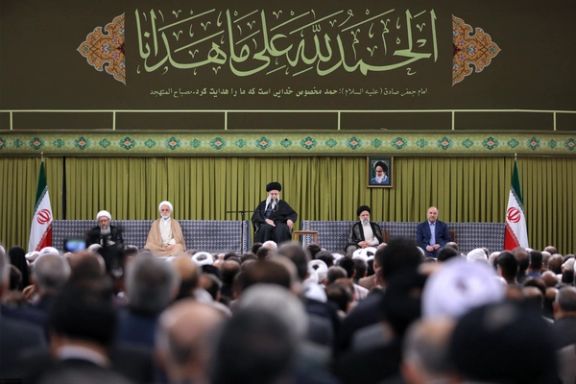
Iran Supreme Leader Ali Khamenei (center) and top government officials during a meeting with a group of envoys of Muslim countries in Tehran on April 10, 2024

Islamic Republic's Supreme Leader Ali Khamenei on Thursday called on Muslim countries to isolate Israel, seemingly taking advantage of rising concerns about a retaliatory attack by Tehran.

Reports emerged on Wednesday indicating that American and Israeli intelligence agencies are anticipating an attack by the Islamic Republic in the coming days in retaliation for a devastating Israeli strike on April 1. Two top Revolutionary Guard generals and five other officers were killed when a precision missile flattened a building in the Iranian embassy compound in Damascus. Tehran began threatening retaliation, which could spark a direct war with Israel.

The issue of Gaza cannot be disregarded, Khamenei said, and insisted that it is at the forefront of concerns in the Islamic world, requiring a sense of collective responsibility from everyone. “The hearts of nations, even non-Muslim nations, resonate with the plight of Palestine and Gaza, evidenced by unprecedented rallies in Africa, Asia, Europe, and even the United States against the crimes of the Zionists.,” he told a group of government officials and unidentified foreign diplomats.

Khamenei, in a condescending tone, stated that the Islamic Republic “has the definite expectation and suggestion” that Islamic countries severe political and economic ties with Israel, at least until such a time when Israel stops attacking Hamas. He went on to say that if referendums were held, the majority of Muslims would support such a move, so their government should respect the public mood.

Once reports of an “imminent” Iranian attack emerged on Wednesday, US Middle East envoy Brett McGurk called the foreign ministers of Saudi Arabia, United Arab Emirates, Qatar and Iraq to ask them to deliver a message to Iran urging it to lower tensions, a source with knowledge of the situation said. The calls took place, and the Iranian foreign minister Hossein Amir-Abdollahian delivered the same message about isolating Israel to his UAE counterpart. He urged Muslim nations to coalesce and put pressure “on Israel and its backers to end the killings in Gaza.”

Turkey this week adopted the strategy demanded by Khamenei restricting exports of a wide range of products to Israel until a ceasefire is declared in Gaza. This was Ankara's first significant measure against Israel after six months of war.

Another major development on Wednesday was the death of Ismail Haniyeh’s three sons and three grandchildren in an Israeli airstrike in Gaza, that rather quickly faded in the news after reports about an imminent Iranian attack emerged later in the day.

Tehran has remained generally quiet about this development, with only the chief commander of the Revolutionary Guard publicly expressing his condolences to Iran’s close Palestinian ally. Calling the airstrike “on a civilian car” a “terrorist act” Hossein Salami both expressed sympathy and congratulated Haniyeh for the “martyrdom” of his sons.

Most Viewed

Iran negotiators ordered to return after internal rift over Islamabad talks
1
EXCLUSIVE

Iran negotiators ordered to return after internal rift over Islamabad talks

2
ANALYSIS

US blockade enters murky phase as tankers spoof signals and buyers hesitate

3
ANALYSIS

Why the $100 billion Hormuz toll revenue is a myth

4

US tightens financial squeeze on Iran, warns banks over oil money flows

5
ANALYSIS

US blockade targets Iran oil boom amid regional disruption

Banner
Banner

Spotlight

  • Hardliners push Hormuz ‘red line’ as US blockade tests Iran’s leverage
    INSIGHT

    Hardliners push Hormuz ‘red line’ as US blockade tests Iran’s leverage

  • Ideology may be fading in Iran, but not in Kashmir's ‘Mini Iran'
    INSIGHT

    Ideology may be fading in Iran, but not in Kashmir's ‘Mini Iran'

  • War damage amounts to $3,000 per Iranian, with blockade set to add to losses
    INSIGHT

    War damage amounts to $3,000 per Iranian, with blockade set to add to losses

  • Why the $100 billion Hormuz toll revenue is a myth
    ANALYSIS

    Why the $100 billion Hormuz toll revenue is a myth

  • US blockade targets Iran oil boom amid regional disruption
    ANALYSIS

    US blockade targets Iran oil boom amid regional disruption

  • Iran's digital economy battered by prolonged blackout
    INSIGHT

    Iran's digital economy battered by prolonged blackout

•
•
•

More Stories

Iranian MP Warns Travel Ban Considered For Hijab Defiance

Apr 11, 2024, 10:33 GMT+1

Iranian MP Mehdi Bagheri has warned that a travel ban is being considered as one of the penalties for defying compulsory hijab as crackdowns on the Islamic dress code continue.

In an interview with Khabar Online, Bagheri warned, "A person who does not respect the law, does not accept the law, and in a way rebels against it, will be deprived of services provided in the country, including foreign travel."

Travel bans have already been imposed on the likes of celebrities for voicing dissent against the government since the 2022 Women, Life, Freedom uprising, but the punishment for hijab defiance comes amidst deepening punishments for women daring to defy the Islamic dress code.

The government continues to lose control of the mass rebellion which has followed the death in morality police custody of Mahsa Amini in 2022, for allegedly not wearing her hijab properly, which led to the biggest uprising since the founding of the Islamic Republic in 1979.

Bagheri, whose popularity waned in recent elections, further discussed the consequences for government employees failing to adhere to compulsory hijab, suggesting that under the latest ‘Chastity and Hijab’ bill, judges could consider penalties such as being denied promotion or facing temporary or permanent dismissal from service.

He also emphasized the potential for imprisonment for women resisting compulsory hijab. Morality police patrols continue alongside surveillance across Iran, with uncovered women banned from public places and thousands already arrested for defiance and imprisoned on trumped up charges such as compromising state security.

Senior officials within the Iranian government have been emphasizing the continuation of enforcing compulsory hijab for women. Supreme Leader Ali Khamenei labeled hijab as a "religious duty" on April 3, condemning attempts to challenge its enforcement within Iran. Khamenei attributed such challenges to foreign instigation aimed at undermining the norms regarding hijab.

Khamenei emphasized that even women who do not adhere to Sharia law are obliged to observe compulsory hijab.


Dissident Urges Iranians To Cancel Flights Amid Rising Regional Tensions

Apr 11, 2024, 09:58 GMT+1

Iranian dissident Hamed Esmaeilion urged travelers to cancel domestic and international flights from Iran fearing a repeat of the tragic 2020 IRGC downing of a Ukrainian airliner, killing all 176 crew and passengers. 

As Tehran threatens retaliatory action for the Israeli airstrike on its consulate in Damascus, Esmaeilion, who lost family in the tragedy, warned of the risk of civilians being caught in the crossfire.

In January 2020 when Iran’s top military commander Qasem Soleimani was killed in a US drone strike in Iraq, the IRGC days later downed a Ukrainian airliner, claiming it was accidental. After the Damascus strike, in which at least two IRGC commanders and several other personnel were killed, Tehran has voiced clear intentions for retaliation.

“In these situations, governments only think about the health of their military forces, and domestic and foreign airlines only think about their financial profits and losses. The International Civil Aviation Organization (ICAO) does not care about the safety of aircrafts and passengers at these times,” the dissident said, warning of the dangers of the current uncertainty.

Esmaeilion stated that when civilians are “the most vulnerable targets of the Islamic Republic and the IRGC’s criminal commanders,” Iranians should themselves prioritize their safety and cancel their flights.

His remarks came just hours after German Lufthansa Airlines suspended all its flights to and from Tehran given the rising tensions in the region.

Citing unnamed American and Israeli officials, Bloomberg reported on Wednesday that a major missile or drone attack by Iran or its proxies on Israel seems imminent in the coming days.

‘We Don’t Just Talk’ Say Iranian Lawmakers As Calls For Israel Retaliation Grow

Apr 11, 2024, 09:26 GMT+1

Hours after Supreme Leader Ali Khamenei’s threats about “punishing” Israel, Iranian lawmakers again called for retaliation against Israel’s airstrike on Iran’s Damascus consulate.

Esmail Kosari, Iranian lawmaker and former IRGC commander, said, “We should make them regret what they did; this should be done and it will be done.

“Israel knows we don’t just talk. When we say something, we will definitely act,” added Kosari, who serves as a member of the National Security and Foreign Policy Commission of the Iranian parliament.

Last week, Israel struck Iran's consulate building in Damascus, killing 7 IRGC forces, including two top commanders. According to the Financial Times, suspected Israeli strikes have claimed the lives of 18 IRGC commanders and advisers since the Gaza war broke out on October 7.

Over recent days, Iranian officials have time and again vowed revenge against Israel but have fallen short of making a decisive move so far.

Meanwhile, Jalil Rahimi Jahanabadi, another senior lawmaker, stressed the need for a “deterrent” response to Israel.

“If deterrence is not created and appropriate response is not provided, the other side [Israel] will construe it as a sign of weakness,” he pointed out.

Fadahossein Maleki, a member of the National Security and Foreign Policy Commission of the Iranian parliament, stated that Iran’s proxies will be key in upcoming actions.

“Proxy groups carried out many operations against Israel in the past and they will not remain inactive this time,” he said.

Israeli Foreign Minister Israel Katz said on Wednesday that Israel will respond if Iran attacks Israel from its own soil.

Countries Scramble To Avert Iran, Israel Escalation

Apr 11, 2024, 08:11 GMT+1
•
Iran International Newsroom

Top diplomats and generals across the Middle East were hustling Wednesday night to avert a regional conflagration, as Iran was said to be readying for a retaliatory strike on Israel.

US secretary of state Antony Blinken called to reassure Israeli defense minister Yoav Gallant of American unwavering support, while foreign ministers of Iraq, Qatar, the United Arab Emirates, and Saudi Arabia called their Iranian counterpart, apparently to convey a message from the Biden administration that asked Iran to de-escalate.

Tensions between Iran and Israel have reached new heights following Israel’s airstrike on Iran’s consulate in Damascus on April 1, which killed two top Revolutionary Guards commanders. After a brief period of vague statements, Iranian officials, including Supreme Leader Ali Khamenei, blunted their words and vowed to hit back at Israel.

"The evil regime made a mistake and must be punished, and it shall be," Khamenei said in his Eid al-Fitr sermon Wednesday, marking the end of Muslims’ holy month of Ramadan. “When they attack the consulate, it is as if they have attacked our soil."

A few hours later, reports emerged of American and allied intelligence pointing to an “imminent” Iranian attack against Israel, potentially from inside Iran, not through allied armed groups in Iraq or Lebanon.

US President Joe Biden took no time to publicly react to the reports. “We also want to address the Iranian threat to launch a significant…attack in Israel,” he said, standing alongside Japan’s prime minister Fumio Kishida on the White House lawn. “Our commitment to Israel’s security against these threats from Iran and its proxies is ironclad. Let me say it again, ironclad. We’re gonna do all we can to protect Israel’s security.”

While warning Iran that it may have to face not just Israeli army but American military might, the Biden administration is trying hard to stop a full-blown regional war that on Thursday seemed as likely as ever.

“We’ve been clear that we do not want this conflict to escalate or spread further in the region,” a Biden spokesperson said Wednesday. “We’ll continue to undertake diplomatic efforts to ensure that remains the case… We also retain a military presence in the region to deter those who seek to take advantage of the conflict.”

Some experts say that two clear “punishment” calls by Khamenei in a matter of days may signal a firm ‘intent’ to target Israeli interests directly. This could come in the form of precision missiles or one-way drone attacks on Israel territory or its diplomatic missions across the region.

If the Biden administration fails to dissuade Iran from such attacks, it will likely turn to Israel to try and prevent a response –that could trigger a vicious circle of retaliations. However, Thursday morning, all seemed quiet in Tehran, with little provocative talk of an attack. Instead, Khamenei in a speech called for Muslims to blockade Israel and exert pressure.

“If Iran attacks from its territory, Israel will respond and attack in Iran,” Israel’s foreign minister, Israel Katz, wrote on X, leaving little doubt that the Middle East is closer than ever to a full-scale regional war.

Israel and Iran have been engaged in indirect conflict since October 7th, with Israel targeting IRGC-affiliated targets in Syria, and Iran’s most powerful ally Hezbollah launching attacks across the Lebanese-Israeli border. Israel’s attack on Iran’s consulate in Damascus elevated the level of hostilities and raised concerns that direct confrontation between the two countries might be unavoidable.

Shortly after that attack, reports emerged of Iran sending messages to the Biden administration, blaming the US for not pressuring Israel –while US officials publicly confirmed that they had been kept in the dark and made aware of the Israeli operation only when warplanes were nearing their targets.

Khamenei faces a dilemma of escalating the conflict and risk its consequences amid Iran's isolation and economic crisis, or do nothing and lose credibility among its domestic and regional followers.

UK Foreign Secretary Reacts to Iran International TV Anchor Stabbing

Apr 11, 2024, 05:13 GMT+1

Britain has taken “strongest” measures against those hired by Tehran to target Iranians on British soil, UK foreign secretary David Cameron said Wednesday in the first government reaction to the stabbing of Iran International's presenter Pouria Zeraati.

Zeraati, who hosts a show on the UK-based broadcaster Iran International, was stabbed earlier this month as he left home for work. He survived the attack with leg injuries and chose to go back on air after a few days in hospital. 

The attack raised further questions about the ability of the UK government to protect its citizens of Iranian origin against a state that seeks to intimidate or kill them because they dare to speak against it. 

“We've taken the strongest possible steps against these thugs that get hired by the Iranian regime and attack people on British soil,” UK foreign secretary David Cameron told Fox News in an interview Wednesday. “We not only have arrested and prosecuted people, but also we've called it out very publicly."

The British government, much like the governments of the United States and the EU, has long faced criticism for its unwillingness to confront an increasingly aggressive state that is fast approaching the nuclear threshold, sponsors armed groups (from Iraq to Lebanon and from Syria to Yemen) to further its interests in the region, and pays criminals to silence those it doesn’t like.

The British foreign secretary was asked about his government’s plans to proscribe Iran’s Revolutionary Guards (IRGC) as a terrorist organization, since it’s widely believed to be the source of most, if not all, such activities –be it in the Red Sea or on the streets of London. 

“We haven't proscribed or broken relations with the Iranian government altogether,” Cameron said. “The fact is I have relations with the Iranian foreign minister. I can deliver very direct messages to him about the unacceptable behavior of his country. And frankly, as a foreign secretary, I'd rather do that myself than have to ask my French counterpart or German counterparts to do it on my behalf.

"Iranian activists in the diaspora have been campaigning to get the UK and EU to add the IRGC to their terror list. It has been on US Foreign Terrorist Organization list since April 2019.