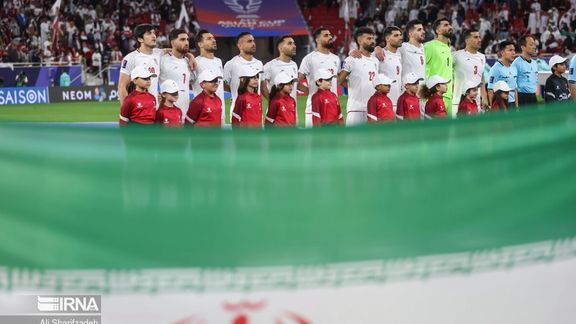
Iran players pose for a team group photo before their last match at the AFC Asian Cup in Doha, Qatar, February 7, 2024.
Iran’s defeat to Qatar in Asian Cup 2024 soccer tournament has once again underscored the profound rift among Iranians, some of whom rejoiced over the national team’s loss.
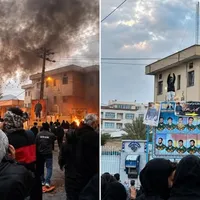
Qatar, the host of the games, beat Iran 3-2 in semi-finals in Doha on Wednesday. In the aftermath of the match, some Iranians took to the streets in cities like Sanandaj, Javanroud, Ahwaz, and Qazvin, celebrating with singing and dancing. Meanwhile, on social media platforms, others exchanged congratulations over the team's loss, expressing a disassociation from a squad they no longer perceive as their own, branding it as the "Mullahs' team."
Cars honking in Sanandaj after the national team’s loss against Qatar
“The team of the mullahs lost and now its supporters are saying those who are happy about the loss of their country's team are not [patriotic] Iranians. The answer to them is that this team is not the ‘national’ team and will never be,” an X post said. “There is a sea of blood between you and us that will never dry up before you are gone.”
Some other Iranians accused the opponents of the national team of not being patriotic.
“Although we lost, the Iranian flag still flies high, carried by the resounding chants of the Islamic Iran's glorious national anthem on the lips of our Iranian cheetahs [= squad]... Let's not forget that just last [Iranian] year, following Iran's defeat, the unpatriotic slaves [of the enemies] were cheering loudly,” one of them wrote on X, referring to protesters celebrating the team's exit from the FIFA 2024 World Cup in Doha amidst the Woman, Life, Freedom movement.
people rejoicing the national soccer team’s loss in Javanroud
The unsympathetic attitude of those who celebrated the once popular squad was a reaction to what they believe is the team members’ lack of solidarity with protesters.
Other athletes in 2022-2023 had reacted to the regime’s suppression of protesters by refusing to sing along with the national anthem or cheer at international competitions as did the volleyball, beach football, water polo, and basketball teams despite authorities’ threats. Most of the soccer squad did the same before one match, but were apparently intimidated into silence and submission after that.
People dancing in Qazvin and honking cars
“We are completely different from the rest of the world in two ways: Firstly, we are the only people who wish to return to their past. Secondly, we are the only people who rejoice the loss of their country's sports teams. There is only one reason for this: Hatred of the regime,” one of the many comments on X said.
Another post responded to those who say people of other countries would never rejoice over their national teams’ loss by arguing that other countries would not shoot down civilian airliners, as did the Revolutionary Guards (IRGC) on January 8, 2020, or kill teen protesters such as Nika Shakarami and Sarina Esmaeilzadeh, and claim they had committed suicide, as the regime did during the 2022 protests.
People honking cars and chanting in Shelangabad neighborhood of Ahwaz
However, this was not always the case. Since the FIFA World Cup matches of 1998, it had been a tradition to take to the streets to celebrate the national soccer team's victories, but fans and others had never "celebrated" the team's losses before.
At the height of the Woman, Life, Freedom protests of 2022, however, thousands took to the streets in various Iran cities on November 29 to celebrate the national soccer team’s elimination from the World Cup in a match against the United States.
The squad of the DR of Congo protesting to armed violence in their country
Security forces responded harshly to this unprecedented reaction from the populace and a young man, Mehran Sammak, was shot in the head in the northern city of Anzali while honking his car like many other protesters.
"This is how a national team should act," another post remarked, citing the protest action of the Democratic Republic of Congo's national team members. They covered their mouths and formed their fingers into a gun, placing it against their temples during the national anthem to raise awareness of the armed violence in their country.
A train passes through the station close to where an Iranian man held 15 hostages on a train for almost four hours, Switzerland, February 9, 2024
Swiss police killed a 32-year-old Iranian asylum seeker who held 15 hostages for several hours on a train using an axe and a knife on Thursday.
The incident occurred between Baulmes and Yverdon-les-Bains in western Switzerland, with the man holding the passengers captive for almost four hours until police stormed the train late on Thursday evening.
According to reports from Vaud police, the hostage-taking began around 6:35 pm local time, when the assailant, speaking Farsi and English, forced the train engineer to abandon his post and join the 14 passengers onboard. The train was immobilized with its doors closed at the Essert-sous-Champvent station, between Baulmes and Yverdon-les-Bains.
Authorities were alerted by passengers directly, leading to the sealing off of the area to facilitate negotiations with the hostage-taker.
The intervention occurred when the perpetrator was separated from the hostages, as stated by Jean-Christophe Sauterel, spokesperson for the Vaud cantonal police. “As the hostage-taker rushed with his axe in the direction of the intervention group, a police officer used his weapon to protect the hostages, fatally hitting the perpetrator,” explained Sauterel. Despite the presence of a doctor among the police team, the man died at the scene, with police asserting that they acted in self-defense.
The Vaud Public Prosecutor's Office has started a criminal investigation into the incident. Attorney General Eric Kaltenrieder stated, “The man's motivations have not been established, nor his psychological state.”
Switzerland is relatively safer among European countries, and hostage-taking incidents of this scale are very rare in the country.
In December, Arman(d) Rajabpour Miyandoab, an Iranian-French national, was arrested in Paris during a deadly knife attack on people.
Rajabpour's social media account, which was opened in the same month on the X platform, contained "many posts about Hamas, Gaza, or generally Palestine."
The Tehran Appeals Court has upheld an eight-year prison sentence for Assadollah Fakhimi and Hoorieh Khanpour, a couple known for their civil activism.
The ruling, issued on February 6th, includes a five-year prison term for Fakhimi and three years for Khanpour on charges of “assembly and collusion with intent to commit crimes against national security.”
The verdict also includes one-year sentences for each of them on charges of “propaganda against the system.”
Initially handed down by Tehran Revolutionary Court, in January, the eight-year sentence against the couple has been fully confirmed by the appeals court.
The home of Fakhimi and Khanpour was raided by agents of the ministry of intelligence on July 11 last year, during which computers, laptops, and mobile phones were seized, and the couple was subsequently summoned to Evin Courthouse.
In a notable act of solidarity, on October 29th, Fakhimi, alongside several other civil activists and families of detainees, visited the family of imprisoned human rights activist Narges Mohammadi, a recipient of the 2023 Nobel Peace Prize, presenting a Human Rights Statue.
Since its establishment, the Islamic Republic has consistently arrested, tortured, and imprisoned government critics, civil and political activists.
Since the nationwide uprising against the Islamic Republic in September 2022, the government's crackdown on civil, political, and protesting activists has persisted and intensified.
Iran's Supreme Leader Ali Khamenei during a meeting with a group of commanders and personnel of the Iranian Air Force in Tehran on February 5, 2024
The United States and Israel should tell Iran it risks an “overwhelmingly powerful strike” if it moves to make a nuclear weapon, leading weapons expert David Albright told Iran International.
In an interview on Thursday, Albright warned that a “convergence of factors” means “this is the time that “Iran may decide to make nuclear weapons.”
“You have a situation where the security incentives for Iran to build nuclear weapons have increased,” he pointed out. “The transparency of the nuclear program has decreased significantly.. Their nuclear weapons capabilities have grown over the last several years… And it's also a point in time where people's attention is elsewhere. The Iran nuclear issue barely makes the newspapers these days.”
David Albright is a world leading weapons expert and the founder of the Institute for Science and International Security. He was associated with the UN's International Atomic Energy Agency (IAEA) in the late 1990s and raised questions about the evidence that led to the US invasion of Iraq in 2003.
Speaking with Iran International’s Fardad Farahzad, Albright called the current moment “a point of extreme danger”, where Iran can make a “crude” nuclear explosive in six months.
“By crude I mean, you can't put it on a ballistic missile and hope that it will survive,” he said. “But it would work underground as a test. And most importantly, it would just signify through, say, a week that Iran was a nuclear weapons power.”
In the past two decades, every US president has announced that a “nuclear Iran” will not be tolerated, often stressing that “all options are on the table” to prevent the regime in Tehran acquiring nuclear weapons. And in the meantime, Iran has advanced its nuclear capabilities in every respect.
The argument in some policy circles is that Iran would have to do tests to become ‘nuclear' and that would give the US government (or Israel) the time it needs to find a response. But Albright believes the evidence suggests otherwise.
“Iran does not need to do a nuclear test to build a nuclear weapon,” he said. “Their original weapons program that ended around 2003 was a program that was designed to avoid the need to conduct a ‘full scale’ test… they can test the components, the subcomponents, and then test the whole assembled device minus the weapons grade uranium, and have a way to know if that test was successful, which we call a cold test.”
David Albright, weapons expert and the founder of the non-governmental Institute for Science and International Security
There is no evidence at the moment to suggest Iran has had a ‘cold test.’ But it is something that can happen with relative ease and in a short time, according to Albright.
Which leads, inevitably, to the question: is there anything that can be done?
“President Biden, backed up by the Israeli government, should say that we are watching you, Iran, even though we have other priorities,” Albright said. “and if you move to make nuclear weapons, we're going to launch an overwhelmingly powerful military strike.
“And that's desperately needed is to empower the IAEA. They're the people on the ground that can look for suspicious activities. If Iran is going to make a nuclear weapon, it's going to have to divert at some point in the six month process the enriched uranium. And the IAEA can look for indications of diversion, insist on being at the sites, resist being excluded from the sites.”
But would any of these work?
“We know from past experience that Iran won't give in completely to this kind of pressure,” Albright said, “but it does get nervous. And that's part of the purpose is to throw the Iranian regime off balance and then in parallel, make sure that the Iranian regime understands that overwhelming military force could be applied.”
There is another side to this ‘threat’, though: it could convince the Iranian regime that it could survive only if it becomes a nuclear power –like North Korea, as some ultra hardliners in Iran would like to say.
But Albright believes a “balancing act” is possible if the US and Israel move swiftly to make the regime understand “it's not in its interest to build nuclear weapons” before it reaches a definite conclusion that it has to have “nuclear deterrent” against the US and Israel.
“We're worried that the US and Israeli intelligence agencies are distracted,” Albrighrt told Iran International, “and Israeli intelligence isn't foolproof, as this attack on October 7th proved in a very dramatic way.
Houthis hold a cutout banner, portraying the Galaxy Leader cargo ship which they seized, during a parade. Feb. 7, 2024
US forces on Thursday conducted seven "self-defense" strikes against Houthi naval drones and cruise missiles that were prepared to be launched against ships in the Red Sea, the US military said.
"CENTCOM identified these missiles and USVs (unmanned surface vessels) in Houthi-controlled areas of Yemen and determined they presented an imminent threat to U.S. Navy ships and merchant vessels in the region," the US Central Command said in a statement on X.
Iran-backed Houthis began attacking commercial vessels and US warships in mud-November after the Islamic Republic’s Supreme Leader Ali Khamenei called on Muslims to blockade Israel.
The Houthi campaign has disrupted international shipping, which uses the Red Sea and the Suez Canal to link Europe with Asia. The United States and Britain have recently launched strikes on Houthi targets in Yemen and returned the militia to a list of "terrorist groups."
Iranian armed proxy militias have been launching attacks on US forces also in Syria and Iraq since mid-October. After a few smaller retaliatory strikes, the United States launched a large air campaign on February 3, targeting dozens of bases belonging to militias controlled by Iran’s Revolutionary Guard.
Iranians celebrating the collapse of the Pahlavi dynasty and the establishment of the Islamic Republic in 1979
A member of Iran's Expediency Council suggests that while the Islamic Republic was once promising to become the Japan of the Middle East, it now risks resembling North Korea.
Morteza Alviri made these remarks in an interview with reformist daily Etemad in Tehran on Tuesday. He attributed Iran's current trajectory to a deviation from the original vision of the revolution, outlined during Ruhollah Khomeini’s manifesto in Paris before his return to Iran in 1979. At that time, the fundamentalist cleric was promising democracy, freedom and equality to Iranians.
Alviri, born in 1948, has had a varied political career, serving in the Iranian parliament thrice, as Mayor of Tehran, a Tehran city councillor, and Iran's ambassador to Madrid. However, his journey began as a student and an Islamic revolutionary activist, once planting a bomb at the office of a weekly magazine in Tehran prior to the 1979 revolution. His transformation into a moderate politician followed, as others around him became more radical.
Alviri emphasized in the interview that many of Iran's current crises stem from a broader crisis of governance. He noted that in the revolution's early years, both extremes of the political spectrum believed they held solutions. However, failure to adhere to revolutionary principles has exacerbated Iran's problems.
However, what Alviri fails to point out is that the Islamic revolutionaries were inherently anti-West and isolationist, traits that their Communist partners in the revolution shared. These characteristics were to an extent in conflict with the need to follow path of development that was rational and secular.
Khomeini initially promised that the Islamic Republic would be a progressive and democratic state. Alviri lamented that this vision has diverged significantly from the reality Iranians voted for in 1979. But again he fails to mention the likelihood that Khomeini made these promises to rally the people to topple the monarchy, and was necessarily committed to the lofty goals.
At the revolution's onset, Alviri argued, there was an intention to maintain press freedom, allowing journalists to express themselves without fear. He recalled a time when the prevailing belief was that every Iranian citizen was an integral part of the new regime. There were no notions of political purification or religious mandates like mandatory hijab. "There was no political purification on anyone's mind, and no one thought of arbitrary vetting of candidates in elections. There was no compulsory religious behavior such as an obligation for women to wear hijab and university professor never thought that they would be expelled from their workplace."
Iranians march on a street in Tehran in February 1979
In stark contrast, another interview in Etemad portrayed the Islamic Republic as resembling North Korea, according to Yadollah Javani, the deputy commander of the IRGC. Javani accused "enemies" of attempting to sow discord between the people and the Supreme Leader. He acknowledged internal problems but focused on external threats, neglecting widespread poverty and corruption.
Javani’s discourse is typical of regime officials who dismiss most problems of governance in Iran and blame the United States and others for their unwillingness and inability to pursue economic growth.
Javani claimed that, so far, the people have protected the regime against all conspiracies. He called the Islamic revolution a miracle, despite other officials' acknowledgement that about 70 percent of the population living under the poverty line. The claim about popular support also contradicts dwindling freedoms and the regime’s repeated brutal suppression of protests.
Javani further claimed that there was nothing wrong about the Islamic Republic. Only the officials need to explain to the youth why the Islamic Republic is the continuation of the holy prophet's movement. Javani obviously ignored the extent of financial and ethical corruption among officials.