• العربية
  • فارسی
Brand
  • Iran Insight
  • Politics
  • Economy
  • Analysis
  • Special Report
  • Opinion
  • Podcast
  • Iran Insight
  • Politics
  • Economy
  • Analysis
  • Special Report
  • Opinion
  • Podcast
  • Theme
  • Language
    • العربية
    • فارسی
  • Iran Insight
  • Politics
  • Economy
  • Analysis
  • Special Report
  • Opinion
  • Podcast
All rights reserved for Volant Media UK Limited
volant media logo

€500m Titanium Mining Project Feared To Be Destroying Iran's Lake Urmia
Iran International Newsroom
Dec 28, 2023, 19:46 GMT+0Updated: 11:18 GMT+0
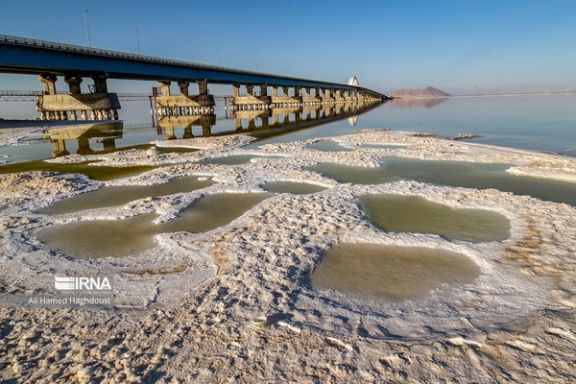
A view from Lake Urmia (Orumiyeh)

Videos have shown trucks around Lake Urmia allegedly carrying titanium, sparking fears its mining may be destroying the Middle East's once largest lake.

Iran Briefing, a group of investigative journalists, have speculated that authorities have been mining titanium, present in the northwestern lake, which could explain why the once thriving salt-lake has dried up. 

Although there has been no official response to these claims, the Urmia region in West Azarbaijan province does possess a titanium mine and magnesium recovered from lake brine can be used to refine it.

A 500 million Euro Titanium mining project was announced in a village near Lake Urmia, approximately ten miles to its west, in January.

The reformist Etemad newspaper published satellite images of Lake Urmia in November and reported that in the past year, “80% of the lake's water has dried up”, which “equates to the death of the sixth-largest saltwater lake globally."

Some experts have ruled out the possibility of reviving the lake which has been illegally salt mined for years, with rumors last year of lithium mining. “It is not in the government's interest, will, or power to revive Lake Urmia,” Roozbeh Eskandari, a hydraulic structures and dam construction expert, told Iran International.

Aerial photos of Lake Urmia  (file photo)
100%
Aerial photos of Lake Urmia

Nikahang Kowsar, an environmental analyst, blames the IRGC, calling it "an environmental menace willing to destroy Iran’s water resources just to line its own pockets,” citing the building of dams "to finance the Quds Force budget,” Nikahang Kowsar told Iran International last month, branding the IRGC "Iran's water mafia".

“This is how the cost of building a dam like Gotvand [south of Iran] can increase from $1.5 billion to $3.3 billion, and nobody even dares to ask where all the money has gone when the contractor did such a poor job,” wrote the analyst in an article for Middle East Institute.

In 2020, the US said that any sales to Iran of titanium, among other metals including chromium, nickel and 60% tungsten, were sanctionable as they are useful to Iran's nuclear, missile, and military programs.

Ali Salajegheh, the head of the Iranian Environmental Protection Organization, on Thursday neither denied nor approved the mining claims but said, "They need to be investigated."

Meanwhile, the hardliner Fars News Agency, affiliated with the IRGC, quoted an academic as saying the “rumors” are not true.

Behzad Hessari, a professor at Urmia University and the director of the environment department of Urmia Lake Research Institute, told Fars: “Methane gas is high in regions like the frozen forests of Siberia. Due to climate change, the ice is melting and the stored methane gas is released. This is not true for Lake Urmia.”

The lake's shrinking, a UNESCO Biosphere Reserve, risks both ecological and human implications. Once home to an array of wildlife, its decline increases the dust from the exposed lake bed reducing air quality, risking increased cases of respiratory illness among the local population.


Most Viewed

Iran negotiators ordered to return after internal rift over Islamabad talks
1
EXCLUSIVE

Iran negotiators ordered to return after internal rift over Islamabad talks

2
ANALYSIS

US blockade enters murky phase as tankers spoof signals and buyers hesitate

3

US tightens financial squeeze on Iran, warns banks over oil money flows

4
INSIGHT

Ideology may be fading in Iran, but not in Kashmir's ‘Mini Iran'

5
INSIGHT

Hardliners push Hormuz ‘red line’ as US blockade tests Iran’s leverage

Banner
Banner

Spotlight

  • Hardliners push Hormuz ‘red line’ as US blockade tests Iran’s leverage
    INSIGHT

    Hardliners push Hormuz ‘red line’ as US blockade tests Iran’s leverage

  • Ideology may be fading in Iran, but not in Kashmir's ‘Mini Iran'
    INSIGHT

    Ideology may be fading in Iran, but not in Kashmir's ‘Mini Iran'

  • War damage amounts to $3,000 per Iranian, with blockade set to add to losses
    INSIGHT

    War damage amounts to $3,000 per Iranian, with blockade set to add to losses

  • Why the $100 billion Hormuz toll revenue is a myth
    ANALYSIS

    Why the $100 billion Hormuz toll revenue is a myth

  • US blockade targets Iran oil boom amid regional disruption
    ANALYSIS

    US blockade targets Iran oil boom amid regional disruption

  • Iran's digital economy battered by prolonged blackout
    INSIGHT

    Iran's digital economy battered by prolonged blackout

•
•
•

More Stories

Iranian Steel Worker Protests Continue For Sixth Day

Dec 28, 2023, 17:54 GMT+0

Iranian National Steel Industrial Group employees entered their sixth consecutive day of strike action on Thursday to obtain better working conditions.

The protest in Ahvaz has been sparked by dissatisfaction over the recent terminations of 21 employees and the failure to implement job classification plans.

A group of workers met with representatives from the Khuzestan province's General Department of Labor, the National Bank, and several other government agencies on Thursday according to the Free Union of Iranian Workers Telegram channel.

A list of demands to be raised at the meeting was published, which included "Removal of the corrupt CEO, removing the National Bank ownership, and workers' participation in the management of the company". However, no results have been released as of yet.

"The independent voice of Ahvaz National Steel Industrial Group workers" released a statement through the Free Union of Iranian Workers, prior to the scheduled meeting.

The authors of the statement said that in the last six days, “Authorities have been eyeing the workers' protest for their share of the company's loot”, and they are using “every means to create division and disrupt the strike” by making “empty promises” and exerting military and security pressure.

Moreover, they stated they would continue their strike as long as “authorities' threats and inaction continue”.
A further 17 employees were prohibited from working on the second day of the protests.

Iranian National Steel Industrial Group, previously controlled by Amir Mansour Aria Investment Company, has gone under private ownership following legal proceedings and the execution of Aria for embezzlement.

In the past few months, workers from a variety of industries, members of different guilds, and retirees have organized protests to oppose the current economic climate, met with crackdowns by security forces during several of the gatherings.

Teachers Brand Iran's Ideological School Curricula 'Dead End' For Kids

Dec 28, 2023, 16:20 GMT+0
•
Iran International Newsroom

School teachers have claimed regime reforms have turned the country's schools into “religious and military bases”.

In an interview with Khabar online on Monday, teachers expressed concern about the plans to "shift schools away from their primary function", resulting in a "dead end" for children.

Teacher Mohammadreza Niknejad told Khabar Online that “authorities have failed in the education sector” as students do not accept today's school teachings. Furthermore, he added that ideological and religious studies have taken over most of the content of the school curriculum, even science, causing students to lose interest in the subject.

In line with the government's propaganda policies and the order of Supreme Leader Ali Khamenei the content of textbooks has changed in the last few years. In November, Reza Morad Sahraei, the Minister of Education, insisted on the need for gender-specific school curricula and confirmed changes in textbooks.

Teacher Mohammadreza Niknejad (December 2023)
100%
Teacher Mohammadreza Niknejad

Sahraei also stressed the Islamic Republic's rejection of both the "Eastern perspective" and the feminist perspective, deeming the latter to be "deviant." A second teacher, Narges Malekzadeh, also noted the role students played in last year's protests and warned of future demonstrations: "If we do not maintain communication with students, they may become frustrated and protests may happen again."

Teachers staged a mass demonstration since the government did not take any tangible measures to identify and pursue the perpetrators, or to explain what was happening to their terrified parents and students. According to Amnesty International's report in April, since November 2022, thousands of schoolgirls have been poisoned and hospitalized in Iran. A trend that also continued at the beginning of this academic year.

In response to teachers' and students' protests, the government introduced a program of mass dismissals at schools known as the 'purge'. A tightening of security was also implemented around teacher recruitment. There is now a six-month selection period for teachers in non-government schools, in addition to the standard 15 days.

Narges Malekzadeh (December 2023)
100%
Narges Malekzadeh

To compensate for the lost staff caused by the “purge”, the Education Ministry integrated religious teachers into the school system. Under a program called “Amin”, they recruited 21,000 seminary graduates to teach in 7 thousand schools. Ministers in President Ebrahim Raisi's administration have praised the "revolutionary" nature of the education ministry. In September, it was reported that Iran's Minister of Education had replaced over 20,000 principals.

The presence of religious teachers as part of the "Amin" program has become common at schools, however, students have a “negative attitude toward them and also they have a negative attitude towards students,” Malekzadeh explained.

In addition, the Education Ministry announced in December that seminary-affiliated schools will be established as part of the ministry's "Mosque, School, and Home" initiative.

In October, Russian President Vladimir Putin announced his intention to open Russian schools in Iran, though questions remain as to the nature of the proposed curriculums and their place in Iran's evermore religious Islamic curriculum.

Iranian Political Prisoner Fatemeh Sepehri’s Health Deteriorates

Dec 28, 2023, 14:17 GMT+0

Fatemeh Sepehri, a political prisoner at Vakilabad Prison in Mashhad, is reportedly in critical condition, according to her lawyer, Khosrow Ali-Kordi.

Ali-Kordi warned, "Due to an elevated heart rate, my client can hardly speak, and her respiratory condition is a serious concern."

In a social media video, Sepehri's brother, Asghar Sepehri, revealed, "In Tuesday's meeting, my sister's heart rate was so high that speaking was difficult for her."

The family holds the Supreme Leader of the Islamic Republic responsible for the imprisonment of Sepehri, as emphasized by her mother in the video, stating that if anything happens to her, Ali Khamenei would be accountable.

Imprisoned since September 21, 2022 amid the Women, Life, Freedom protests, Sepehri faces severe charges, including "collaboration with hostile countries" resulting in a 10-year sentence, "conspiracy and collusion" leading to five years of imprisonment, "insulting the leadership" resulting in two years of imprisonment, and "propaganda against the system" leading to one year of imprisonment.

Despite a brief release in October 2022 for medical treatment, Sepehri was re-arrested three days later at her home in Mashhad by security forces.

She is the latest in a long line of prisoners such as rapper Toomaj Salehi and Nobel Laureate Narges Mohammadi, whose lives remain threatened in the confines of Iranian prisons.

Canadian PM Stops Short Of Designating Iran's IRGC

Dec 28, 2023, 12:35 GMT+0

Canadian Prime Minister Justin Trudeau addressed concerns about the impact of Iran's Revolutionary Guard Corps (IRGC) during a speech on Wednesday.

While he refrained from directly answering Iranian journalist Negar Mojtahedi's questions whether Canada would consider listing the IRGC as a terrorist entity, Trudeau emphasized the government's commitment to monitoring and taking responsible measures against the IRGC's influence.

In response to questions regarding the more than 700 Iranian regime-linked individuals reportedly living freely in Canada, Trudeau stated, "We continue to watch and make sure that we're able to do everything we can that is responsible against the impact of the IRGC." However, he did not explicitly commit to designating the IRGC as a terrorist organization.

Trudeau asserted that Canada would persist in holding the Iranian regime accountable, limiting its global impact, and protecting Canadians. He highlighted the ongoing efforts of security services and police agencies to ensure the safety of Canadians.

The Prime Minister's remarks come against the backdrop of increased scrutiny on the IRGC following the downing of the PS752 Ukrainian passenger airliner in January 2020, resulting in the loss of Canadian lives. Despite calls from the Iranian Canadian community, Trudeau has not committed to labeling the IRGC as a terrorist group, citing factors such as mandatory military service that compel some Iranians to join the organization.

Critics argue that existing measures, including expanded sanctions and amendments to the Magnitsky legislation, are insufficient to address the issue of regime-connected officials residing in Canada. The debate surrounding the designation of the IRGC continues, with members of the diaspora expressing concerns about accountability for crimes committed abroad by those holding Canadian citizenship.


Iran's IRGC Spokesman Breaks Ranks On Hamas, Soleimani

Dec 28, 2023, 12:31 GMT+0
•
Iran International Newsroom

Contradicting a statement from the IRGC spokesman, its top commander, Hossein Salami, denied Iran's involvement in Hamas's October 7 invasion of Israel.

“The al-Aqsa Flood operation was completely a Palestinian operation. It was designed and implemented by Palestinians and no decision was made outside of Palestine,” stressed IRGC Commander, Salami, speaking during the funeral service for Razi Mousavi, the IRGC's man in Syria, killed in an alleged Israeli airstrike this week. 

“Resistance in Iraq is part of the resistance front [in the region], but acts independently. In Lebanon, Hezbollah acts independently,” Salami went on to say.

However, his comments came a day after Ramezan Sharif, the spokesperson for the IRGC, said the October 7 attack by Hamas on Israel was a retaliatory action for the assassination of Qasem Soleimani, the Iranian regime’s top military and intelligence operator in the Middle East, who was killed in a US drone strike in January 2020 in Iraq.

“The Al-Aqsa Storm was one of the retaliations of the Axis of Resistance against the Zionists for the martyrdom of Qasem Soleimani,” Sharif stated on Wednesday as the contradictions from within the IRGC ranks continued, suggesting Tehran's ongoing denials may be losing traction. Iran has long supported Hamas, with financial and military aid. Last month, Hamas political leader Ismail Haniyeh was in Tehran meeting the Supreme Leader.

The Hamas militant group immediately rejected Sharif’s claim, insisting that the attack on Israel was carried out in response to “Israeli occupation and enduring hostilities against our people and holy sites,” in spite of the fact its top leaders had been in top level meetings with Tehran in the weeks and months leading up to the atrocity.

Trying to unravel the contradictions, on Thursday, Salami openly undermined the IRGC spokesperson’s remarks and said, “We have not yet avenged the assassination of Martyr Qasem Soleimani. We will do this in due time. We sincerely declare what we do and we are not scared.”

Since the beginning of the Israel-Hamas war, the Islamic Republic officials have time and again made contradictory remarks about the conflict. On October 7, the Iranian government immediately praised the invasion and ordered street celebrations, with large banners erected within hours, suggesting Tehran had known in advance of the attacks which killed 1,200 mostly civilians and saw 240 or more taken hostage to Gaza.

However, following the escalation of the conflict and the US move to dispatch its warships to the region, Tehran officials toned down their public rhetoric, with many of them, including Supreme Leader Ali Khamenei, repeatedly denying the Islamic Republic’s role in Hamas’s attack.

Meanwhile, Iran's proxy groups in Lebanon, Iraq, Syria, and Yemen continue to attack Israeli and American targets in the region. Iran's most powerful proxy, Hezbollah, has engaged in the heaviest clashes with Israel for almost 20 years, but has avoided a full-fledged war.

Experts view Hezbollah’s unwillingness to wage an all-encompassing war against Israel as Tehran’s conservative approach to the conflict. Though the Iranian officials vow “great blows” to Israel and the country’s imminent destruction, Tehran has so far refrained from launching any direct attack against Israel and its allies. However, just days ago, the US blamed Iran directly for an attack on a vessel caught up in the maritime front of the war in Gaza. 

As recently as Tuesday, an explosion occurred near the Israeli embassy in New Delhi, India. The staff members sustained no injuries in the attack. Though no group has claimed responsibility for the attack, eyes turned once again to Iran and Revolutionary Guard extraterritorial Qods force (IRGC-QF) in the wake of other foiled plots such as one to attack the Israeli embassy in Baku, just a few months ago.