• العربية
  • فارسی
Brand
  • Iran Insight
  • Politics
  • Economy
  • Analysis
  • Special Report
  • Opinion
  • Podcast
  • Iran Insight
  • Politics
  • Economy
  • Analysis
  • Special Report
  • Opinion
  • Podcast
  • Theme
  • Language
    • العربية
    • فارسی
  • Iran Insight
  • Politics
  • Economy
  • Analysis
  • Special Report
  • Opinion
  • Podcast
All rights reserved for Volant Media UK Limited
volant media logo

Iran’s Regime Struggles To Enforce Hijab As Women Resist

Maryam Sinaiee
Maryam Sinaiee

Iran International

Jun 9, 2023, 14:34 GMT+1Updated: 17:58 GMT+1
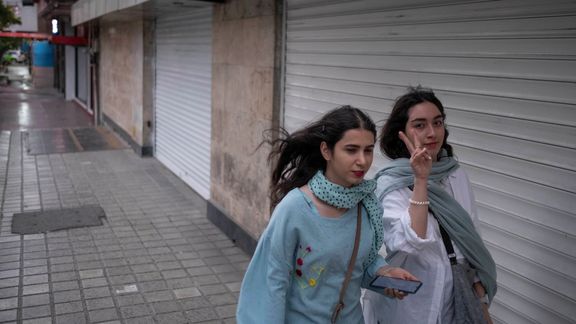
Two Iranian women walk along a street-side in the strong winds without wearing the mandatory Islamic headscarf in downtown Tehran,on June 8, 2023.

Iran's Police Chief Ahmad Radan has threatened government offices that do not deny services to unveiled women with repercussions as part of hijab enforcement. 

Speaking on the sidelines of a ceremony in the northern province of Mazandaran Wednesday, Brigadier General Radan said his force will be reporting lack of adequate action in enforcing hijab laws by government offices as administrative infringement. 

He also vowed that police will be surveilling Caspian Sea beaches, in Mazandaran and Gilan provinces, by special patrols and electronically to prevent any behavior violating hijab laws. 

Threats against unveiled women have increased with the arrival of summer which has always been a season for women to ignore the strict government dress code. 

In July 2022, after weeks of harsher measures on the streets, President Ebrahim Raisi ordered all government entities to strictly implement a “chastity and hijab” law approved by the Supreme Cultural Revolution Council under hardliner Mahmoud Ahmadinejad in 2005. 

Not long after that, the death of the 22-year-old Mahsa Amini in the custody of hijab enforcers, morality police, fuelled protests that spread throughout the country and lasted for several months. 

Two Iranian women walk past an urban art without wearing the mandatory Islamic headscarf in downtown Tehran,on June 8, 2023.
100%
Two Iranian women walk past an urban art without wearing the mandatory Islamic headscarf in downtown Tehran,on June 8, 2023.

Since March hardliners have tried to put an end to women’s increasing defiance of the compulsory hijab and to reclaim the lost ground but to no avail: More women are now walking around, commuting, shopping, and jogging unveiled. 

Iran's media published the final version of a new hijab bill prepared jointly by the judiciary and the government. An earlier draft which was revealed two weeks ago was strongly criticized by hardliners which saw its punishments for unveiling “too lenient” to be able to stop women from unveiling. 

Punishments proposed in the bill are mainly cash fines ranging from 5 million rials ($10) to 240 million rials ($480) for repeat offenders, and deprivation from employment and social media activity for athletes, celebrity artists and activists who unveil. 

The bill, however, also includes provisions against “anyone” other than authorized entities, who confronts citizens in public and uses violence and threats against unveiled women. 

Hardliners such as Raisi’s very influential father-in-law, Ayatollah Ahmad Alamolhoda, who represents Supreme Leader Ali Khamenei in Khorasan-e Razavi Province, have strongly criticized the bill. 

Alamolhoda alleged on May 26 that the bill, if passed, would promote unveiling rather than prevent it. 

Firebrand Hossein Shariatmadari, the editor of the flagship hardliner newspaper Kayhan wrote about the first version of the bill on May 21. “A look at the content of the bill and comparison with the existing laws suggests that the bill has been prepared with the possible aim of removing the existing legal obstacles [against unveiling] and preparing the ground for the spread of this nasty and abominable phenomenon rather than taking action against unveiling,” 

The population in general, however, even in many smaller and more conservative areas of the country, appears to have become much more tolerant of women who do not dress according to the prescribed codes and their newfound freedom from the hijab. 

“Women know that it’s now or never because the mullahs are afraid of more protests. They are persisting with all their might, given this opportunity, to normalize the presence of unveiled women in the society,” Ronak, a 34-year-old engineer in Tehran told Iran International. 

“They can pass any laws they want to convince their supporters they are doing something or reinstate their control but after the recent protests they have realized that the enforcement of such laws by force could be very costly and one little push too far may cause the Berlin Wall to crash down,” she said. “That’s why they are telling the vigilantes to back down.”


Most Viewed

Iran negotiators ordered to return after internal rift over Islamabad talks
1
EXCLUSIVE

Iran negotiators ordered to return after internal rift over Islamabad talks

2
ANALYSIS

US blockade enters murky phase as tankers spoof signals and buyers hesitate

3
ANALYSIS

Why the $100 billion Hormuz toll revenue is a myth

4

US tightens financial squeeze on Iran, warns banks over oil money flows

5
ANALYSIS

US blockade targets Iran oil boom amid regional disruption

Banner
Banner

Spotlight

  • Hardliners push Hormuz ‘red line’ as US blockade tests Iran’s leverage
    INSIGHT

    Hardliners push Hormuz ‘red line’ as US blockade tests Iran’s leverage

  • Ideology may be fading in Iran, but not in Kashmir's ‘Mini Iran'
    INSIGHT

    Ideology may be fading in Iran, but not in Kashmir's ‘Mini Iran'

  • War damage amounts to $3,000 per Iranian, with blockade set to add to losses
    INSIGHT

    War damage amounts to $3,000 per Iranian, with blockade set to add to losses

  • Why the $100 billion Hormuz toll revenue is a myth
    ANALYSIS

    Why the $100 billion Hormuz toll revenue is a myth

  • US blockade targets Iran oil boom amid regional disruption
    ANALYSIS

    US blockade targets Iran oil boom amid regional disruption

  • Iran's digital economy battered by prolonged blackout
    INSIGHT

    Iran's digital economy battered by prolonged blackout

•
•
•

More Stories

Iranian Activist Says Regime Intends To Force Him Into Exile

Jun 9, 2023, 09:47 GMT+1

Former political prisoner Hossein Ronaghi says the intelligence ministry has requested the Prosecutor's Office to issue an order to send him into exile.

He further noted in a tweet that he has found out that based on the order his bank accounts will be blocked and he will be deprived of his citizenship rights.

Ronaghi is an Iranian blogger, human rights activist and political dissident who was arrested on September 24. 2022, along with his lawyers in front of the Evin Prison prosecutor's office and transferred to jail where he was tortured.

In protest, Ronaghi went on a hunger strike after his arrest amid antigovernment protests and refused liquid nourishment and water.

Tehran residents rushed to the hospital in November after his brother wrote in a tweet that security agents had moved Ronaghi from prison to a hospital. He said his brother “got on an ambulance fully awake after talking to his mother,” adding “whatever happens to Hossein is nothing more than a pre-planned scenario because they intend to kill him.”

Ronaghi, 37, a contributor to The Wall Street Journal, has for years been one of the most fearless critics of the Islamic Republic who has stayed in the country.

Iranian authorities on November 26 released Ronaghi on bail.

In previous rounds of torture, the dissident has lost one kidney and his second kidney is functioning at 60 percent, according to human rights sources.

Hossein Ronaghi has been arrested and jailed several times in the past 13 years. He was detained in 2009 for his role in the post-election protests. Ronaghi was arrested again in February 2022 after criticizing a bill that would limit internet access in Iran.

Commentators In Iran Call On Officials To Reconcile With People

Jun 9, 2023, 07:39 GMT+1
•
Iran International Newsroom

Commentators on both sides of Iran's factional divide continue to criticize the government and offer advice on what is needed to get out of the political impasse.

Referring to Supreme Leader Ali Khamenei's recent speech in which he said, "The enemy has started to prepare its artillery against the upcoming elections in Iran," conservative commentator Mohammad Mohajeri quipped in a column in the reformist Etemad newspaper: "What can the enemy do to harm the elections?" and explained that "downplaying the importance of voter turnout, manipulating the election process, rigging the elections, and helping unqualified people to win the elections are among the things the enemy can do to that end."

The commentator was referring to the interference of the Guardian Council, an undemocratic body inserted into the constitution, that rejected hundreds of candidates in the parliamentary election in 2020, and again rejected qualified contenders in the 2021 presidential vote. 

Conservative commentator Mohammad Mohajeri (undated)
100%
Conservative commentator Mohammad Mohajeri

Mohajeri pointed out that the enemy cannot interfere with the process of elections. Those who interfere are Islamic Republic officials. executives, supervisory bodies, and security organizations. The enemies will begin their attacks and propaganda only after state officials and institutions make big mistakes by intervening in the election process with the aim of changing the results, he said.

Mohajeri added: "The Guardian Council is where most of such mistakes are made. It is involved from the beginning to the end of the elections and its behavior has always been controversial. The council vets the candidates and appoints the inspectors and supervisors." 

He further pointed out that many of those who have been disqualified by the Guardian Council in previous years are well-known political figures who would have been more useful than the current members of the parliament. 

Reformist commentator Abbas Abdi  (undated)
100%
Reformist commentator Abbas Abdi

Meanwhile, reformist commentator Abbas Abdi accused current officials of making the government useless by bringing it into constant confrontation with the people and their demands. This approach, he said, “will tire everyone including yourselves and I can see the signs of this fatigue in your behavior.”

"The government's interventionist approach and its insistence on excessive and often unnecessary control and punishment, as well as its confrontational approach and its refusal to hold any dialogue have a destructive impact on many economic, political, social and cultural processes including the country's foreign policy," Abdi said.

"When we follow the news, we see many examples of that confrontational behavior for instance in trying to control prices through issuing orders. Everyone, except the government, knows that this does not work. Not only it does not work, it also leads to corruption. The government uses the same wrong methods to fix interest rates, foreign exchange rates and the price of eggs, utilities, fuel, rent and so on. 

The government intervenes in everything, including dress code and childbirth, which are issues that cannot be regulated through confrontation, penalties and imprisonment," Abdi added. 

The prominent commentator stressed that such methods can only widen the gap between the people and the government. 

Moderate politician Ali Rabiei  (undated)
100%
Moderate politician Ali Rabiei

Meanwhile, shedding light on the bigger picture, former government spokesman and moderate politician Ali Rabiei wrote in article in Etemad that "All revolutions in the Middle East have given governments in the region a license to violate citizenship and human rights as well as democratic rules."

He suggested that governments that rule in the name of revolutions need to find a way to reconcile revolutionary values and citizens' rights by giving the people the right to complain to the judiciary system if government officials undermine their essential rights. 

Two Iranian University Students Die Suspiciously Within A Week

Jun 8, 2023, 16:17 GMT+1

The second student of Tehran’s Amirkabir University suspiciously died this week due to alleged medical negligence.

The telegram channel of the Amir Kabir University said Yusef Sevizi, a mining engineering master's student suffered a cardiac arrest on Wednesday in the dormitory while the university authorities did not provide medical service.

On Wednesday last week, another student named Basir Ebrahimpour suffered a cardiac arrest and died in the Abureihan building of the university.

According to the channel, the emergency department of the university caused the death of these two students within a week by "failing to send medical staff and taking care of them in time".

Mohammad Shahriari, Head of Tehran's Criminal Affairs Prosecutor's Office, said Sweizi's body was transferred to the forensics department claiming the cause of his death will be announced after "toxicology and pathology tests".

Farsi media has speculated that the two were poisoned, but so far, there has been no confirmation.


Activist Lashes Out At UK For Inability To Protect Citizens From IRGC Threats

Jun 8, 2023, 15:19 GMT+1

Masih Alinejad, a political activist, slammed the relocation of Iran International’s activities from the London office to Washington due to the UK’s inability to protect its citizens on its soil.

In an article in Time magazine, she urged the British government to take more measures to stop the IRGC and its terrorist activities around the world.

“The situation in the UK had already become so dire that Iran International—a Persian language media outlet which has invited the chagrin of the regime for daring to beam reliable news into Iran via satellite—was forced to flee the UK,” added Alinejad.

She went on to question how the UK, with one of the most sophisticated security apparatuses in the world, cannot even protect people on its own soil.

The authorities of the Islamic Republic have repeatedly threatened Iran International and its employees, significantly following the coverage of the Iranian people's uprising in recent months.

Alinejad, who has had multiple threats on her life from the IRGC and was recently under 24-hour police protection during a UK visit, said: “The UK has not even punished the Islamic Republic after its own citizens were maimed and killed. For instance, in July 2021 after the IRGC’s Aerospace Force attacked the Mercer Street commercial vessel killing two European nationals, including one British citizen, not even one sanction was levied on the Islamic Republic.”

The challenge facing Europe is not only about protecting its own citizens but also about standing up for the values of freedom, democracy, and human rights, underlined Alinejad.

She said by designating the IRGC as a terrorist organization, the UK prime minister can send a powerful message that he will not tolerate state-sponsored terrorism and will defend those who fight for justice and liberty.


Iranian Opposition Figure Wins Sydney Peace Prize For Activism

Jun 8, 2023, 12:13 GMT+1

The Sydney Peace Prize for 2023 has been awarded to Iranian-born actress and political activist Nazanin Boniadi for her work advancing human rights in Iran.

Her work brought human rights in Iran into sharp focus after the death of Mahsa Amini last year, presenting the case to the UN Security Council, US Senate Human Rights Caucus, British Parliament, and a number of other forums around the world.

The Peace Prize jury said Boniadi was selected from a strong field of nominations “for drawing attention to human rights violations, for lending a powerful voice to support Iranian women and girls and their Woman Life Freedom movement, and for using a high-profile platform to promote freedom and justice in Iran.”

On accepting the Prize, Boniadi said: “Receiving the Sydney Peace Prize is an extraordinary honor. As my compatriots in Iran are subjected to unspeakable assaults on their minds, bodies and souls and risk their lives to speak out against the injustices they experience daily, I can only dedicate this recognition to them.”

The Sydney Peace Prize is Australia’s international prize for peace that recognizes leading global voices that promote peace, justice and nonviolence.