• العربية
  • فارسی
Brand
  • Iran Insight
  • Politics
  • Economy
  • Analysis
  • Special Report
  • Opinion
  • Podcast
  • Iran Insight
  • Politics
  • Economy
  • Analysis
  • Special Report
  • Opinion
  • Podcast
  • Theme
  • Language
    • العربية
    • فارسی
  • Iran Insight
  • Politics
  • Economy
  • Analysis
  • Special Report
  • Opinion
  • Podcast
All rights reserved for Volant Media UK Limited
volant media logo

Iran, Saudi Arabia, Renew Ties After Seven Years Of Deadlock

Iran International Newsroom
Mar 10, 2023, 12:33 GMT+0Updated: 17:24 GMT+1
Ali Shamkhani (R) with China's Wang Yi and Saudi Arabia's Musaad bin Mohammed Al Aiban in Beijing on March 10, 2023

Iran and Saudi Arabia have agreed to re-establish diplomatic ties after Chinese-mediated talks in Beijing.

Over five days of negotiations, it was agreed that the two countries will reinstate embassies and missions after seven years of deadlock.

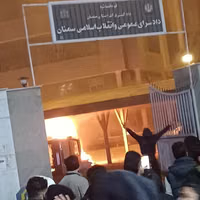
Saudi Arabia severed relations with the Islamic Republic in January 2016 after pro-government Iranian mobs attacked and ransacked its embassy in Tehran and consulate in Mashhad following the execution of a Saudi Shiite cleric.

Relations remained tense as Iran expanded its influence in Arab countries with substantial Shiite populations and built up its proxy forces opposed to Saudi Arabia and supporting Iran’s regional policies.

The most crucial bilateral tension was with Yemen, where Iran supported Houthi rebels against the remnants of the country’s legal government, supported by Saudi led forces. However, a truce has been holding since last year.

The Secretary of Iran’s Supreme National Security Council, Ali Shamkhani, ‘the representative of the Supreme Leader’, Saudi Arabia’s national security advisor Musaad bin Mohammed Al Aiban and China’s Wang Yi, Director of the office of the Central Foreign Affairs Commission of the Chinese Communist Party, all signed the deal.

China’s role in mediating the detente amid serious Western tensions with Iran signals the elevation of its status as a Middle East power player. Beijing has good relations both with Riyadh and Tehran and its success this week will irk other parties such as Qatar which has long tried to position itself as the region’s negotiator.

Attack on Saudi embassy in Tehran in January 2016
100%
Attack on Saudi embassy in Tehran in January 2016


Reinstating relations with the most powerful Persian Gulf nation will be seen as a huge boost to Iran which is facing serious economic problems due to the lack of a nuclear agreement with the West and US sanctions weighing heavily over its finances. This has been exacerbated since the recent protests which began in September.

Meanwhile, the revived relationship does not alleviate Saudi’s concerns for the regime’s continued expansion of its nuclear capacity. Saudi Arabia and the United States have allegedly been in talks to build Saudi’s own civilian nuclear program as fears around Iranian actions grow and even the Persian Gulf's most powerful nation seeks greater security reassurances from its allies.

In spite of tense relations between the Biden administration and Crown Prince Mohammed Bin Salman, the de facto ruler, Saudi Arabia also wants fewer restrictions on US arms sales, according to the New York Times.

People close to the talks say the US is leveraging the request to force Saudi’s hand to normalize relations with Israel, furthering the Trump-negotiated Abraham Accords which saw the United Arab Emirates, Bahrain and Morocco sign up to diplomatic ties with the Jewish state. Sudan has since joined.

Saudi has long said that formal diplomatic relations with Israel depend on a peaceful resolution to the Israel-Palestine conflict, though the two have been conducting business and security cooperation behind closed doors for some time. Saudi also opened its air space to Israel, in the wake of the Accords, signed in 2020.

However, as revelations of Iran’s growing capabilities continue and the JCPOA talks look no more likely to be revived after their collapse last year, the Kingdom is seeking other options. It is no simple process.

The US has no desire to give Saudi nuclear capabilities - Biden having already stated a desire to make the Kingdom a “pariah state” following the execution of Saudi journalist Jamal Khashoggi in the Saudi embassy in Istanbul in 2018. In spite of a visit last year, relations between the two countries remain tense.

Such a deal would no doubt be greatly challenged in Congress where several Democrats have voiced a desire to downgrade not increase relations with Saudi Arabia, where dozens of executions continue each year, without trial, and human rights are still widely violated, according to rights groups.

Without the assurances of a body such as NATO, agreements to arm Saudi could be a huge risk and possibly the end of the Biden administration.

Senator Christopher S. Murphy, Democrat of Connecticut and a member of the Foreign Relations Committee and a vehement campaigner to limit US arms sales to Saudi, told the New York Times: “If we’re going to enter into a relationship with the Saudis where we’re doing more significant arms sales, it should be in exchange for better behavior toward the United States, not just better behavior toward Israel.”
Most Viewed

Iran negotiators ordered to return after internal rift over Islamabad talks
1
EXCLUSIVE

Iran negotiators ordered to return after internal rift over Islamabad talks

2
ANALYSIS

US blockade enters murky phase as tankers spoof signals and buyers hesitate

3
ANALYSIS

Why the $100 billion Hormuz toll revenue is a myth

4

US tightens financial squeeze on Iran, warns banks over oil money flows

5
ANALYSIS

US blockade targets Iran oil boom amid regional disruption

Banner
Banner

Spotlight

  • Hardliners push Hormuz ‘red line’ as US blockade tests Iran’s leverage
    INSIGHT

    Hardliners push Hormuz ‘red line’ as US blockade tests Iran’s leverage

  • Ideology may be fading in Iran, but not in Kashmir's ‘Mini Iran'
    INSIGHT

    Ideology may be fading in Iran, but not in Kashmir's ‘Mini Iran'

  • War damage amounts to $3,000 per Iranian, with blockade set to add to losses
    INSIGHT

    War damage amounts to $3,000 per Iranian, with blockade set to add to losses

  • Why the $100 billion Hormuz toll revenue is a myth
    ANALYSIS

    Why the $100 billion Hormuz toll revenue is a myth

  • US blockade targets Iran oil boom amid regional disruption
    ANALYSIS

    US blockade targets Iran oil boom amid regional disruption

  • Iran's digital economy battered by prolonged blackout
    INSIGHT

    Iran's digital economy battered by prolonged blackout

•
•
•

More Stories

Iran's Security Chief Holding 'Crucial' Talks Abroad - Report

Mar 10, 2023, 10:42 GMT+0

Iran's national security chief Ali Shamkhani, has been conducting “very important negotiations” in a foreign country in the past days, a website close to him reports.

Nour News said Friday that the results of these talks will be announced soon and will signal “noteworthy developments.”

There have been signs that the United States might be negotiating with Iran to secure the release of two Iranian-Americans held hostage in Tehran. Officials from Qatar and Oman have recently held frequent discussions with the Islamic Republic. The two Arab countries have maintained good relations with Tehran and have played the role of mediators in the past.

Iran International reported in January that US special envoy Robert Malley held several discreet meetings with Iran’s ambassador to the United Nations in New York.

At the time, the State Department did not deny the report and in response to questions by Iran International said that messages were being delivered to the Islamic Republic, even though the nuclear deal, JCPOA, “is not on the agenda.” That could mean warnings were being delivered to Tehran not to expand military ties with Russia or talks over dual-nationals held in Iran.

In the past, there have been multiple reports about a possible deal by which the US agrees to the release of $7 in frozen Iranian assets held in South Korea in exchange for the release of prisoners.

However, after Iran’s bloody crackdown on protesters, killing more than 500 civilians, and its supply of killer drones to Russia, a deal providing billions of dollars to the clerical regime could be politically costly for the Biden administration.

Hardliners Trying To Reclaim Control Over Hijab As Women Remain Defiant

Mar 10, 2023, 09:52 GMT+0
•
Maryam Sinaiee

Iran's hardliners appear to be launching a new effort to enforce veiling laws more forcefully again to put a stop to women’s increasing defiance of the compulsory hijab.

At a meeting of the State Social Council Thursday, President Ebrahim Raisi described women’s abidance by veiling laws as a “sharia requirement” and said all authorities are of the same mind on this matter. “It is necessary for everyone to feel responsible, and although some people may have different opinions on this matter, in social life, adherence to legal standards should be considered as a principle".

He also claimed that the social experience of the Islamic Revolution has shown that the Iranian women themselves are adamant on keeping the veiling as a priority to ensure their safety and security in the society while also calling on all responsible entities to support those who practice ‘amr-e be marouf’, that is, calling others to enjoin what is good and forbid them from doing what is wrong.

This video shows a veiled woman taking photos of two young girls on the street and telling them the photos will be used to identify them with face recognition software.

Raisi’s very influential father-in-law, Ahmad Alamolhoda, who represents Supreme Leader Ali Khamenei in Khorasan-e Razavi Province, urged “pious” women and men not to allow the women in the Iranian society unveil. Making similar remarks about individual’s responsibility to enforce the hijab last week he had implied that the regime and its security apparatus are no longer able to take the burden of stopping those who defy the compulsory hijab.

Iran’s President Ebrahim Raisi (left), Mashhad’s representative in the Assembly of Experts Ahmad Alamolhoda (center) and Supreme Leader Ali Khamenei  (file photo)
100%
Iran’s President Ebrahim Raisi (left), Mashhad’s representative in the Assembly of Experts Ahmad Alamolhoda (center) and Supreme Leader Ali Khamenei

Several videos have emerged on social media in the past few days of disputes in public over veiling between its proponents and the women who are now defiantly appearing ‘hijabless’ in public.

“You live in an Islamic society and you must abide by its law,” a veiled woman holding a baby in her lap in a city bus is seen telling another woman in a video apparently taken in Isfahan, but the ‘hijabless’ young woman who is filming the incident with her mobile phone, objects and tells her how she dresses is none of other people’s business. The veiled woman threatens her with filming her, sending it to authorities and causing her trouble in getting into university for her defiance of the hijab.

A veiled woman being thrown out of an underground car by a crowd of young girls after trying to exhort them about observance of hijab.

To enforce the veiling rules the regime has always used the so-called ‘morality police’ as well as organized groups of male and female Basij militia. It was in custody of the morality police that the 22-year-old Mahsa Amini suffered injuries that led to her death in September, fueling the longest-ever anti-regime protests in the country.

The morality police have been keeping a very low profile in the past few months but on Wednesday hardliner female lawmaker Zohre Elahian said in a tweet that Basijis held their first “verbal warning (amr-e be marouf) maneuver” in some areas of the capital.

“The devout Basijis’ act, after the recent domestic and foreign riots and seditions in the country, is unprecedented,” she tweeted with a hashtag calling on authorities for support.

A video posted Wednesday on Twitter showed a long line of black-veiled women parading on a street in Isfahan in central Iran. The post called the parade “the great and mighty maneuver of chaste Isfahani ladies.”

These “maneuvers” seem to be part of a larger initiative planned to bring anti-compulsory hijab movement under control before more women flaunt the hijab rules in the intense heat of the summer.

Iran’s Speaker Isolated As Rival Hardliners Gear Up To Win Next Majles

Mar 10, 2023, 03:23 GMT+0
•
Iran International Newsroom

Iran’s parliament speaker, an old IRGC hand, fears isolation as ultraconservatives have begun forming coalitions to maximize their chances in the 2024 elections.

According to Iranian media, Mohammad Bagher Ghalibaf and his "neo-con" allies face a preponderance of hardliners who want to win power.

Ghalibaf won the speakership of the Majles (parliament) in 2020, despite the fact that his allies constituted a minority among the ultraconservative groups that control the parliament. His winning cards were his close ties to the IRGC and his kinship with Supreme Leader Ali Khamenei.

Nonetheless, those he calls "radicals" and teases as "revolutionaries" could have prevented his ascension to the Speaker's chair. They let him go forward only after he gave them concessions such as posts in and out of the parliament using his influence.

Iran’s Parliament Speaker Mohammad Bagher Ghalibaf  (file photo)
100%
Iran’s Parliament Speaker Mohammad Bagher Ghalibaf

For the next year's elections, however, some young ultraconservatives such as populist Roads and Housing Minister Mehrdad Bazrpash and radical cleric Hamid Rasaei seem to have started early campaigning that marginalizes "old” conservatives such as Ghalibaf.

According to Rouydad24 news website in Tehran, young ultraconservatives have formed the Strategic Council of the Supporters of the Islamic Revolution (Persian acronym Sharian) led by Bazrpash. A group of conservatives also formed an alliance called the "Society To Revive the Popular Institutions of the Islamic Revolution" led by Tehran Mayor Alireza Zakani. The latter's opening session was attended by heavyweight hardliners such as Gholamali Haddad Adel, a former Majles speaker whose daughter is married to Khamenei's son Mojtaba.

Former Speaker of Iran’s Parliament Gholam-Ali Haddad-Adel (file photo)
100%
Former Speaker of Iran’s Parliament Gholam-Ali Haddad-Adel

This group operates under the umbrella alliance called the council of Coalition of Revolutionary Forces (Persian acronym Shana).

Although both groups do not shy away from claiming that they want to monopolize political power, Sharian is better positioned as it rallied some 500 aspiring younger politicians in its general assembly, a far larger number than Shana.

Members of the older group say they are looking for unity among conservatives, an idea that failed to materialize during the past 30 years.

Young ultraconservatives, on the other hand, come from the same party that disrupted any attempt to unite conservatives during several parliamentary and presidential elections in Iran. Their party, Paydari, once close to former President Mahmoud Ahmadinejad, believes in networking at the bottom and bargaining for power at the top and that is what they have been successfully doing since 2005 when their name was Abadgaran Javan (Young developers).

Meanwhile, a report in Khabar Online featured photos and a long list of the leading members of the Sharian group mainly to show that they are much younger. The website tagged the next parliamentary election in Iran as a competition between young and old conservatives.

So far, the only reaction by Ghalibaf's neo-cons has been highlighting Bazrpash and Rasaei's bad records as well as the unpleasant track record of mayor Zakani in reports in the pro-Ghalibaf daily Sobh-e No and Farda News website which is also close to Ghalibaf. The daily characterized Rasaii as a critic of former IRGC Qods Force Commander Qasem Soleimani hoping it would alienate conservatives.

Khabar Online quoted some unnamed moderate conservatives as saying that one year ahead of the elections Ghalibaf cannot think of anything better than the position he already has

Meanwhile, according to centrist daily Ham-Mihan, Paydari and Sharian aim to knock Ghalibaf out of the Majles in the same way they ousted Haddad Adel a decade ago. Their message to Ghalibaf is that Raisi will definitely serve a second term as Iran's President and there is no chance for Ghalibaf to become Iran's next president. Their second message is that Ghalibaf himself may not be able to become the speaker again. His choices are limited and his days on the Speaker's seat are numbered.

Iran, Belgium FMs Discuss Prisoner Exchange

Mar 9, 2023, 23:19 GMT+0

The foreign ministers of Iran and Belgium are in discussions regarding the fate of a Belgian aid worker sentenced to 40 years in prison and 74 lashes.

In late February and on the sidelines of the UN Human Rights Council in Geneva, Belgium’s Hadia Lahbib and Iran’s Hossein Amir-Abdollahian met to discuss the situation of Olivier Vandecasteele.

Vandecasteele, 41, was mysteriously lured back to the country last year by ‘a girlfriend’ and was subsequently detained. It is believed his arrest was an attempt to force Belgium to release Iranians in prison for terror offences.

His health is rapidly deteriorating since being in solitary confinement for a year under what is believed to be false allegations of espionage, typical of Iran’s hostage diplomacy. He has also been given a $1m fine.

Lahbib became a vocal supporter of the unrest after she cut her hair in a statement showing solidarity with the country’s ‘woman, life, freedom’ movement. She has, however, been blasted for her ongoing talks with the foreign minister as the two sides try to build bridges.

Daria Safaie, a member of the Belgian Parliament of Iranian origin, lashed out at the Belgian Foreign Minister on Wednesday that her meeting with Amir Abdollahian was “inappropriate”.

“You just kneel… and give them the message that they are more powerful and superior. They are happy with your kneeling and continue to take hostages.”

Iran Must Not Be Allowed To Acquire Nukes: Israeli Defense Minister

Mar 9, 2023, 21:15 GMT+0

Israel's defense minister says the Islamic Republic must not be allowed to acquire nuclear weapons and Jerusalem must "be prepared for every course of action".

Yoav Gallant made the remarks on Thursday during a meeting with his American counterpart Lloyd Austin who landed in Israel’s Ben Gorion Airport earlier.

Israeli Prime Minister Benjamin Netanyahu told Iran International in an interview Wednesday that he will not tolerate if Iran becomes a nuclear threshold state. Successive Israeli governments have said they keep all options open to prevent Iran from obtaining nuclear weapons.

Austin's talks with Gallant focused in part on Iran, but escalating violence in the West Bank cast a long shadow over the negotiations.

A senior US defense official told Reuters on condition of anonymity that Israel's preoccupation with the West Bank "detracts from our ability to focus on what the strategic threat is right now and that is Iran's dangerous nuclear advances and continuing regional and global aggression."

Pentagon chief Austin, for his part, urged Israeli leaders to take steps to ease tensions in the occupied West Bank, amid growing concerns in Washington that the situation could distract allies from their efforts to counter Iran.

The United States is Israel's closest ally, and both countries are increasingly concerned about Iran's military activities in the region and its nuclear program, which Tehran says is entirely focused on power generation and other peaceful projects.