• العربية
  • فارسی
Brand
  • Iran Insight
  • Politics
  • Economy
  • Analysis
  • Special Report
  • Opinion
  • Podcast
  • Iran Insight
  • Politics
  • Economy
  • Analysis
  • Special Report
  • Opinion
  • Podcast
  • Theme
  • Language
    • العربية
    • فارسی
  • Iran Insight
  • Politics
  • Economy
  • Analysis
  • Special Report
  • Opinion
  • Podcast
All rights reserved for Volant Media UK Limited
volant media logo

Iran's Ultraconservatives Rebrand Ahead Of 2024 Election
Iran International Newsroom
Mar 7, 2023, 17:50 GMT+0Updated: 17:38 GMT+1
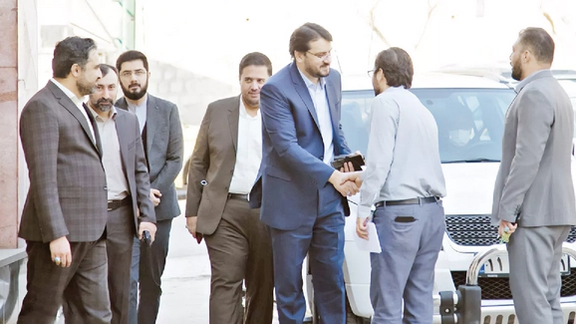
Mehrdad Bazrpash seen with a group of hardliners. Undated

News broke March 2 of the emergence of a new ultraconservative political coalition in Iran, indicating jostling for next year’s parliamentary elections.

Iranian journalist Saleh Meftah reported on Twitter two days later that a new coalition has emerged among members of the ultraconservative Paydari Party, which has the upper hand in the Iranian parliament. According to the report some 500 ultraconservative politicians took part in a meeting in Velenjak at a building where former President Mahmoud Ahmadinejad meets his aides.

The meeting was called by Roads and Housing Minister Mehrdad Bazrpash, a leading member of Paydari and at least two other Paydari leaders, firebrand cleric Mahmoud Nabavian who is known for his opposition to the 2015 nuclear deal and former populist presidential candidate Amir-Hossein Ghazizadeh Hashemi. They were seen close to Bazrpash at the meeting. Less prominent Paydari members such as controversial cleric Hamid Rasaei were also present.

Officially, the meeting was the first general assembly of a coalition named Sharian [Vein] which stands for the Persian acronym of the Strategic Network of Supporters of the Islamic Revolution. Critics said that Sharian was the rebranded version of Paydari [steadfastness] which has been discredited for its inaction in the parliament despite slogans of bringing about revolutionary changes in the country's current situation.

The economic and political situation has deteriorated so much since the hardliners took over both the parliament and the presidency that a re-branding is seen as necessary for maintaining power.

President Raisi seen during his inauguration in the parliament with hardliner lawmakers in August 2021
100%
President Raisi seen during his inauguration in the parliament with hardliner lawmakers in August 2021

Moderate Rouydad24 news website observed that the large meeting by ultraconservatives was held while their political rivals, Iran's reformists seem generally not engaged with electoral politics.

It also teased the ultraconservatives who call themselves "revolutionaries" for holding their meeting at one of the most affluent neighborhoods of Tehran on the slopes of Alborz mountains, at a place higher than the blanket of smug suffocating the Iranian capital.

The coalitions leaders have said that the new group was born immediately after the 2021 presidential election that brought ultraconservative Ebrahim Raisi to power in the absence of any other serious candidate.

The official launching of the coalition coincided with similar events in the conservative camp including the introduction of another new coalition by Tehran's Mayor Alireza Zakani, labeled the "Society for the Revival of Islamic Revolution's Popular Institutions."

Ultraconservative politician and Tehran mayor Alireza Zakani
100%
Ultraconservative politician and Tehran mayor Alireza Zakani

This comes while according to Rouydad24, it is highly unlikely that reformist groups and parties can get organized and geared up for the parliamentary elections in early 2024, even if Khamenei's Guardian Council gives them the go ahead to run.

Khamenei’s loyalists disqualified reformists en masse before the 2020 elections, which resulted in a low turnout race, which hardliners handily won.

The website said that reformists are so isolated that they appear to have lost their appetite for any political competition. Meanwhile, the recent resignation of the Chairman of Reform Front, the umbrella organization of Iran's reformist groups may have made it even more difficult for the reformist to think of competing in March 2024.

The emergence of the two hardliner coalitions also marks a divide among ultraconservatives. However, Zakani's around 20 coalition members cannot be compared to Bazrpash's 500 men.

During the weekend, conservative news website Nameh News Criticized Bazrpash for his early start to election campaigning and complained to Raisi about his behavior and asked the President whether he has allowed Bazrpash to take time off from the troubled administration to organize an electoral coalition. Raisi has so far not responded, but criticism of Bazrpash is not unprecedented as his rivals have accused him of getting his job based on fake academic credentials. They also charged that he has no executive experience for his role as a cabinet minister.

The critics asked Raisi isn't it better that his ministers focus on the country's problems? They have also asked about the financial resources for the party meeting.


Most Viewed

Iran negotiators ordered to return after internal rift over Islamabad talks
1
EXCLUSIVE

Iran negotiators ordered to return after internal rift over Islamabad talks

2
ANALYSIS

US blockade enters murky phase as tankers spoof signals and buyers hesitate

3
ANALYSIS

Why the $100 billion Hormuz toll revenue is a myth

4

US tightens financial squeeze on Iran, warns banks over oil money flows

5
INSIGHT

Ideology may be fading in Iran, but not in Kashmir's ‘Mini Iran'

Banner
Banner

Spotlight

  • Hardliners push Hormuz ‘red line’ as US blockade tests Iran’s leverage
    INSIGHT

    Hardliners push Hormuz ‘red line’ as US blockade tests Iran’s leverage

  • Ideology may be fading in Iran, but not in Kashmir's ‘Mini Iran'
    INSIGHT

    Ideology may be fading in Iran, but not in Kashmir's ‘Mini Iran'

  • War damage amounts to $3,000 per Iranian, with blockade set to add to losses
    INSIGHT

    War damage amounts to $3,000 per Iranian, with blockade set to add to losses

  • Why the $100 billion Hormuz toll revenue is a myth
    ANALYSIS

    Why the $100 billion Hormuz toll revenue is a myth

  • US blockade targets Iran oil boom amid regional disruption
    ANALYSIS

    US blockade targets Iran oil boom amid regional disruption

  • Iran's digital economy battered by prolonged blackout
    INSIGHT

    Iran's digital economy battered by prolonged blackout

•
•
•

More Stories

Two More University Dorms In Iran Attacked By Chemicals

Mar 7, 2023, 12:01 GMT+0

Chemical attacks targeting female students with poison gas continued on Monday evening with two women's dormitories at Esfahan University of Medical Sciences.

Students Trade Unions Council said the attack forced the students to come out of the dormitory around 11pm following a bad smell which gave students symptoms typical of dozens of attacks which have been witnessed across schools and dormitories since November, namely nausea, vomiting and dizziness. The council said "there is still no accurate information on the number of those poisoned”.
The United Students Telegram channel published some photos of girls gathered in the open area around the dormitories with images shared on social media showing several ambulances and police cars surrounding the buildings, suggesting large numbers needed medical support.
The poison attack on female student dormitories began on Thursday, exactly three months after the attacks on schoolgirls began. The first poisonings at dorms were reported at Karaj Technical and Vocational University.
After that, a dormitory for girls at Urmia Technical and Vocational University was attacked in the early hours of Sunday. At least 29 students were hospitalized after being transferred to Urmia clinics.

Serial chemical attacks on girls’ schools and dormitories that first were reported in the religious city of Qom have since spread to at least 21 of Iran’s 30 provinces.

On Monday, Iran's ruler Ali Khameini finally spoke out, saying: "The country’s officials must earnestly investigate the matter of the poisoning of students. This is a huge crime which is unforgivable. If the poisoning of students is proven, the perpetrators of this crime must be given the maximum punishment without pardon."

However, the government has made no arrests so far and Khamenei's hardliner supporters have tried to explain away or minimize the attacks.

Iran Politicians, Commentators Unhappy About Grossi's Visit

Mar 7, 2023, 02:46 GMT+0
•
Iran International Newsroom

Regardless of the apparent hullabaloo about IAEA chief Rafael Grossi’s visit to Tehran, politicians and commentators in Iran appear to be skeptical about the outcome of the visit.

The political editor of a leading reformist daily Etemad in Tehran, Sara Massoumi, noted that hours after a joint press conference by Grossi and Iranian nuclear chief Mohammad Eslami, the official website of President Ebrahim Raisi and all of Iran's news agencies deleted parts of what they had earlier published as Grossi's statement in the news conference.

In the deleted parts Grossi was quoted as having said, "We have had very constructive and positive meetings with Iranian officials," and "It is quite clear who should be blamed for the current situation of the JCPOA." Another deleted sentence blamed "sinister elements" for preventing IAEA's cooperation with the Islamic Republic.

On Sunday, foreign policy analyst Amir Ali Abolfath said in an interview with conservative Nameh News website that Iran should not pin its hopes on the visit, adding that "regardless of the success or failure of Grossi's trip, there is no bright outlook for the Islamic Republic's relations with the IAEA."

Abolfath noted that the IAEA is a UN body and various countries do not have equal weights at the United Nations particularly in the areas linked to security issues. He added that one cannot expect the IAEA to be satisfied about Iran's nuclear activities as long as tensions between Tehran and Washington are not reduced.

Iranian commentator Amir Ali Abolfath (file photo)
100%
Iranian commentator Amir Ali Abolfath

Meanwhile, former diplomat Fereydoun Majlesi pointed out in an interview with Khabar Online that "Iran's main problem is to have US sanctions lifted and not a visit to Tehran by Grossi." Majlesi also pointed out that Tehran should know that it cannot endlessly attack its adversaries without any repercussion.

He added that if the UN trigger mechanism or ‘snapback’ of international sanctions is activated, Iran will be in a difficult position and will have to reach out to foreign powers to solve its problems. Majlesi reiterated: "I have said many times in more than two years that the JCPOA is a burnt out case. Iran's problems are now about the Non Proliferation Treaty (NPT) and other nuclear commitments. Leaving the NPT is extremely dangerous for Iran and might lead to snapback before the end of 2023.

Grossi's visit, he said was mainly about making matters clear after 84-percent enriched uranium was detected in Iran and Grossi wanted to warn Tehran that this requires more rigorous monitoring and inspection of its nuclear activity.

Meanwhile, the editor of hardline daily Kayhan Hossein Shariatmadari wrote in a commentary on Sunday that Grossi's visit to Tehran was unnecessary and accused the IAEA chief of reporting back to Israel. He said Grossi will inform Israel before anyone else of the outcome of his visit.

In another development, the former chairman of parliament's National Security and Foreign Policy Committee Heshmatollah Falahatpisheh said in an interview with Etemad Online that Iran's Foreign Ministry is incapable of handling nuclear negotiations with JCPOA partners, and the matter should be handed over to the Supreme Council of National Security, a body closely linked to Supreme Leader Ali Khamenei.

Falahatpisheh said that the Foreign Ministry has so far missed all the opportunities it had to settle the nuclear disputes and reach an agreement with the United States and Europe.

He also said in another interview with Rouydad24 that the JCPOA should be removed from the gambling table of world powers and from the political rivalries between various political factions in Iran.

Iran Would Welcome Prisoner Swap With Belgium: Spokesman

Mar 6, 2023, 16:33 GMT+0

The Islamic Republic says it is ready for a prisoner swap with Belgium after the constitutional court in the European country upheld an exchange treaty.

The Constitutional Court of Belgium on Friday rejected a request to annul a prisoner exchange treaty with the Islamic Republic signed last year that can lead to the release of an Iranian diplomat, Assadollah Assadi, convicted of terrorism, for Belgian aid worker Olivier Vandecasteele, held hostage in Iran.

Iran’s foreign ministry spokesperson said Monday that the ground is ready to execute the prisoner exchange pact.

"With the recent development, we hope to see an opening in connection with the case of this diplomat," added Nasser Kanaani.

However, the Belgian Supreme Court said in its ruling that plaintiffs can appeal to lower courts to block Assadi’s repatriation to Iran.

Belgian aid worker Olivier Vandecasteele was arrested on a visit to Iran in February 2022 and sentenced in January to 40 years in prison and 74 lashes on charges including spying.

Brussels gave a 20-year jail term to Assadi in 2021 over a foiled bomb plot in the first trial of an Iranian official for suspected terrorism in Europe since Iran's 1979 revolution.

Under a treaty Belgium and Iran signed in 2022, Vandecasteele would have been eligible to be swapped for Assadi but in December Belgium’s constitutional court suspended the implementation of the treaty until it could make a ruling.

Some Belgian lawmakers voiced concern that the prisoner exchange treaty might lead to "hostage diplomacy" and put other Belgians at risk of detention.

Iranians Set For Nationwide Protests Over Chemical Attacks On Schoolgirls

Mar 6, 2023, 12:39 GMT+0
•
Iran International Newsroom

Amid a wave of chemical attacks on schoolgirls across Iran, several teachers' and students' unions have called for nationwide protests on Tuesday and Wednesday. 

The Coordination Council of Iranian Teachers' Trade Associations issued a statement on Monday, demanding an “an end to biological repression and the threat to the lives of citizens, especially students."

The council urged a transparent and independent fact-finding mission comprised of civil, trade union and political activists along with a group of doctors and experts as well as human rights lawyers to thoroughly investigate the issue and publish the results to the public. The large scale of the attacks and number of affected students cast doubts on the regime’s argument that the assaults are the results of arbitrary actions by hardliners who are against girls’ education, read the statement. 

The group had already issued statements about the March 7 gathering, calling on teachers and the people of Iran to stage rallies outside the parliament in Tehran and in front of the education department offices in other cities to demand action on school attacks.

Teachers are also distraught about their falling purchasing power amid a sharp decline of Iran’s currency and raging inflation. This will also be a part of their protest.

Describing the attacks as “bioterrorism,” the national teachers’ union also criticized the government for three months of denials. “There is strong suspicion that the purpose of the attacks is quashing the Woman, Life, Freedom movement by instilling fear among girls and their families,” the statement said while demanding Supreme Leader Ali Khamenei and other top religious figures to condemn the attacks expressly and decisively.

An artwork created to raise awareness about chemical attacks on schoolgirls  (February 2023)
100%
An artwork created to raise awareness about chemical attacks on schoolgirls

Several other groups, including the Council of Freethinking Students of Iran and provincial guilds for teachers, also called for demonstrations to condemn the regime’s reluctance to act about the mass poisonings. The Council of Freethinking Students said that the gas attacks is the continuation of the regime project to indoctrinate students that started by “the introduction of Taliban ideology and employment of 20,000 mullahs into the education system as teachers."

"The tragedy of poisoning students by the rusty brains of lying and hypocritical authoritarian rulers, is an attempt to take revenge for the women, life, freedom uprising," added their statement.

There are other calls for protests to mark International Women's Day on Wednesday, with imprisoned journalist and human rights activist Narges Mohammadi urging more "street protests in Iran" over the poisoning of schoolgirls. In a post on her Instagram page Mohammadi called for "immediate practical action by all international human rights organizations and the United Nations" regarding the serial poisoning of students, especially girls. "Let's stop the crime against our girls with widespread protests and street presence across the country," she addressed the people of Iran.

Also on Monday, Iran's ruler Ali Khamenei finally spoke about the poisoning of schoolgirls, describing it as an "unforgivable" crime and denying any government role in the attacks. "Authorities should seriously pursue the issue of students' poisoning. This is an unforgivable crime... the perpetrators of this crime should be severely punished," Khamenei said.

If the attacks cease to happen from now on, it shows that the perpetrators are followers of Khamenei, strengthening speculations that they were acting following his remarks about “small punishment of youngsters” who took to the streets for anti-regime protests. 

Iran's Khamenei Finally Speaks Out On School Gas Attacks

Mar 6, 2023, 09:05 GMT+0

Iran's ruler Ali Khamenei said Monday that poisoning of schoolgirls in recent months is an "unforgivable" crime and denied any government role in the attacks.

"Authorities should seriously pursue the issue of students' poisoning. This is an unforgivable crime... the perpetrators of this crime should be severely punished," Ayatollah Ali Khamenei was quoted as saying by state media.

The first incidents of chemical attacks on girls’ schools began in November, but officials first ignored the incidents until they began to spread to several cities in February. Khamenei had so far remained silent while other officials were blaming foreign enemies and regime opponents without showing any proof.

Over a thousand Iranian girls in different schools have suffered "mild poison" attacks since November, according to state media and officials, with some politicians suggesting they could have been targeted by religious groups opposed to girls' education.

However, citizens and critics on social media ask why the government has failed to arrest the perpetrators of such a large and coordinated campaign, while it was efficient in killing and detaining antigovernment protesters.

Other say the hardliner establishment is behind the attacks to take revenge from schoolgirls who joined the Woman, Life, Freedom protests in October and November.

The spreading attacks that started in the holy Shi'ite Muslim city of Qom in central Iran have spread to at least 25 of Iran's 31 provinces, prompting some parents to take their children out of school and hold protests against the establishment.