• العربية
  • فارسی
Brand
  • Iran Insight
  • Politics
  • Economy
  • Analysis
  • Special Report
  • Opinion
  • Podcast
  • Iran Insight
  • Politics
  • Economy
  • Analysis
  • Special Report
  • Opinion
  • Podcast
  • Theme
  • Language
    • العربية
    • فارسی
  • Iran Insight
  • Politics
  • Economy
  • Analysis
  • Special Report
  • Opinion
  • Podcast
All rights reserved for Volant Media UK Limited
volant media logo

Iran Arrests Two More French Citizens As West Increases Pressure
Iran International Newsroom
Nov 12, 2022, 23:05 GMT+0Updated: 18:05 GMT+1
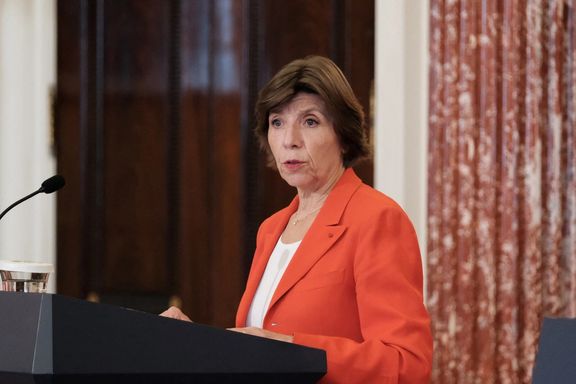
French Foreign Minister Catherine Colonna

Paris says the number of French nationals detained by the Islamic Republic of Iran has reached seven with the arrest of two more citizens.

French Foreign Minister Catherine Colonna said on Saturday that Paris is concerned over the incarceration of two other citizens urging Tehran to immediately release them and provide them with consular protection.

Colonna made the comments in an interview with Le Parisien newspaper about the new development, which would seemingly bring about a further deterioration in mutual relations.

She reminded the Islamic Republic of its international obligations warning the if the goal behind the detention is to blackmail France, “then it cannot work.”

Human rights organizations accuse Iran of a systematic policy of hostage taking over four decades from the earliest period of the Islamic republic after the ouster of the Shah, starting with the 1979-1981 siege at the US embassy in Tehran.

Tehran denies any policy of hostage taking and insists all foreigners are arrested and tried according to legal process. However, it has frequently shown readiness for prisoner exchanges and participated in swaps in the past.

Most trials of political cases, including detained Western detainees are without due process of law and based on trumped up charges.

In her interview, Colonna however noted that her Iranian counterpart Hossein Amir-Abdollahian “has committed to respect the prisoners’ right of access.”

Her comments come a day after French President Emmanuel Macron expressed solidarity with Iranian freedom-seeking protesters calling their movement a “revolution”.

President Emmanuel Macron of France meeting an Iranian activist on Nov. 11, 2022
100%
President Emmanuel Macron of France meeting an Masih Alinejad, an Iranian activist on Nov. 11, 2022

In early October, France accused the Iranian regime of “dictatorial practices” after Iran’s state TV aired the forced confessions of two French nationals arrested in the Middle Eastern country ruled by its 83-year-old anti-West ruler, Ali Khamenei.

In the video of the forced confessions, one of the two French nationals - Cecile Kohler - said they were in Iran to “prepare the ground for the revolution and the overthrow of the regime of Islamic Iran.”

Iran’s state media are infamous for purported confessions by prisoners in politically charged cases. Such prisoners are held without due process of law and usually cannot choose their own defense attorney.

On Friday, Le Figaro newspaper reported that the two nationals had been arrested prior to the start of anti-government protests in September over the death of 22-year-old Mahsa Amini.

Ties between France and Iran have soured recently as efforts to revive 2015 nuclear talks in which Paris is one of the parties have come to a standstill.

Following the uprising against their authoritarian government after killing of Amini in police custody, the EU imposed new sanctions on Iran following similar measures by the United States, Canada and Britain.

A new round of European Union sanctions for human rights violations by Tehran will also be approved at a foreign ministers' meeting on Monday, two diplomats told Reuters.

The sanctions are set to target 31 individuals and entities and would freeze their assets and imposing travel bans.

“France has also proposed new designations for those who would sell drones to Iran and to sanction people involved in the export of electronic components for drones,” one of the diplomats said.

The identity of the two new French detainees was not immediately clear, but Cecile Kohler and Jacques Paris, whose confessions earlier aired on the Iranian TV, have been arbitrarily detained since May 2022.

Fariba Adelkhah, is another Iranian-born woman, who was arrested in 2019 and sentenced to five years in prison for “undermining national security.” Benjamin Briere was similarly arrested in May 2020 and sentenced to eight years and eight months for espionage, without due process of law.


Most Viewed

Iran negotiators ordered to return after internal rift over Islamabad talks
1
EXCLUSIVE

Iran negotiators ordered to return after internal rift over Islamabad talks

2
ANALYSIS

US blockade enters murky phase as tankers spoof signals and buyers hesitate

3
ANALYSIS

Why the $100 billion Hormuz toll revenue is a myth

4

US tightens financial squeeze on Iran, warns banks over oil money flows

5
ANALYSIS

US blockade targets Iran oil boom amid regional disruption

Banner
Banner

Spotlight

  • Hardliners push Hormuz ‘red line’ as US blockade tests Iran’s leverage
    INSIGHT

    Hardliners push Hormuz ‘red line’ as US blockade tests Iran’s leverage

  • Ideology may be fading in Iran, but not in Kashmir's ‘Mini Iran'
    INSIGHT

    Ideology may be fading in Iran, but not in Kashmir's ‘Mini Iran'

  • War damage amounts to $3,000 per Iranian, with blockade set to add to losses
    INSIGHT

    War damage amounts to $3,000 per Iranian, with blockade set to add to losses

  • Why the $100 billion Hormuz toll revenue is a myth
    ANALYSIS

    Why the $100 billion Hormuz toll revenue is a myth

  • US blockade targets Iran oil boom amid regional disruption
    ANALYSIS

    US blockade targets Iran oil boom amid regional disruption

  • Iran's digital economy battered by prolonged blackout
    INSIGHT

    Iran's digital economy battered by prolonged blackout

•
•
•

More Stories

Serious Medicine Shortages Grip Iran Amid Inflationary Recession

Nov 12, 2022, 19:18 GMT+0
•
Mardo Soghom

Iran faces a serious shortage in medicines with some prices rising sevenfold, months after the government eliminated cheap dollars for importing raw materials.

The crisis in health care is just one aspect of the overall economic crisis, precipitated by a centralized and often mismanaged economy, and for the past years, US sanctions.

Most medicines in Iran are produced locally by quasi-governmental companies that import the raw material from other countries. When the Iranian currency began to lose value in early 2018, the government offered a fixed exchange rate for essential goods, mainly food and medicines. However, earlier this year, the new administration of President Ebrahim Raisi eliminated what was in fact a government subsidy. Now, food and medicine producers must buy dollars at rates seven times higher to import their raw materials, which has disrupted production.

Deputy chairman of pharmaceuticals producers, Ali Fatemi told Aftab News in Tehran that when an economic sector is controlled by the government and is managed according to “a command economy” it is not surprising that a situation like the current shortage would emerge. The government sets unreasonably low prices and then stops subsidies, which makes it impossible for its companies to but raw materials and produce, he said.

To partially alleviate the shortage, the Iranian government allows medicines, such as antibiotics and simple cough syrups to be imported from India, Fatemi explained, and as a result the country spends much more foreign currency, instead of importing the raw materials.

Ali Fatemi, a pharmaceuticals executive in Iran
100%
Ali Fatemi, a pharmaceuticals executive in Iran

Apart from pharmaceuticals, inflationary recession has gripped other sectors, according to Fararu website in Tehran. As prices have risen at least by 40 percent for two consecutive years, consumers have lost their purchasing power and demand has fallen. This has led to a “domino effect for producers and factories” that must stop operations. This in turn creates more unemployment and less consumer demand.

Iran’s currency has fallen by more than 15 percent since early September when it became clear that a nuclear agreement with West was not a realistic expectation.

Since early 2018, when the United States signaled its intention to withdraw from the 2015 nuclear deal known as the JCPOA, Iran’s rial has fallen tenfold from 35,000 to the dollar to 350,000 on November 12. When the US did withdraw from the accord in May of that year, it imposed damaging oil and banking sanction on Iran. This further devalued the rial and led to very high inflation, which coupled with the inefficiencies of a government-controlled economy, has impoverished tens of millions of people.

Ehsan Soltani, an economist in Iran told the website that while food prices have risen eightfold since 2018, wages, at most, have increased threefold.

“In recent years with rising inflation, economists warned officials about ‘inflationary recession’, but the government did not pay attention at all,” Soltani explained.

In fact, from cautious statements by many officials, especially in the previous Iranian government headed by President Hassan Rouhani, it was apparent that they were aware of the dire situation, but they had no control over the country’s foreign policy, which had brough about crippling US sanctions.

But Iran’s 83-year-old anti-Western ruler, Ali Khamenei, has the last word on foreign policy and only he could allow a new nuclear deal to be signed that would lift the most damaging sanctions.

Iran’s economic growth in the past decade has been zero and Soltani compared Iran to its neighbor Turkey. “Just look at Turkey…and see the high rate of growth it has achieved in the past ten years, adding tremendously to its foreign currency revenues, while we have faced economic and infrastructure decay.”

Activists Report Torture, Sexual Abuse Of Detained Protesters In Iran

Nov 12, 2022, 18:23 GMT+0

A network of activists with a mandate to follow up on the condition of detained protesters in Iran has reported dire human rights violations such as torture and sexual abuse.

The “Volunteer Committee to Follow-Up on the Situation of Detainees” reported torture, sexual harassment, threats of rape, not having access to medical services, and the detention of some detainees in secret locations.

The committee announced that it was able to identify over 1,600 prisoners, including 65 minors.

“These prisoners include 969 ordinary citizens, 393 students, 145 civil activists, 42 journalists, 40 political activists, 38 women's rights activists and 26 attorneys.”

According to this committee, some others have been threatened with arrest and harassment of their family members.

“A female prisoner has been openly threatened with rape. The interrogators told her and other detainees “If you are raped here, you cannot protest! Your want to get naked, and you must pay for it!” The government and its agents accuse anti-hijab protesters of improper attire and nudity.

Another detainee has told activists that some protest prisoners are kept with criminals, and they have been sexually abused by them.

According to this report, some injured people who have dozens of shotgun pellets in their bodies were left unattended.

At least 14,000 people have been arrested during the recent protests. However, Kazem Gharibabadi, secretary of Iran's High Council for Human Rights denied the arrest of so many people but did not provide any official information about the number of detainees.

Sweden Indicts Two Iranian-Born Brothers 'Spying For Russia'

Nov 12, 2022, 09:35 GMT+0

Sweden says two Iranian-born brothers and citizens of the country have been charged with spying for Russia and its military intelligence for about a decade.

Swedish authorities have identified the two as, Peyman Kia, 42 and Payam Kia 35. One of these two brothers has also been indicted for alleged gross unauthorized handling of secret information.

Reportedly the older brother has been working with Sweden's Domestic Intelligence Agency for years.

“It has been a complex investigation concerning a crime that is very difficult to investigate and the suspicion concerns very serious criminality directed against Sweden's intelligence and security system," National Security Unit chief prosecutor Per Lindqvist said.

He noted that this case is about confidential and very sensitive information but refused to give further explanation.

According to the charge sheet obtained by AP, these two brothers have provided information to the Russian Military Intelligence Department (GRU) between September 28, 2011 and September 20, 2021.

It adds that Peyman Kia, obtained this information from various security and intelligence institutions of Sweden when he was working at Sweden's Domestic Intelligence Agency and the Swedish Armed Forces. The other brother also helped to make contact with “Russia and the GRU including matters of surrender of information and receipt of compensation.”

They were arrested in September and November 2021. Both have denied any wrongdoing, Swedish media reported. The brothers face up to life imprisonment if convicted. A life sentence in Sweden generally means a minimum of 20-25 years in prison.

Germany, Iceland Call For UN Human Rights Meeting On Iran

Nov 11, 2022, 23:32 GMT+0

Germany and Iceland submitted a request on Friday on behalf of dozens of countries to hold a special session at the UN Human Rights Council on the ongoing protests in Iran later this month. 

According to the letter signed by the two countries' ambassadors., the request called for the session "to address the deteriorating human rights situation in the Islamic Republic of Iran, especially with respect to women and children."

At least one-third of the UN Human Rights Council's voting members backed the proposal, as is required for meetings outside of the body's normal agenda, meaning its convening is a formality.

According to the German diplomatic mission in Geneva, dozens of others also signed up, bringing the total number of backers to 44. 

Earlier in the day, the Islamic Republic’s foreign minister warned the UN Human Rights Council over organizing any session to discuss the situation. 

Alleging that the Islamic Republic has "deeply exercised restraint" in the ongoing unrest – which has left over 300 protesters dead and about 15,000 detained, Hossein Amir-Abdollahian told UN Secretary General Antonio Guterres that such a meeting should be held for countries that "promote violence and terror."

Islamic Republic Warns UN’s Guterres Against Meeting Over Protests

Nov 11, 2022, 13:15 GMT+0

Amid international concerns over the Islamic Republic’s violent crackdown on dissent, its foreign minister has warned the UN Human Rights Council over organizing any session to discuss the situation. 

In a phone conversation with UN Secretary General Antonio Guterres Thursday night, Foreign Minister Hossein Amir-Abdollahian warned of the “negative consequences” of the UNHRC’s “political measure” on cooperation between the Islamic Republic and the West, referring to calls for a special meeting over the deadly clampdown on the current protests across Iran. 

Alleging that the Islamic Republic has "deeply exercised restraint" in the ongoing unrest – which has left over 300 protesters dead and about 15,000 detained, he told the UN chief that such a meeting should be held for countries that "promote violence and terror."

“The UN Human Rights Council should hold sessions for governments that are encouraging violence and terror, not for the Islamic Republic of Iran which is a true defender of human rights and has exercised great restraint during recent riots,” he said. 

Amir-Abdollahian added that “Contrary to the UN Charter, a few Western countries exploited the peaceful demands in Iran and encouraged violence and offered tutorials on building weapons and Molotov cocktails on media and social networks which led to the killing of police and insecurity in Iran.”

Iranian officials have been accusing “enemies” of fomenting protests, but so far have not presented any evidence.

He also claimed that “technical” negotiations between Iran and the International Atomic Energy Agency (IAEA) are at “appropriate” levels, despite remarks by the head of the UN’s nuclear watchdog. Rafael Mariano Grossi said Wednesday Iran did not offer anything new during a recent meeting in Vienna to resolve major differences.