• العربية
  • فارسی
Brand
  • Iran Insight
  • Politics
  • Economy
  • Analysis
  • Special Report
  • Opinion
  • Podcast
  • Iran Insight
  • Politics
  • Economy
  • Analysis
  • Special Report
  • Opinion
  • Podcast
  • Theme
  • Language
    • العربية
    • فارسی
  • Iran Insight
  • Politics
  • Economy
  • Analysis
  • Special Report
  • Opinion
  • Podcast
All rights reserved for Volant Media UK Limited
volant media logo

Iranians See Mismanagement, US Sanctions At Root Of Economic Crisis
Iran International Newsroom
Mar 24, 2022, 15:01 GMT+0Updated: 17:39 GMT+1
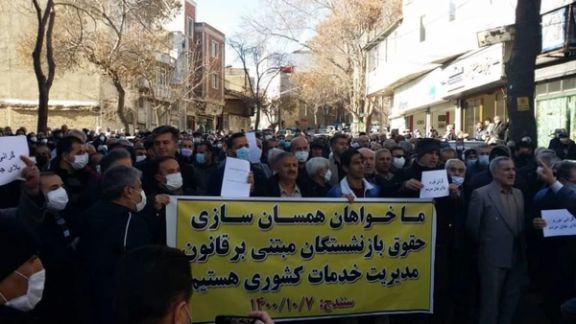
Retirees protest in Tehran for higher social security payments. December 28, 2021

Prices in Iran have risen five to ten-fold since 2018, impoverishing tens of millions and widening income gaps, the head of construction workers' union says.

Cumulative inflation in the construction industry has been 700 percent, while wages for workers has maybe doubled, Akbar Shokat the national chairman of construction workers unions told the Iranian Labour News Agency (ILNA) this week.

Shokat said while each square meter of building construction cost 10 million rials three years ago, now it costs 70-80 million. The same applies to food workers have to buy. One kilo of red meat cost 250 rials in 2018 while now the price has reached 1.6 million rials.

The examples mentioned by the union leader clearly show the impact of ‘maximum pressure’ sanctions imposed by the United States after former President Donald Trump withdrew from the Iran nuclear accord in May 2018. It also shows that inflationary pressures picked up as time passed, averaging above 40 percent in 2021.

While with US sanctions Iran’s currency nosedived in 2018, it took months for annual inflation to increase to above 30 and then 40 percent. The currency, rial dropped from 33,000 to the dollar to the current low of 260,000, or almost eightfold.

The claim about people with capital getting richer is based on the reality that business owners raise prices as the value of Iranian currency falls and maintain a higher margin of incomes than wage earners whose salaries change once a year by a government decision on minimum wage. Salary increases are always far less than inflation.

Akbar Shokat, national representative of construction workers in Iran. March 22, 2022
100%
Akbar Shokat, national representative of construction workers in Iran

With the most recent minimum wage hike, an average worker will take home around $200 a month, while labor groups say the minimum needed for a family of 3.3 persons is $450 a month.

People owning real estate, profitable businesses or foreign currencies are by-and-large immune from the perils of a falling currency and inflation, because the value of their capital remains mostly intact. For example, real estate prices calculated in US dollars, have stayed the same since 2018, while salaries have dropped.

Jalal Mirzaee, a former member of parliament, told ILNA on Thursday that without the removal of US sanctions the economy cannot improve, especially that President Ebrahim Raisi in many cases has appointed top managers who are not experts in their fields.

Raisi, for example, has appointed former Revolutionary Guard commander Mohsen Rezaei as one of his top economic aides, but he has never managed a large bureaucracy or a private sector company.

“The root cause of many economic difficulties is US sanctions,” Mirzaee said, but added that this does not mean successive governments have not mismanaged the economy, which is largely state-owned and run by the government. If sanctions are lifted, it would be easier to address Iran’s economic problems, but that would depend on effective management by the government, Mirzaee said, which is doubtful in the current administration.

Hossein Raghfar, a respected economist, told Etemed Online this week that the country’s foreign currency revenues have been mishandled and the rial has fallen so much that economic stability is questionable. The result is capital flight, with most investors shifting their businesses to neighboring countries.

Raghfar criticized the established economic order, saying that the Islamic Republic has created an “oligarchy that benefits most from foreign currency revenues” gained by exporting crude oil and other national resources. He argued that in the first instance, political insiders and the military should exit the business world and allow a real private sector to emerge. Raghfar said, “If there is no private sector, the economy cannot move forward.”


Most Viewed

Iran negotiators ordered to return after internal rift over Islamabad talks
1
EXCLUSIVE

Iran negotiators ordered to return after internal rift over Islamabad talks

2
ANALYSIS

US blockade enters murky phase as tankers spoof signals and buyers hesitate

3
ANALYSIS

Why the $100 billion Hormuz toll revenue is a myth

4

US tightens financial squeeze on Iran, warns banks over oil money flows

5
ANALYSIS

US blockade targets Iran oil boom amid regional disruption

Banner
Banner

Spotlight

  • Hardliners push Hormuz ‘red line’ as US blockade tests Iran’s leverage
    INSIGHT

    Hardliners push Hormuz ‘red line’ as US blockade tests Iran’s leverage

  • Ideology may be fading in Iran, but not in Kashmir's ‘Mini Iran'
    INSIGHT

    Ideology may be fading in Iran, but not in Kashmir's ‘Mini Iran'

  • War damage amounts to $3,000 per Iranian, with blockade set to add to losses
    INSIGHT

    War damage amounts to $3,000 per Iranian, with blockade set to add to losses

  • Why the $100 billion Hormuz toll revenue is a myth
    ANALYSIS

    Why the $100 billion Hormuz toll revenue is a myth

  • US blockade targets Iran oil boom amid regional disruption
    ANALYSIS

    US blockade targets Iran oil boom amid regional disruption

  • Iran's digital economy battered by prolonged blackout
    INSIGHT

    Iran's digital economy battered by prolonged blackout

•
•
•

More Stories

Iran Traffic Police Chief Questions Import Of Chinese Car Parts

Mar 24, 2022, 14:17 GMT+0

Iran’s traffic police chief has criticized manufacturers for importing car parts from China, saying there is no effective quality control.

Brigadier General Kamal Hadianfar told Hamshahri Online in an interview Wednesday there were no cars with all components built domestically.

“Why do they import parts from China? Who monitors the quality of these Chinese parts?” he asked. Hadianfar said car manufacturers could learn from the self-sufficiency of the defense industry in making “largest ballistic missiles in the region”.

President Ebrahim Raisi said in October that Iran’s military and nuclear sectors had responded to United States with “great achievements” due to motivation and effort. But, Raisi argued “we have not invested the technology of the missile industries in the automotive industry.”

China has been the world’s largest car maker since 2008, with its output since 2009 higher than US, European Union, and Japan combined. China accounts for 29 percent of world car exports with Saudi Arabia its leading market, and two Chinese electric car manufactures listed on the Nasdaq. But quality of Chinese cars is considered poor, with focus on low prices and high production numbers.

Echoing those in Iran who blame low-quality vehicles for road casualties, Hadianfar criticized January domestic automakers for producing "carriages of death."

A deputy of Iran’s traffic police, Sivash Mohebbi, said Thursday that 322 people had died in the previous week.

Iran's Presence At Qatar's Defense Exhibition Draws US Criticism

Mar 24, 2022, 12:30 GMT+0

Iran’s participation in a defense show in Qatar has drawn criticism from the United States, as Revolutionary Guard commanders set up shop to showcase weapons.

"We reject the presence of Iran at a maritime defense exhibit, considering that it’s Iran that single-handedly is threatening maritime stability throughout the Gulf region," US State Department spokesperson Ned Price said in a statement.

Their presence was striking when other Sunni Muslim Gulf states and Israel are alarmed at the prospect of the United States removing its terrorist designation of the IRGC as part of efforts to revive a nuclear pact with Iran.

The Iran booth was organized by Iran's Ministry of Defense and the commanders were part of a broader Iranian delegation.

A Qatari official said in a statement to Reuters on Thursday no invitation had been sent to the IRGC.

"The participation in the event and pavilion was by the Iranian Ministry of Defense and there were no invitations sent to Iran’s Revolutionary Guard."

Washington is reportedly considering removing the IRGC from a terrorist organization blacklist in return for Iranian assurances about “de-escalation” in the region.

Qatar's DIMDEX exhibition drew international defense firms hoping to boost sales to wealthy Gulf states that are moving to expand the military capabilities of the energy-producing region.

Qatar has good ties with Iran, with which it shares a giant gas field. In contrast, Qatar's neighbor Saudi Arabia is locked in several proxy conflicts with Tehran, which strives for regional dominance.

With reporting by Reuters

Lawmaker Says Many Iranian Academics Want To Leave The Country

Mar 24, 2022, 08:50 GMT+0

An Iranian lawmaker says many university professors have applied for retirement or are planning to leave the country amid economic hardships.

Reformist member of Parliament from Tabriz Massoud Pezeshkian told ILNA on Wednesday that despite the call by Supreme Leader Ali Khamenei to boost innovation, nothing special will happen in academia until authorities change their views and perspectives.

Khamenei designated the new Iranian calendar year of 1401 (started on March 21) as the year of knowledge-based productivity and job creation.

Khamenei has been designating slogans for each year in the past decade, such as “Leap in Production” and this year his motto became innovation and knowledge based economic growth.

Officials will face an uphill battle implementing this slogan because most of the things that the parliament has approved are not practical or science-based and would further restrict universities in innovation and employment, Pezeshkian noted.

Pezeshkian added that when the parliament, the presidential administration and the judiciary choose private sector contractors for projects, you cannot encourage the academics to stay in the government universities to boost efforts with the same salary.

In addition to all this, universities are also firing many of professors in what critics see as further political cleansing of academia.

Iran’s Azad University has fired 325 professors and lecturers in recent months and has decided to dismiss 1,500 more.

The Lives of Iran’s Shiite Clerics – The Rules Of The Game - Avoid A Taxi

Mar 23, 2022, 21:59 GMT+0
•
Iran International Newsroom

This article is the second in a series about Iran’s Shiite clerics, explaining how they study, get a clerical rank, get married and what they do for a living.

-------------------------------------------------------------------------------------------------------------------------

-Getting into the clerical robe and putting the turban on the head requires the completion of the introductory seminary courses and passing an easy exam which is mainly about ideology and ethics.

Clerical students usually put on a shirt without a collar and a pair of regular pants – no jeans. Putting on the robe and the turban is a turning point in the life of a young cleric. The turban or ammameh must be placed on the young cleric's head by a prominent clergyman or one highly respected by the students at the madrassah.

Once the young clergyman gets into the clerical outfit, he no longer is allowed to wear anything with a bright color. His shoes must be modest and devoid of any ornamentation. Most senior clerics frown at a young cleric with a wristwatch. They never wear it. However, in recent years, one might come across exceptions.

Generally, a typical cleric will walk and talk slower and dress more modestly once he gets his robe and turban. It is at this point that some clerics put on white turbans while others who are a seyyed or alleged descendants of the prophet will wear black turbans as a symbol of mourning for the martyred Imams particularly the third imam, Hussain

Two young clerics in the courtyard of a seminary. FILE
100%
Two young clerics in the courtyard of a seminary.

The clerical outfit usually consists of a turban and a robe, and two long and short jackets (labbadeh and qaba) put on under the robe, a delicate pair of white thin trousers and finally a pair of slippers (na'lain). If they have to wear shoes, shoelaces are frowned at and seen as a sign of immodesty.

Many clerics with hair loss, attribute it to the turban which is placed on their head all day and during part of the night. Most clerics traditionally keep their hairs short. After the 1979 revolution, many clerics, including Supreme Leader Ali Khamenei are not so keen to have regular haircuts. Some, again including Khamenei, allow a bit of hair to slip out of the turban on their forehead. These are believed by other clerics to be more modern, which is not necessarily a good trait.

Forcing a smile is good but a laughter is not supposed to be heard. Former President Hassan Rouhani was often criticized even by colleagues and fellow clerics for his laud laughter.

Although modern clerics usually go to see their relatives and sometimes have gatherings of family and close friends at their home, many older clerics rarely go for a visit to a friend or relative's house. The younger ones, mix with the rest of the family more often, although in most of their parties they shed their clerical outfit and get into something more secular.

A group of older clerics bored during an official ceremony. FILE
100%
A group of older clerics bored during an official ceremony.

Most clerics frown at traditional occasions for a family get together such as Nowruz (the New Year) or Yalda, (the longest night of the year). Nonetheless, younger clerics who have joined the ranks of akhunds during in the past two decades, celebrate the festive seasons like most other people.

However, many clerics have complained that they find it increasingly difficult to show up at shopping centers or the streets. Many Iranians, fed up with clerical rule, can hardly differentiate between those in the government and others who are teachers, or pastoral work or have small jobs here and there. Consequently, when they see them, they begin to voice their frustration and anger or at least try to tease a mullah.

Until some 40 years ago, most clerics and their families were familiar with concepts of andarouni (private interior) and birouni (less private exterior) in their homes which determined where the clerics could behave more comfortably, and where they had to be weary of prying. Nowadays, with smaller houses and flats these concepts have faded out and many occasions young and poor clerics find their dignity and privacy compromised.

If they are not rich enough to drive their own car or to be driven to work, taking a taxi is a nightmare for any cleric. Most taxi drivers prefer not to give a ride to an akhund. Or if they do, they most likely want to embarrass him in front of other passengers as taxis in Iran sometimes have up to five people on board.

During the fasting month of Ramadan and the mourning months of Muharram and Safar many young clerics travel to the provinces for "Islamic propagation." Most of the time, they are paid by the seminary or the government, while the pious local merchants also make sure that the visiting cleric is taken good care of and is paid good money by local businesses.

Youngsters in the provinces, however, fail to differentiate between these poor clerics who are dispatched to instill the party line and the Islamic Republic ideology among provincials. They constantly tease the mullahs for eating too much or having big pockets to collect easy money, or for wasting government resources. And the mullahs fail to understand that even villagers in Iran have access to satellite TV and foreign broadcasts which make them different from villagers in the past who took as fact whatever was uttered by a cleric.

Removing IRGC From US Terror List 'Dangerous Capitulation'

Mar 23, 2022, 19:54 GMT+0

Three former senior Trump administration officials say removing Iran’s IRGC from the US list of foreign terrorist organizations (FTO) is “a dangerous capitulation".

In a joint statement exclusively shared with Axios on Tuesday, former Secretary of State Mike Pompeo, Director of National Intelligence John Ratcliffe, and national security advisor Robert C. O'Brien said the move would be “a denial of the basic reality that the IRGC's core mission is to spread terror".

Quoting the US Intelligence Community Annual Threat Assessment issued last month, they reiterated that Iran is a threat to US persons directly and via proxy attacks and "previously attempted to conduct lethal operations in the United States."

“These assessments, combined with the IRGC's lengthy history of killing hundreds of Americans…make it clear: The IRGC is a terrorist organization and should remain labeled as such," they said.

“The pursuit of an ill-conceived ‘deal’ should not compel American leaders to acquiesce to the demands of a terrorist regime to deny the truth. American lives are at stake, and this is a time to project strength, not weakness."

Republican lawmakers are raising objections to removing the IRGC from the US terror list. In their latest effort, 87 representatives wrote a letter to Secretary of State Antony Blinken, urging him not to remove the IRGC from the list, saying the IRGC "is one of the most dangerous terrorist groups in the world today.