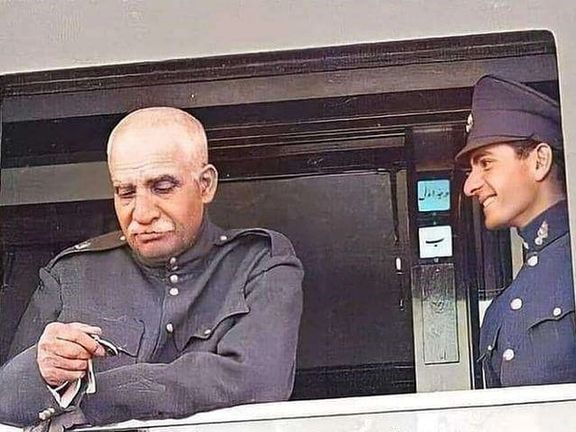
Reza Shah Pahlavi and His son Mohammad Reza inaugurating Iran's south-north railway in 1938.
Hijab remains at the heart of Iranian politics 85 years after Reza Shah Pahlavi's decree of January 8, 1936 outlawing traditional Islamic veils and scarves.
The founder of the Pahlavi dynasty banned women from wearing both traditional Islamic veils covering the whole body (chador) and headscarves. The shah had previously spent several years promoting "kashf-e hejab,” or unveiling, through requiring female teachers and students to attend school unveiled.
The shah regarded Iranian hijab and traditional costumes as a sign of ‘backwardness,’ and tried also to compel men to wear what he regarded as ‘western’ costumes and hats.
With the ban on hijab, many women stayed inside their homes for years or left home only in the dark or hidden inside carriages to avoid confrontation with the police who would if necessary use force to unveil them. Even older Christian and Jewish women found the ban on headscarves hard to comply with.
Iranian women shortly after the ban on hijab.
The ban was declared at the graduation ceremony of Tehran teacher's college, at which the queen and the shah’s two daughters appeared in public unveiled in Western attire. In a speech at the ceremony, the shah said Iranian women “should stand out in society the same way as they stand out at their homes.”
The religious establishment which saw, and still sees, the unveiling of women as a blow to its values and power, strongly opposed the decree and Reza Shah's other attempts at modernization.
It was "one of the huge crimes" of the Pahlavi dynasty aimed at destroying and modesty in Iran,” Iranian Supreme Leader Ali Khamenei said in a speech on January 7, 2016. "It was meant to get people engrossed in their very powerful sexual desires so that they would abandon everything else."
Implementation of the ban eased, and many women went back to traditional ways of dressing when Reza Shah went into exile in 1941 due to his German sympathies and under British pressure for the succession of his son Mohammad Reza Pahlavi.
Iranian women with traditional chador veils before the hijab ban.
In the last few years before the Islamic Revolution of 1979, wearing headscarves became popular among those in the younger generation who often saw it as a means to express their political opposition to the monarchy and its westernization of the Iranian society.
In the early days of the Revolution, some women who did not cover their hair were prevented from entering government offices, banks, and other public areas. The law requiring women to cover hair heads and wear long, loose-fitting coats in public was passed in 1983 and those who defy it, even inside their cars risk face fines or prison and lashing. Some anti-hijab activists have been jailed.
A report by the parliament's research center in 2018 said the number of Iranians who believed in mandatory hijab had waned. According to the report those who considered the hijab a value that could be stipulated in law had fallen from 85 percent in the early 1980s to around 35 percent.
Iranian expats visiting Iran recently have reported that intelligence agents interrogated them at the airport to collect financial and personal infomation.
Rouydad24, a news website in Tehran quoted a passenger who arrived in Tehran on a flight from the Netherlands, as saying, "A security officer took my wife and me to the interrogation room after passport control and asked us to fill in a form about our addresses, income, and place of residence." He said that several others were sitting in the same room filling forms. He added that the officers also asked them about other countries they have visited.
Airport officials have distanced themselves from the development by making it clear that they had nothing to do with the interrogations that continue to be made by intelligence organizations.
The Iranian government and its top officials including President Ebrahim Raisi, Judiciary Chief Gholamhosein Ejei and Foreign Minister Hossein Amir-Abdollahian have recently called on Iranian expats to return to Iran and invest in their homeland. It is still not known whether the interrogations are linked to this, or it is an independent project carried out by intelligence organizations.
The development has been a cause for concern among Iranians living abroad as it is also not clear whether everyone who has been interrogated was allowed to leave the airport or some of the passengers have been held by the authorities.
Iran is known for taking dual citizens hostage and using them as pawns in their negotiations with other countries. Several Iranian officials including former Foreign Minister Javad Zarif had frequently put forward the idea of exchanging such hostages with pro-regime Iranians in prison in other countries.
The Iranian Rouydad24 news website says the interrogations are against the government's general policies about expat Iranians.
The Foreign Minister has recently said that his ministry has set up a website that Iranians abroad can visit and find out if they might be arrested when travelling to Iran. He said that the website is linked to the Iranian Judiciary and the intelligence services. Iran has more than a dozen intelligence services. The most powerful ones are the Ministry of Intelligence and the Intelligence Organization of the IRGC. Recently, the Iranian police has also announced the launch of its own intelligence organization.
These organizations do not necessarily work in coordination. Recently, while the Intelligence Ministry told Iranian Academic Saeed Madani that he is free to go to the United States for a sabbatical, the IRGC's Intelligence Organization stopped him at the airport and confiscated his passport. Madani has complained to the Judiciary Chief, so far to no avail.
Some Iranian travellers said officials handpick a few passengers from a flight and take them to a room for interrogation. Others have said that occasionally, all Iranian passengers of a flight are taken for interrogation as officials hope they can find someone with a problem among a larger number of passengers. Most visitors being interrogated reportedly come from Europe. However, some may be coming from the United States as there are no direct flights between Iran and the United States.
Another passenger coming from Germany gave almost the same description about his case but added that it appeared the officers were particularly looking for dual nationals among the passengers.
Homeless people sleeping on Tehran city buses in late December 2021.
Controversies over "night bus sleepers" and whether to allow people to sleep on city buses have deepened in Iran, as high inflation impoverishes more people.
Most are not drug addicts, the report said Saturday, and were people who work but cannot afford the cheapest guesthouses as accommodation. The night bus sleepers told ISNA that buses offered the chance for a few hours’ secure sleep away from shelters they found unsanitary and unsafe. Some said they always sleep in buses.
Ahmad Alavi, a member of Tehran City Council, told ISNA Sunday that municipality officials were aware that night bus sleepers were different from the “typical” homeless who were often addicted to drugs and frequented homeless shelters.
Social media activists responded to the report by suggesting mosques should open their doors for rough sleepers on cold winter nights, while hardliners who control the government and religious institutions opposed the idea on grounds that mosques should be used strictly for religious purposes. Mosques were not "dormitories," tweeted Abdollah Ganji, editor-in-chief of Javan newspaper, affiliated with the Revolutionary Guard.
Homeless family sleeping on a night bus in Tehran, late December 2021.
In response, social media users said mosques are being used for state propaganda and housing the Basij, the paramilitary arm of the Revolutionary Guards, and even for economic activities such as cryptocurrency mining which is much cheaply done in mosques due to the special rates they pay for electricity.
There are around 2,000 mosques in Tehran alone. According to Tehran Municipality, Tehran had around 130,000 homeless last year while shelters could only accommodate around 3,000.
Adding to the media hubbub, Mehdi Chamran, conservative chairman of Tehran City Council, said Tuesday he had asked the mayor, Alireza Zakani, to stop people sleeping on buses and to find other accommodation. He said foreign media running the story had “forgotten how garbage scavengers live in London or other places."
Living costs, particularly housing, have risen sharply in Tehran, which according to the Economist's 2021 index of worldwide cost of living jumped from 106th in 2019 to 29th in 2021. The EIU attributed the rise to “continued supply-side constraints, goods shortages and rising import prices following the reimposition of US sanctions.” The EIU ranked Tel Aviv as the most expensive city in the world, followed by Paris.
According to a report by EcoIraneconomic website published January 3, the index for ‘misery’ – adding the unemployment rate to inflation – rose 20 points to 55 points in the twelve months leading to September 2021.
The increase results entirely from rising inflation as government figures, on which the EcoIran report was based, show a fall in unemployment from around 12 percent in summer 2020 to 9.6 percent in 2021.Economists say the figuredoes not include those losing work during the pandemic, and that the government-run Iran Statistical Center considers anyone who has worked for at least one hour a week to be employed. According to ISC,unemployment is at the lowest levelsince 1996, with the center highlighting “the spread of the coronavirus disease which has caused many young adults to leave the labor market.”
The Washington-based conservative Cato Institute, committed to ‘libertarian’ economics, ranked Iran 8th in the world in its Hanke's 2020 Annual Misery Index, with Venezuela as the world’s most miserable country.
Lawmakers arguing with Speaker Ghalibaf in Iran's parliament in October 2021.
A leading news website in Tehran says the current Majles is a "minority parliament" that should avoid provocative legislation opposed by most Iranians.
The ultra-conservative parliament has already annoyed a major part of the population by considering a bill to limit citizens access to the Internet and opposing a long-awaited pay adjustment for the country's low-paid teachers who have been taking to the streets in recent months, the moderate-conservative website, Khabar Online said.
The website added that insisting on ratifying radical laws will impose a high cost on the current Majles which has a weak voter base. Some lawmakers were elected by around 2 percent of their constituency's eligible voters.
Hundreds of reformist candidates were barred from candidacy in the 2020 election and ultra-conservatives virtually ran unopposed.
Based on a massive body of facts and figures, Khabar Online said that 38 of the lawmakers at the Majles have won between 2 to 10 percent of the votes in their constituencies. Two members won around 2 percent of the votes in their districts, while at least 3 lawmakers in this group chair various parliamentary committees despite their less than 10 percent voter base.
The next group includes 175 lawmakers who have won between 11 to 20 percent of the votes in their constituencies in the February 2020 parliamentary election. This is the largest group of lawmakers at the Majles, and Speaker Mohammad Bagher Ghalibaf who has won some 19 percent of the eligible votes in Tehran falls in this group.
The third group, which includes 77 lawmakers have won between 21 to 40 percent of the votes in their regions, while only two lawmakers managed to get 40 percent of eligible votes in their districts.
While the overall turnout of the 2020 election was announced as 42.5 percent, the actual turnout was far less due to the large number of void ballots. In some cities the number of votes won by the leading winner was less than the number of void ballots. According to Khabar Online, the reason for the low turnout, which was lowest in Tehran with just over 26 percent, was popular discontent over the bloody clampdown on the 2019 nationwide protests and barring reformist candidates from running in the election.
Last week, reformist newspaper Sharq examined the performance of the lawmakers and concluded that although the new Majles had promised to take on a predominantly supervisory role and control the presidential administration, it has done very little in this regard. According to one lawmaker who spoke on the condition of anonymity, the parliament’s performance was "unacceptable." The lawmaker criticized the ultraconservative parliament for "not being able to solve any of the country's economic problems, including its uncontrolled inflation."
Sharq quoted another lawmaker as having said that the Majles tables a large number of meaningless bills, "but some 95 percent of them are never being discussed, let alone being ratified." In August, the official news agency IRNA said that "over 300 bills were tabled by the lawmakers during the preceding 6 months often about insignificant matters."
At the same time, the Majles has failed to supervise President Ebrahim Raisi’s administration although more lawmakers have lately become vocal in their criticisms of the government.
According to Sharq, even Speaker Ghalibaf has called for less legislation, and demanded attaching more significance to the parliament's supervisory role. Nonetheless, last week, when lawmakers wanted to perform their supervisory role by impeaching the economy minister, it was Ghalibaf who stopped the motion.
A provincial governor has created an uproar in Iran by telling medical doctors that they are not indispensable, and they can leave the country if they wish.
The highly controversial remark came amid calls by Iran's President and other officials on educated Iranian expats to return to Iran where their services are badly needed.
"Doctors who threaten to leave Iran are free to go and I will see them off," said Mohammad Hadi Imanieh the governor-general of Fars Province and the longest serving dean of the medical school in Shiraz, the capital of Fars Province.
He has also been quoted as having said that he would be willing to pay the travel cost of medical doctors who wish to leave Iran.
Iranian lawmakers and social media users have described Imanieh's comment as "outrageous". Some social media users have also disclosed that Imanieh took advantage of his position and transferred his son, a student of veterinary medicine in Urmia in northwest Iran to Shiraz University and changed his major to Medicine. Other students accused him of forcing medical students to spy on their classmates for him.
Two weeks ago, a conservative lawmaker, Kazem Mousavi, said those who want to listen to music and keep dogs as pet should leave the country. Mousavi was harshly criticized by Iranian musicians and other people including a state television presenter who told him on live TV that he should leave the country rather than trying to impose his ideas on the public.
But these were not the only people who have told other Iranians to leave the country if they do not like what is going on. Earlier, a woman in Islamic outfit who was presented as an expert on family affairs told other Iranians on TV to leave the country if they follow a different lifestyle than what is being mandated by the Islamic Republic’s clerical government.
Like all other Iranian officials who often claim their comments were misreported once they prove to be controversial, both the lawmaker and the governor general claimed their remarks were distorted by the media.
According to Aftab News in Tehran, Imanieh's remarks attracted harsh reactions by the medical community. Former lawmaker Dr. Ali Nobakhtcalled on the Iranian Medical Council to launch an investigation into the matter. He called the remarks by Imanieh "naive and insulting." Several other medical doctors including the chairman of Iranian Consultants' Society Dr. Iraj Khosrownia reminded the governor that "We do not need your permission for leaving the country or remaining where we are." The doctors demanded an apology from the governor-general for his politically incorrect comment.
Other doctors said it was regrettable that the governor, himself a medical doctor, has made such annoying comments instead of trying to encourage doctors not to leave Iran. One doctor, Behrouz Boroumand charged that during the 12 years when Imanieh was the dean of the medical school in Shiraz he hardly had any achievement. He also charged that Imanieh was not qualified enough for the post of governor-general.
Deputy Chief of the Iranian medical council Mohammad Mehdi Qiamat said that Imanieh has hardly ever worked as a medical doctor.
On social media, one Twitter user remindedthat Imanieh has launched his Twitter account only two months ago and has posted 13 tweets, but he has created a lot of controversy with his remarks during this short period.
Another social media user from Shiraz reminded that Imanieh had earlier threatened to expel all private banks from Shiraz. The user jokingly advised the governor to hand over his phone to his wife and stop making remarks for a while after “smoking something”.
The son-in-law of Iran’s former president has said that a recent meeting between Hassan Rouhani and Iran’s leader Ali Khamenei was “normal and intimate”, rejecting rumors to the contrary.
In an interview with Sharq newspaper published on Sunday, Kambiz Mehdizadeh made the comments in reaction to numerous reports about the content and tone of the meeting, Rouhani’s first since his term ended in early August.
News of the meeting that was disclosed by Mohammad Mohajeri, an editorial-board member of Khabar Online website, sparking a lot of speculations and interpretations on the Iranian political scene.
Some sources said that during the meeting Rouhani warned the Supreme Leader over the perils of delaying a nuclear deal with the West and urged establishing relations with the United States before Iran’s economic crisis endangers the regime.
The rumors that Mehdizadeh was rejecting were about remarks by Iranian conservative political analyst Abbas Salimi Namin, who reportedly said Rouhani had asked Khamenei to appoint him as a member of the Expediency Discernment Council, but the leader rejected it.
The Council was originally set up to resolve differences or conflicts between the parliament and the Guardian Council, but it is primarily an important advisory body with some supervisory powers whose members are chosen by Khamenei every five years.