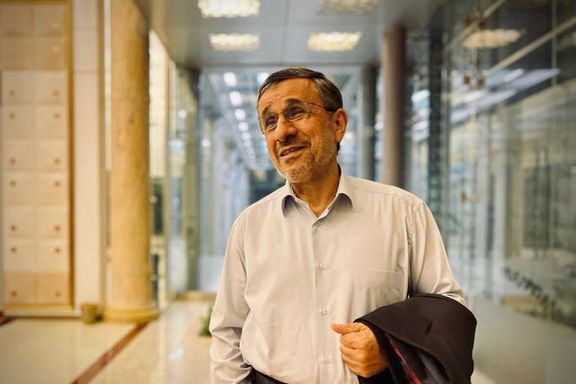
Mahmoud Ahmadinejad after his return to Dubai in Tehran. October 17, 2021
Mahmoud Ahmadinejad ended his Dubai trip on Sunday after the Iranian Consulate prevented him from holding a press conference, sources told Iran International.
Officials blocked reporters entering the venue, the Iranian Club Dubai, the sources in the United Arab Emirates said. The Iranian Club Dubai is a luxury hospitality center belonging to the state-affiliated ‘charitable’ Mostazafan Foundation. Later in the evening Ahmadinejad returned to Tehran prematurely.
This was the former president's first visit abroad since his second term ended in 2013. Media supporting Ahmadinejad had said that he was going to visit Expo 2020, a trade fair.
Principlist media claimed that Ahmadinejad had been deported by UAE police. It had become clear he was up to "political games and populist activities" that would undermine Expo 2020, Jahan News wrote Monday.
The reason for his early departure is not clear. It could have been a request by Emirati authorities or an order from Tehran for him to return.
The Revolutionary Guards-affiliated Fars news agency Sunday called Ahmadinejad's trip a "desperate attempt to be seen" that ended when he was "advised by UAE authorities" to return to Tehran.
Ahmadinejad's trip was well publicized by supporters and had sparked speculation a foreign travel ban had been lifted. Ahmadinejad criticized Supreme Leader Ali Khamenei for calling the June 18 presidential election an "epic" event, after he was barred from the poll. Ahmadinejad’s presidency saw him disagree with Khamenei, notably when heboycotted government meetingswhen the leader insisted that Heydar Moslehi remain intelligence minister.
Ahmadinejad gave an interview in Dubai to Independent Persian website covering relations with the United States, the Taliban, Saudi Arabia, the nuclear issue, Syria, and Yemen.
In the interview Ahmadinejad said he would not call himself an opposition figure. "I'm an Iranian and like any other Iranian I have a right to live and to express my views," he said. "If now someone is sitting at the head of the state, the country is not his, the country belongs to everyone and everyone has a right to express their views.”
In a video taken at Tehran's International Imam Khomeini Airport after his return, Ahmadinejad said he had intended to stay in Dubai three days but had extended his visit for two more. He promised "a full report” on his visit.
Some Iranian media last week published photos of Ahmadinejad with a woman claiming it was taken at the Israeli pavilion at the trade fair, while pro-Ahmadinejad media denounced this as a trick to tarnish Ahmadinejad's image. "Whoever says Ahmadinejad visited the Zionist regime's pavilion is a Mossad agent," Mohammad-Hossein Heydari, a pro-Ahmadinejad journalist tweeted.
Pro-Ahmadinejad lawmaker Ahmad Alireza-Beigi, who accompanied him to Dubai, dismissed an attempt to mislead the public. "The publication of this type of misinformation proves that Ahmadinejad's international popularity has worried those who lack such popularity and don't have similar travel chances," he said.
Spokesman of Iran's foreign ministry, Saeed Khatibzadeh. FILE PHOTO
Iran’s foreign ministry spokesman, Saeed Khatibzadeh has said on Monday that talks with Saudi Arabia “have been cordial and to the same degree serious”.
Khatibazadeh who was speaking to reporters during his weekly briefing, said that so far four rounds of negotiations have been held in Iraq and “talks have taken place in a friendly and positive atmosphere.”
Saudi Arabia and Iran severed diplomatic ties in January 2016 when mobs attacked and ransacked the Saudi embassy in Tehran and its consulate in Mashhad.
Riyadh later supported former US president Donald Trump’s decision to withdraw from the 2015 nuclear deal (JCPOA) and impose tough sanctions on Tehran.
Khatibzadeh did not offer any details to reporters but said that talks should be allowed to proceed at the negotiating table. He denied reports that a Saudi delegation might soon visit Iran.
Iran has so far presented a more optimistic picture of the talks while Saudi Arabia has said they have been “exploratory”.
The United States and its European allies who have been holding talks with Iran over its nuclear program have also raised the issue of Iran’s interventionist policies in the region. Iran might be interested to present its talks with Saudi Arabia as a counterweight to their arguments.
Iran's Supreme Leader Ali Khamenei (L) and president Ebrahim Raisi. FILE PHOTO
Iran’s President Ebrahim Raisi (Raeesi), in a rare move, has appointed two active-duty Revolutionary Guard commanders as governors in two key provinces.
In a decision of the cabinet on Sunday Abedin Khorram, Islamic Revolution Guard Corps (IRGC) commander in Eastern Azerbaijan was appointed governor of same province. Also, Yaghubali Nazari, IRGC commander in Khorasan-Razavi province became governor of the same province.
Raisi’s move in effect changed the civilian governorship in the two provinces into military governorship, since both IRGC officers were commanders in the same provinces, although they might be replaced as military commanders in the two provinces.
Islamic Republic presidential administrations and state entities have routinely given civilian positions to less active or former IRGC senior commanders but appointing active-duty military commanders directly to top civilian positions within the jurisdiction of their own commands has been rare.
IRGC's Abedin Khorram, appointed governor by Raisi.
Dozens of IRGC officers also swept into the parliament in the February 2020 elections, when hundreds of reformist candidates were barred from running, and with a very low voter turnout, hardliners and IRGC officers won an overwhelming majority.
Khorram was previously IRGC commander in Khoi and deputy commander and commander in Western Azerbaijan. Fars news agency affiliated with IRGC had earlier mentioned him as a veteran of the Syrian war, where Iran has deployed an array of forces since 2011 to defend Bashar al-Assad’s rule.
Nazari commanded IRGC forces in Khorasan-Razavi province for the past six years before being appointed as governor.
Raisi has already appointed several former IRGC officers as ministers in his cabinet and top managers in other positions throughout the government. One of his main economic aides is Mohsen Rezaei, a former top IRGC commander who has no experience as an economic manager.
Another military officer appointed as governor by Raisi is Ahmad Mohammadizadeh, who was the head of IRGC’s ‘strategic center for management and command’ and is now governor of Bushehr province.
Raisi’s agriculture minister Mohammad Sadatinejat also issued an order appointing the former commander of IRGC in Tehran, Mohsen Kazemeini to a special branch of the ministry in charge of food supply security. He was commander of the ‘Mohammad Rassoul Allah’ division in Tehran which plays the most critical role among all IRGC forces to protect and defend the regime against protests.
The policy of hardline supporters of Supreme Leader Ali Khamenei, backed by IRGC, in pushing many other loyal regime elements to the margins of politics has opened more vistas for Revolutionary Guard officers. The military force already is perhaps the biggest economic actor in Iran with hundreds of companies in all sectors.
General Mohammad Bagheri, head of Iran's Joint Staff. FILE PHOTO
In a visit to Moscow on Monday, the head of Iran’s Armed Forces Joint Staff Mohammad Bagheri said that Afghanistan is a special issue for bilateral discussions.
General Bagheri said that Iran has always had cooperation with Russian armed forces, and in recent years the cooperation has expanded.
“I have been invited by the Russian defense minister and in addition to bilateral military issues that need follow-up, Afghanistan is among special issues that both sides will discuss,” Bagheri maintained.
He added, “Events in Afghanistan definitely have impact on regional counties, including the Islamic Republic, the Russian Federation and others and we will talk about these.”
Iran and Russia are military allies in Syria since 2015, when Russia deployed its air force in the war-torn country to defend the rule of Bashar al-Assad. With ground forces Iran supplied and with Russian air power, the anti-Assad armed opposition was largely defeated.
Bagheri also spoke about defense cooperation with Russia since the lifting of a United Nations arms embargo on Iran last October and said Iran has plans of weapons purchases from Russia. He also stressed the need to continue cooperation in Syria.
President Ebrahim Raisi with aides pictured in August 2021
More than two months after his inauguration as Iran's new hardline President, Ebrahim Raisi (Raeesi) has completed the setup of his key economic team.
He appointed Ali Salehabadi as the Governor of the Central Bank of Iran, Majid Eshghi as the Chairman of the Stock Exchange and Davoud Manzour as the Taxation Department Chief in mid-October.
The official news agency said in an October 15 report that the make-up is not yet complete as there are still some vacant positions in the team, although these are not key positions.
Most of Raisi’s economic officials are either former military background or are functionaries of various types, none with high state-level or private sector economic experience.
Mohammad Mokhber, a key member of Supreme Leader Ali Khamenei's financial trust is First Vice President. His main job is to coordinate matters among various cabinet ministers. MassoudMirkazemi, an aide to former President Mahmoud Ahmadinejad, is the head of the Planning and Budget Organization. Farhad Rahbar, a former economic official at the Intelligence Ministry is Raisi’s assistant for economic affairs, and former IRGC commander Mohsen Rezaei is Vice President for Economic Affairs.
First Vice President Mohammad Mokber. FILE PHOTO
Rezaei recently issued a long directive to all economic officials and cabinet ministers which turned out to be nothing more than suggesting selling oil for food and other staples as a way of circumventing US sanctions, which could work only if Iran's possible trade partners risk being subjected to secondary sanctions.
Apart from Rezaei who has never been holding a position even remotely linked to economic affairs, the other members of President Raisi's economic team come mainly from Khamenei's office and his financial trust or from the administration of the holy shrine in Mashhad, where they worked with Raisi when he was the superintendent for about two years. Otherwise, none has had any executive experience in the government where they have to be more or less accountable for their performance.
Raisi’s officials are not used to checks and balances and the relative transparency of the government operations in comparison to non-accountable financial institutions that work parallel and sometimes totally separate from the government, do not pay taxes, and their operations are not scrutinized by the parliament and the State Auditing Organization.
Raisi's economic aide, Mohsen Rezaei.
These characteristics are also shared by Raisi's eight economic cabinet ministers, including Industries, Mining and Trade Minister Reza Fatemi Amin whose biggest job previously was the investment manager of the holy shrine's administration.
The highlight in the career of Labor Minister Hojjatollah Abdolmaleki is working at the Office of the Imam Khomeini Relief Committee, a pseudo-charity that operates under the aegis of Khamenei's office and runs various businesses that do not have anything to do with relief work or Khomeini.
Oil Minister Javad Owji's former job as deputy oil minister is not the only activity he is known for. The stories in the press in the 2010s alleged that he was trading oil for gold to help circumvent the sanctions. Road and Urban Planning Rostam Ghasemi was also involved and at one point was called to court for investigations regarding illicit oil trade under Ahmadinejad. On the other hand, Ahmadinejad's Industry and Trade Minister Ali Akbar Mehrabian who was found guilty of piracy and violating an innovator's patent rights is now Raisi's Energy Minister.
Very little is known in the public domain about the track record of Communication and ITC Minister Isa Zarepour and Agriculture Minister Javad Sadatinejad.
Ehsan Khandouzi, who is the Minister of Economy, has very little chance to do any serious work under the conflicting influences of Mokhber and Rezaei. Khandouzi and Mirkazemi are the two key officials who need to tackle the long-standing problems of high inflation, low employment and a more than 50 percent budget deficit, not to mention the problem of a battered currency.
In the meantime, Mirkazemi is also tasked with correcting the country's budgeting system which means depriving powerful religious institutions of hefty budgets they get for doing nothing for the economy. Doing so will turn some of Raisi's supporters into critics.
The Keyword for any success for Raisi's economic team is "coordination". A task difficult to accomplish partly because of the differences among Raisi's top officials and partly because of sudden ad-hoc orders issued by Raisi himself, without consulting anyone when he faces serious issues.
IRGC General Gholamreza Soleimani, commander of Basij. FILE Photo
Iran’s Revolutionary Guards will take a share of an ambitious housing construction project promised by the government, that could cost billions of dollars.
General Gholamreza Soleimani, the commander of the Basij, a paramilitary wing of the Islamic Revolution Guard Corps (IRGC) said Sunday that his organization will construct 100,000 residential units. President Ebrahim Raisi (Raeesi) has promised to build one million units a year during his four-year term, a huge project that would need billions of dollars a year, although the government has not presented a budget or a clear plan.
Soleimani did not mention how much the Basij would charge the government for the project. The IRGC is the largest economic force in the country, having dozens of companies in all sectors. Its business involvement has been a controversial issue among Iranians.
Iran’s government faces a deficit equal to 35-50 percent of its overall budget, as US sanctions have cut off most of its oil export revenues. It also has to cope with a falling currency and near 50 percent annual inflation.
A previous housing project during the presidency of Mahmoud Ahmadinejad was never completed although it was carried out during high oil prices and up to $100 annual oil exports.