• العربية
  • فارسی
Brand
  • Iran Insight
  • Politics
  • Economy
  • Analysis
  • Special Report
  • Opinion
  • Podcast
  • Live TV
  • Iran Insight
  • Politics
  • Economy
  • Analysis
  • Special Report
  • Opinion
  • Podcast
  • Live TV
  • Theme
  • Language
    • العربية
    • فارسی
  • Iran Insight
  • Politics
  • Economy
  • Analysis
  • Special Report
  • Opinion
  • Podcast
  • Live TV
All rights reserved for Volant Media UK Limited
volant media logo

Trump says Iran memorandum is over, calls Tehran leaders 'scums'

Jul 8, 2026, 09:11 GMT+1Updated: 15:04 GMT+1

US President Donald Trump said on Wednesday a memorandum of understanding with Iran aimed at ending the conflict was over, describing Iran's leaders as "liars and scums" and saying he no longer wanted to negotiate with them.

"As far as I'm concerned, it's over," Trump told reporters in Ankara before a NATO summit.

"I don't want to deal with them anymore. They're scum... they're sick people, they're led by sick people, and they're vicious, violent people."

Trump said he would allow US negotiators to continue talks if they wished but signaled he no longer believed diplomacy would succeed.

"They want to negotiate. They're good people... but they have to come back to me," he said. "As far as I'm concerned, it's just a waste of time dealing with them, they're liars."

Last month, Washington and Tehran had signed a memorandum of understanding setting out a framework to end the conflict, including steps toward a ceasefire and renewed talks over Iran's nuclear program.

Trump defends overnight strikes

Trump defended US strikes carried out overnight, saying they came after Iran launched missiles at ships a day earlier.

"We hit them very hard last night, very hard," he said. "I told them every time you hit, we hit."

He said Iran targeted commercial shipping after Washington had allowed time for funeral ceremonies for supreme leader Ali Khamenei following earlier fighting.

"We said, 'Go and do your funeral stuff,' and instead of that they start shooting rockets at ships yesterday."

'We're going to denuke it'

Trump repeated that Iran could never be allowed to obtain a nuclear weapon.

"They can't have a nuclear weapon," he said. "We're going to denuke it. We're not going to let them."

He said Iran killed US troops through proxy attacks and blamed former Iranian military commander Qassem Soleimani for supplying roadside bombs that killed American soldiers.

"They've killed thousands and thousands of our soldiers," Trump said. "They've killed hundreds of thousands of innocent people."

Trump also said Iran had sought to kill him.

"I saw things this morning. I'm on every single one of their lists," he said. "So far I guess I've been lucky."

He described Iran's leaders as "evil, sick people" and compared the country to "cancer."

"You've got to cut out cancer early."

'They killed 54,000 people'

Trump also said Iran's authorities killed thousands of protesters during anti-establishment demonstrations.

"They killed 54,000 people as of now that were protesting," he said.

"When people say, 'How come they haven't taken over?' They can't take over because they're dead."

He also added that Iran repeatedly breaks agreements.

"We make a deal... everyone's agreed, no nuclear weapon... they go outside, talk to the press, they say we never even talked about it," Trump said.

"There's something wrong with them. They're cuckoo."

Criticizes NATO allies

Trump also renewed criticism of NATO, saying several allies refused to support the United States during the conflict with Iran.

He said Britain, Germany and France declined requests to assist Washington during the fighting.

"They said, 'We don't want to help you now, but we'll help you when the war is over,'" Trump said.

He said the United States had been "treated unfairly" by NATO and paid "billions and billions of dollars too much" for the alliance's defense.

Trump also repeated criticism of Spain, calling it "a terrible partner in NATO" and saying he wanted to end US trade with the country.

The remarks came after the United States carried out a new wave of strikes on military targets in Iran in response to attacks on commercial shipping in the Strait of Hormuz. Iran later launched missile and drone attacks on US military sites in Bahrain and Kuwait, further eroding the memorandum signed earlier this week to halt the fighting.


Most Viewed

Iran’s oil industry has too many masters
1
OPINION

Iran’s oil industry has too many masters

2
ANALYSIS

Why Trump said no to Iran’s Hormuz proposal

3

Tehran seeks negotiated way out as Washington maintains pressure

4
PODCAST

Trump may be buying time on Iran until after the midterms

5

Iran wrong to expect midterms to restrain Trump, former US official says

Banner
Banner

Spotlight

  • Why Trump said no to Iran’s Hormuz proposal
    ANALYSIS

    Why Trump said no to Iran’s Hormuz proposal

  • Iran’s oil industry has too many masters
    OPINION

    Iran’s oil industry has too many masters

  • Iran wrong to expect midterms to restrain Trump, former US official says

    Iran wrong to expect midterms to restrain Trump, former US official says

  • Trump may be buying time on Iran until after the midterms
    PODCAST

    Trump may be buying time on Iran until after the midterms

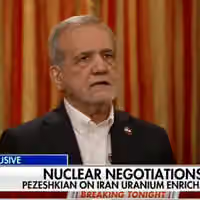
  • Pezeshkian’s Fox News nuclear overture draws hardline backlash
    INSIGHT

    Pezeshkian’s Fox News nuclear overture draws hardline backlash

  • US and Iran want a deal, but neither wants to move first
    ANALYSIS

    US and Iran want a deal, but neither wants to move first

Banner
Banner
  • US ends Iran's brief oil opening after Hormuz tanker attacks

    US ends Iran's brief oil opening after Hormuz tanker attacks

  • Commercial ships hit near Strait of Hormuz as Iran-US talks stall

    Commercial ships hit near Strait of Hormuz as Iran-US talks stall

•
•
•

More Stories

Khamenei to end Eje'i’s judiciary tenure after one term

Jun 30, 2026, 20:48 GMT+1
100%

Iran's Supreme Leader Mojtaba Khamenei plans to remove judiciary chief Gholam-Hossein Mohseni Eje'i at the end of his first five-year term and appoint a new figure to lead the judiciary, sources familiar with the matter told Iran International.

Sources inside Iran told Iran International that Khamenei does not intend to extend Eje'i’s term for another five years, breaking with a practice followed for nearly four decades in which judiciary chiefs have usually served two consecutive five-year terms.

The sources, who spoke on condition of anonymity, said the decision is not aimed at judicial reform but is part of a broader reshaping of power after the recent war.

They said the new supreme leader is seeking to replace key officials in major state institutions with figures more closely aligned with him.

Eje'i’s expected removal could mark one of the first major signs of Khamenei’s effort to rebuild control over the Islamic Republic’s judicial, security and political apparatus after the transfer of power.

Hardliners step up pressure on Eje'i

The decision comes amid growing criticism of Eje'i from hardline figures after the names of Supreme National Security Council members who voted in favor of a memorandum of understanding with the United States were disclosed.

Critics say Eje'i’s vote was at odds with Khamenei’s stated position, after the leader said in a letter that he had, in principle, held a different view on the memorandum of understanding.

Signs of dissatisfaction with Eje'i’s five-year record have also appeared in recent official and semi-official commentary close to the power structure.

In a message marking Judiciary Week, Khamenei did not clearly endorse Eje'i’s continuation in office. Instead, he addressed the judiciary as an institution and called for the “actualization” of demands previously made by former Supreme Leader Ali Khamenei.

The message repeated calls for the implementation of the judicial transformation document, fighting corruption inside the judiciary, reviving public rights, blocking the use of recommendations and lobbying, and improving communication with the public.

Eje'i seeks to defend his record

A day later, Eje'i published a letter to Khamenei in deferential language, defending the judiciary’s performance and pledging to continue the path of “judicial transformation.”

“I and all components of the judiciary consider ourselves obliged to carry out Your Excellency’s binding commands precisely, swiftly and without any reduction,” Eje'i wrote.

Media outlets and figures close to the establishment criticized Eje'i for not publishing such a letter before Khamenei’s message. Some also described the new leader’s renewed emphasis on his father’s demands as a negative assessment of Eje'i’s record, arguing that their repetition showed the judiciary had failed to deliver practical results under him.

Rival factions inside the establishment have also stepped up attacks on Eje'i, accusing him of distancing himself from the leadership’s demands.

Media close to Parliament Speaker Mohammad Bagher Ghalibaf and President Masoud Pezeshkian have described the attacks as part of an effort by the faction aligned with Saeed Jalili, a member of Iran’s Supreme National Security Council, and the Paydari Front to create divisions among senior officials and weaken the postwar political path.

Media close to the judiciary and Eje'i’s supporters have sought to portray his five-year record as successful, citing reduced imprisonment, electronic court proceedings, shorter trials, anti-corruption efforts and public outreach.

Rights groups point to record of repression

Human rights groups and activists say Eje'i is not a reformist figure but a long-standing part of the Islamic Republic’s repressive judicial and security apparatus.

They point to his record in the Special Clerical Court, the Ministry of Intelligence, and later as first deputy and head of the judiciary, saying his tenure has been marked by continued heavy sentences against protesters, political activists, journalists, prisoners of conscience and minorities.

Rights advocates say the judiciary under Eje'i has continued to act as the legal and executive arm of security institutions in political and security cases.

They also argue that replacing Eje'i alone would not bring meaningful change without structural reform, an end to security interference in judicial cases, guaranteed access to lawyers, a halt to forced confessions, the annulment of political verdicts and respect for fair trial standards.