• العربية
  • فارسی
Brand
  • Iran Insight
  • Politics
  • Economy
  • Analysis
  • Special Report
  • Opinion
  • Podcast
  • Iran Insight
  • Politics
  • Economy
  • Analysis
  • Special Report
  • Opinion
  • Podcast
  • Theme
  • Language
    • العربية
    • فارسی
  • Iran Insight
  • Politics
  • Economy
  • Analysis
  • Special Report
  • Opinion
  • Podcast
All rights reserved for Volant Media UK Limited
volant media logo
INSIGHT

Trump’s ‘Stone Age’ threat draws fury from Iranians

Maryam Sinaiee
Maryam Sinaiee

Iran International

Apr 3, 2026, 19:19 GMT+1
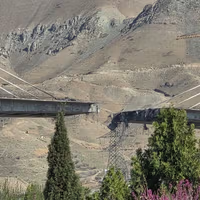
The B1 Bridge near Karaj, Iran, was struck twice by the United States on April 2, 2026.

President Trump’s threat to bomb Iran’s infrastructure and “send it back to the stone ages,” followed by strikes that reportedly included a not-yet-opened bridge, has sparked anger among Iranians at home and abroad.

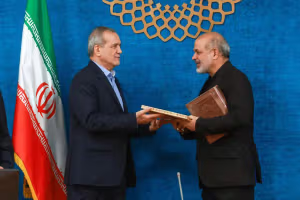
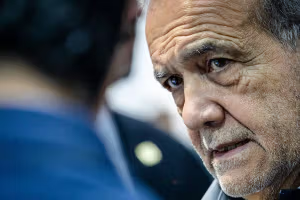
Iran’s president Masoud Pezeshkian condemned the remarks, writing: “Does threatening to send an entire nation back to the Stone Age mean anything other than a massive war crime? … History is full of those who paid a heavy price for their silence in the face of criminals.”

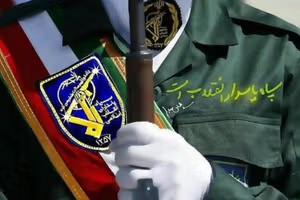
Ground Forces commander Ali Jahanshahi, warned to send US troops “not to the Stone Age but to pre-Stone Age.”

International reactions have also been critical. Former IAEA chief Mohamed ElBaradei accused Trump and Israel’s prime minister Benjamin Netanyahu of “employing horrific methods” and quipped, “I truly don't know who belongs to the Stone Age!”

Former Swedish prime minister Carl Bildt also weighed in, saying Iranians want “a decent and representative government” not being bombed back to the Stone Age.

‘War crimes’

Anger also surged among ordinary Iranians and diaspora communities—many of whom oppose the government but object strongly to threats against national infrastructure and civilian sites.

Strikes on health facilities such as the Pasteur Institute of Tehran have heightened sensitivities about civilian harm.

Hadi Partovi, a technology investor with Iranian roots, framed the issue in moral terms: “Many Iranians supported your war because your plan was to liberate Iran. Instead, you celebrate sending a civilization to the Stone Age. Great leaders build, not destroy… I weep to see America like this.”

London-based human rights lawyer Shadi Sadr accused Western governments of hypocrisy, arguing that initial justifications under the “Responsibility to Protect” have given way to actions that “send those same people back to the Stone Age, committing war crimes on a massive scale.”

Tehran-based journalist Yashar Soltani wrote: “You first spoke of ‘liberating Iran.’ Then you bombed a school in Minab and took the lives of children. And today you speak of dragging Iran back to the ‘Stone Age’.”

“Iran is a land that, when many nations were still in the Stone Age, was building cities, writing laws, and creating civilization,” he added.

Rift over costs of war

Despite widespread criticism, reactions among Iran’s opposition have not been uniform.

Some supporters of regime change argue that damage to infrastructure, while painful, can ultimately be repaired. They point to historical precedents such as the Iran–Iraq War, when key facilities including oil refineries and export terminals were rebuilt after extensive destruction.

Others contend that the Islamic Republic’s long-term impact on governance, the economy and human capital outweighs the immediate damage caused by military strikes. For them, the focus should remain on political repression, including executions and internet shutdowns.

One social media user questioned priorities: “How can your infrastructure and the Stone Age be your priority before you even mention the executions and internet shutdowns!”

Another argued that reconstruction would follow regime change, writing: “Don’t worry about iron and concrete; worry about a homeland occupied by incompetence… after that, a free Iran will build infrastructure worthy of the name Iran.”

Some commentators have also suggested that Trump’s rhetoric was directed primarily at Iran’s ruling establishment rather than the public. “When he says… ‘we’ll hit you and send you back to the Stone Age,’ he’s talking to the clerics, not the people,” one user wrote.

Most Viewed

Iran’s wartime messaging targets its own citizens
1
INSIGHT

Iran’s wartime messaging targets its own citizens

2

Two more political prisoners executed in Iran

3

Iran executes two men as protest-related hangings continue

4

Hardliners pile on 'traitor' Zarif, urge his arrest over call for end of war

5
PODCAST

UAE crackdown could hit Iran’s wider shadow network, experts say

Banner
Banner

Spotlight

  • UAE crackdown could hit Iran’s wider shadow network, experts say
    PODCAST

    UAE crackdown could hit Iran’s wider shadow network, experts say

  • Trump’s ‘Stone Age’ threat draws fury from Iranians
    INSIGHT

    Trump’s ‘Stone Age’ threat draws fury from Iranians

  • Iran’s wartime messaging targets its own citizens
    INSIGHT

    Iran’s wartime messaging targets its own citizens

  • War follows us Iranian scientists far from home
    OPINION

    War follows us Iranian scientists far from home

  • War tests Iran’s Dubai trade lifeline
    ANALYSIS

    War tests Iran’s Dubai trade lifeline

•
•
•

More Stories

Iran’s wartime messaging targets its own citizens

Apr 3, 2026, 16:38 GMT+1
•
Behrouz Turani

Iran’s state broadcaster has adopted a noticeably harsher tone toward dissent, increasingly framing domestic protests as part of a war waged by “enemies.”

One of the clearest examples came on March 10, when Police Commander Ahmad-Reza Radan addressed the possibility of protests during the conflict.

Speaking on state television, he warned that anyone who took to the streets “at the will of the enemy” would no longer be treated as a protester but as an “enemy combatant.”

The wording marked a significant escalation. By invoking the language of combat, the state effectively framed domestic dissent as participation in the war itself.

Such framing has appeared repeatedly in recent broadcasts. Commentators and officials frequently describe protests not as political grievances but as extensions of foreign military pressure.

The same rhetorical shift is evident in the way foreign adversaries are described. Television hosts increasingly employ dehumanizing metaphors to portray Western and Israeli leaders.

Israeli officials have been repeatedly referred to as “rabid dogs” on talk shows, imagery that casts them as biological threats rather than political opponents.

Foreign-based Persian-language media outlets are portrayed in similarly extreme terms. Iran International TV, for example, has been described on state television as a “satanic network,” while presenters have warned that its regional offices could be considered legitimate targets.

The tone is often even more unrestrained online, where state television presenters engage in public taunts and insults with Israeli officials and journalists on social media.

The language echoes wartime propaganda seen in many conflicts, where demonization of the enemy is used to mobilize domestic support. But the Iranian broadcasts go further by combining this rhetoric with arguments that dismiss international norms governing warfare.

On several television panel discussions in March, state-aligned analysts suggested that international humanitarian law and institutions such as the United Nations serve merely as tools of Western power.

Some commentators declared bluntly that “the age of diplomacy is dead” and that the West understands only “the language of missiles.”

In this atmosphere, messaging increasingly serves not only to condemn foreign adversaries but also to warn domestic audiences about the consequences of dissent.

When protests are described as actions carried out “at the will of the enemy,” the implication is that political opposition itself becomes a form of collaboration with hostile powers.

Wars have always reshaped political language. Governments under military pressure tend to simplify narratives, divide the world into allies and enemies, and suppress ambiguity. Iran’s state television now appears to be moving decisively in that direction.

When state television begins speaking about its own citizens in the language of the battlefield, it signals that the war is no longer being presented as something happening only beyond the country’s borders.

Iran’s Pezeshkian faces hardline backlash over conditional war-end offer

Apr 3, 2026, 07:23 GMT+1
•
Maryam Sinaiee

Iranian President Masoud Pezeshkian is facing a fierce political backlash after signaling a conditional willingness to end the war, exposing deep divisions within Iran’s political and military establishment over diplomacy versus continued conflict.

In a phone call on Tuesday with European Council President Antonio Costa, Pezeshkian said Iran has the “necessary will” to bring the conflict to an end - provided that “essential conditions, especially guarantees to prevent renewed aggression, are met.”

Following Pezeshkian’s remarks, US President Donald Trump wrote on Truth Social that the “president of the new Iranian regime” had requested a ceasefire. Oil prices dipped slightly after the comments.

Iranian officials swiftly rejected Trump’s characterization. Mehdi Tabatabaei, the deputy for communications and information at the president’s office, responded on X:

“The position of the Islamic Republic of Iran regarding the defense of the nation against the aggression of evildoers and the conditions for ending the imposed war has not changed, and there is no regard for the delusions and lies of criminals.”

In a letter addressed to the American public published on Wednesday, Pezeshkian reiterated that Iran’s military actions were “purely a response and defense, not the initiation of war and aggression.” He described continued confrontation as “costly and fruitless,” signaling a more pragmatic tone from parts of the political establishment.

  • Rift deepens between Iran’s president and Guards chief over war, economy

    Rift deepens between Iran’s president and Guards chief over war, economy

  • IRGC pressured Pezeshkian to appoint Zolghadr as security chief

    IRGC pressured Pezeshkian to appoint Zolghadr as security chief

Hardliners and figures aligned with the security establishment have set stricter conditions for ending the war. Mohsen Rezaei, now a military adviser to Mojtaba Khamenei, has said the conflict should only end with reparations and guarantees, including the removal of US bases from the region.

Hardliner backlash intensifies

Pezeshkian’s comments triggered strong criticism from conservative and hardline figures. Lawmaker Hamid Rasaei described the remarks as evidence of a “wavering personality” and “passivity in the face of the enemy,” arguing that such positions could embolden further attacks.

Rasaei has previously compared Pezeshkian to Iran’s first president, Abolhassan Banisadr, who was removed from office by parliament for “political incompetence”. Similar comparisons have circulated widely on social media in recent days.

Some critics framed the conflict as a struggle between “truth and falsehood” and opposed any negotiated settlement short of total victory.

Calls for deterrence over diplomacy

In an open letter published on X, hardline activist Mohammad Shirakvand criticized Pezeshkian’s appeal for European guarantees, writing: “When you yourself state that the United States does not believe in diplomacy, what does speaking of guarantees for ending the war mean other than repeating a costly mistake?”

“This war is a battle of truth against falsehood and an arena of clashing wills. The government must play on this field, not on promises that have repeatedly proven unreliable,” he added.

Shirakvand argued that “real guarantees are not built through diplomacy, but through power and deterrence on the battlefield.”

  • IRGC takes de facto control of Iran government amid deepening power struggle

    IRGC takes de facto control of Iran government amid deepening power struggle

  • Pezeshkian grilled after apologizing for ‘fire at will’ strikes on neighbors

    Pezeshkian grilled after apologizing for ‘fire at will’ strikes on neighbors

Another widely shared post by a conservative account, Rah-e Dialameh, described Pezeshkian’s remarks as “sending a signal of weakness to the enemy,” linking them to the drop in oil prices and warning that such a strategy “must be stopped before it causes further damage.”

Some hardline users accused Pezeshkian of “sending ceasefire signals” and weakening Iran’s military posture, demanding that security authorities “control” him.

One user appeared to issue an implicit threat, suggesting authorities should restrict his public appearances “to protect his life,” claiming the country “is better managed on autopilot.”

Son defends the president’s stance

Amid escalating criticism, Pezeshkian’s son and adviser, Yousef Pezeshkian, publicly defended his father. He challenged critics’ logic, asking: “I do not understand the meaning of these criticisms; are we not seeking to meet conditions and obtain guarantees? Or are we seeking war until the complete destruction of America and Israel?”

He framed the president’s position as a realistic attempt at conditional de-escalation, contrasting it with what he implied were unrealistic or maximalist goals.

He also defended his father’s earlier apology to neighboring countries affected by Iranian strikes, calling it an “ethical duty” and highlighting efforts to maintain regional relations despite the conflict.

‘War must end—but so must the regime’: civilians speak from under fire

Apr 2, 2026, 20:45 GMT+1
•
Maryam Sinaiee

Relentless airstrikes by Israel and the United States have transformed life across Iran, reshaping cities and daily routines while leaving millions caught between fear, resilience, and deeply divided views on the war.

For many ordinary citizens, the psychological toll of constant airstrikes is profound. In the absence of an effective warning system, a near-permanent sense of insecurity dominates daily life.

Families—especially those with children or vulnerable members requiring medical care—have fled heavily targeted cities such as Tehran. Some of them have sought refuge in smaller towns and rural areas considered relatively safer from the repeated strikes that occur both day and night.

Those who have remained in their homes describe a life defined by constant anticipation of attacks.

Golshan, a woman living in Tehran with her two dogs, writes daily about her experiences on X. “Night is no longer a time for sleep—it is a field of waiting,” she wrote. “Waiting for a sound you don’t know where it will come from, but you are certain that when it does, something inside you will break.”

She added that she avoids using the elevator, fearing a sudden power outage could trap her and her pets during an attack.

Another user, Marzieh, described how even basic activities have become stressful. “Taking a shower has become anxiety-inducing for many,” she wrote, explaining that people fear being trapped mid-attack or losing water if the electricity is cut. “Every moment of their lives is filled with fear and worry.”

The International Committee of the Red Cross recently shared the account of a mother named Golnaz on X, describing the aftermath of an airstrike that cut off electricity and blew doors and windows off their hinges.

“After that, our home was no longer a safe place,” she said. She added that they had to move to her brother’s house, but even there her sons do not feel safe, so she is considering taking them somewhere far from the noise of war to recover from the shock.

Despite these conditions, some citizens say they are trying to preserve a sense of normalcy. They continue to visit cafés, walk in parks, and exercise outdoors whenever possible, attempting to maintain fragments of everyday life amid the uncertainty.

Reactions to the war’s broader implications remain deeply divided.

Supporters of the government describe the conflict as a “holy war” and insist it must continue until what they call “final victory.” Despite nightly bombardments, including during rainstorms, men and women who back the authorities continue to gather in city squares, chanting slogans and attending funerals for officials killed in the strikes.

Their presence is not limited to such rallies. According to social media reports, groups of pro-government men, alongside members of the Basij militia—sometimes including teenagers—patrol neighborhoods at night on motorcycles and pickup trucks.

  • Children as young as 12 can join war support, IRGC says

    Children as young as 12 can join war support, IRGC says

They broadcast slogans over loudspeakers or play religious mourning songs late into the evening, adding to the strain of already sleepless nights for many residents.

Some Iranians express hope that continued strikes and the killing of government officials could lead to the collapse of the current system. One user wrote that relatives in Tehran become anxious when attacks appear to decrease, fearing that the war might end and “they”—meaning the Islamic Republic—might survive.

A user, Elham, shared the words of an acquaintance: “When there are no attacks, I get stressed that we’re still here and these savages are still in power."

"When the strikes happen, I’m so afraid I can only cry and wish for it to end quickly. I don’t even know what I want anymore. I just want them gone—and the war gone too," she added. “This is not a life anyone deserves. We wanted nothing more than an ordinary life.”

Those who share this view warn that an inconclusive end to the war could bring severe consequences: intensified repression of dissent, continued sanctions, widespread unemployment, the collapse of businesses, rising inflation—particularly in food prices—and potential shortages of electricity, water, and essential goods such as medicine.

Yet there is also a third group—neither aligned with government supporters nor hopeful that war will bring political change. These individuals simply call for an immediate end to the conflict.

A woman named Somayeh, opposing the continuation of the war, addressed both sides in a post: “Do you know what it feels like to hang a whistle around your neck and your child’s before going to sleep at night? If you don’t, then don’t tell me that war is the best thing for me.”

War follows us Iranian scientists far from home

Apr 2, 2026, 04:46 GMT+1
•
Ebrahim Karimi

I have learned as an Iranian-American scientist that war and politics rarely remain outside the laboratory for scholars from the Middle East, following us into our visas, our collaborations and even our ability to concentrate on our work.

To be born a scientist in the Middle East, and particularly in Iran, is to inherit constraints that shape your education, your mobility and often your sense of belonging long before you publish your first paper.

For many students, the obstacles begin early. Access to higher education can depend on geography, religion, ethnicity or family background. Certain research topics are restricted. Background checks are routine. Resources are uneven.

These constraints do not extinguish ambition. Many of the most driven students I have met from the region have worked relentlessly to overcome barriers that would discourage others. A significant number succeed in gaining admission to leading universities abroad, often ranking among the strongest in their cohorts.

But leaving does not mean leaving politics behind.

Students from Iran and other parts of the Middle East frequently undergo additional security screening when applying for visas or research permits in Western countries. Even when governments recognise the vulnerability of marginalised groups, the bureaucratic process can be prolonged and uncertain. Delays disrupt research timelines, funding and family life.

For a graduate student on a fixed stipend, uncertainty is not an abstraction. It is rent, tuition and the ticking clock of a degree.

Once abroad, the challenges evolve rather than disappear entirely. Family, friends and history bind students to their countries of origin. Political upheaval, internet shutdowns, military escalation or widespread protests reverberate across continents.

During periods of unrest, many students feel a moral obligation to support loved ones financially and emotionally. They spend hours each day checking the news, supporting movements on social media, translating information, sending money and making calls at odd hours.

Research suffers. Sleep suffers. Concentration suffers. The entire laboratory feels the impact when one member is under acute stress.

Political manipulation and disinformation can deepen divisions within diaspora communities, leading to heated disputes that further isolate students already under strain.

I have lived through several such cycles as a graduate student and now as a professor. Today I receive daily messages from students—via email, on social media or during meetings—asking for advice. My guidance is simple, though not easy to follow: help where you can, avoid corrosive debates and focus on your research and your long-term goals.

This tension between civic conscience and scientific focus is what I think of as a form of geographic discrimination. Events far beyond one’s control can disrupt internet access, travel, funding and collaboration, affecting thousands of scientists across the globe simply because of where they were born.

The current conflict involving Iran, Israel and the United States illustrates this clearly. Universities and schools have closed. Conferences and workshops have been postponed or cancelled. Laboratories face interruptions, whether from direct damage, security restrictions or the displacement of staff and students.

Even when military actions are described as targeted, research institutes and surrounding civilian infrastructure are not immune to the shock.

Recent strike damage near civilian educational facilities in Iran, which cost the lives of 160 students, and the previous attack on the Weizmann Institute of Science in Israel are reminders that scientific ecosystems are fragile. Rebuilding infrastructure takes years. Rebuilding trust and a sense of safety can take longer.

The long-term cost is not measured only in damaged buildings or delayed experiments. It is measured in lost collaborations, abandoned projects and the quiet departure of talented young people who decide that stability matters more than prestige.

Science thrives on openness, mobility and sustained concentration. War undermines all three.

When we speak about geopolitical conflict, we often focus on borders, strategy and power. We speak less about research teams fractured by forces entirely outside their control.

If we value scientific progress, we must recognise how deeply it depends on the human beings who carry it forward. For many scientists from the Middle East, war is not a distant headline. It is an interruption that follows them into the laboratory and into the quiet hours when research demands clarity of mind.

Protecting science, in times of conflict, means protecting them as well.

War tests Iran’s Dubai trade lifeline

Apr 1, 2026, 21:23 GMT+1
•
Dalga Khatinoglu

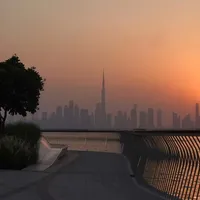
The war pitting the United States and Israel against Iran is being fought across airspace and shipping lanes, but one of its most consequential economic effects may be unfolding elsewhere: the fragile commercial relationship between Tehran and the United Arab Emirates.

A series of recent economic measures taken by the UAE following Iranian attacks on Emirati infrastructure has exposed how deeply Iran’s external trade depends on Dubai’s role as a financial and logistical gateway.

The steps—ranging from restrictions on Iranian nationals to disruptions in financial and trade channels—highlight both the extent of interdependence between the two economies and the vulnerabilities that accompany it.

Iran’s consulate in Dubai confirmed that more than 1,200 Iranians were repatriated through indirect routes via Armenia and Afghanistan after direct travel links were suspended.

More consequential than these immediate measures, however, is the disruption of bilateral trade flows. The UAE is Iran’s second-largest trading partner after China and serves as a critical gateway for imports.

No container ships have been seen crossing from Emirati ports to Iran since the start of the conflict, according to Rebecca Gerdes, an analyst at data company Kpler.

According to official data, Emirati exports to Iran rose from about $5.2 billion in 2018—when the United States withdrew from the nuclear deal—to roughly $23 billion in recent years, accounting for more than one-third of Iran’s total imports.

Iran’s non-oil exports to the UAE have also grown, rising from $5.7 billion to nearly $8 billion.

Data from Kpler, seen by Iran International, indicates that Iran exports about 160,000 barrels per day of fuel oil (mazut) to the UAE, along with smaller volumes of other petroleum products such as LPG.

Services trade constitutes another vital channel. Iran imports roughly $23 billion in services annually—including logistics, engineering, insurance and trade facilitation—of which the UAE accounts for about 22 percent.

A substantial portion of this economic relationship also operates outside formal channels. Iran is estimated to import more than $20 billion worth of smuggled goods each year, much of it routed through the UAE.

Dubai has also served as a key node for currency exchange networks, document falsification related to oil shipments and other mechanisms used to circumvent international sanctions. Iranian exchange houses have played a central role in facilitating these activities.

Recent reports suggest that dozens of exchange operators with alleged links to Iran’s Islamic Revolutionary Guard Corps have been detained in the UAE as tensions escalated. While the full scope of these actions remains unclear, they point to a broader effort by Emirati authorities to tighten enforcement and limit illicit financial flows.

Iran’s recent military actions have targeted multiple locations in the UAE, including Fujairah—the country’s only oil export terminal outside the Strait of Hormuz—raising concerns about energy security and trade continuity.

A recent Goldman Sachs report warned that a prolonged closure of the Strait of Hormuz could reduce the UAE’s GDP by as much as 6 percent in April alone, underscoring the broader regional economic risks posed by the conflict.

Yet the same dynamics also expose Iran’s vulnerabilities. The UAE’s role as a commercial, financial and logistical hub makes it difficult to replace in the short term.

Few countries possess the infrastructure, geographic proximity and established trade networks required to replicate Dubai’s function in Iran’s economic ecosystem.

Whether the UAE’s response becomes a decisive pressure point for Iran will depend on both the duration and the breadth of the restrictions.

In the short term, disruptions to trade, finance and logistics are likely to raise costs and complicate supply chains for Iranian importers. Over the longer term, sustained constraints could push Tehran to diversify routes and partners, though replacing the UAE’s role would be neither quick nor straightforward.

For now, the trajectory of tensions suggests that friction with the UAE may emerge as one of the most consequential external challenges to Iran’s trade architecture long after the current conflict subsides.