• العربية
  • فارسی
Brand
  • Iran Insight
  • Politics
  • Economy
  • Analysis
  • Special Report
  • Opinion
  • Podcast
  • Iran Insight
  • Politics
  • Economy
  • Analysis
  • Special Report
  • Opinion
  • Podcast
  • Theme
  • Language
    • العربية
    • فارسی
  • Iran Insight
  • Politics
  • Economy
  • Analysis
  • Special Report
  • Opinion
  • Podcast
All rights reserved for Volant Media UK Limited
volant media logo

'Rat-Ali': Iran’s protest nickname targets Ali Khamenei’s time underground

Arash Sohrabi
Arash Sohrabi

Iran International

Jan 28, 2026, 10:04 GMT+0Updated: 12:49 GMT+0
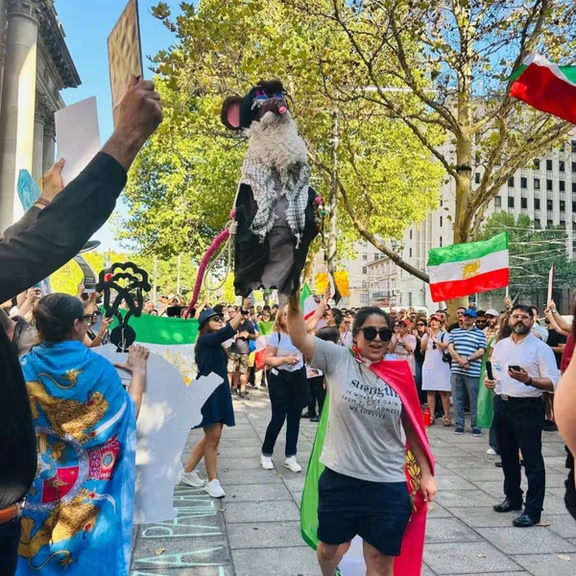
An Iranian protester holds an effigy depicting Supreme Leader Ali Khamenei with a rat’s head during a rally in Adelaide, Australia, in support of protests in Iran, January 2026.

Many Iranians on social media have been referring to Supreme Leader Ali Khamenei as ‘Moush-Ali’ (Rat-Ali), a nickname rooted in reports that he has repeatedly gone into underground seclusion and now echoed at rallies inside Iran and in diaspora protests.

The expression gained traction during the 12-day war with Israel in June, when Khamenei largely disappeared from public view amid reports that he had moved into a fortified underground shelter.

While Iranian officials did not confirm his location at the time, state media limited his presence to a pair of prerecorded video statements, which appeared to be filmed from a bunker rather than his office.

Since then, new reports have reinforced the perception of prolonged seclusion.

According to sources who spoke to Iran International on condition of anonymity, Khamenei has again taken refuge in an underground facility in Tehran amid heightened concerns about a potential US strike amid the recent wave of nationwide protests.

The site is described as a fortified complex with interconnected tunnels, with his son, Masoud Khamenei, overseeing day-to-day operations and serving as the main conduit between the leader’s office and the government.

Protesters hold a rat’s head wearing a turban during a rally in support of protests in Iran
100%
Protesters hold a rat’s head wearing a turban during a rally in support of protests in Iran

In Persian, “moush” (rat) is a common metaphor for timidity or avoidance, particularly when someone is perceived as retreating from danger rather than confronting it. By pairing the word with Khamenei’s name, critics draw a sharp contrast between the image he has long cultivated – of a steadfast leader and commander-in-chief – and his physical absence during moments of acute national crisis.

The nickname has also taken on a visual dimension. Protest imagery circulating online depicts rats in clerical robes or emerging from underground tunnels, reinforcing the association between concealment and political weakness.

One chant that includes the term – “Cry out, Moush-Ali, Pahlavi is coming” (Zajjeh Bezan Moush-Ali, Dareh Miad Pahlavi) – links the insult to broader political demands and signals a rejection not only of Khamenei personally, but of the authority structure he represents.

For analysts, the spread of the phrase points to something deeper than mockery. Khamenei’s extended absence during the war, followed by reports that senior officials struggled to reach him directly, has raised questions about leadership visibility and continuity.

While political slogans in Iran have evolved before, the rapid adoption of “Moush-Ali” shows how language becomes a vehicle for social judgment – compressing complex grievances about power, accountability, and legitimacy into a single, resonant word.

In that sense, the term is less about insult than about perception: a reflection of how authority is being re-imagined, contested, and, increasingly, stripped of its aura.

100%
A protester holds a rat doll wearing a turban and bearing the word “Moush-Ali” during a rally in Brussels in support of protests in Iran, January 2026.
100%
A protester holds a rat doll wearing a turban and bearing the word “Moush-Ali” during a rally in Brussels in support of protests in Iran, January 2026.

Most Viewed

Ideology may be fading in Iran, but not in Kashmir's ‘Mini Iran'
1
INSIGHT

Ideology may be fading in Iran, but not in Kashmir's ‘Mini Iran'

2
INSIGHT

Hardliners push Hormuz ‘red line’ as US blockade tests Iran’s leverage

3
VOICES FROM IRAN

Hope and anger in Iran as fragile ceasefire persists

4

US sanctions oil network tied to Iranian tycoon Shamkhani

5

Iran International says it won’t be silenced after London arson attack

Banner
Banner

Spotlight

  • Hardliners push Hormuz ‘red line’ as US blockade tests Iran’s leverage
    INSIGHT

    Hardliners push Hormuz ‘red line’ as US blockade tests Iran’s leverage

  • Ideology may be fading in Iran, but not in Kashmir's ‘Mini Iran'
    INSIGHT

    Ideology may be fading in Iran, but not in Kashmir's ‘Mini Iran'

  • War damage amounts to $3,000 per Iranian, with blockade set to add to losses
    INSIGHT

    War damage amounts to $3,000 per Iranian, with blockade set to add to losses

  • Why the $100 billion Hormuz toll revenue is a myth
    ANALYSIS

    Why the $100 billion Hormuz toll revenue is a myth

  • US blockade targets Iran oil boom amid regional disruption
    ANALYSIS

    US blockade targets Iran oil boom amid regional disruption

  • Iran's digital economy battered by prolonged blackout
    INSIGHT

    Iran's digital economy battered by prolonged blackout

•
•
•

More Stories

Wealthy Iranian brothers chose protest and were killed

Jan 28, 2026, 01:53 GMT+0

Brothers Hamid and Vahid Arzanlou were two well-known entrepreneurs in Iran’s furniture industry who despite their wealth still chose to raise their voices in anti-government protests this month and paid with their lives.

During mass killings by security forces in the Tehranpars area east of Tehran on January 9, Hamid Arzanlou was shot in the head and Vahid was shot twice in the neck while trying to save him, according to sources close to the family.

Both brothers later died from their wounds.

At their funeral, a third brother Kiomars Arzanlou asked mourners to clap if they believed his brothers had chosen the right path, and the mourners responded by applauding the two Arzanlou brothers.

According to the sources, security agencies demanded more than one billion tomans (about $6,670) from the relatives in exchange for handing over the bodies.

Hamid and Vahid, the sources added, actively supported and helped organize walkouts during the early days of strikes in Tehran’s central bazaar beginning late last year.

The large‑scale strike on January 7 at the furniture market in the Delavaran district was organized partly through their efforts and became one of the biggest strikes in eastern Tehran.

Sources close to the family say the two brothers were also among the first on the streets on the night of January 8, standing alongside other protesters for hours before security forces unleased a two-day crackdown which killed them along with thousands of other demonstrators.

Hamid and Vahid were owners and managers of the Aysa Mobl Kian furniture company which is one of the best‑known brands in Iran’s furniture industry.

At its peak, this group created jobs for at least one thousand people directly and indirectly and employed about 200 workers directly.

The two brothers hailed from a working‑class family and grew up in Tehran’s Khak‑e Sefid neighborhood and had built up wealth through their hard work and thrift, the sources added.

Vahid was the father of three children while Hamid is leaves behind two young children. Their mother, 68, survives them.

A protester’s final wish: 'Bury me wrapped in the lion and sun flag'

Jan 27, 2026, 21:17 GMT+0
•
Azadeh Akbari

Mojtaba (Shahmorad) Shahpari, a protester from the southwestern Iranian city of Izeh who was injured during the nationwide protests and later found dead in a cold storage warehouse in Isfahan, was laid to rest wrapped in the lion and sun flag, fulfilling his final wish.

Shahpari was shot by security forces on January 8, 2026, during protests in Baharestan, Isfahan province, people familiar with the matter told Iran International.

The sources, who asked not to be named for fear of retaliation, said security forces opened fire indiscriminately on protesters that night.

“They opened fire on everyone that night, men and women, young and old,” the source said.

Videos sent to Iran International show gunshots being heard as protesters chant “long live the King” in Baharestan on January 8.

Security forces shot Shahpari in the leg on Isar Street in Baharestan sometime between 8:30 p.m. and 9 p.m. local time, causing him to fall to the ground, a source said.

Wounded but alive, he was taken by ambulance to Al-Zahra Hospital in Isfahan.

“He was not dead when he was taken to hospital,” the source added.

For days afterward, Shahpari’s family searched hospitals across Isfahan. Authorities repeatedly told them he was wounded and alive but refused to say where he was, the source said.

“Then there was nothing. No answers.”

Three days later, the family’s search ended near Bagh-e Rezvan cemetery, Isfahan’s main burial ground.

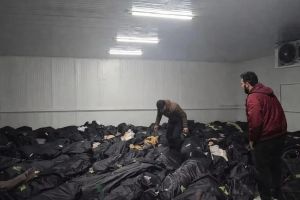
With the cemetery morgue full, bodies were being kept in a storage warehouse used for fruit and vegetables near Bagh-e Rezvan cemetery, the source said.

“There was no space ... They had put the bodies in a warehouse. As far as the eye could see, there were bodies,” putting the total at a minimum of 500.

When the body was found, a gunshot wound was visible on the side of his head, which the source said was not present when he was taken to hospital.

The source said they believed it was a gunshot to execute him and that he had been operated upon on his abdomen without his family's knowledge and later stitched back up.

About 18 miles southeast of Baharestan, also in Isfahan province, in the provincial capital, another source told Iran International that at the height of protests, “several containers of bodies” were brought to Bagh-e Rezvan in the middle of the night and unloaded into warehouses.

According to the source, some of the bodies were still alive and semi-conscious.

100%

Shahpari, 32, was originally from Izeh in Khuzestan province in southwestern Iran, but had moved to Baharestan in search of work.

To support himself, he worked nights as a building security guard and spent his days unloading cargo as a laborer.

“He was a freedom-seeker,” a source said. “He opposed religion and supported the monarchy.”

Shahpari was buried on January 18, 2026, in the village of Nashil-e Do near Izeh.

“He was buried wrapped in the lion and sun flag, just as he wished...just as we all do.”

Iranians burying slain protest youths mourn with dancing and defiance

Jan 27, 2026, 20:10 GMT+0
•
Negar Mojtahedi

Iranian families are turning funerals of youths killed in a deadly protest crackdown this month into celebrations of life, with dancing and wedding music aimed at defying their heartbreak and state repression.

The transformation of funerals into celebrations is a deliberate act of resistance, said Siavash Rokni, an expert on Iranian popular culture.

“If you, the Islamic regime, are telling me that I need to cry at the deathbed of my child, I will laugh just to defy your existence," Rokni told Iran International

Rokni said the funerals-turned-celebrations strike at one of the clerical establishment's defining pillars, overturning the Islamic Republic’s long-standing use of grief and martyrdom as a galvanizing force.

With the internet crackdown still in place, footage from these funerals is only now beginning to surface.

Traditionally in Iran, funerals are defined by grief: mournful music, Islamic sermons and Quranic recitations. But what is unfolding now looks completely different.

The songs being played are the kind usually reserved for weddings. People clap. They dance.

Across Iran, families are transforming burials into acts of resistance.

The relatives and close friends of slain protesters Mohammad-Hossein Jamshidi and Ali Faraji honored their memory with music and applause as they were laid to rest at Hesar Cemetery in Karaj, west of Tehran, according to a video obtained by Iran International.

In Lordegan, mourners chanted “Death to Khamenei” and “This is the final battle — Pahlavi will return” during the funeral of Ali Khaledi, with the pre-1979 Lion and Sun flag raised above the crowd.

Sina Haghshenas, a young florist from northern Iran, was also killed during the nationwide uprisings by the Islamic Republic. At his funeral, mourners celebrated his life even in death — refusing silence, and turning grief into a final act of pride and defiance.

It is not customary in Iran to hold funerals with dancing and clapping, but this has become a form of protest among families who have lost loved ones.

Holly Dagres, a senior fellow at the Washington Institute, said the scenes reflect a profound shift in Iranian society.

"For the Islamic Republic, that is a very worrying thing, that instead of these people mourning and being traumatized by what has happened, which they are to an extent, they're celebrating. And that means to me and signifies that this is a people that's no longer afraid of the Islamic Republic.”

By rejecting religious rituals and replacing them with wedding music, families are sending a clear and defiant message.

“Whether you're simply looking at the fact that Iranians are calling their martyrs, not martyrs but Javid Nam, or 'long-lived name,'" said Behnam Ben Taleblu, director of the Foundation for Defense of Democracies’ Iran Program.

"There are many, many signs that the Iranian population, even as they grieve are trying to push past the discourse imposed on them by the Islamic Republic," he said.

More than 36,500 Iranians were killed by security forces during the January 8-9 crackdown on nationwide protests, according to documents reviewed by Iran International's Editorial Board, making it the deadliest two-day protest massacre in history.

For many Iranians, the celebrations are not a denial of loss but a declaration that fear has broken.

In the face of mass killings, families are reclaiming the meaning of death from a theocratic system that has long weaponized mourning and turned funerals into acts of national resistance, where even in grief, their message of defiance is clear.

'Where are you, son?' Iranian father's morgue odyssey breaks hearts

Jan 27, 2026, 16:54 GMT+0
•
Maryam Sinaiee

A long video of an Iranian father's agonized trudge among the bloodied corpses of slain protestors in a Tehran morgue in search of his son has seared viewers with the enormity of the state's mass killings this month.

Its emotional sting is so sharp that Iranian state media is seeking to dismiss the heart-rending scene as a fake aimed at sapping national morale, in an effort that was refuted by online sleuths.

Filmed inside the Kahrizak forensic complex, the film shows rows of black body bags laid side by side spilling onto outside pavements on a blustery day.

The father calling out again and again to his missing son Sepehr as if he could answer as he navigates among hundreds of bodies and shrieking loved ones.

Over the course of nearly twelve minutes, the father moves through the nightmarish space, stepping past blood trails left by dragged corpses and parents opening body bags to discover slain sons.

His voice trembles as he calls out: “Sepehr, daddy's Sepehr, where are you, my son? Sepehr, get up, I’ve come for you! I’ll find you, son!”

Screams and sobs from disconsolate relatives punctuate his walk. “Khamenei, you bastard, may God curse you," he finally mumbles weakly. "Come and see what you’ve done … you’ve killed so many young people.”

The video never shows whether the father ultimately finds his son, intensifying the tragedy for many viewers.

Amateur boxer Sepehr Ebrahimi, 19, killed in Tehran
100%
Amateur boxer Sepehr Ebrahimi, 19, killed in Tehran

State media pushback

Almost simultaneously with the video’s circulation, reports emerged of the death of another young protester, Sepehr Ebrahimi, a 19-year-old amateur boxer killed during protests in Andisheh town in the west of Tehran.

Iran’s state broadcaster, which has a long record of reshaping protest narratives and airing interviews with families under pressure from security agencies, aired a clearly scripted interview with Ebrahimi’s family. The segment framed the viral video as a fabrication by opposition media.

In the broadcast, Ebrahimi’s parents denied any connection to the 'Where are you, son' video, describing themselves as loyal supporters of the Islamic Republic.

His father said their son had left home only to go to a sports club and was killed “for the homeland and the Islamic system” by “rioters and terrorists.” He added that he was an active Basij member and that his brother had died in the Iran-Iraq war. Ebrahimi’s mother spoke of her son’s devotion to the Quran.

The broadcast immediately circulated online, where pro-government users used it to discredit critics and protest reporters.

One wrote: “They made Sepehr their symbol, but didn’t know he was religious, Quran-reading, an athlete — with a Basiji father and a martyr uncle. Now go look for a new project.”

Another added: “The counter-revolutionaries make a business out of people’s pain. But the voices of Sepehr’s parents were a strong slap in the face of this dark trade.”

For many Iranians, the episode recalled 2022, when state TV aired coerced statements from relatives of Nika Shakarami, a 16-year-old protester, to falsely claim she had committed suicide.

A longer cut emerges

In the initial version published by activist journalist Vahid Online, Sepehr’s surname is not mentioned. After the state TV broadcast, Vahid released a longer cut of the video containing additional audio.

In the longer cut, the father can be heard clearly saying the family name “Shokri” while searching among the bodies — confirming that the Sepehr in the video was not Sepehr Ebrahimi. Subsequently, photos of the 25-year-old Sepehr Shokri and footage of his funeral emerged on social media.

One X user noted: “The fact that the Islamic Republic could immediately find a Sepehr Ebrahimi to cover up the killing of another Sepehr shows how many bodies were there — enough to randomly pick one of the Sepehrs.”

Meanwhile, social media users examining Ebrahimi’s Instagram activity reported that he was indeed a protester and had liked posts by US-based exiled Iranian Prince Reza Pahlavi, contradicting claims that he was not a protester.

Efforts by Iran International to reach the family and ascertain whether Sepehr was found have not succeeded as an internet blackout in place since Jan. 8 persists.

For those who have watched his father's misery and shared his heartbreak, closure remains elusive.

36,500 deaths in context: How Iran’s toll compares with wars and crackdowns

Jan 27, 2026, 12:02 GMT+0
•
Amirhadi Anvari

The killing of 36,500 people in just two days represents a scale of violence without precedent in the history of repression under the Islamic Republic – and one that stands out even when compared with some of the deadliest episodes of state violence and full-scale wars worldwide.

The figure is not final and could still rise.

The killing of 36,500 people in just two days represents a scale of violence without precedent in the history of repression under the Islamic Republic—and one that stands out even when compared with some of the deadliest episodes of state violence and full-scale wars worldwide. The figure is not final and could still rise.

Information obtained and published by Iran International this week indicates that Iranian authorities killed more than 36,500 people over a 48-hour period during the national uprising.

Even conflicts that later came to be described as “genocidal” involved far lower casualty rates over comparable periods.

Put differently, the figure implies 18,250 deaths per day, 760 per hour, 13 per minute, or one person killed every five seconds.

At the height of the war in Gaza, the deadliest single day recorded roughly 400 fatalities. During the most intense phase of urban bombardment in the Iran-Iraq war, Iraqi missile and air strikes killed an average of 188 Iranian civilians per day. The scale of the recent killings far exceeds both.

It also surpasses the deadliest crackdowns carried out by authoritarian governments such as Syria under Hafez al-Assad or Iraq under Saddam Hussein.

  • Over 36,500 killed in Iran's deadliest massacre, documents reveal

    Over 36,500 killed in Iran's deadliest massacre, documents reveal

Gaza war

Figures released by Gaza’s Health Ministry, which is under Hamas control, place the total number of people killed in Israeli strikes at around 71,000. Israeli officials say 17,000 to 20,000 Hamas fighters were among the dead, suggesting 51,000 to 54,000 civilian fatalities.

Those deaths occurred over roughly two years following October 7, 2023 – an average of 70 to 74 deaths per day. The single deadliest day, reported on March 18, 2025, saw about 400 fatalities, though the civilian share remains unclear.

Iran-Iraq War

During approximately 80 days of missile and aerial attacks on Iranian cities, 15,000 civilians were killed – about 188 per day.

1991 Iraqi uprisings

The Sha’baniyah uprising in Iraq lasted about a month from March to April 1991. Iraqi forces killed between 30,000 and 100,000 people over roughly three weeks, using tanks, artillery, and attack helicopters – an estimated 1,400 to 4,800 deaths per day.

Hama, Syria

In 1982, Syrian forces besieged the city of Hama for 27 days, killing 10,000 to 40,000 people – between 370 and 1,480 per day – in a campaign involving air power and heavy artillery.

Killings under the Islamic Republic

Unrest of the 1990s

Limited access to information and the absence of independent media mean that the full scale of protest crackdowns during the 1990s remains poorly documented. Demonstrations in cities including Shiraz, Arak, Mashhad, and Islamshahr were suppressed with force, but detailed casualty records are scarce.

One of the harshest episodes occurred in 1992, during the suppression of protests at the Tollab district in Mashhad. Estimates suggest up to 50 people were killed.

In the July 9, 1999, crackdown on student protests at Tehran University, the number of fatalities has been estimated at between seven and nine.

The Green Movement

Protests following Iran’s disputed 2009 presidential election began on June 13 and continued into early 2010. Major demonstrations took place on several dates, including June 12, 13, 15 and 20; July 19; August 5; November 4; December 7; and February 14.

Across the duration of the movement, estimates place the number of people killed at between 70 and 112. The deadliest single day came during Ashura ceremonies, on December 27, 2009, though precise figures are unavailable. Various sources have put the number of deaths that day at between eight and 37.

Protests of the 2010s

Nationwide protests erupted again between December 29, 2017, and January 8, 2018, marked by the widespread use of monarchist slogans. Authorities reported 25 deaths, while external sources cited figures of up to 50.

A far deadlier wave followed in November 2019, when protests began on November 15 and lasted roughly a week. Authorities imposed a total internet shutdown, and security forces carried out what human rights organizations later described as the most severe crackdown to date.

Human rights groups have independently identified at least 324 victims by name, while other investigations, including reporting by Reuters, estimated the death toll at as many as 1,500, with the majority of killings occurring on November 16 and 17.

Woman, Life, Freedom

The protests known as Woman, Life, Freedom began on September 17, 2022, and continued into early 2023. Authorities did not release official casualty figures. Independent estimates place the number of people killed at between 540 and 600.

Even official figures point to unprecedented violence

Iranian authorities have officially acknowledged 3,117 deaths, categorizing victims as civilians, security forces, or what they call “terrorists.” While observers consider this breakdown unreliable, the admission itself is unprecedented.

Even in the 12-day war, the authorities reported 276 civilian deaths, though given the Islamic Republic’s track record, the accuracy of those figures has also been widely questioned.

Even if the official figure of the crackdown deaths were accepted at face value, it would imply 1,559 deaths per day – a daily toll higher than that of a full-scale war, more than three times the deadliest day in Gaza, and nearly eight times the daily civilian death rate during the Iran–Iraq war.

Some media outlets have cited lower estimates of around 6,000 deaths. Even those figures would still place the January killings beyond any comparable episode in Iran’s recent history –and alongside the most severe mass killings of civilians in the modern era.