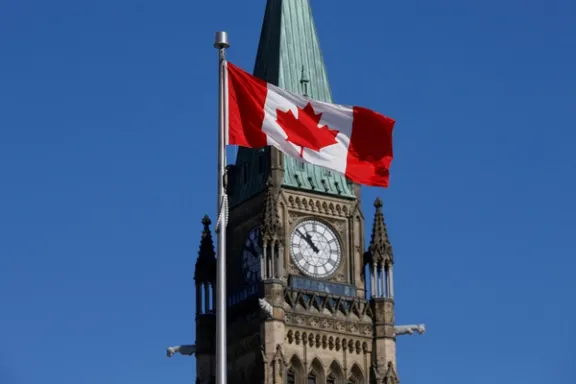
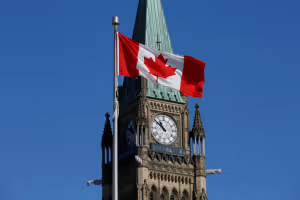
Canada on Wednesday rejected Iran’s decision to designate the Royal Canadian Navy as a terrorist organization, calling the move baseless and politically motivated and reaffirming its sanctions and human rights pressure on Tehran.
John Babcock, a spokesperson for Global Affairs Canada, said the designation had “no basis in fact” and was a retaliatory response to Ottawa’s decision last year to list Iran’s Islamic Revolutionary Guard Corps (IRGC) as a terrorist entity under Canadian law.
“Iran’s announcement is a baseless political reaction to Canada’s lawful decisions regarding national security and international law,” Babcock said in a statement.
Iran’s foreign ministry said the move was taken under a 2019 Iranian law adopted in response to US sanctions, arguing that Canada’s June 2024 listing of the IRGC violated international law. Tehran said it was acting under the principle of reciprocity by applying its counter-terrorism legislation to the Canadian navy.
Canada said its decision to list the IRGC under the Criminal Code followed a “rigorous, evidence-based assessment” that found reasonable grounds to believe the force had engaged in terrorist activity, either directly or through proxies.
Ottawa maintains a policy of “controlled engagement” with Tehran, limiting official contact to Iran’s nuclear program, regional security, human rights and consular issues, Babcock said.
Canada has imposed sanctions on 215 Iranian individuals and 256 entities over what it describes as threats to international peace and security, human rights violations and support for terrorism.
The human rights situation in Iran remains deeply concerning, Babcock said, adding that Canada led a United Nations General Assembly resolution on Iran’s human rights record in 2025. Canada also imposed new sanctions on four senior Iranian officials in December over their alleged involvement in gross and systematic human rights abuses.
Babcock said Ottawa was monitoring reports of protests in Iran and urged Iranian authorities to respect freedom of expression and peaceful assembly.
Canada has no resident diplomatic mission in Iran and advises Canadians to consult official travel advisories before travelling there, citing limited consular capacity.
Iran’s foreign minister appealed directly to Donald Trump in a Guardian op-ed on Tuesday, urging him to reopen negotiations with Tehran, reconsider Washington’s alignment with Israel and acknowledge what he described as Iran’s invincibility.
“For those willing to go where no one has gone before, there is a brief window of opportunity,” Abbas Araghchi wrote.
Standing beside Netanyahu, Trump warned that renewed Iranian missile expansion or nuclear advances would trigger a US response.
"We’ll knock the hell out of them," said Trump. “Now I hear that Iran is trying to build up again, and if they are, we’re going to have to knock them down."
In June, Israel and the US carried out coordinated strikes on Iran that severely damaged several key nuclear facilities. Iran retaliated with missile attacks on a US base in Qatar and on Israeli targets. After 12 days of escalation, a ceasefire was reached under US pressure.
Israeli officials say Iran is quietly rebuilding systems damaged during the conflict.
Trump on Monday expressed his support for possible Israeli attacks on Iran if Tehran continues to develop its ballistic missile program.
Israel shaped US policy through 'myths'
Araghchi argued that what he called a “manufactured crisis” over Iran’s nuclear program has long been driven by Israeli narratives, misleading Washington into abandoning the 2015 nuclear deal and adopting a “maximum pressure” strategy that produced only resistance, according to the foreign minister.
“Those myths encouraged Washington to abandon a functional diplomatic framework in favor of ‘maximum pressure’ that only produced ‘maximum resistance’,” he wrote.
He also pointed to what he described as shifting opinion among Trump supporters, saying Israel is increasingly seen as a liability rather than an ally.
“A growing number of Americans – particularly those who want a focus on rebuilding the US – are publicly acknowledging what has been taboo: that uncritical acceptance of Israel’s narratives has drained American resources, undermined American credibility, and entangled the US in conflicts that do not serve American interests,” Araghchi wrote.
Araghchi also said recent conflicts across Gaza, Lebanon, Syria, Iran, Yemen and Qatar have led regional governments to view Israel’s actions as “a threat to us all,” opening space for new diplomatic alignments.
Iran open to negotiations
Araghchi said “mutual friends of Iran and the US” are prepared to help facilitate talks and guarantee implementation of any future agreement, without naming those mediators.
Iran, Araghchi insisted, remains open to negotiations but not to surrender.
“Despite Israel’s attack on diplomacy amid Iran-US nuclear negotiations, Iran remains open to an agreement that is built on mutual respect and mutual interest,” he wrote, warning that Iran’s restraint should not be mistaken for weakness.
Araghchi reiterated that Iran will not give up what it regards as its rights under the Nuclear Non-Proliferation Treaty, including domestic enrichment for civilian use, and said any future deal must include “tangible and verifiable sanctions lifting.”
The unrest, driven by the plunging rial and surging prices, is widening in scope against the leadership and some analysts warn it could threaten the Islamic Republic itself.
Iran’s foreign ministry said Tehran has designated Canada’s navy a “terrorist organization,” in retaliation for Ottawa’s decision to list Iran’s Islamic Revolutionary Guard Corps (IRGC) as a terrorist entity.
In a statement, the ministry said Canada’s move violated international law by branding an official branch of Iran’s armed forces as “terrorist,” and said the new designation was a reciprocal response.
Canada listed the IRGC under its Criminal Code in June 2024, a step Ottawa said was aimed at curbing alleged Iranian influence operations and holding Tehran to account over security and human-rights concerns.
The exchange adds to long-running tensions between the two countries. Canada has imposed multiple rounds of sanctions on Iranian officials in recent years and has cited the IRGC’s role in domestic repression as part of its rationale.
Canada severed diplomatic ties with Iran in 2012 and closed its embassy in Tehran, leaving the two countries without formal diplomatic relations.
Russian Foreign Minister Sergei Lavrov said Iran has shown restraint and pursued dialogue despite what he described as direct Israeli and US attacks on Iranian nuclear-related facilities, warning that Middle East tensions remain highly volatile.
In an interview with Russia’s TASS news agency, Lavrov said 2025 had seen “unprecedented events,” including Israeli strikes on Iran, carried out together with Washington, that targeted facilities linked to Iran’s nuclear program despite those sites being under International Atomic Energy Agency safeguards.
“Iranians have been exercising maximum restraint and composure by responding to all the provocations and blackmail on behalf of the West by stating their commitment to dialogue and resolving the lingering differences by political means.”
Russia has firmly condemned the attacks, which Lavrov said violate international law and universally recognized moral norms. “They are completely at odds with international standards and universally recognized moral imperatives.”
Lavrov warned that Israeli officials’ statements about being prepared to use force against Iran again were a “matter of grave concern,” adding that tensions in the region risk remaining volatile.
He also criticized European countries, saying some were “adding fuel to the fire” by seeking to deepen divisions in the Middle East rather than encouraging regional cooperation.
Against that backdrop, Lavrov said Iran had responded to provocations and what he described as Western pressure and blackmail by reaffirming its commitment to dialogue and political solutions to resolve outstanding disputes.
Twenty-one Arab and Islamic countries including Iran issued a joint statement on Saturday denouncing Israel's move to recognize the self-declared Republic of Somaliland, describing it as a threat to regional peace, according to Iran's foreign ministry.
Israel on Friday became the first country to formally recognize Somaliland as an independent and sovereign state. The decision drew the immediate condemnation of the Organization of Islamic Cooperation (OIC) which rejected it as "a violation of the sovereignty of the Federal Republic of Somalia, its national unity, and its territorial integrity."
The OIC's statement on Friday was followed by a similar joint statement by 21 mostly Middle Eastern or African countries which rejected the recognition “given the serious repercussions of such unprecedented measure on peace and security in the Horn of Africa, the Red Sea and its serious effects on international peace and security as a whole.”
The joint statement also fully rejected "any potential link between such measure and any attempts to forcibly expel the Palestinian people out of their land.”
Syria also rejected Israel’s decision in a separate statement.
On Saturday, Iran's foreign ministry spokesman condemned what it described as Israel’s blatant violation of Somalia’s sovereignty and territorial integrity.
"Israel’s actions amount to a gross breach of Somalia’s sovereignty and territorial integrity through efforts to advance a plot to fragment the Islamic country," Esmail Baqaei said.
"They constitute a clear violation of the fundamental principles of the United Nations Charter and international law."
Somaliland is a largely arid region along the Gulf of Aden, opposite Yemen and bordering Djibouti, a small country that hosts military bases for the United States, China, France and several other nations.
After signing a joint declaration of mutual recognition with Israel's prime minister, Somaliland's president Abdirahman Mohamed Abdullahi said his country would join the so-called Abraham Accords, calling it a step toward regional and global peace.
The 2020 accords were brokered by US President Donald Trump's first administration and included Israel formalizing diplomatic relations with the United Arab Emirates and Bahrain, with other countries joining later.
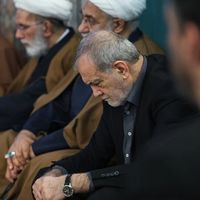
Iran’s president said on Saturday the country is facing a full-scale confrontation with the United States, Israel, and Europe, describing the pressure campaign against Tehran as more complex and damaging than the Iran–Iraq war.
“In my view, we are in an all-out war with the United States, Israel, and Europe; they do not want our country to stand on its own feet,” Masoud Pezeshkian said in an interview with the Supreme Leader’s official website.
He said the current war is worse than the Iraq war in the 1980s. “If one understands it properly, this war is far more complex and more difficult than that war.”
“In the war with Iraq, the situation was clear; they fired missiles, and it was clear where we would strike back. But here, they are now besieging us in every respect, putting us under pressure and in tight corners, creating problems—economically, culturally, politically, and in terms of security.”
Pezeshkian made the comments on the eve of Israeli Prime Minister Benjamin Netanyahu's trip to the United States, where he plans to brief President Donald Trump on options for potential future strikes against Iran, amid concerns that Tehran is rebuilding ballistic missile production facilities and repairing air defenses damaged during the June conflict, according to NBC News.
Israel has told the United States that the recent Iranian missile drills may conceal preparations for a potential strike, Axios reported last Sunday, one day after Iran International reported unusual Iranian air activity spotted by Western intelligence agencies.
Israeli Chief of Staff Eyal Zamir raised the issue directly with Brad Cooper, head of US Central Command, warning that recent missile movements could serve as a cover for a surprise operation against the Jewish state.
Pezeshkian said on Saturday that Iran is "stronger than during the 12‑day war" with Israel in terms of equipment and manpower. "If the enemy chooses confrontation, they will naturally face a more decisive response."
In June, Israel carried out airstrikes and covert operations against Iranian military and nuclear sites, killing more than 1,000 people including senior officials and nuclear scientists.
Iran retaliated by launching hundreds of missiles and drones at Israel, killing at least 33 people, among them an off-duty soldier.
The United States helped Israel intercept Iranian attacks and later joined the Israeli campaign, bombing three Iranian nuclear facilities on June 22.