From markets to streets: Iran protests spread nationwide on day two
Nationwide protests continue into day three in Iran with merchants vowing to strike further.
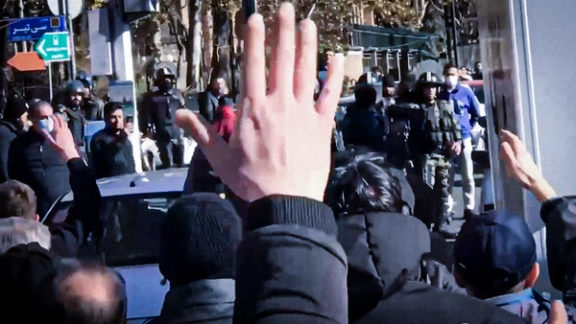
Strikes and protests in Iran spread nationwide on Monday, turning violent in several cities as nighttime crowds chanted against the ruling state and bazaar merchants vowed to continue their shutdowns and demonstrations into Tuesday.
What began as anger over the surging price of the US dollar and the collapse of the rial has widened into a broader wave of unrest, moving beyond market corridors and into streets, squares and university campuses across multiple provinces.
In Tehran, major sections of the bazaar were shuttered, including major commercial centers in the Grand Bazaar as well as the Alaeddin mall.
Crowds poured into streets in several parts of central Tehran, where security forces deployed tear gas and clashes were reported.
One widely shared video shows a protester sitting on the ground in front of security forces. Many viewers compared the scene to the “Tank Man” moment during China’s 1989 Tiananmen Square protests, a symbol of solitary defiance in the face of state power. The protester was quickly beaten and removed.
The unrest deepened outside the capital. Protests and nighttime rallies were reported from Qeshm Island in the south to Zanjan and Hamadan in the north, and from Malard and Pardis near Tehran to Kerman in the southeast.
In Hamadan, security forces reportedly shot directly at demonstrators, and in Malard, tear gas was fired at protesters.
While the slogans were mainly focused on economic issues on the first day, the second day's chants underscored a transition from economic frustration to more explicit political dissent.
Chants in several cities targeted Iran's political authority, with crowds shouting slogans such as 'death to the dictator" and "Seyyed Ali (Khamenei) will be toppled this year".
Pro-monarchy slogans like "This is the final battle, Pahlavi will return," and "Reza Shah may God bless your soul" were also heard in various parts of Tehran and other cities during Monday protests, videos obtained by Iran International show.
Exiled Prince Reza Pahlavi in a message on Instagram called on Iranian people to join protesters in the streets and put an end to the rule of Tehran's theocracy which toppled his father's monarchy in 1979.
Root causes of protests
At the core of the crisis is the dollar’s surge to roughly 144,000 tomans over the weekend before easing slightly to 136,000 tomans on Monday.
Shopkeepers say the volatility has made it impossible to price goods, secure supply or plan for basic business survival.
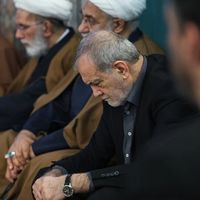
Amid the turmoil, the governor of Iran’s central bank resigned and President Masoud Pezeshkian appointed Abdolnaser Hemmati as the new chief in an effort widely seen as aimed at calming markets and protests.
However, there was no immediate sign the move influenced protesters, and momentum continued to build.
Tehran shopkeepers have vowed to extend their strikes into Tuesday, marking a third consecutive day of action.
Students at Shahid Beheshti University and Amirkabir University, prestigious academic centers in Tehran, also announced plans for a protest gathering Tuesday morning.
With protests spreading nationwide, turning more confrontational and carrying into the night, the coming days will test whether this wave remains anchored in economic collapse or develops into a broader challenge to authority.
US President Donald Trump said on Monday he would support possible Israeli strikes on Iran if the Islamic Republic develops its ballistic missile or nuclear programs, warning Tehran against rebuilding military capabilities destroyed in a brief June war.
Speaking to reporters alongside Israeli Prime Minister Benjamin Netanyahu in Florida, Trump said the United States will deal a heavy blow on Iran if it tries to recover from the US and Israeli strikes in June.
"I'm hearing that Iran is trying to recover—if that happens, we'll have to hit them hard," Trump added.
"If they will continue with the missiles, yes. The nuclear, fast. Okay? One will be yes, absolutely. The other was, we'll do it immediately," Trump said when asked if he would support Israel's strikes on Iran in case it further develops its ballistic missile and nuclear programs.
In a joint press conference with Netanyahu later in the day, Trump said he hopes Iran is "not trying to build up again, because if they are, we're going to have no choice, but very quickly to eradicate that buildup."
"I hope Iran is not trying to build up, as I've been reading, that they're building up weapons and other things. And if they are, they're not using the sites that we obliterated, but they're using possibly different sites. We know exactly where they're going, what they're doing, and I hope they're not doing it, because we don't want to waste the fuel on B-2, it's a 37-hour trip both ways. I don't want to waste a lot of fuel," he said.
The United States held five rounds of negotiations with Iran over its nuclear program earlier this year, for which Trump set a 60-day deadline.
When no agreement was reached by the 61st day on June 13, Israel launched a surprise military offensive followed by US strikes on June 22 targeting key nuclear facilities in Isfahan, Natanz and Fordow.
The attacks killed nuclear scientists along with hundreds of military personnel and civilians. Iranian counterattacks killed 32 Israeli civilians and an off-duty soldier.
Iran denies seeking nuclear weapons and says its nuclear program is for peaceful purposes. Supreme Leader Ali Khamenei has said dealing with Trump is beneath the dignity of the Islamic Republic, while Iranian officials have rejected US demands to end uranium enrichment and curb missile capabilities.
Meanwhile, Iranian Foreign Minister Abbas Araghchi spoke with Oman’s Foreign Minister on Monday over the phone. Oman has previously mediated negotiations between Tehran and Washington.
Trump blames Obama for nuclear Iran
Ahead of his meeting with Netanyahu, Trump shared a post on his Truth Social account of an old share on X that the Obama and Biden administrations gave money to Iran to fund its nuclear program.
The message originated on X from an account using the pen name Chris Bjornberg and was part of a promotion for his 2023 book “The Night Rider and the Warrior Queen.”
“One of Obama’s most treasonous policies was to fund Iran’s nuclear program,” the post shared by Trump said, alongside an image of a nuclear explosion over New York City and further criticism of Democratic administrations’ Iran policy.
“Biden and Obama gave Iran over $220 billion to research and build nukes. Iran nearly had 6 nuclear bombs and Intercontinental Ballistic Missiles (ICBM’s) that would have destroyed Israel and 5 cities in the US," the post said.
The Obama administration negotiated the 2015 nuclear deal with Iran, officially known as the Joint Comprehensive Plan of Action (JCPOA), which restricted Tehran’s nuclear activities in return for sanctions relief, before Trump withdrew the United States from the agreement in 2018.
Iran has since expanded its nuclear program beyond JCPOA limits, and the deal has effectively stalled.
Iran’s judiciary warned on Monday that it would pursue and punish individuals accused of disrupting the country’s economic system, as authorities face mounting pressure from a collapsing currency, high inflation and widening public unrest.
Judiciary chief Gholamhossein Mohseni Ejei said those whose actions increase pressure on people’s livelihoods – whether deliberately or not – would be warned and, if they persist, prosecuted, according to remarks carried by state media.
“Those who, knowingly or unknowingly, put added pressure on people and their livelihoods and effectively move in the direction of the enemy’s objectives must be cautioned,” Ejei said. “If they do not heed these warnings, they must be seriously pursued and punished by the relevant authorities.”
Ejei framed economic disruptions as part of what he described as coordinated “psychological and economic pressure” by Iran’s adversaries, saying judicial authorities must respond decisively.
He cited laws allowing harsh penalties for acts deemed to constitute “corruption on earth,” a charge that can carry the death penalty, including in cases of large-scale economic disruption.
He said penalties such as fines were insufficient in the current climate. “These fines are not deterrent,” Ejei said, calling for punishments proportionate to current conditions.
The judiciary chief also stressed that responsibility extended beyond traders to officials who enable economic violations. He warned that individuals inside government bodies who facilitate hoarding, smuggling or currency abuses would face prosecution.
Addressing currency volatility, Ejei said authorities must identify those responsible for market instability.
He cited figures from central bank officials indicating that around $18 billion in export revenues had not been returned to the country.
The warning comes amid sharp falls in the rial, accelerating inflation and protests by shopkeepers in Tehran over rising costs and economic mismanagement.
Shopkeepers in Tehran extended strikes into a second day on Monday, with closures reported across several key markets amid mounting economic pressure and a sharp fall in the national currency, according to information received by Iran International.
Traders in the historic Chaharsouq bazaar joined the strike, while Tehran’s gold market remained shut and shopkeepers gathered for a protest on Lalehzar Street.
Merchants at other markets, including Jafari bazaar and parts of the Shoush wholesale district, were also reported to have stopped work.
The latest closures follow protests on Sunday by mobile phone traders outside the Iran Mobile Center and the Alaeddin Mobile Shopping Center on Hafez Street in central Tehran. V
ideos sent to Iran International showed crowds chanting antigovernment slogans, with passersby later joining demonstrations near Jomhouri Street.
Reports also circulated on social media of protests at Tehran’s Charsou mall, while iron market traders were said to have closed their shops to protest the currency’s decline.
The unrest comes as Iran’s rial slid to new record lows, weakening to around 1,445,000 per dollar on Sunday, compared with about 1,370,000 the day before and roughly 1,140,000 a month earlier, according to open market rates.
Iran has been grappling with soaring prices and currency volatility. Official data show food prices have risen by more than 66% over the past year, while year-on-year inflation reached 52.6% in December.
There were no immediate reports of security force intervention on Monday.
Protests broke out among shopkeepers in central Tehran on Sunday after a sharp slide in the rial, with videos sent to Iran International showing crowds chanting antigovernment slogans.
Mobile phone traders gathered outside the Iran Mobile Center and the Alaeddin Mobile Shopping Center on Hafez Street in central Tehran, according to eyewitness accounts and videos sent Iran International.
An eyewitness said the chants began with shopkeepers, with passersby later joining in on Jomhouri Street near the Hafez underpass on Sunday.
Reports also circulated on social media of protests at Tehran’s Charsou mall.
Separately, iron market traders in Tehran stopped work on Sunday morning, closing their shops to protest the rial’s decline, according to reports on social media.
The protests come as Iran’s rial weakened to new historic lows on Sunday, falling to about 1,445,000 per dollar, 1,700,000 per euro and 1,950,000 per pound, according to Tehran's open market rates.
A day earlier, the rial was trading at about 1,370,000 to the dollar. About a month earlier, it was valued at around 1,140,000 per dollar on the open market.
In recent months, runaway inflation and the rial's declining value have added to concerns over worsening economic conditions in Iran.
Over the past year, prices of food items in Iran have risen by an average of more than 66 percent, according to official data.
Iran’s Statistics Center said on Saturday that year-on-year, or point-to-point, inflation rose to 52.6 percent.
Iran’s economy slipped back into contraction in the first half of the current year as inflation accelerated and the rial sank to record lows, compounding the pressure on President Masoud Pezeshkian as his government seeks approval for a tight budget starting on March 21.
Fresh central bank data showed gross domestic product shrank by 0.6% including oil and by 0.8% excluding oil in the first six months of the year 1404 (started on March 21), reflecting weak demand, falling investment and heightened uncertainty across the real economy, Tasnim reported.
The downturn came despite modest growth in the oil sector, which expanded by 1.1% but failed to offset deeper declines elsewhere.
Agriculture contracted by 2.9% and industry and mining by 3.4%, while construction suffered a sharp 12.9% slump, the central bank said, pointing to a deepening recession in a sector that is a key engine of employment and related industries.
At the same time, inflation pressures intensified. The statistics center said point-to-point inflation rose to 52.6% in the month to late December, up 3.2 percentage points from the previous month, while average annual inflation climbed to 42.2%.
Food inflation was far higher, with prices of food, beverages and tobacco up 72% year-on-year, compared with 43% for non-food goods and services. Monthly inflation reached 4.2%, led by sharp increases in staples such as dairy and bread.
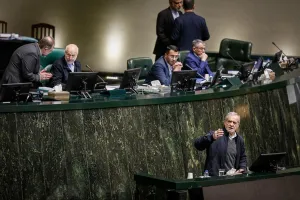
The deteriorating data frame a contentious budget debate in parliament, where Pezeshkian has warned that the state lacks the resources to cushion households fully from price rises.
“They tell me to raise wages, but someone should tell me where the money is supposed to come from,” he told lawmakers while defending the draft budget, which proposes a 20% public-sector pay increase – well below inflation – alongside broader tax exemptions.
Pezeshkian has said the priority is to prevent a deficit-fueled surge in prices by restraining spending growth and tightening fiscal discipline.
“An orderly budget without a deficit reduces the fire of inflation and can contain price rises to some extent,” he said, adding that the government would expand tax exemptions and roll out targeted subsidies to protect low-income households.
Parliamentary leaders and lawmakers from across factions have pushed back, arguing the budget risks aggravating inflation and living costs.
Some lawmakers have been more blunt. “The 1405 budget has an inflationary nature,” said Hossein Samasami, a member of parliament’s economic committee. “Budget decisions are among the most important drivers of prices and inflation, and ignoring their impact directly weakens purchasing power.”
Volatility in the currency market has added to the pressure. The rial has fallen sharply in recent weeks, fueling gains in gold and hard assets as households seek protection from inflation.
Guards-linked Tasnim news agency said in an analysis on Sunday that the dollar had become “a symbol of lost confidence,” criticizing what it described as inaction by the government and central bank as expectations worsened.
Markets have continued to test policy credibility. On Sunday, the rial weakened to a new record low of about 1,420,000 per dollar.