Next war with Israel would not end in 12 days, Guards-linked daily warns
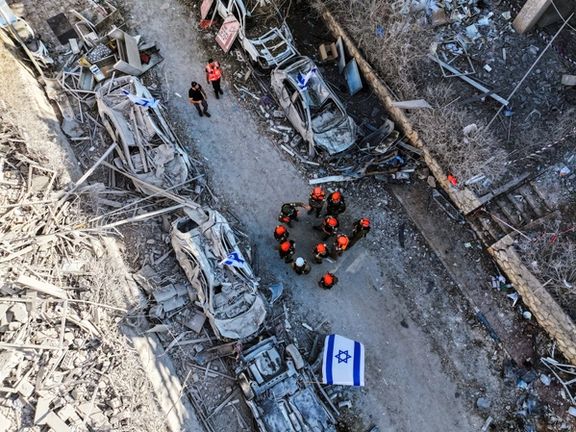
A drone photo of rescue forces at the impact site of residential homes, following a missile attack from Iran on Israel, in Ramat Gan, Israel, June 14, 2025
Israel lacks the capacity to fight a prolonged war with Iran, an Iranian daily affiliated with the Islamic Revolutionary Guards Corps wrote, saying that any renewed conflict would be far costlier and longer than a previous 12-day confrontation.
“Israel does not have the capacity for an intense war of attrition or for confronting a major power like Iran, and it is clear that another war would not end in 12 days as the previous one did,” Javan wrote in an analysis on Wednesday.
The 12-day war between Iran and Israel in June 2025 was a brief but intense conflict. It began with extensive Israeli airstrikes on Iranian military and nuclear facilities.
The United States became militarily involved mid‑conflict. On June 22, US Air Force and Navy forces carried out coordinated strikes on three Iranian nuclear facilities – Natanz, Fordow and Isfahan – in an operation codenamed Operation Midnight Hammer, using B‑2 bombers and submarine‑launched missiles, marking the first US offensive against Iranian territory in decades. Iranian forces fired missiles at US assets in Al Udeid Air Base in Qatar, after those strikes.
The conflict ended with a US and Qatari-mediated ceasefire, but it caused significant casualties, infrastructure damage.
Israeli rhetoric, the paper said, has shifted from threats of decisive victory to language of caution and warnings about the costs of renewed conflict.
Air strikes, according to Javan, failed to halt what it called Iran’s “distributed and self-sufficient” military production. The paper also argued that the previous fighting severely strained Israel’s multilayer missile defense systems.
“Israeli officials are now openly speaking of the ‘real threat’ posed by Iran’s missiles and warning that without preventive action Iran could reach annual production of thousands of missiles,” the paper said.
Focus shifts from battlefield to society
Javan framed the change in tone as evidence that the military option has lost credibility, writing that the inability to control the consequences of war has weakened Israel’s long-standing doctrine of absolute military superiority.
Rescuers work at the site of a damaged building, in the aftermath of Israeli strikes, in Tehran, Iran, June 13, 2025.
“War in the contemporary world is not merely a military confrontation, but a test of social capacity, political cohesion and national resilience,” the paper wrote, arguing that internal divisions, political strains and reliance on external support limit Israel’s ability to endure a prolonged conflict.
The article concluded that future confrontation will be shaped as much by narratives and domestic resilience as by missiles and air defenses.
Russian President Vladimir Putin told US President George W. Bush in 2001 that Iran was seeking nuclear weapons but that Moscow would not assist Tehran in acquiring sensitive technologies, according to a newly released memorandum of their first face-to-face meeting.
“There is no doubt they want a nuclear weapon. I’ve told our people not to tell them such things,” Putin said during a restricted session with Bush on June 16, 2001, referring to Iranian inquiries directed at Russian experts, according to the declassified memorandum of conversation.
The remarks appear in notes taken during a one-on-one meeting at Brdo Castle in Slovenia, held shortly after Bush took office, and come amid broader discussions between the two leaders on missile proliferation, non-proliferation and Iran’s regional role.
Putin told Bush that Iranian specialists were pressing Russian experts on what the memo described as “sensitive matters,” but said he had ordered Russian officials not to share information related to nuclear weapons or missile technology.
“I will restrict missile technology to Iran,” Putin said, according to the document, while acknowledging that some Russian actors were interested in profiting from cooperation with Tehran.
Bush, for his part, raised concerns that weapons transfers to Iran could threaten both US and Russian security.
A sample of the document
The memo shows the US president sought Moscow’s cooperation on non-proliferation, warning that Iranian access to advanced weapons or delivery systems would be destabilizing.
The exchange also touched on US policy toward Tehran. When Putin suggested Washington might be moving toward improved relations with Iran, Bush rejected that notion.
“That’s not true. Congress makes that completely impossible now,” Bush said, pointing to legislative constraints on any normalization of US-Iran relations even at the start of his presidency.
Putin countered that European states, including Germany, were expanding financial ties with Iran, mentioning a credit line extended by Berlin and arguing that trade in conventional weapons was treated by some countries as a commercial matter.
The document shows that Iran featured repeatedly in the discussion as a proliferation concern alongside North Korea, with Putin portraying Moscow’s engagement with Tehran as constrained by history, geography and security pressures on Russia’s southern borders.
The memorandum was produced as part of a US government record of the meeting and later released through the National Security Archive following a Freedom of Information Act request.
Israeli strike scenario in 2005 and Natanz as a potential target
A separate memorandum of conversation dated September 16, 2005 depicts Bush and Putin discussing how Iran’s enrichment and reprocessing capabilities could be redirected toward a weapons program, and how escalating disputes could narrow options toward military action.
In that Oval Office meeting, US officials stressed that the core concern was not civilian nuclear power but Iran’s ability to master the fuel cycle.
“Our concern is Iran’s ability to reprocess and enrich,” Secretary of State Condoleezza Rice said, adding that such capabilities “would be dangerous and could be turned to a military program.”
Putin argued that an immediate referral of Iran’s file to the UN Security Council could push Tehran to accelerate its program, warning that pressure could reduce outside visibility and control.
“Our concern is that immediate referral will lead Iran to take the North Korean route,” Putin said.
He then raised the question of military action and the uncertainties surrounding it: “If they are indeed striving for nuclear weapons, then we will have lost control over what is happening in Iran. Then we need to do something. What? Strike? Who does that? Where? What targets? Are you sure of the information you have?”
Bush told Putin he saw diplomacy as the priority but said military action could not be fully ruled out, and he framed Israel as the actor most likely to consider a strike if it judged Iran was nearing a nuclear capability.
“The military option stinks, but we can’t take it off the table,” Bush said. “If Sharon feels he needs to strike Iran, all hell will break loose,” he added referring to then prime minister Ariel Sharon.
In the same 2005 conversation, Bush explicitly mentioned Iran’s Natanz enrichment site as a possible Israeli target while emphasizing Washington was not selecting targets on Israel’s behalf. “If they think there’s enriching at Natanz, that’s one. But we aren’t doing the targeting for Israel.”
The 2005 memo also reflects proliferation concerns tied to external networks. Putin pointed to evidence suggesting Pakistani-origin material had been found in Iranian centrifuges, and Bush referenced discussions with then Pakistani President Pervez Musharraf about transfers linked to Abdul Qadeer Khan’s network.
“As far as I understand, they found uranium of Pakistani origin in the centrifuges,” Putin said, to which Bush responded that it involved undeclared material and constituted a violation: “Yes, the stuff the Iranians forgot to tell the IAEA about. That’s a violation.”
Bush happy with Russia’s fuel-for-no-enrichment approach
A third memorandum, dated April 6, 2008, shows Iran continuing to feature in US-Russian talks in the context of nuclear cooperation safeguards, alleged illicit procurement, and the question of Iranian enrichment.
In that meeting in Sochi, Rice told Putin the United States had focused on resolving what she described as a sensitive issue involving Iran, including concerns about illicit assistance. “We needed to resolve an issue with Iran,” Rice said.
Putin said, “Everything is under control there. Sometimes there are instances of cooperation they're trying to pursue in a clandestine manner that's not apparent to the government. We will find them and they will be punished.”
When Bush asked where the questionable activity was occurring, Rice answered directly: “Arak.”
Putin said Russian authorities were monitoring for unauthorized cooperation driven by profit motives. “There are people willing to earn a bit of money on this, but we identify those cases,” Putin said.
The 2008 memo also shows Bush praising Moscow’s approach of providing nuclear fuel for civilian power while pressing Tehran not to enrich domestically – an argument intended to test whether enrichment was needed for energy or indicative of weapons intent.
Bush described it as a practical non-proliferation framework: “Russia says, ‘Here’s the fuel, therefore you don’t need to enrich. If you do, it shows you don’t want civil nuclear power, you want more,’” Bush said.
Putin, recounting his own discussions with Iranian officials, questioned the timing of Iranian enrichment given long construction timelines for reactors, including Russia’s work at Bushehr. “You won’t complete a new plant for 15 years, so why are you building up enrichment now?” Putin said.
A cluster of former officials and pundits in Tehran has sought to downplay the likelihood of a US-backed Israeli strike on Iran, arguing that Washington has little appetite for such military action.
The claims have circulated amid growing public anxiety about escalation—concerns that have begun to ripple through Iran’s currency and gold markets.
“Trump is no longer interested in playing Netanyahu’s game,” Nameh News, a conservative outlet widely seen as close to Iran’s intelligence community, quoted Heshmatollah Falahatpisheh, the former head of parliament’s national security committee, as saying.
Falahatpisheh offered little evidence for the assertion, suggesting only that “all of Trump’s attention is currently focused on the Western hemisphere.”
Those assurances stand in contrast to remarks on Wednesday by Israeli Prime Minister Benjamin Netanyahu, who said Israel still needed to “settle accounts” with Iran, adding that while Israel did not seek confrontation, it remained alert to “every possible danger.”
Meeting in Mar-a-Lago
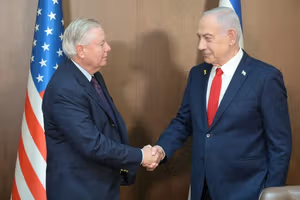
Netanyahu is set to meet Donald Trump next week, primarily to discuss the next phase of the Gaza conflict but also Iran’s nuclear standoff.
Nameh News introduced the interview by citing the upcoming meeting, asserting that it would have no impact on Tehran’s determination to pursue its nuclear and missile programs.
Falahatpisheh further argued that the Trump–Netanyahu meeting was intended mainly to shield Israel from broader US national security priorities, claiming Washington was no longer willing to spend resources on military operations outside the Western hemisphere.
As support, he cited US national security documents, noting that Iran was mentioned 17 times in 2024 but only three times in 2025.
‘US not interested’
The same day, the outlet quoted foreign policy analyst Ali Bigdeli, who echoed Falahatpisheh’s assessment almost verbatim.
“I do not assume that the United States is likely to enter an action against Iran to assist Israel,” Bigdeli said, while maintaining that the Trump–Netanyahu meeting would indeed focus on Iran. He warned of the possibility of a “surprise military attack” but concluded that a broader conflict between Israel and Iran remained unlikely.
A similar argument appeared in the reformist daily Arman Melli, which published an interview that day with political commentator Hassan Hanizadeh.
Hanizadeh said the United States was “not interested in taking part in a new war against Iran” and accused Netanyahu and Israeli media of amplifying regional instability for domestic political reasons.
Taken together, the remarks suggest a coordinated effort to reassure domestic audiences that war is unlikely, even as official rhetoric remains confrontational. Whether such messaging can ease public anxiety—and calm markets in Iran—remains an open question.
Iran’s Revolutionary Guards said on Wednesday they had seized a tanker in the Persian Gulf carrying millions of litres of smuggled fuel, in the latest maritime interception announced by Tehran in the strategic waterway.
The vessel was stopped in a “highly coordinated operation,” according to the IRGC-linked Tasnim citing senior navy commander Mohammad Gholamshahi.
“The tanker was carrying 4 million litres of smuggled fuel and was intercepted as it attempted to leave Iran’s territorial waters,” Gholamshahi said, adding that the ship had a crew of 16 non-Iranian nationals and was stopped before leaving Iranian waters.
Iranian officials did not disclose the vessel’s flag, ownership or destination.
The Guards said the crew had been detained and that the case had been referred to judicial authorities for further investigation, with additional inquiries under way to identify networks linked to the smuggling operation.
Iran periodically announces the seizure of vessels accused of fuel smuggling, a trade driven by heavily subsidised domestic fuel prices and compounded by sanctions that restrict formal energy exports.
The latest seizure comes amid heightened regional tensions, with Tehran repeatedly warning that it could restrict or close the Strait of Hormuz, the narrow maritime chokepoint linking the Persian Gulf to global markets, in response to military action.
About a fifth of the world’s oil supply passes through the strait, making any disruption a major concern for global energy markets.
Gholamshahi asserted that the cargo of the seized tanker had been transferred from smaller boats and was intended to be offloaded to larger ships outside the Persian Gulf.
An Iranian revolutionary court in the northwestern city of Urmia has sentenced a man to death on charges of cooperating with Israel, according to information received by Iran International and people familiar with the case.
The defendant, identified as Yaghoub Karimpour, a resident of Miandoab in West Azarbaijan province, was arrested by Iran’s intelligence ministry during the 12-day conflict between Iran and Israel earlier this year, the sources said.
Karimpour, born in 1984, was convicted of “corruption on earth” through alleged cooperation with Israel and the transmission of data, they added. He is currently being held in Urmia Central Prison.
According to the sources, Karimpour has denied the charges throughout his detention and trial, saying he had no links to Israel and had not passed any information. They said he told investigators that confessions attributed to him were extracted under coercion.
Iran’s judiciary has not publicly commented on the case, and Reuters was not able to independently verify the allegations.
Iranian authorities have intensified arrests, prosecutions and executions on charges of espionage or collaboration with Israel in the months following the brief war. Officials say the measures are necessary to safeguard national security, while rights groups say the trials often lack transparency and rely on forced confessions.
In recent weeks, Iran has carried out several executions linked to espionage allegations.
Earlier in December, authorities executed Aghil Keshavarz, an architecture student, after convicting him of spying for Israel, state-linked media reported.
The Hengaw human rights organization said that at least 17 people have been executed in Iran this year on charges related to cooperation with Israel, 15 of them after the conflict.
Iranian officials have arrested hundreds of people since the war on suspicion of espionage or collaboration with Israel.
Many of the cases have been pursued under a law passed by parliament in October that broadened definitions of espionage and cooperation with “hostile states,” including Israel and the United States, and allows for capital punishment in a wide range of activities involving alleged information sharing.
Iran’s Supreme Leader approved the development of compact nuclear warheads for ballistic missiles in October, reversing years of restraint after Iran’s June war with Israel, the Italian Institute for International Political Studies said in a report on Wednesday.
“Our sources in Tehran now tell us that, in October, Khamenei decided to give the green light to the development of compact warheads for ballistic missiles,” the report said.
The report said Khamenei had previously blocked any move to enrich uranium to weapons-grade levels or to develop deliverable nuclear warheads, despite pressure from within Iran’s security establishment, particularly the Revolutionary Guards.
It said the June conflict with Israel marked a turning point, exposing weaknesses in Iran’s air defenses and allied forces, while highlighting the limits of its missile arsenal in a prolonged conflict.
“The only true deterrent that could save the Iranian regime in the event of a conflict against Israel and its US allies would be nuclear weapons,” the report said.
Enrichment still capped, for now
“At the same time, however, Khamenei would still not have authorised uranium enrichment beyond 60%,” the report said, adding that rumors persist of an undisclosed enrichment effort at a covert site not declared to the International Atomic Energy Agency.
It said Iran appears to be prioritizing warhead design over enrichment to reduce the risk of exposure to military strikes.
The report said that even if Iran chose to move quickly on enrichment, developing a deliverable warhead would take far longer.
“While enrichment to 90% would require only a few weeks if there were still enough working centrifuges, compact warheads remain a far more complex challenge,” it said, citing Pakistan’s experience in the 1990s, when years of testing and design work were needed before a viable compact warhead was achieved.
Iran’s focus on compact warheads is tied to its medium- and long-range missile force, which the report said proved decisive in forcing a ceasefire with Israel in June, even as Israel destroyed a significant number of Iranian missiles and launchers.
Recent contradictory reports over possible missile activity in Iran, later denied by state television, underscore the sensitivity around the country’s missile program and its role in deterrence.
The report said Iran could seek external assistance to shorten the timeline for developing compact warheads, noting persistent rumors within the Revolutionary Guards of cooperation with North Korea.
“Even access to previously tested warhead schematics would represent a major shortcut,” it said, while adding that cooperation beyond missile technology remains impossible to verify.
Iran has long said its nuclear program is peaceful and defensive, while Western governments accuse Tehran of keeping open the option of developing nuclear weapons.