• العربية
  • فارسی
Brand
  • Iran Insight
  • Politics
  • Economy
  • Analysis
  • Special Report
  • Opinion
  • Podcast
  • Iran Insight
  • Politics
  • Economy
  • Analysis
  • Special Report
  • Opinion
  • Podcast
  • Theme
  • Language
    • العربية
    • فارسی
  • Iran Insight
  • Politics
  • Economy
  • Analysis
  • Special Report
  • Opinion
  • Podcast
All rights reserved for Volant Media UK Limited
volant media logo

Iran introduces limited gas price rise in sensitive political move

Nov 25, 2025, 15:40 GMT+0Updated: 23:50 GMT+0
File photo of an Iranian gas station

Iran on Tuesday announced a limited fuel price increase in a move which appears aimed at reining in costly government subsidies while avoiding public anger which has previously exploded into protests.

The move will introduce a higher fuel charge to drivers refueling without government-issued smart ration cards or beyond their allowed quotas.

Iran’s cabinet approved the new three-tier fuel pricing system that will introduce a 5,000-toman (4.4 cents per the free market rate) rate for motorists who refuel without their smart cards or after exhausting their lower-priced quotas, according to a government directive published by domestic media.

The initiative, dated November 23, says that the two existing subsidized rates — 1,500 tomans (1.3 cents) for monthly quotas and 3,000 tomans (2.6 cents) for non-quota purchases with personal smart fuel cards — will remain in place but with reduced allocations.

An across-the-board fuel price rise in November 2019 triggered nationwide protests that were quashed with deadly force, with hundreds reported killed and thousands detained.

The increased rate was kept and maintained unchanged until the latest initiative.

From mid-December, refueling with “emergency station cards” will be charged at 5,000 tomans. The rate represents about ten percent of the government’s refinery purchase cost, the directive said.

Reports in Iranian outlets earlier this autumn had indicated that several pricing scenarios were under review.

In late October, President Masoud Pezeshkian said there was “no doubt” that fuel prices would eventually need to rise as domestic consumption continues to climb.

Fuel demand has at times exceeded 140 million liters per day, outpacing production of roughly 110 million liters, driven by inefficient vehicles, smuggling and seasonal spikes, according to officials.

Under the new measures, government-plated vehicles, cars in free-trade and special economic zones, imported cars and newly registered domestic vehicles will no longer receive 1,500- or 3,000-toman quotas.

Instead, they will be allocated a monthly amount priced entirely at the new 5,000-toman tier. Private individuals owning more than one gasoline-powered car will be entitled to quota rates for only one vehicle.

Alongside the new pricing policy, the first cargo of imported super gasoline — 300,000 liters — was sold on Iran’s energy exchange on November 22 at 65,800 tomans (57 cents) per liter.

Tasnim news agency reported that further changes, including adjustments to gas quotas for CNG-powered taxis, are expected to be announced in February.

Most Viewed

Iran negotiators ordered to return after internal rift over Islamabad talks
1
EXCLUSIVE

Iran negotiators ordered to return after internal rift over Islamabad talks

2
EXCLUSIVE

Iran’s central bank warns economy may take 12 years to rebuild after war

3
INSIGHT

Iran's digital economy battered by prolonged blackout

4
ANALYSIS

US blockade enters murky phase as tankers spoof signals and buyers hesitate

5
ANALYSIS

Why the $100 billion Hormuz toll revenue is a myth

Banner
Banner

Spotlight

  • Hardliners push Hormuz ‘red line’ as US blockade tests Iran’s leverage
    INSIGHT

    Hardliners push Hormuz ‘red line’ as US blockade tests Iran’s leverage

  • Ideology may be fading in Iran, but not in Kashmir's ‘Mini Iran'
    INSIGHT

    Ideology may be fading in Iran, but not in Kashmir's ‘Mini Iran'

  • War damage amounts to $3,000 per Iranian, with blockade set to add to losses
    INSIGHT

    War damage amounts to $3,000 per Iranian, with blockade set to add to losses

  • Why the $100 billion Hormuz toll revenue is a myth
    ANALYSIS

    Why the $100 billion Hormuz toll revenue is a myth

  • US blockade targets Iran oil boom amid regional disruption
    ANALYSIS

    US blockade targets Iran oil boom amid regional disruption

  • Iran's digital economy battered by prolonged blackout
    INSIGHT

    Iran's digital economy battered by prolonged blackout

•
•
•

More Stories

Iran crude piles up at sea as Chinese demand slows, Kpler data show

Nov 25, 2025, 11:13 GMT+0

Iranian crude held on tankers at sea has climbed to its highest level in about two and a half years, indicating softer buying from China even as Iran’s exports remain high, Bloomberg reported citing shipping data cited by market sources.

About 52 million barrels of Iranian oil were sitting in floating storage, the most since May 2023, with roughly half of the volumes parked off Malaysia, data from shipping-intelligence firm Kpler showed.

The offshore build has nearly doubled from a month earlier, the data indicated, and has risen sharply from early-2025 levels as cargoes wait for buyers.

Traders said the backlog has widened discounts on Iranian grades such as Iran Light, in some cases to as much as $8 a barrel below ICE Brent, compared with around $4 in late summer.

Reuters reported this week that that China’s official crude imports from Indonesia have surged to levels far above what Indonesia actually exports, prompting traders and analysts to say the barrels are likely sanctioned Iranian oil being rebranded after ship-to-ship transfers near Malaysia.

They said Iran’s suppliers have long masked origins by labeling cargoes as Malaysian, but tougher scrutiny of Malaysian oil by banks and Malaysia’s clampdown on at-sea transfers have pushed dealers to use Indonesia as a new paper origin.

On Monday, Indonesia announced it will auction the seized Iranian tanker MT Arman 114 and its 1.245 million barrels of crude oil starting December 2.

  • Indonesia to sell seized Iranian tanker and crude cargo at auction

    Indonesia to sell seized Iranian tanker and crude cargo at auction

  • Iran’s oil discounts to China widen as sanctions and quota hit demand

    Iran’s oil discounts to China widen as sanctions and quota hit demand

  • Iran oil sales hit seven-year high despite US sanctions, trackers say

    Iran oil sales hit seven-year high despite US sanctions, trackers say

Even with the relabeling shift, analysts cited by Reuters said most Iranian crude bound for China is still transferred between tankers off Malaysia, and Kpler estimates China has taken about 1.37 million barrels per day of Iranian or suspected Iranian crude this year, mainly via such transfers.

The accumulation comes as the global oil market is well supplied, with OPEC+ easing production curbs and non-OPEC producers adding output, pressuring prices this year.

Despite US sanctions, Iranian exports are still running at their fastest pace in years, leaving more barrels vulnerable to congestion when demand slows.

China remains the dominant buyer of Iranian crude, largely through independent “teapot” refineries that import discounted barrels.

  • Defying 'maximum pressure', China uptake of Iranian oil hits pre-Trump high

    Defying 'maximum pressure', China uptake of Iranian oil hits pre-Trump high

  • Oil sanctions squeeze Iranians as buoyant flows to China enrich elite

    Oil sanctions squeeze Iranians as buoyant flows to China enrich elite

Traders said many teapots have nearly exhausted the import quotas they need to bring in overseas crude, cooling their appetite for new Iranian shipments.

Recent USsanctions on Chinese firms and terminals accused of handling Iranian oil, including the Rizhao Shihua crude terminal, have further complicated offloading, forcing some tankers to divert to alternative ports.

Firefighting efforts have contained weeks-old forest blaze, official says

Nov 25, 2025, 02:52 GMT+0

A blaze which had devastated a unique forest ecosystem in northern Iran has been brought under control after weeks of firefighting efforts, an environmental official said on Tuesday.

But when pressed on state television about the extent of damage to the ancient Hyrcanian Forest, head of Iran’s Natural Resources and Watershed Management Organisation Reza Aflatouni on Monday declined to respond.

“State TV should not make the sweetness of such management bitter for people’s taste,” he said.

Aflatouni said that the main phase of the blaze, which reignited on 15 November is now extinguished, with only isolated smoldering spots left under close monitoring.

The Elit wildfire has burned through parts of Iran’s ancient Hyrcanian Forests, a UNESCO World Heritage site dating back 25–50 million years and home to over 3,200 plant species and endangered wildlife, including Persian leopards.

In a report on Sunday, the semi-official ISNA news agency wrote that the fire has been burning for about 20 days. However, the head of natural resources in Mazandaran province rejected this, insisting two separate fires occurred 10 to 15 days apart.

ISNA's said local residents insist the blaze has continued without interruption since November 1, with smoke showing it never fully went out.

“The fire in the Hyrcanian forests is not merely an environmental disaster; it is a symbol of managerial backwardness, social neglect and a weak environmental culture,” the news website Rouydad24 wrote.

“Without urgent action, the continuation of this trend could destroy large parts of Iran’s natural heritage and cause irreparable damage to the country’s society and economy,” the report added.

Mazandaran Governor Mahdi Younesi estimates around eight hectares have been destroyed so far.

Indonesia to sell seized Iranian tanker and crude cargo at auction

Nov 25, 2025, 02:10 GMT+0

Indonesia announced it will auction the seized Iranian tanker MT Arman 114 and its 1.245 million barrels of crude oil starting December 2, with a reserve price of Rp 1.174 trillion ($70 million) through the government’s online auction platform.

The 1997-built supertanker (IMO 9116412), flagged to Iran and under US sanctions, was seized by Indonesia’s Maritime Security Agency in October 2023 in the North Natuna Sea.

The MT Arman 114 had conducted an illegal ship-to-ship transfer with the Cameroon-flagged MT S Tinos while both vessels had their AIS identification systems switched off.

Drone footage captured a pipeline between the ships and an oil spill entering the sea.

Following a district court ruling on July 10, 2024, the Egyptian captain, Mohammed Abdelaziz Mohamed Hatiba, was convicted of illegal waste dumping. He was sentenced to seven years in prison and fined Rp 5 billion (approximately $300,000).

The court ordered both the vessel and its cargo forfeited to the state, paving the way for the upcoming auction.

A security deposit of Rp 118 billion ($7 million) is required for the aucion. Only companies licensed to trade or process oil and gas, or those registered with the Energy and Mineral Resources Ministry, are eligible to bid. As of Monday, 19 firms have registered interest.

‘We can’t breathe’: Iranians recount daily toll of persistent smog

Nov 24, 2025, 14:04 GMT+0

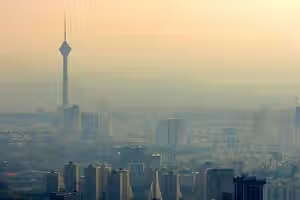
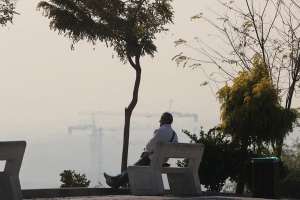
Iran’s latest spell of heavy air pollution is disrupting daily life and raising health fears, with school closures in some provinces and residents reporting acute respiratory symptoms as smog blankets cities and even smaller towns.

In comments sent to Iran International, residents described daily life under heavy haze in blunt, personal terms.

A resident of Urmia in northwest Iran said schools in Urmia and nearby Salmas were closed for two days because of dirty air. “They made us homebound and depressed,” the person wrote.

An Iran–Iraq war veteran with pulmonary injuries from Karaj said he had no choice but to keep working despite the smog. “Pollution is poison for me,” he wrote, “but if you miss one day of work, you fall behind for ten days.”

In Tehran, another resident said the air felt unbreathable. “They’ve turned Tehran into a gas chamber. You can’t catch your breath.”

Several other people echoed the same theme. “Breathing has become difficult,” one wrote, while another said, “There is a gray fog every morning. It feels like something is weighing on my chest.”

Parents and people with existing illnesses said they were hit hardest. One mother wrote: “My 17-year-old daughter has shortness of breath because of the pollution, and the doctor prescribed a spray.”

A marketing worker who said they have a lung condition wrote: “I have a lung problem and I can’t even speak up. Talking leaves me breathless.”

Another person reported persistent symptoms. “Long headaches and breathing trouble,” the message said, while another wrote: “My eyes burn so badly I can’t keep them open.”

  • Breathing the air that’s no more

    Breathing the air that’s no more

  • Smog grips Iran’s big cities despite holiday shutdowns, orange alert issued

    Smog grips Iran’s big cities despite holiday shutdowns, orange alert issued

People blame industrial pollutants

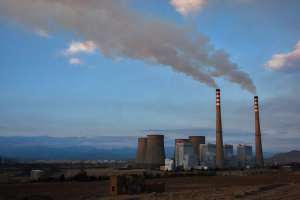
Many users blamed a mix of vehicle emissions, industrial smoke and heavy fuel burning.

One message cited “non-standard gasoline, high-consumption cars, and mazut and diesel used for power plants and factories,” saying they produce “thousands of tons of toxic pollutants every day.”

A resident of Zanjan province, a smaller industrial area, alleged that nearby metal workshops release smoke at night. “The smoke looks like thick mist,” the person wrote, warning that the health damage “will show itself later.”

Another contributor said the problem had spread beyond big cities: “Pollution has reached a stage where even small towns and villages are not spared.”

Psychological toll

Alongside physical complaints, the comments conveyed mounting psychological strain.

“People’s moods are tense and abnormal, and it is affecting work and daily life,” one person wrote.

Another said, “We’re terrified of getting sick and not being able to afford treatment.”

Several linked the crisis to rising medical costs with one Tehran resident saying the pollution had triggered asthma-like allergies and that a prescription now costs millions of rials.

While some submissions used strongly political language, the core grievance was consistent: residents said they feel unprotected against a recurring hazard that closures and short-term restrictions have not solved.


Smog grips Iran’s big cities despite holiday shutdowns, orange alert issued

Nov 24, 2025, 08:54 GMT+0

Iran issued an orange air-pollution alert on Monday for several major urban centers, with official monitoring showing unhealthy air even as the country observed a public holiday and many schools and universities were closed or moved online.

Forecasters said pollution could intensify through the end of the week in densely populated and industrial areas, warning that stagnant weather and temperature inversions could push air-quality readings in some places into the “very unhealthy” range.

The alert follows days of red readings in cities such as Tehran and Isfahan, highlighting a winter pattern in which vehicle exhaust, industrial output and heavy-fuel use combine with stagnant weather to drive smog spikes.

  • Iran turns to heavy mazut fuel despite worsening air pollution

    Iran turns to heavy mazut fuel despite worsening air pollution

  • US says Iran's theocracy has taken air out of people's lungs

    US says Iran's theocracy has taken air out of people's lungs

Tehran has recorded only six clean-air days so far this Iranian year (started on March 21), according to the capital’s Air Quality Control Company, and more than half of days have been unhealthy for sensitive groups – children, older adults, pregnant women and people with heart or lung disease.

With seniors making up about 8.4% of Tehran province’s population – roughly 1.2 million people – health experts warn that prolonged exposure during repeated pollution waves is elevating risks of respiratory and cardiovascular complications, adding to a crisis authorities have struggled to contain beyond temporary closures and driving restrictions.