• العربية
  • فارسی
Brand
  • Iran Insight
  • Politics
  • Economy
  • Analysis
  • Special Report
  • Opinion
  • Podcast
  • Iran Insight
  • Politics
  • Economy
  • Analysis
  • Special Report
  • Opinion
  • Podcast
  • Theme
  • Language
    • العربية
    • فارسی
  • Iran Insight
  • Politics
  • Economy
  • Analysis
  • Special Report
  • Opinion
  • Podcast
All rights reserved for Volant Media UK Limited
volant media logo

Iran's rial dips to 1.18 million per dollar following UN sanctions snapback

Oct 2, 2025, 13:46 GMT+1
The American flag and other flags are displayed on a sign at a currency exchange in Tehran, Iran, September 27, 2025.

Iran’s rial weakened on Thursday to about 1,180,000 per US dollar on Tehran’s unofficial market, roughly a week after the United Nations reimposed snapback sanctions, as President Masoud Pezeshkian urged cost-cutting and efficiency to shield households.

Traders also quoted the euro around 1,386,500 rials and the pound at about 1,591,200.

The UN measures, restored over Iran’s nuclear program, have added pressure to an economy already struggling with high inflation and repeated supply strains. Iran denies seeking nuclear weapons.

Visiting Bandar Abbas on Thursday, Pezeshkian said savings and better management could soften the blow.

“We can organize livelihoods, living conditions and housing by saving 10% in costs, which is equivalent to $16–18 billion a year,” he said.

“They say with snapback, they will sanction you, while we have sanctioned ourselves,” he added, arguing that curbing waste and relying less on oil and gas would blunt external pressure.

“They scare us with snapback because we tied our life to oil and gas,” he said. “I think of a day when we have neither oil nor gas. Should we die?”

The president called for practical conservation across government. He said employees and managers could work in smaller offices and avoid unnecessary energy use, recalling that at the United Nations “the corridor was partitioned and managers worked there in 2-by-3 rooms, next to the Secretary-General’s office. In Iran, everyone has a room, and the secretary has a room. You can avoid keeping all the lights on.”

Most Viewed

Iran negotiators ordered to return after internal rift over Islamabad talks
1
EXCLUSIVE

Iran negotiators ordered to return after internal rift over Islamabad talks

2
INSIGHT

Iran's digital economy battered by prolonged blackout

3
ANALYSIS

US blockade enters murky phase as tankers spoof signals and buyers hesitate

4
ANALYSIS

Why the $100 billion Hormuz toll revenue is a myth

5

US tightens financial squeeze on Iran, warns banks over oil money flows

Banner
Banner

Spotlight

  • Hardliners push Hormuz ‘red line’ as US blockade tests Iran’s leverage
    INSIGHT

    Hardliners push Hormuz ‘red line’ as US blockade tests Iran’s leverage

  • Ideology may be fading in Iran, but not in Kashmir's ‘Mini Iran'
    INSIGHT

    Ideology may be fading in Iran, but not in Kashmir's ‘Mini Iran'

  • War damage amounts to $3,000 per Iranian, with blockade set to add to losses
    INSIGHT

    War damage amounts to $3,000 per Iranian, with blockade set to add to losses

  • Why the $100 billion Hormuz toll revenue is a myth
    ANALYSIS

    Why the $100 billion Hormuz toll revenue is a myth

  • US blockade targets Iran oil boom amid regional disruption
    ANALYSIS

    US blockade targets Iran oil boom amid regional disruption

  • Iran's digital economy battered by prolonged blackout
    INSIGHT

    Iran's digital economy battered by prolonged blackout

•
•
•

More Stories

Iran signals ‘strategic patience’ after rejecting latest US proposal - IRNA

Oct 2, 2025, 09:55 GMT+1

Iran is adopting a policy of “strategic patience” in response to mounting Western pressure, the government's news agency IRNA said on Thursday, after Foreign Minister Abbas Araghchi returned from talks in New York.

Araghchi told CNN this week that negotiations with Washington under the current conditions amounted to “a total deadlock,” citing what Tehran calls repeated breaches of commitments by the United States.

He said UN sanctions reimposed under the snapback mechanism had made diplomacy more complicated and difficult.

The IRNA analysis said Iran and the United States, since Donald Trump’s return to the White House in January, had moved between dialogue and confrontation.

Initial indirect talks mediated through Oman and Qatar saw US envoy Steve Witkoff float limited enrichment proposals, but Washington later demanded zero enrichment and the handover of enriched uranium stockpiles.

Iran has strongly rejected US demands, a stance underscored by Supreme Leader Ali Khamenei in a televised address just before President Masoud Pezeshkian’s speech to the UN General Assembly.

  • Khamenei’s reversal on secret US talks hamstrings president at UN

    Khamenei’s reversal on secret US talks hamstrings president at UN

Echoing that line, Ali Larijani, secretary of Iran’s Supreme National Security Council, said on Thursday that Western powers were not seeking genuine negotiations but aimed to exploit economic and security pressure. “Western governments see economic pressure as a tool to trigger unrest and weaken Iran,” he said.

Pezeshkian also rejected those terms, saying: “Why should we give them our enriched uranium? For what reason? If there is to be dialogue, it must be about the whole issue. Otherwise this is not negotiation; this is surrender.”

Government spokesperson Fatemeh Mohajerani said on Wednesday that, according to Araghchi, Iran had expressed readiness in New York to hold a meeting with the three European countries, the International Atomic Energy Agency and US envoy Steve Witkoff, but the proposal was either rejected or the counterparts failed to attend.

Mistrust deepens after June conflict

IRNA said Tehran views US demands as unilateral impositions and believes the American approach has aligned with Israel’s military campaign against Iran earlier this year.

The agency added that Israel’s 12-day conflict with Iran in June, joined briefly by US forces, was seen in Tehran as “a shot at diplomacy” that reinforced mistrust.

Citing Iranian officials, IRNA said Washington most recently offered to delay snapback sanctions by three, then nine, and finally 12 months in return for a halt to enrichment and the transfer of uranium stocks.

Tehran rejected the plan, with Pezeshkian calling it “excessive and coercive.”

  • G7 blames Iran for renewed sanctions, urges immediate US talks

    G7 blames Iran for renewed sanctions, urges immediate US talks

  • Sanctions response betrays Tehran's entrenched divides, policy drift

    Sanctions response betrays Tehran's entrenched divides, policy drift

Tehran mulling over response

The analysis said Iran’s immediate response is likely to be guided by the Supreme National Security Council, with possible measures including suspending the “Cairo Agreement” with the International Atomic Energy Agency.

While exit from the Nuclear Non-Proliferation Treaty was described as unlikely, IRNA said Iran would continue to rely on “resistance economics,” closer ties with non-Western partners such as China and Russia, and selective diplomacy.

  • EU revives bans on Iran’s oil, banking and transport sectors after UN snapback

    EU revives bans on Iran’s oil, banking and transport sectors after UN snapback

The government is scheduled to approve a response plan to the UN snapback sanctions on Sunday, Mohajerani said on Wednesday, adding the strategy assigns ministries tasks to ease public pressure.

“Tehran currently sees the solution in adopting strategic patience until the West changes course or the playing field shifts,” the agency wrote. It added that success would depend on domestic economic reforms, unity at home, and stronger backing from non-Western allies.


US attorney says clients deported to Iran without due process - ABC News

Oct 2, 2025, 09:06 GMT+1

An attorney representing two Iranian nationals alleged on Wednesday that US authorities deported his clients to Iran without due process, placing them at risk of persecution, ABC News reported.

Ali Herischi, who represents several Iranians seeking asylum in the United States, told ABC News that two of his clients “disappeared” from the Immigration and Customs Enforcement (ICE) detainee locator system this week and were then deported to Iran.

He said one of them is a Christian convert who had arrived at the southern border earlier this year with his pregnant wife.

“We tried multiple times to ask for his appeal,” Herischi said. “And suddenly, without any information, we realized that he disappeared from [the ICE] detainee locator and then the news broke that Iranians had been deported back to Iran.”

Herischi said his client’s wife, who recently gave birth and remains in the United States, was able to briefly speak with her husband after his deportation. According to Herischi, the man told her that he was “shackled and handcuffed all the way to Iran.”

The attorney called the deportations “unconscionable,” adding, “It was so wrong, and unfortunately these are the same people that … US foreign policy tries to protect. These are those who stand up against the regime, who pay a price for standing up against the regime, and then you give them back directly to the hand of evil.”

ABC News reported that Herischi represents 25 people who are worried about being deported to Iran.

  • US deports over 100 Iranians in rare deal with Tehran - NYT

    US deports over 100 Iranians in rare deal with Tehran - NYT

Earlier this week, Iranian state media quoted an official as saying about 120 Iranian nationals detained in the US would be returned in the coming days.

The New York Times reported on Tuesday that a chartered US flight carrying more than 100 Iranians departed Louisiana and was scheduled to arrive in Tehran via Qatar.

Iranian officials confirmed that 120 citizens are being repatriated, some voluntarily, while others had asylum claims denied.

For decades, the US has provided refuge to Iranians fleeing political or religious persecution. Human rights advocates warn that returnees -- including converts to Christianity, dissidents and activists -- could face serious risks on arrival in Iran.

Turkey freezes assets linked to Iran’s nuclear program

Oct 2, 2025, 01:55 GMT+1

Turkey has frozen the assets of dozens of individuals and entities tied to Iran’s uranium enrichment and nuclear activities, moving in lockstep with the latest UN sanctions against Tehran.

The decision, signed by President Recep Tayyip Erdogan, extends to organizations across Iran’s energy, shipping, banking, and research sectors.

The Atomic Energy Organization of Iran, Bank Sepah and several firms involved in nuclear fuel production and uranium conversion are among the most significant entities blacklisted by Ankara.

Other sanctioned entities include Isfahan Nuclear Fuel Research and Production Center (NFRPC), Isfahan Nuclear Technology Center (ENTC), First East Export Bank, Irano Hind Shipping Company, IRISL Benelux NV, Jaber Ibn Hayyan, Karaj Nuclear Research Center, Kavoshyar Company, Mesbah Energy Company, Modern Industries Technique Company, Novin Energy Company, Agriculture and Medical Nuclear Research Center, Pars Trash Company, Pishgam Energy Industries, South Shipping Line Iran and Tamas Company.

The decision was made official on Wednesday when it was published in Turkey’s Official Gazette — the government’s legal record of new laws and decrees.

The measure updates earlier Turkish actions from 2006, 2015, and 2021 that implemented United Nations Security Council resolutions on Iran.

The latest decree underscores Ankara’s alignment with a renewed global pressure campaign targeting Tehran’s nuclear ambitions.

The coordinated steps follow the United Nations’ recent reimposition of sanctions against Tehran through the so-called snapback mechanism.

The sanctions had been lifted under the 2015 nuclear deal, but European powers triggered the mechanism citing Tehran’s failure to comply with its obligations.

  • G7 blames Iran for renewed sanctions, urges immediate US talks

    G7 blames Iran for renewed sanctions, urges immediate US talks

Turkey’s decision to free Iran’s assets signaled its support for the broader international effort to contain Iran’s nuclear and military programs, even as Ankara maintains complex trade and diplomatic ties with its eastern neighbor.

G7 blames Iran for renewed sanctions, urges immediate US talks

Oct 1, 2025, 19:09 GMT+1

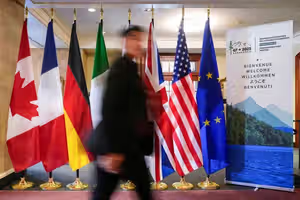
The G7 grouping of wealthy democracies plus the European Union on Wednesday blamed Iran for newly-imposed international sanctions and urged Tehran to resume talks with Washington and allow inspections of its nuclear sites.

Meanwhile, Russia, itself heavily sanctioned by the West announced it would flout the new UN sanctions it unsuccessfully opposed at the UN Security Council last week.

“The E3 and the United States have repeatedly offered diplomatic avenues in good faith to Iran to avoid the snapback and reach a durable and comprehensive negotiated resolution,” the G7 said in a joint statement.

It was signed by the foreign ministers of Canada, France, Germany, Italy, Japan, the United Kingdom, and the United States, along with the EU High Representative.

'Diplomacy essential'

The statement referred to the European troika of Britain, Germany and France which invoked the return of UN sanctions citing what they called Iran’s lack of transparency on its nuclear program.

“Diplomacy remains essential now that the UNSC process has led to the reimposition of sanctions. We call on Iran to refrain from any escalatory action, immediately engage in direct talks with the United States, and make demonstrable progress toward fully meeting its nuclear non-proliferation obligations,” the ministers said.

They urged Iran to fully cooperate with the International Atomic Energy Agency (IAEA) without delay, including by implementing its Comprehensive Safeguards Agreement under the Nuclear Non-Proliferation Treaty (NPT).

“This includes allowing IAEA inspections to resume in all nuclear facilities and accounting for all nuclear material it holds,” the statement said.

Iran denies seeking a nuclear weapon and has called the sanctions a violation of international law and its sovereignty.

Russia set to defy sanctions

Russia announced on Wednesday it will not recognize or implement the reinstated UN sanctions on Iran.

“We’ll be living in two parallel realities, because for some snapback happened, for us it didn’t,” Moscow’s UN envoy Vassily Nebenzia told reporters.

Russia’s UN envoy also claimed the move could serve as a pretext for another round of military strikes on Iran, referencing the 12-day war during which Israel and the United States targeted major nuclear sites.

“This development is fraught with the risk of major escalation around Iran, because it opens the door for those countries who want to finish off Iran’s nuclear program,” Nebenzia added.

Iran, as a signatory to the NPT, is obligated to host IAEA inspections of its nuclear facilities.

Tehran has warned the return of UN sanctions threatens its collaboration with the IAEA, and the diplomatic impasse over Iran's disputed nuclear program appears to have no end in sight.

Disgruntled students protest at Iranian universities, videos show

Oct 1, 2025, 18:41 GMT+1

Protests against university authorities and gripped several campuses across Iran, according to videos sent to Iran International, pointing to widespread anxiety among students which stopped short of overtly political grievances.

In one video, filmed at night, students are seen protesting disciplinary measures and calling for an end to harsh punishments.

At Khajeh Nasir Toosi University of Technology they chanted, “University is not a barracks; expulsion is no longer the answer.” The dispute related to student dissatisfaction with food and accommodation.

University administrators in Iran frequently deploy expulsion to silence pushback and punish students who protest their conditions.

Tabriz University of Medical Sciences also witnessed series of protests alleging administrators' alleged mismanagement and provision of substandard accommodation.

A video obtained by Iran International showed students chanting slogans including “incompetent official, resign!” and “university officials, shame shame!”

Bus crash tragedy

A separate incident in the town of Sorkheh north of Tehran has left the community reeling. A bus carrying female paramedical students crashed on Tuesday, killing two and leaving five others in critical condition.

In a recorded meeting with the dean, one student described the scene as horrific and said some victims were impossible to identify because their faces were badly damaged.

“Seeing two of your friends’ faces crushed, unrecognizable — we identified them by their clothes and nail polish. Someone you were talking and laughing with, and now they’re being brought back as a corpse, it’s very hard,” she said.

Multiple videos show students pressing the dean and university administrators for accountability.

Provincial authorities pledged a full investigation into the crash.

Iranian university students have continued staging demonstrations despite heavy pressure from authorities, demanding accountability and an end to harsh disciplinary measures such as expulsions and suspensions.

Slogans on walls

Other citizen-submitted videos showed dissidents painting slogans on city walls and on large billboards around Tehran in several separate locations.

Large-scale political protests have been rare since authorities quashed with deadly force the so-called Woman, Life, Freedom protests sparked by the death of a young woman in morality police custody in 2022.

One man is filmed writing messages in favor of Iran's monarchy, which was ousted by the Islamic Revolution in 1979, while others call on citizens to resist authorities: “Break the silence, compatriot, while there’s still time.”

Another slogan directly addresses the country’s Supreme Leader: “Khamenei should know he will be overthrown soon.”

UN sanctions reactivated by European powers took effect over the weekend and are set to deepen Iran's economic pain.

Iran denies seeking nuclear weapons the West accuses it of pursuing and has warned the measures could deepen civil unrest.