• العربية
  • فارسی
Brand
  • Iran Insight
  • Politics
  • Economy
  • Analysis
  • Special Report
  • Opinion
  • Podcast
  • Iran Insight
  • Politics
  • Economy
  • Analysis
  • Special Report
  • Opinion
  • Podcast
  • Theme
  • Language
    • العربية
    • فارسی
  • Iran Insight
  • Politics
  • Economy
  • Analysis
  • Special Report
  • Opinion
  • Podcast
All rights reserved for Volant Media UK Limited
volant media logo

Australia expels Iranian envoy after blaming Tehran for antisemitic attacks
Aug 26, 2025, 07:00 GMT+1Updated: 07:07 GMT+1
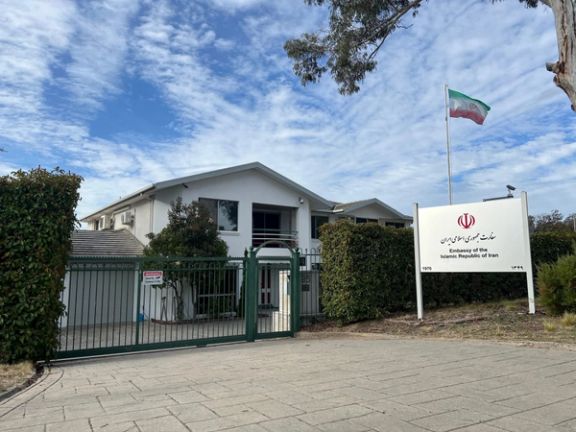
 Iranian Embassy in Canberra
Iranian Embassy in Canberra

Australia accused Iran of two antisemitic arson attacks and ordered its ambassador to leave the country within seven days, Prime Minister Anthony Albanese said on Tuesday.

Albanese said intelligence gathered by the Australian Security Intelligence Organisation showed Iran had directed attacks on a kosher restaurant in Sydney and a synagogue in Melbourne last year.

“These were extraordinary and dangerous acts of aggression orchestrated by a foreign nation on Australian soil,” Albanese told reporters.

ASIO Director-General Mike Burgess said Iran had “sought to disguise its involvement,” but the agency assessed it was behind the attacks on the Lewis Continental Kitchen in Sydney on 20 October last year, and the Adass Israel Synagogue in Melbourne on 6 December. He said Iran was “likely” behind further incidents targeting Jewish Australians.

Revolutionary Guards to be listed as terrorist group

Albanese also said Iran’s Revolutionary Guards would be listed as a terrorist group and confirmed Australia’s diplomats had left Tehran and were now in a third country.

Foreign Minister Penny Wong said Iran’s ambassador Ahmad Sadeghi and three officials must leave within a week. This is the first time Australia has expelled an envoy since World War Two.

The Australian government had previously warned Ambassador Ahmad Sadeghi over inflammatory social media posts, including a June message where he described Israel as “the most venomous snake on the planet” and a “genocidal regime.”

The remarks were made during the June conflict between Iran and Israel. A spokesperson told Iran International that Australia had made clear to Tehran that such rhetoric was unacceptable and urged all sides to de-escalate. Sadeghi had also faced past warnings for praising Hezbollah and calling for Israel’s destruction.

Politicians condemn Iran as Jewish community says fears were long ignored

Australian politicians condemned Iran’s alleged role in antisemitic attacks. Victorian Premier Jacinta Allan said her anger “will never subside,” calling the synagogue fire an act of terror. NSW Premier Chris Minns said the revelations were “deeply disturbing and utterly unacceptable.” Independent MP Allegra Spender, whose electorate includes the targeted Bondi restaurant, urged the government to continue working with Jewish communities to address security concerns.

Jewish community figures said the announcement confirmed long-standing concerns. Rabbi Gabi Kaltmann, whose synagogue is near the one targeted in Melbourne, called it “an I told you so moment” that had shaken community trust. Naomi Levin, CEO of the Jewish Community Council of Victoria, said the attacks were acts of international terrorism and a threat to national security.

Israel also welcomed the expulsion, with its embassy in Australia saying Iran was a threat not only to Jews or Israel but to the free world.

Former detainee says response is overdue

Australian academic Kylie Moore-Gilbert, who was imprisoned in Iran and is a vocal critic of Tehran, welcomed the move but said it had been too long coming.

In a post on X, she applauded the government's "decisive action against a brutal regime" but called it "a shame that it's taken them so long."

“For years now the Iranian-Australian community and other victims of the IRGC, including myself, have been literally screaming at rallies... that Iranian agents are operating brazenly and with few consequences here on Australian soil,” she wrote.

Travel warning for Australians in Iran

The Department of Foreign Affairs has advised Australians and dual nationals in Iran to leave the country if it is safe to do so. The Australian embassy in Tehran has suspended operations, and the government has warned of a high risk of arbitrary detention for foreigners.

Albanese said the government’s actions sent a message that foreign-directed aggression on Australian soil would not be tolerated.


Most Viewed

Iran negotiators ordered to return after internal rift over Islamabad talks
1
EXCLUSIVE

Iran negotiators ordered to return after internal rift over Islamabad talks

2
ANALYSIS

US blockade enters murky phase as tankers spoof signals and buyers hesitate

3
ANALYSIS

Why the $100 billion Hormuz toll revenue is a myth

4

US tightens financial squeeze on Iran, warns banks over oil money flows

5
ANALYSIS

US blockade targets Iran oil boom amid regional disruption

Banner
Banner

Spotlight

  • Hardliners push Hormuz ‘red line’ as US blockade tests Iran’s leverage
    INSIGHT

    Hardliners push Hormuz ‘red line’ as US blockade tests Iran’s leverage

  • Ideology may be fading in Iran, but not in Kashmir's ‘Mini Iran'
    INSIGHT

    Ideology may be fading in Iran, but not in Kashmir's ‘Mini Iran'

  • War damage amounts to $3,000 per Iranian, with blockade set to add to losses
    INSIGHT

    War damage amounts to $3,000 per Iranian, with blockade set to add to losses

  • Why the $100 billion Hormuz toll revenue is a myth
    ANALYSIS

    Why the $100 billion Hormuz toll revenue is a myth

  • US blockade targets Iran oil boom amid regional disruption
    ANALYSIS

    US blockade targets Iran oil boom amid regional disruption

  • Iran's digital economy battered by prolonged blackout
    INSIGHT

    Iran's digital economy battered by prolonged blackout

•
•
•

More Stories

Russia drafts UN resolution to delay snapback of Iran sanctions

Aug 25, 2025, 23:00 GMT+1

Russia has circulated a UN Security Council draft resolution to extend the implementation period of Resolution 2231 by six months in a bid to postpone the looming reimposition of sanctions on Iran under the resolution's snapback mechanism.

"The Russian resolution was circulated, but not put in blue yet," the French mission to the UN confirmed to Iran International.

Britain, France, and Germany have warned Iran they would restore UN sanctions by the end of August by triggering the mechanism unless Tehran reengages in talks on its nuclear program immediately and produced concrete results.

The new draft resolution proposed by Russia at the UN Security Council calls for a six-month technical extension of Resolution 2231, which underpins the 2015 Iran nuclear deal.

The draft, seen by Iran International, seeks to delay until 18 April 2026 the expiration of the resolution’s ten-year term, with the possibility of further extensions.

According to the text, the Council would suspend "any substantive consideration of matters related to resolution 2231 and the Joint Comprehensive Plan of Action (JCPOA)" during the extension, while urging all original participants to resume negotiations immediately.

The resolution was first reported by UK-based news outlet Amwaj.

The report came shortly after a phone call between Iranian President Masoud Pezeshkian and his Russian counterpart Vladimir Putin and on the eve of Iran's nuclear talks with Europe in Geneva.

In the call, Putin expressed optimism that discussions on the “snapback” mechanism would yield a “desirable result,” according to Tehran’s readout.

Iran's stance on deadline extension

In July negotiations with Iran held in Turkey, the three European powers reportedly proposed sidestepping a confrontation by agreeing to a six-month extension of their "snapback" authority in return for a set of concessions.

Last week, Iran's top security official rejected the European proposal for the extension of the August deadline, saying, "Some countries have requested a six-month extension [of snapback deadline], but Iran does not agree."

"We had an agreement that was supposed to be completed within 10 years; it's not meant to be extended repeatedly. This is just rule-twisting, and we do not accept it," Ali Larijani said in an interview with the Supreme Leader's website.

However, a Friday report by Axios said Iran's foreign minister Abbas Araghchi expressed some openness to the extension of the snapback during a phone call with his European counterparts on the same day.

Araghchi, however, has stressed this is for the United Nations Security Council to decide, not for Iran,” the report said citing an unnamed source.

European officials have pressed Iran to re-engage with Washington and cooperate fully with the International Atomic Energy Agency (IAEA) to avert the return of sanctions. EU foreign policy chief warned last week that Iran’s cooperation was crucial as the deadline neared.

Despite Western pressure, Supreme Leader Ali Khamenei on Sunday rejected calls by moderates in Tehran for direct talks with the United States, insisting that hostility from Washington could not be resolved through negotiations.

Trump signs executive order to crack down on US flag burning

Aug 25, 2025, 22:00 GMT+1

President Donald Trump issued an executive order on Monday directing federal agencies to prosecute the burning of the American flag as incitement, a hate crime or property destruction.

“Our great American flag is the most sacred and cherished symbol of the United States of America,” the order said, adding that burning it “is uniquely offensive and provocative” and may incite violence.

The measure instructs the attorney general to prioritize enforcement of criminal and civil laws against flag desecration and allows immigration authorities to deny visas or deport foreign nationals involved in such acts.

The announcement comes after scattered incidents in recent years in which US flags were burned at protests across the country.

In April 2024, demonstrators in New York City waving the banners of Hezbollah, Iran’s ally in Lebanon, torched American flags during an anti-Israel rally in Manhattan.

Months later in Washington, DC, protesters opposing Israeli Prime Minister Benjamin Netanyahu’s address to Congress burned a US flag near Union Station, with several arrests reported.

Outside the United States, flag burnings have long been a fixture in Iran, where state-organized rallies for decades have featured the torching of American and Israeli flags.

In June 2025, crowds in Tehran, Tabriz, Shiraz and Isfahan torched US flags during mass state-sponsored demonstrations, chanting slogans against the United States and pledging loyalty to Supreme Leader Ali Khamenei.

In earlier years, Iran’s parliament itself staged televised burnings of the American flag.

Members of the Iranian parliament set fire to a US flag
100%
Members of the Iranian parliament set fire to a US flag

Ventilation chutes let US bombs pierce Iran nuclear sites, Trump says

Aug 25, 2025, 19:53 GMT+1

US President Donald Trump said on Monday that the ventilation shaft Iran had installed at its underground nuclear facility in Fordow worked to America’s advantage, ensuring the success of June’s airstrikes.

“They have a chute that goes right down deep into the mountain. And they shouldn’t have put ventilation in, I can tell you that, because we used it to our advantage,” Trump told reporters at the White House.

The United States struck three Iranian nuclear facilities — at Isfahan, Natanz, and Fordow — with long-range bombers and submarine-launched missiles on June 22.

The operation, dubbed Operation Midnight Hammer, involved B-2 stealth bombers armed with 30,000-pound Massive Ordnance Penetrators (MOPs) — so-called “bunker busters” designed to penetrate fortified underground facilities.

“The United States studied Fordow for 15 years, identified its weaknesses, and developed weapons for that exact purpose — which led to modifications of the MOP used during the attack,” General Dan Caine, chairman of the Joint Chiefs of Staff, said on June 26.

Ventilation shafts were the most effective entry point identified in planning analysis, Caine said, adding that a total of 14 MOPs were dropped on targets at Fordow and Natanz.

“We’re looking at the mission you just accomplished with Iran — 36 hours back and forth. Flawless. Every bomb hit its target. They went right down those chutes. Dark at night, no moon, no nothing. Every target, every bomb went right down,” Trump added.

 Defense Secretary Pete Hegseth and Air Force Gen. Dan Caine, chairman of the Joint Chiefs of Staff, conduct a press briefing at the Pentagon, June 26, 2025
100%
Defense Secretary Pete Hegseth and Air Force Gen. Dan Caine, chairman of the Joint Chiefs of Staff, conduct a press briefing at the Pentagon, June 26, 2025

Trump praised the precision strikes and said Iran’s nuclear facilities targeted in the attacks were “totally obliterated.”

The opposite of what Carter did in Iran

Trump compared the June 22 attacks on Iran to the Carter administration’s failed hostage rescue mission on April 24, 1980, calling it the “exact opposite.”

“We had 52 tankers — people don’t realize — so that they could refuel. We had many fighter jets, F-22s, F-35s. It was an amazing operation. It was flawless,” Trump said.

“Compare that to the operation when they went in with the helicopters crashing, everyone running around the desert, and prisoners being taken. And there was Jimmy Carter. What a horrible thing. This was the exact opposite,” Trump added.

The Tabas attack, known as Operation Eagle Claw, was an effort ordered by President Jimmy Carter to rescue 52 American diplomats taken hostage in Iran by revolutionary forces.

Eight helicopters were sent to a staging area called Desert One in the Tabas Desert, but only five arrived operational due to hydraulic problems, a sandstorm, and a cracked rotor blade.

The mission was aborted due to insufficient functioning helicopters. During withdrawal, a helicopter collided with a C-130 transport plane, killing eight American servicemen and destroying both aircraft.

Iran's top judge threatens to prosecute reformists over call for US talks

Aug 25, 2025, 17:54 GMT+1

Iran’s judiciary chief on Monday warned of legal action against Tehran moderates advocating direct talks with the United States over its nuclear program, a day after Supreme Leader Ali Khamenei accused them of sowing discord in the country.

“Those who, out of negligence or with certain motives, issued a statement should admit their mistake and retract this disgraceful act,” Judiciary Chief Gholamhosein Mohseni Ejei said Monday, reacting to a call by Iran's Reform Front for direct US talks and full IAEA monitoring.

"Tehran's prosecutor will act according to his legal duty in this matter," Ejei added, speaking in a meeting of the Supreme Council of the Judiciary.

Ejei's warning comes after Iran’s Reform Front, on August 17, called for major political and nuclear policy shifts, including a voluntary suspension of uranium enrichment.

The coalition of 27 reformist organizations, in a statement, said “Iran’s social fabric was deeply wounded, with public life overshadowed by despair and anxiety.”

The statement urged the government to declare readiness for suspending enrichment and to accept full International Atomic Energy Agency (IAEA) monitoring in exchange for the lifting of sanctions.

Such a step, it said, could open the way for “comprehensive, direct negotiations with the United States and normalization of relations.”

Iran's Supreme Leader Ali Khamenei, however, rejected direct talks with the United States on Sunday, insisting that Washington’s hostility cannot be resolved through talks.

  • 'If not treason, then what?' Iran hardliners torch reformists’ manifesto

    'If not treason, then what?' Iran hardliners torch reformists’ manifesto

“Those who say, ‘Don’t chant slogans against America, they’ll get upset and become hostile toward you,’ are superficial. Those who argue, ‘Why don’t you negotiate directly with the United States and solve your problems?’ are, in my view, also superficial. That’s not the reality of the matter; this issue cannot be resolved," Khamenei said.

Iran's Supreme Leader said the enemies of the Islamic Republic seek to create division inside the country and to sow discord from within in order to bring about a regime change.

"They have agents inside: agents of Zionism and of America, present here and there in the country. Through them — or through those who are heedless of what they say and write — they try to create divisions among the people and generate discordant voices in the nation," he said in an apparent reference to the moderate critics of his policies.
Israel used WhatsApp to target Iran officials during war, ex-minister says

Aug 25, 2025, 17:31 GMT+1

Iranian officials with sensitive information on their phones were easy targets for Israeli cyber operations during June's 12-day war, Iran’s former communications minister said, adding that Israel exploited platforms such as WhatsApp to track them.

“In the recent war, those who had information and were of interest to Israel were easy prey for hacking,” former minister Mohammad Javad Azari Jahromi said. He did not identify those targeted.

"WhatsApp has low resistance to cyberattacks and low security, and Israel has used this tool," he added.

He said that using WhatsApp for exchanging confidential information was not permitted for officials and military personnel.

His remarks come as Iranian authorities face scrutiny over security lapses following the assassination of senior commanders in June during the war with Israel.

Mahdieh Shadmani, daughter of slain commander Ali Shadmani, has publicly disputed official claims that mobile applications exposed locations that led to Israeli strikes, saying her father carried no smart devices.

“My father’s location changed every few hours. He carried no smart devices or phones. Security protocols were followed, yet during his time commanding the war headquarters, he was repeatedly targeted for assassination by Israel,” she said on July 4.

Jahromi's comments come two months after Israel launched a surprise military campaign on June 13 targeting military and nuclear sites, killing hundreds of military personnel, nuclear scientists and civilians.

The Islamic Republic says 1,062 people were also killed by Israel during the conflict, including 786 military personnel and 276 civilians.

Tehran responded with missile strikes that killed 31 civilians and one off-duty soldier, according to official figures published by the Israeli government.

On June 22, the US carried out airstrikes on Iran’s key nuclear sites at Fordow, Natanz, and Isfahan. A US brokered ceasefire came into effect on June 24, which ended the 12-day air war.