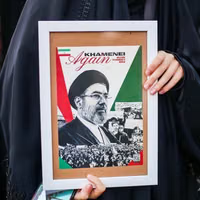
A picture of Iran's legendary artist Mahmoud Farshchian is put on display alongside Iranian flags during his state funeral, Isfahan, Iran, August 18, 2025
The state funeral of renowned miniature artist and "national treasure" Mahmoud Farshchian drew large crowds in Isfahan on Monday, reigniting heated debates on Persian social media over the notion of “state-affiliated artists.”
Farshchian, 95, passed away on August 9 in Englewood Cliffs, New Jersey, where he had lived since 1983. His body was returned to his hometown for burial beside the poet Saeb Tabrizi, in accordance with his wishes.
At the funeral, mourners filled the streets as Farshchian’s coffin was carried from the Conservatory of Fine Arts. Culture Minister Seyyed Abbas Salehi praised him as both a “sage of artists” and a creative genius who gave “a special color and flavor to Iranian art.” President Masoud Pezeshkian also issued condolences, underscoring his stature as a national figure.
The tributes highlighted Farshchian’s towering legacy, even as questions over his relationship with the Islamic Republic continue to spark controversy online.
Asr-e Ashura (Evening of Ashura) by Mahmoud Farshchian
Public reactions
On social media, responses ranged from praise to condemnation.
“He held the hands of those from whose hand the blood of the country’s youth flowed,” one post on X read. “The people’s historical memory never fades. We will neither forgive nor forget.”
“Without a doubt, the Islamic Republic used him for its propaganda, and sadly, he complied and showed no resistance,” another user wrote.
Others defended him: “Farshchian has painted several panels from the Shahnameh, each more beautiful than the other. His beliefs are his own. We don’t have the right to question his art even if we assume he was a government-affiliated artist. Leonardo da Vinci and Michelangelo were also court artists, serving the monarchy and the Christian Church.”
Panel depicting a scene from Shahnameh, Iran's national epic
Themes in Farshchian’s work
His miniatures often explore Shiite traditions, while others interpret Persian literature, including the national epic Shahnameh. He also designed new metal lattice enclosures for Shiite shrines in Mashhad and Karbala.
Farshchian’s works are on permanent display at a museum named after him in Tehran’s Saadabad Palace.
Iran's polarized cultural landscape
Collaboration or opposition to the state carries heavy personal and professional consequences in Iran.
Artists who work with state entities, like television, are often labeled “state-affiliated” by dissidents and exiled communities, while appearing with political leaders can spark backlash.
A notable case is singer Alireza Eftekhari, whose embrace of the populist President Mahmoud Ahmadinejad during a concert went viral and provoked outrage among critics, resulting in his isolation in the artistic community and loss of his fans.
Conversely, artists challenging the official narrative risk being blacklisted, banned from work, or imprisoned.
One prominent example was the legendary traditional vocalist Mohammad Reza Shajarian.
He performed a song urging security forces to lay down their weapons during the widespread anti-government protests of 2009. This act of defiance drew the ire of authorities.
The state media banned the broadcast of Shajarian’s songs, image, and his name. Even his iconic Ramadan prayer performance—beloved among religious audiences—was permanently removed from radio and television broadcasts, and he was barred from concerts or album releases.
"Curse the Islamic Republic, which always pits the people against each other … Artists like Farshchian or Shajarian—whatever they may have been—were ultimately artists. The Islamic Republic has even violated the very concept of art and the artist," a post on X stated.