• العربية
  • فارسی
Brand
  • Iran Insight
  • Politics
  • Economy
  • Analysis
  • Special Report
  • Opinion
  • Podcast
  • Iran Insight
  • Politics
  • Economy
  • Analysis
  • Special Report
  • Opinion
  • Podcast
  • Theme
  • Language
    • العربية
    • فارسی
  • Iran Insight
  • Politics
  • Economy
  • Analysis
  • Special Report
  • Opinion
  • Podcast
All rights reserved for Volant Media UK Limited
volant media logo

Afghans rally behind boycott of Iranian goods as deportations surge
Jul 15, 2025, 16:59 GMT+1Updated: 07:25 GMT+0
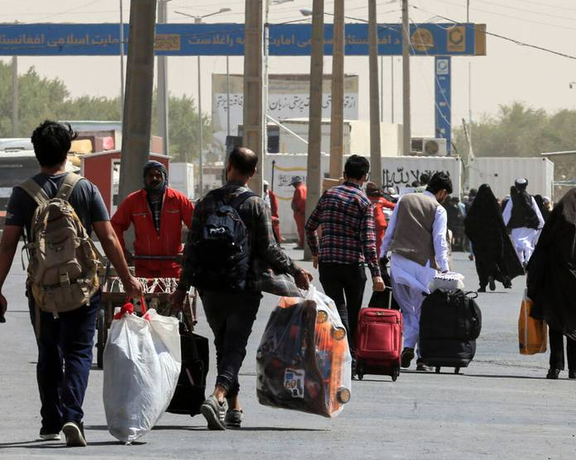
Afghan immigrants leaving Iran through land border

As forced deportations of Afghan migrants from Iran escalate, Afghans are pushing a nationwide boycott of Iranian goods in protest.

Activists are urging citizens and business owners to halt the import and purchase of Iranian goods, with some deploying the social media hashtag "Boycott Iranian goods: a national demand".

More than half a million Afghans have been deported from Iran in the weeks after its 12-day conflict with Israel ended.

Iranian state-affiliated media have promoted unverified accusations that Afghan migrants were involved in espionage for Israel.

The Red Cross now warns that as many as one million more could be forced out by year’s end.

“We should not financially support a regime that humiliates, tortures, and discriminates against Afghan migrants,” wrote one Afghan user, Niloofar Yousefi.

“Until this injustice ends, we will raise our voices through this boycott.” She urged Afghan merchants to stop importing Iranian goods altogether.

In 2024, Iran accounted for between a quarter and a third of Afghanistan's $10.8 billion in total imports, World Bank figures show, making it the country’s largest trading partner by value.

Trade figures underline what’s at stake economically for Iran. Between March and June 2025 alone, Tehran exported $520 million in non-oil goods to Afghanistan. Over the course of 2024, that number reached $3.1 billion, placing Afghanistan among Iran’s top five export markets.

In the city of the Afghan city of Herat, a physician, Dr. Alireza Hashemi, announced he would stop prescribing Iranian-made medications in protest of Tehran’s treatment of Afghan nationals.

Another social media user, Nasim Kamgar, posted a video of a young Afghan child describing abuse at the hands of Iranian border guards.

“This is not our right,” she wrote, adding that Taliban policies have left Afghan migrants increasingly vulnerable to mistreatment abroad.

Iranian officials have insisted that only undocumented migrants are being deported, but both Afghan news outlets and international aid groups have reported otherwise.

Multiple cases have surfaced in which migrants with valid visas or residency papers were expelled—some even had their passports and identity cards torn up by Iranian border forces.

With public anger mounting and the boycott movement gaining traction, Iran’s economic ties to Afghanistan now face unprecedented strain—intensifying a rift between the two countries as hundreds of thousands of vulnerable Afghans face the threat of forced return.


Most Viewed

Iran negotiators ordered to return after internal rift over Islamabad talks
1
EXCLUSIVE

Iran negotiators ordered to return after internal rift over Islamabad talks

2
ANALYSIS

US blockade enters murky phase as tankers spoof signals and buyers hesitate

3
ANALYSIS

Why the $100 billion Hormuz toll revenue is a myth

4

US tightens financial squeeze on Iran, warns banks over oil money flows

5
ANALYSIS

US blockade targets Iran oil boom amid regional disruption

Banner
Banner

Spotlight

  • Hardliners push Hormuz ‘red line’ as US blockade tests Iran’s leverage
    INSIGHT

    Hardliners push Hormuz ‘red line’ as US blockade tests Iran’s leverage

  • Ideology may be fading in Iran, but not in Kashmir's ‘Mini Iran'
    INSIGHT

    Ideology may be fading in Iran, but not in Kashmir's ‘Mini Iran'

  • War damage amounts to $3,000 per Iranian, with blockade set to add to losses
    INSIGHT

    War damage amounts to $3,000 per Iranian, with blockade set to add to losses

  • Why the $100 billion Hormuz toll revenue is a myth
    ANALYSIS

    Why the $100 billion Hormuz toll revenue is a myth

  • US blockade targets Iran oil boom amid regional disruption
    ANALYSIS

    US blockade targets Iran oil boom amid regional disruption

  • Iran's digital economy battered by prolonged blackout
    INSIGHT

    Iran's digital economy battered by prolonged blackout

•
•
•

More Stories

Disgraced ex-UN envoy resurfaces in Iran, misusing Oberlin credentials

Jul 15, 2025, 15:09 GMT+1
•
Benjamin Weinthal

Disgraced former Iranian UN envoy Mohammad Jafar Mahallati has resurfaced in Iran, presenting himself as an Oberlin College professor, despite allegations that saw him removed from his position in the US for covering up mass executions and committing sexual misconduct.

The Alliance Against Islamic Regime of Iran Apologists (AAIRIA), an Iranian-American advocacy group, found Mahallati in Shiraz, where he is listed as a senior researcher at the Majd Research Center.

His biography on the center’s website claims he is a “full professor of Religious Studies and Peace Studies at Oberlin College”—though the college dismissed him in 2023.

Return under false credentials

In May 2025, Mahallati co-organized and participated in the Sixth Annual Conference on Peace and Conflict Resolution at the University of Tehran.

He moderated a panel and gave a talk titled “The Complex Nature of Human Conflicts... A Qur’anic Perspective.” The program listed him using his former Oberlin title.

Mahallati was removed from Oberlin after AAIRIA launched a campaign outlining his role in whitewashing the 1988 executions of thousands of political prisoners in Iran.

The group also highlighted his antisemitic and anti-Baha’i rhetoric during his time as a UN envoy, and multiple allegations of sexual abuse, including rape and harassment at Columbia University in the 1990s.

The US Department of Education launched an investigation into Oberlin in 2023 for allegedly tolerating antisemitism on campus.

Following his removal, Oberlin scrubbed his profile from its website.

New platform, familiar faces

Another speaker at the Tehran event was Ali Akbar Mousavi, previously listed as a senior advisor and postdoctoral researcher at George Mason University’s Center for World Religions, Diplomacy, and Conflict Resolution.

His university profile now leads to a "Not Found" error.

The conference listed Mousavi as speaking on “Technology for Peace and Transformation in Conflict Management.”

Iran International contacted George Mason for comment but received no reply.

Lawdan Bazargan, AAIRIA’s director, said: “The Islamic Republic has long weaponized the language of ‘peace’ and ‘friendship’ to sanitize its image while continuing repression and destabilization at home.”

“Figures like Mahallati and Mousavi lend academic legitimacy to this propaganda and should be held accountable," she added. "US institutions shouldn’t allow regime apologists to whitewash crimes as dialogue.”

Academic silence, state rhetoric

In what appears to be a rebranding effort, a 2024 website promoting Mahallati’s writings again lists him as a “full Professor of Religion in Islamic Studies” at Oberlin. The site provides no contact information.

Iran International contacted Oberlin’s VP of communications, Josh Jensen, and chief of staff David Hertz to ask whether the school has warned Iranian institutions or taken steps to stop Mahallati from using its name. No response was received.

Despite a three-year campaign by AAIRIA, Oberlin President Carmen Twillie Ambar and her staff refused to meet with Iranian-American advocates.

Though billed as a peace conference, the University of Tehran event included incendiary rhetoric.

Iranian science minister Hossein Simaee Sarraf called for Israel’s destruction: “It is hoped that... all Muslim nations and people of conscience will unite to overcome this savage and bloodthirsty regime,” he said.

Dr. Charles Randall Paul, founder of the US-based Foundation for Religious Diplomacy, also addressed the conference via Zoom. He did not respond to press inquiries.

Oberlin has largely ignored the Mahallati scandal since his removal. After student journalist Gigi Ewing graduated, the campus paper dropped coverage.

Ewing and her colleagues had earlier published a 2021 editorial titled “Evidence Against Mahallati Irrefutable."

EU sanctions Iran-linked network over alleged role in assassination plots

Jul 15, 2025, 15:00 GMT+1

The European Union on Tuesday sanctioned eight individuals and one entity tied to Iran for what it described as serious human rights violations and acts of transnational repression including assassinations and enforced disappearances of dissidents abroad.

The European Council said the designations target actors “responsible for committing serious human rights violations and abuses on behalf of Iranian state bodies outside of Iran,” including extrajudicial killings and arbitrary executions.

"Today’s listings confirm the EU’s concerns about transnational repression by Iranian state bodies through the use of proxy agents, in particular involving criminals and organized crime networks targeting dissidents and human rights defenders across the world, including on EU territory," it said in a statement.

Among those listed is the Zindashti Network, a criminal group linked to Iran’s Ministry of Intelligence and Security (MOIS), which the EU accused of carrying out assassinations of Iranian dissidents overseas.

The group's leader, Naji Ebrahim Sharifi-Zindashti, an Iranian narcotics trafficker and organized crime figure, was also sanctioned alongside five of his alleged associates.

The Council said the group was involved in the killings of Iranian dissident Masoud Molavi Vardanjani in Turkey and Saeed Karimian, the owner of Iran-focused satellite broadcaster Gem TV.

The EU also sanctioned Mohammad Ansari, identified as the leader of Unit 840 of Iran’s Islamic Revolutionary Guard Corps (IRGC) Quds Force, for allegedly ordering the assassination of journalists critical of the Islamic Republic.

Reza Hamidiravari, an intelligence ministry officer said to oversee Zindashti’s state-backed operations, was also named.

Those designated face EU-wide asset freezes and travel bans. EU individuals and entities are also prohibited from making funds or resources available to them.

Last January, the US Treasury’s OFAC and UK government sanctioned Naji Ibrahim Sharifi‑Zindashti, leader of the Zindashti Network, along with 11 associated individuals for orchestrating assassinations, kidnappings, and murder‑for‑hire plots against Iranian dissidents. The sanctions hit Iranian officials involved in threats to kill Iran International TV journalists on British soil.

“The Iranian officials designated are members of Islamic Revolutionary Guard Corps (IRGC) Unit 840, which was exposed in an ITV investigation into plots to assassinate two television presenters of Iran International news on UK soil,” the UK government said in a statement at the time.


Iran may approach bomb-grade enrichment if UN sanctions restored – IRGC media

Jul 15, 2025, 13:28 GMT+1

Iran could boost its uranium enrichment to 90%, weapons-grade level, and consider exiting the Nuclear Non-Proliferation Treaty (NPT) if European powers move to trigger the UN snapback sanctions mechanism, Tasnim News reported on Tuesday.

The report came as France said it would trigger the UN snapback mechanism against Iran by the end of August if no tangible progress is made on a nuclear deal.

French Foreign Minister Jean-Noel Barrot said Tuesday that Iran has violated its commitments under the 2015 agreement and that France, the United Kingdom, and Germany, known as the E3, are justified in reapplying global embargoes on arms, banks, and nuclear equipment. “Without a firm, tangible, and verifiable commitment from Iran, we will do so by the end of August at the latest,” Barrot told reporters in Brussels.

In response, Tasnim warned that Iran could raise uranium enrichment from 60% to 90%, and may use its enriched uranium stockpile for what it called “non-prohibited military purposes.”

The outlet also said that while exiting the Nuclear Non-Proliferation Treaty (NPT) would be a major step, it remains one of several options Iran is considering.

Snapback seen as 'military aggression' by Iranian officials

Foreign Minister Abbas Araghchi last week warned that triggering the snapback would be viewed by Iran as equivalent to a military strike. “This move would mark the end of Europe’s role in Iran’s peaceful nuclear file,” he said, calling it a “historic mistake” that could irreversibly damage ties.

Tasnim echoed that view, saying that the US strikes on Iran’s nuclear infrastructure, combined with European inaction, have shifted Tehran’s strategy from "political patience to strategic deterrence".

Iran may expand nuclear activity, restrict IAEA oversight

In its report, Tasnim said Iran "should halt dilution of 60% enriched uranium, accelerate advanced centrifuge deployment, expand research into uranium metal production, and scale back cooperation with the International Atomic Energy Agency (IAEA)."

“These responses are lawful and proportionate,” the outlet said, while warning that Tehran would not accept any further Western pressure without consequences.

France warns of UN snapback if no Iran deal by August

Jul 15, 2025, 09:49 GMT+1

France, Britain, and Germany will activate the United Nations snapback mechanism against Iran by the end of August if no tangible progress is made on a nuclear deal by then, French Foreign Minister Jean-Noel Barrot said on Tuesday.

"France and its partners are... justified in reapplying global embargoes on arms, banks, and nuclear equipment that were lifted 10 years ago. Without a firm, tangible, and verifiable commitment from Iran, we will do so by the end of August at the latest," Barrot told reporters ahead of a meeting with EU Foreign Ministers in Brussels.

The snapback mechanism is part of UN Security Council Resolution 2231, which endorsed the 2015 Joint Comprehensive Plan of Action, or JCPOA. It allows any participant in the nuclear agreement to reimpose sanctions if Iran is deemed non-compliant. If no resolution to maintain sanctions relief is passed within 30 days, all previous UN measures return automatically.

Barrot said earlier in June that France and its European partners can reinstate a global embargo on weapons, nuclear equipment, and key financial sectors in Iran through a simple letter.

France announces EU sanctions on Iranians tied to killings, demands hostage release

As part of a broader EU action, the European Council has sanctioned nine Iranian individuals and entities accused of carrying out assassinations and transnational repression on European soil. Barrot announced the measures on Tuesday, saying the listed individuals were responsible for “violating the interests of France and Europe.”

“We are freezing the assets and banning the entry into Europe of nine Iranian individuals and entities responsible for assassinations on European territory,” Barrot said. “This is the result of efforts I personally led, and I welcome their outcome.”

Barrot also called for the “immediate and unconditional release” of French nationals held in Iran and demanded Iran resume cooperation with UN nuclear inspectors. He said Tehran’s “destabilizing activities” would not go unanswered.

Iran warns of ‘appropriate response’ if Europe triggers sanctions

Iran will respond proportionately if the European parties re-activate the snapback mechanism, Foreign Ministry spokesman Esmail Baghaei said on Monday.

He dismissed the legal basis of the measure and accused the European parties of violating their own JCPOA obligations. “They have no standing to invoke the mechanism,” he said at a weekly briefing. “The so-called snapback has no legal, political, or ethical justification.”

Baghaei reiterated that Iran still considers itself a JCPOA signatory, despite scaling back commitments after the US withdrawal in 2018 and what he called Europe’s failure to uphold its end of the deal.

Iran accuses Germany and IAEA of double standards

Baghaei also criticized Germany for hosting US nuclear weapons and backing Israeli military operations, calling its position a violation of the Non-Proliferation Treaty (NPT). He accused Berlin of “supporting violations of international law” while taking a hard line on Iran’s nuclear activity.

He further accused the International Atomic Energy Agency (IAEA) of “instrumental and selective behavior,” alleging that information provided by the agency had been used in recent military strikes against Iran’s nuclear sites. He condemned the IAEA’s silence over those attacks, including the US bombing of the Fordow facility, whose damage he said is still being assessed.

No new nuclear talks planned, Iran says

Baghaei said no date or venue has been set for nuclear talks, though consultations with China and Russia are ongoing. He called recent reports of new intermediaries “speculative” and stressed that Iran makes independent decisions on its nuclear policy.

He also said Iran remains open to diplomacy but will not re-enter talks until there is “confidence in the effectiveness of diplomacy.” He cited a coordinated Israeli-US military strike just before the sixth round of negotiations as a key turning point.

US judge orders release of Iranian student held after strikes - NYT

Jul 15, 2025, 09:14 GMT+1

An Iranian doctoral student arrested in Louisiana following US airstrikes on Iran must be released and protected from deportation, a federal magistrate judge ruled on Monday, the New York Times reported.

Pouria Pourhossein Hendabad, 29, was arrested on June 22 in Baton Rouge, where he was pursuing a PhD in mechanical engineering at Louisiana State University. He and his wife, Parisa Firouzabadi, were detained after reporting a car accident. According to his lawyers, officers posing as state police lured the couple out of their home and handed them over to a waiting team of ICE agents in tactical gear.

He had a valid student visa through 2030 and faced no known criminal charges. His attorneys called the arrest “an unconstitutional ruse,” and said it was carried out without a warrant or legal justification.

Pouria Pourhossein Hendabad
100%
Pouria Pourhossein Hendabad

On Monday, Magistrate Judge Joseph H.L. Perez-Montes ordered his immediate release and barred the government from deporting or transferring him, citing a “grave risk” of irreparable harm.

Part of a growing pattern

Pourhosseinhendabad’s case is the latest in a string of arrests of Iranian students and nationals in the US this year.

In March, Alireza Doroudi, a PhD student at the University of Alabama, was arrested by ICE without formal charges and held for six weeks before choosing to self-deport.

His lawyers said the government admitted it had no evidence he posed a national security threat, but prolonged detention and pressure forced him to leave the country.

More than 130 Iranians arrested after US strikes

In late June, more than 130 Iranian nationals were detained across the country in a sweeping enforcement operation, according to Fox News. Federal officials said some had ties to the IRGC or Hezbollah, but many of those arrested, including students and recent immigrants, faced no public charges.